
Sacred Service
Vastu Consultation
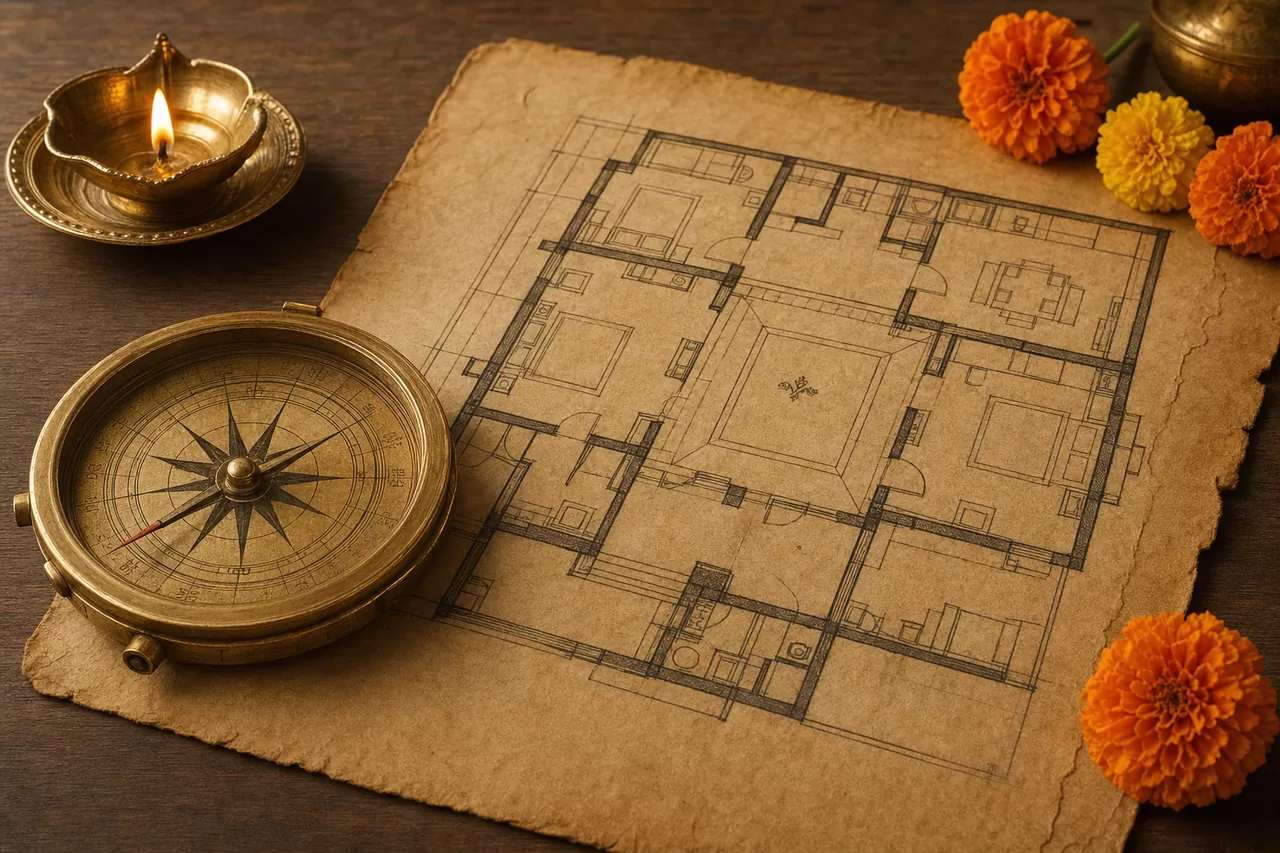
Practical vastu for homes and offices, with nothing that needs demolition.
Learn more
Griha pravesh is a family's first entry into a new home, made on an auspicious muhurat with a puja that dedicates the house, settles its vastu and asks Ganesh and the nine planets to bless those who will live in it. Master Vijay Ram chooses the date, performs the vastu shanti puja personally in your family's name, and guides the entry itself by phone or video.
How it works
A new house in Australia arrives with a settlement date, a removalist's booking and a school term, and almost never with a pandit. Families in the estates around Tarneit, Point Cook and Schofields, in apartment towers in Parramatta and Clayton, and in first homes in Logan and Mandurah ring Master Vijay Ram with the same question: the keys are ours on Friday, so when do we actually move in?
Griha pravesh answers it. The first entry is made on a chosen day and hour, after a puja that clears the house of whatever it held before and dedicates it to the family that will live there. It is the moment the building becomes a home, and it is the ritual most families regret skipping once something feels wrong a few months later.
Vijay Ram ji fixes the muhurat from the panchang and the householder's own chart, performs the puja personally in the family's name, and talks you through the entry itself — the kalash, the right foot, the first lamp, the boiling milk — on a video call as it happens. How a house-warming puja is done in Australia walks through the day in detail; this page covers the service and what it costs.
The Sacred Process
Message or ring with the date the keys are yours, the suburb, the direction the front door faces, a floor plan or a few photographs, and the birth details of the householder, both partners where you can. Say whether it is a new build, an older house, an apartment or a rental, because the puja differs for each.
Vijay Ram ji chooses the day and hour for your city's own clock, then lists what should be attended to before the first night: the direction of the kitchen fire, the placement of the bed, a mirror facing the door, water in the wrong corner. Most points are a matter of furniture, not builders, and the common fixes need no demolition.
On the muhurat he performs the vastu shanti, the Ganesh puja and, where the chart or the house calls for it, a Navagraha havan at his own place of practice in Auburn, in your family's name. At the same hour you stand at your own door with the kalash, and he guides each step by phone or video, with grandparents in India welcome on the same call.
The tradition names three kinds of entry. Apoorva griha pravesh is the first entry into a newly built house on new ground. Sapoorva is the return to a home after a long absence, a major renovation or a flood. Dwandwah is the entry made after the household has been broken by a death, a separation or a calamity, and it carries the most careful puja of the three.
In every form the sequence is the same in spirit. The Vastu Purusha, the spirit of the plot, is asked to forgive the digging and building. Ganesh is invited first so that the household begins without obstruction. The nine planets are pacified for the householder, whose chart is the one the house will answer to. A kalash of water with mango leaves and a coconut is carried over the threshold, a lamp is lit in the kitchen, milk is boiled until it rises, and the family's first meal is cooked and shared.
What the puja does is dedicate the house. It does not sterilise it, and it is not a service that smokes the rooms and leaves. The previous occupants, the builders and the land all leave something behind, and griha pravesh is the moment the family's own intention is laid over all of it. Families who have moved in weeks before the ceremony usually say the house felt like theirs only afterwards.
A griha pravesh muhurat is read from the panchang and from the householder's chart together. The tradition prefers the Shukla paksha, the fortnight between the new moon and the full, a fixed or friendly nakshatra, and a daytime hour under a steady lagna. It avoids the dark fortnight, Rahu kaal, Bhadra, eclipse days and, in most families, the weeks while the Sun is in Dhanu from mid-December to mid-January, as well as the days around Diwali when the house is busy with other duties.
The city matters, as it does for every muhurat. A tithi that covers sunrise in Delhi may have ended before sunrise in Perth, which is why dates taken from an Indian panchang or a relative's pandit sometimes miss by a day here. How griha pravesh dates are chosen for 2027 explains the rules, and a muhurat consultation applies them to your own chart and clock.
Settlement rarely waits for the stars, and it does not need to. Boxes can go in, tradespeople can finish and the family can sleep elsewhere or even in the house; the formal entry with the kalash is what is held for the muhurat. Where a family must live there from the first day, a brief symbolic entry is made on the best hour available and the full ceremony follows on the chosen date.
Few Australian floor plans were drawn with vastu in mind, and almost none can be rebuilt for it. The vastu shanti puja exists for exactly this: it pacifies what cannot be altered and gives the family a short list of what can. The list is practical, and it is written for the house you actually have.
| Common point in an Australian home | What is usually done |
|---|---|
| Kitchen stove in the north-east or beside a water point | A second cooking point is not practical; the fire is pacified in the puja and a lamp is kept on the south-east side of the kitchen |
| Bed with its head to the north | Turn the bed so the head rests south or east; nothing else needs to move |
| Toilet or mirror facing the front door | Keep the door closed, hang a curtain or a screen, place a tulsi or a bright plant by the entrance |
| Water feature, aquarium or laundry in the south-east | Move portable water to the north or north-east; a fixed laundry is pacified in the puja |
| Store room or clutter in the north-east | Clear it, keep it light, make it the place of the lamp or the small altar |
Apartments and units are read on the same principles but with a lighter hand, since the entrance, the plumbing and the orientation are shared and fixed; vastu for apartments and units covers what can realistically be done on the fourteenth floor. For a house with deeper faults, a full vastu consultation is read from the plan before the griha pravesh.
A rented home deserves a blessing too, and a simpler one. No havan is lit at the premises, nothing is fixed to a wall, and the entry is made with the kalash, the lamp and a Ganesh puja performed in the family's name, so the landlord's property is left exactly as it was found. Share houses and student apartments are handled the same way, often with the puja timed for a weekend when flatmates are out.
Some families ring months after moving in, because sleep is poor, the children are unsettled or the house simply feels like someone else's. Why a new home can feel wrong is usually ordinary — light, noise, a long commute, a marriage under strain from the mortgage — and Vijay Ram ji says so when it is. Where the previous occupants left something heavier, a negative energy removal is done first and the griha pravesh follows; a new house can also be protected before anyone moves in.
The consultation is $50 and covers the muhurat and the vastu points, by phone, video or WhatsApp anywhere in Australia, or in person at Auburn by appointment. The house-warming puja itself, with the vastu shanti and any havan the house needs, starts from $250 and is agreed with you before it is arranged; it is performed personally by him at his own place of practice in Auburn on the muhurat, with your family joining by video from your own doorstep, and he does not travel to homes. This is faith-based guidance within the Vedic tradition, not building, legal or financial advice: a leaking roof, a defective build or a lease dispute belongs with an inspector, a lawyer or your state's fair trading office, and he will say so.
Good to Know
Yes, and it should be. The rental form is lighter: a Ganesh puja and the kalash entry, a lamp and boiled milk in the kitchen, nothing fixed to walls and no fire at the premises, so the property is left as the lease requires. The puja itself is performed in your family's name at Auburn, and you make the entry at your own door while Vijay Ram ji guides you by phone or video.
No. His only place of practice is Auburn in Sydney's west, and he does not travel to homes in Sydney or anywhere else. The vastu shanti, Ganesh puja and havan are performed personally by him there, in your family's name, on the muhurat chosen for your city, and the entry at your own threshold is guided step by step on a video call so that nothing is missed.
A kalash or a clean steel pot, five mango leaves, a coconut, a small amount of rice, turmeric and kumkum, a ghee or oil lamp, flowers, fresh milk and a new pot to boil it in, and the makings of a simple first meal. Every item is sold at Indian grocers in Harris Park, Dandenong, Sunnybank or Canning Vale, and you will be sent the exact list once the date is fixed.
Take the keys, move the boxes and let the tradespeople finish; none of that is the entry. If the family must sleep there, a short symbolic entry is made at the best hour that day, with a lamp and a Ganesh prayer, and the full griha pravesh is held on the proper muhurat a week or two later. Practical dates and sacred ones can be kept apart without any harm.
A full vastu shanti is read from the plan and is most needed where the kitchen, the bedroom or the entrance sit against the principles and cannot be changed. For a home with no serious fault, the vastu element of the puja is brief and the emphasis falls on Ganesh and the planets. Vijay Ram ji tells you which applies after seeing the plan, and the fee reflects it.
The consultation is $50 and covers the muhurat, the vastu points and the list of what to prepare. The puja, performed personally in your family's name on the chosen day, starts from $250 and is agreed with you before anything is arranged, with the figure rising only where a full havan or a vastu shanti for a difficult plan is called for. No other figure is added later.
The muhurat is chosen for your own clock and your own sunrise, not Sydney's. Perth runs two to three hours behind Sydney depending on daylight saving and Brisbane matches Sydney in winter and falls an hour behind in summer, so Vijay Ram ji performs the puja at Auburn at the moment that corresponds to your hour, and the video call runs on your time. Families in Adelaide and Darwin are handled the same way, on the half-hour.
Explore More
Practical vastu for homes and offices, with nothing that needs demolition.
Learn more
Cleansing for a person or a home, with ordinary causes ruled out.
Learn more
Nazar utarna and protection for families and businesses.
Learn moreFrom the Journal
Read before you book: what the work involves, what it costs and what it cannot promise.
Independent educational references — open in a new tab.
Begin at the Threshold
The muhurat, the vastu shanti and the first step over the door — chosen and performed personally, with your family guided by video from your own home.
Consultation $50
Share your concern in confidence. Vijay Ram ji replies personally, and what you send stays private.