

Sacred Service
Negative Energy & Evil Eye
Cleansing for a person or a home, with ordinary causes ruled out.
Learn more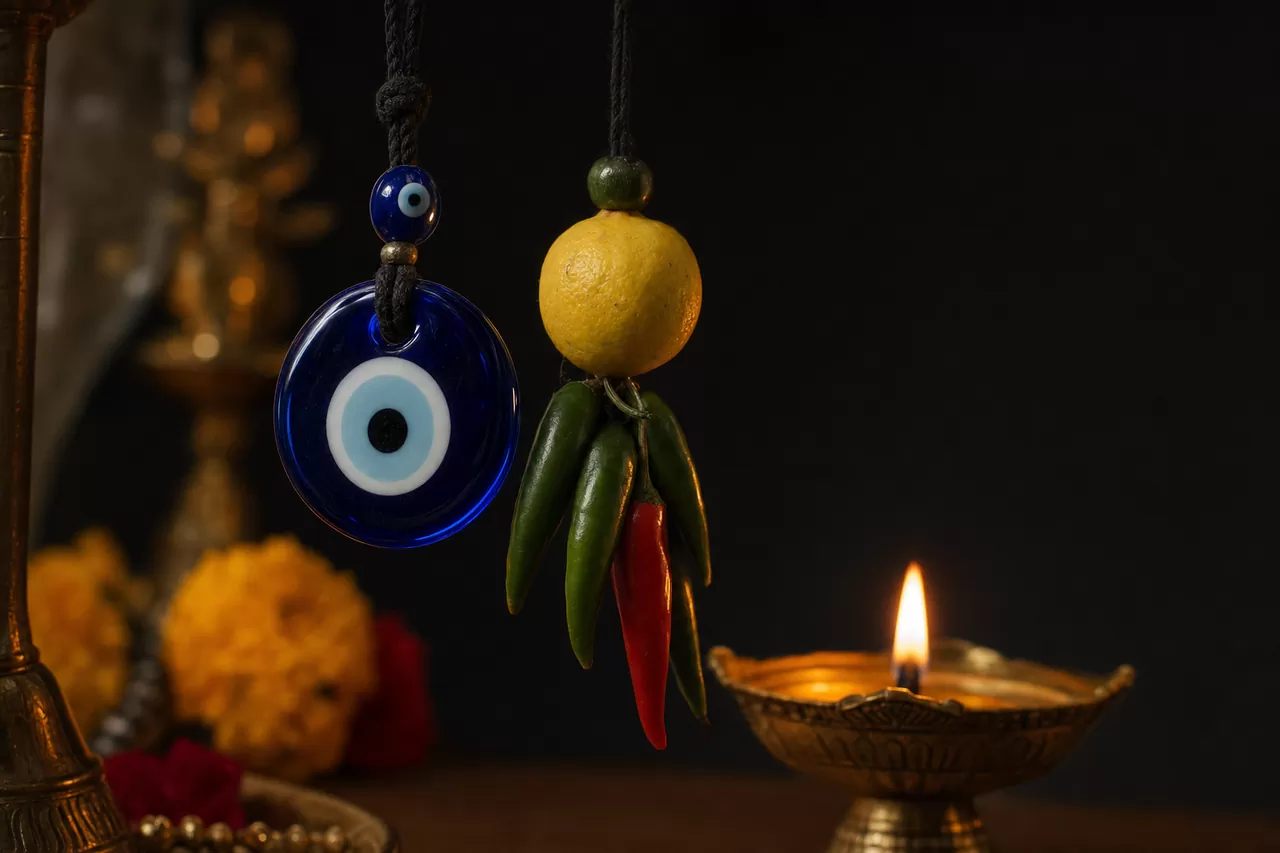
Evil eye removal, or nazar utarna, is the household rite of drawing off buri nazar, the harm the tradition links to envious or over-admiring looks, by circling salt, red chillies or mustard seed around the person and then burning or discarding them. Master Vijay Ram checks the ordinary explanation first, guides the utarna by video, and adds a havan or a kavach, from $250, only where the chart calls for one.
How it works
A baby who cries every evening after a crowded naamkaran. A new car scraped twice in its first month, a sweet shop that went quiet after a glowing write-up, a daughter whose exam nerves began the week the relatives praised her marks. These are the moments families reach for the old word, and they ring Master Vijay Ram to ask whether it is nazar.
Buri nazar, also called drishti dosh, is the belief, shared from Punjab to the Mediterranean, that a look carrying envy or excessive praise can unsettle a person, a child, a home or a business. The household answer is just as old: the nazar utarna, done by a mother or grandmother with salt and red chillies, often on a Tuesday or Saturday evening. It belongs to the family, and most of the time it is all that is needed.
What Vijay Ram ji adds is a calm look at whether the pattern is nazar at all, the utarna done properly with the right mantra, and protection afterwards where the chart shows a vulnerable period. Safe daily practices against the evil eye covers what any household can do on its own. This page covers the service, what it costs and what it will not do.
The Sacred Process
Describe the moment it seemed to begin (a function, a promotion, a photograph shared widely, a new purchase) and what has changed since, and for whom. Birth details of the person affected help, and for a baby the parents' details too.
A baby's crying is checked against feeding, sleep and fever before anything else, an adult's slump against sleep and stress, a shop's quiet month against the season and the street. Only then does Vijay Ram ji read the chart: the Moon, Rahu and the period running when the trouble began.
Most families are taught the utarna and do it themselves, with Vijay Ram ji guiding the count and the mantra on a video call. Where the chart shows more, a havan or a personally energised kavach is prepared at Auburn, from $250, agreed with you before anything is performed.
The tradition's own test is timing and target. Nazar is suspected when trouble begins soon after a moment of display, such as a wedding photograph, a housewarming or a promotion announced to the whole family group, and when it touches the very thing that was admired. A run of misfortune spread across every part of life, with no such moment behind it, is read differently, and often it is not spiritual at all.
| What families notice | What it often is instead | What to do first |
|---|---|---|
| A baby unsettled every evening after visitors | Overtiredness, feeding, wind, a growth spurt, the ordinary evening crying of the early months | A child health nurse or GP, and a doctor straight away for a fever, poor feeding or a floppy, drowsy baby |
| A bride or groom unwell before the wedding | Exhaustion, nerves, too little food and sleep | Rest, proper meals and a GP if it does not settle |
| A shop busy at launch, quiet a month later | The opening rush ending, the season, roadworks, a new competitor | The numbers, with an accountant or a mentor |
| A new car scratched or dented twice | Tight parking, a narrow garage, an unfamiliar car | Patience, and the insurer |
| A student who freezes after being praised | Pressure and the fear of disappointing the family | A calm talk, the school counsellor, and less public praise |
None of this means nazar is imaginary in the tradition's terms; it means the word is used last, not first. Where the timing fits and the ordinary checks come back clear, the chart is read, and a vulnerable Moon or a Rahu period at the time of the trouble is what Vijay Ram ji looks for. Where the heaviness is wider than one admired thing, negative energy removal is the better starting point.
The common form is simple. The person sits facing east, and a mother or grandmother holds a fist of rock salt with seven whole dried red chillies, or a pinch of mustard seed, and circles it around their head seven times while saying the words the family keeps. The salt and chillies are then dropped into a flame outdoors or flushed away; some households circle a lump of alum (phitkari) instead, and at a shop door a lemon with green chillies is hung and replaced each Saturday.
For babies the custom is gentler: a small black dot behind the ear rather than kajal in the eyes, since some imported kajal and surma contain lead, and a loose black thread on the wrist or ankle, checked daily and taken off before sleep. Nothing goes around an infant's neck and nothing goes into the cot, because a cord near a sleeping baby is a strangulation risk that no tradition asks a parent to accept; gentle nazar protection for newborns sets out the safe forms.
Burning chillies gives off a sharp, choking smoke, so it is done outside on a metal tray, away from children, pets and anyone with asthma, and never under a smoke alarm. Vijay Ram ji guides the whole rite on a video call, from the evening and the count to the words and where the remains go, with a grandmother in Ludhiana or Jalandhar welcome to join and lead it her way. What salt, lemon and chillies mean explains the reasoning behind each item.
Where the chart shows a vulnerable period, the utarna is followed by protection: a Hanuman or Durga havan performed personally at his own place of practice in Auburn on a muhurat, with the family joining by video if they wish, or a personally energised taweez or kavach for protection. Photographs or a short recording of the havan are sent afterwards only when he offers them.
Wherever there are new babies and new shops, which in practice means the growth suburbs and the Little India strips. In Sydney the calls come from Harris Park, Parramatta's Little India around Wigram Street, where shopkeepers ask about the shop as often as families ask about the baby, and from Westmead, Blacktown and the young families of the Hills; evil eye removal in Harris Park describes how those consultations run.
In Melbourne, Dandenong's Little India precinct and the young families of Point Cook, Tarneit and Craigieburn ring most often, and nazar and negative energy in Dandenong covers that side of the city. Brisbane's southside around Sunnybank, Perth's Canning Vale and Harrisdale, and Adelaide's north around Salisbury follow, and the Perth consultation page explains how the time difference is handled.
All of it is done by phone, video or WhatsApp, in English, Hindi or Punjabi, often with three generations on one call: the parents in Australia, the baby on a lap and the grandmother in India who has done the utarna for forty years. Families who prefer to sit with him can come to 25 Antwerp St, Auburn, by appointment, the only place he sees anyone in person; he does not come to homes or shops.
A consultation is $50, and for most families it ends with the utarna taught and a short practice to keep. A havan or a kavach, where the reading finds one warranted, starts from $250 and the figure is agreed before it is performed; if nothing more is needed, nothing further is charged. The work itself, when there is any, is booked as a havan performed at Auburn.
He will not tell you whose eye it was. Families often want a name, an aunt who stared at the baby or a neighbour who admired the car, but that accusation cannot be checked, it wrecks relationships, and the tradition itself answers envy with protection and a quieter display, never with blame. No outcome is promised either: the utarna is an act of care and faith, not a switch.
This is faith-based guidance, not medical, legal, financial or psychological advice. A baby with a fever, poor feeding or unusual drowsiness needs a doctor today, and an adult whose low mood, poor sleep or anxiety has lasted weeks should see a GP or a psychologist first. If you or someone at home is in distress, Lifeline is on 13 11 14 and Beyond Blue on 1300 22 4636.
Good to Know
Many families do, gently, and it is a loving custom. Keep to the soft forms: the utarna done by a parent or grandparent with the salt burned outside, a black dot behind the ear rather than kajal in the eyes, and a loose thread on the wrist or ankle that comes off before sleep, never around the neck and never in the cot. Any fever, poor feeding or unusual sleepiness goes to a doctor first, whatever anyone believes about nazar.
Yes, in the traditional ways: a lemon and green chillies at the door replaced each Saturday, a Ganesh at the counter with a lamp lit in the morning, and less talk of turnover in front of customers and relatives. Where the owner's chart shows a hard period, a havan or a yantra for the counter may be advised. The accounts still belong with an accountant.
It can be read that way if trouble began right after the housewarming and touches the house itself. Check the ordinary things first, the damp, the heater, the commute and the mortgage, then do the utarna at the threshold and keep a lamp at the door. If the house was never formally blessed, a griha pravesh is the fuller answer.
Not indoors. Burning dried chillies gives off a harsh smoke that can set off alarms, drift to neighbours through shared vents and bring on an asthma attack. In an apartment, circle the salt and chillies as usual, flush the salt away and wrap the chillies to be discarded outside the building, or burn them later on a metal tray in an open outdoor space.
No. Naming a person cannot be checked, and an accusation against an aunt, a neighbour or a colleague causes more harm than any look ever did. The tradition's answer to envy is protection and a quieter display, so the reading looks at your family, your chart and your timing, never at someone to blame.
Both, in all likelihood. The count, the items and the words vary from Punjab to Gujarat to the south, and a family's own way carries its own meaning. Vijay Ram ji is happy for her to join the video call and lead it, and he only suggests a change where something is unsafe, such as burning chillies indoors.
A consultation is $50, and most families leave it with the utarna taught and nothing else to pay for. A havan or a personally energised kavach, where the chart calls for one, starts from $250, and the figure is agreed with you before anything is performed. No further charge appears afterwards.
Explore More
Cleansing for a person or a home, with ordinary causes ruled out.
Learn more
Protection objects prepared and energised personally.
Learn moreVedic cleansing practices for heaviness and low energy.
Learn moreFrom the Journal
Read before you book: what the work involves, what it costs and what it cannot promise.
Independent educational references — open in a new tab.
Kept in Proportion
A $50 consultation by phone, video or WhatsApp looks at the ordinary explanation first, teaches the utarna where it fits, and adds protection only where Master Vijay Ram finds it warranted.
Consultation $50
Share your concern in confidence. Vijay Ram ji replies personally, and what you send stays private.