

Quick answer
A thank-you puja thanks the house for the years of shelter before a family leaves it. Hold it in the last week while the shrine is still up: clean, light a lamp, give thanks and share sweets. Move the deities first in the family car, leave the house clean with your customs taken down, and check WA or Tasmanian rules before carrying a tulsi.
Why thank a house before you leave it?
A thank-you puja is a short act of gratitude a family offers in a home it is about to leave, thanking the house and the spirit of the dwelling for the years of shelter and asking forgiveness for anything done amiss within its walls. Families describe it more simply: they do not want to walk out of a place that held their children's first steps as if it were a hotel room.
The tradition puts a ceremony at the door on the way in, and many families feel the way out deserves one too. A puja before moving out closes one chapter cleanly so that the next can open properly somewhere else.
It is the quiet partner of the house-warming, and griha pravesh and home blessing covers both ends of a move for families who want a puja performed for them.
When should it be held?
In the last week, while the home shrine is still in place and before the removalists arrive. Once the boxes take over the lounge, the house already feels half gone, and the puja loses the room it needs.
For a family selling, that usually means before the final inspection and settlement; for a family leaving a rental, before the final clean and the return of the keys. Some families hold the fuller puja a few days early and keep only the lamp for the last evening, and those who like a good day and hour for both the leaving and the arriving can have them chosen through a muhurat consultation for the move.
What does a thank-you puja involve?
At its simplest it needs nothing that is not already in the house. The shrine is cleaned, Ganesh is remembered first, a lamp is lit, and the family says its thanks in its own words, naming the house and the years lived there.
A short prayer asking forgiveness for any wrong done in the home, the kshama prarthana that closes many pujas, fits naturally here. Sweets are offered and then shared, and many families take a plate next door, because neighbours are part of what is being thanked.
Some families choose a fuller form, such as a Satyanarayan katha in the old house, and others ask for a havan performed for them. Master Vijay Ram conducts such a havan himself in Auburn, at an hour chosen for the family, who can watch on video from the rooms they are leaving.
What does the last week look like?
The practical jobs and the customs run side by side, and a family that plans both avoids a frantic final night.
| When | The practical task | The custom |
|---|---|---|
| About a week before | Book the final clean; reread the lease or contract; check plant rules if moving to WA or Tasmania | The thank-you puja, while the shrine is still in place |
| A few days before | Patch and repair as the lease requires; deal with any bathroom mould | Sweets for the neighbours and a proper goodbye |
| The day before | Water the tulsi; label the boxes for the new rooms | The deities packed in their own box; the toran and threads taken down |
| The last evening | Smoke alarms on; boxes well away from any flame | The final lamp at dusk, put out before anyone sleeps |
| Moving day | Photograph every room, read the meters, hand over the keys | The deities travel in the family car |
| At the new home | Beds and kitchen first | The deities set up first; the griha pravesh on its own muhurat |
How are the household deities moved?
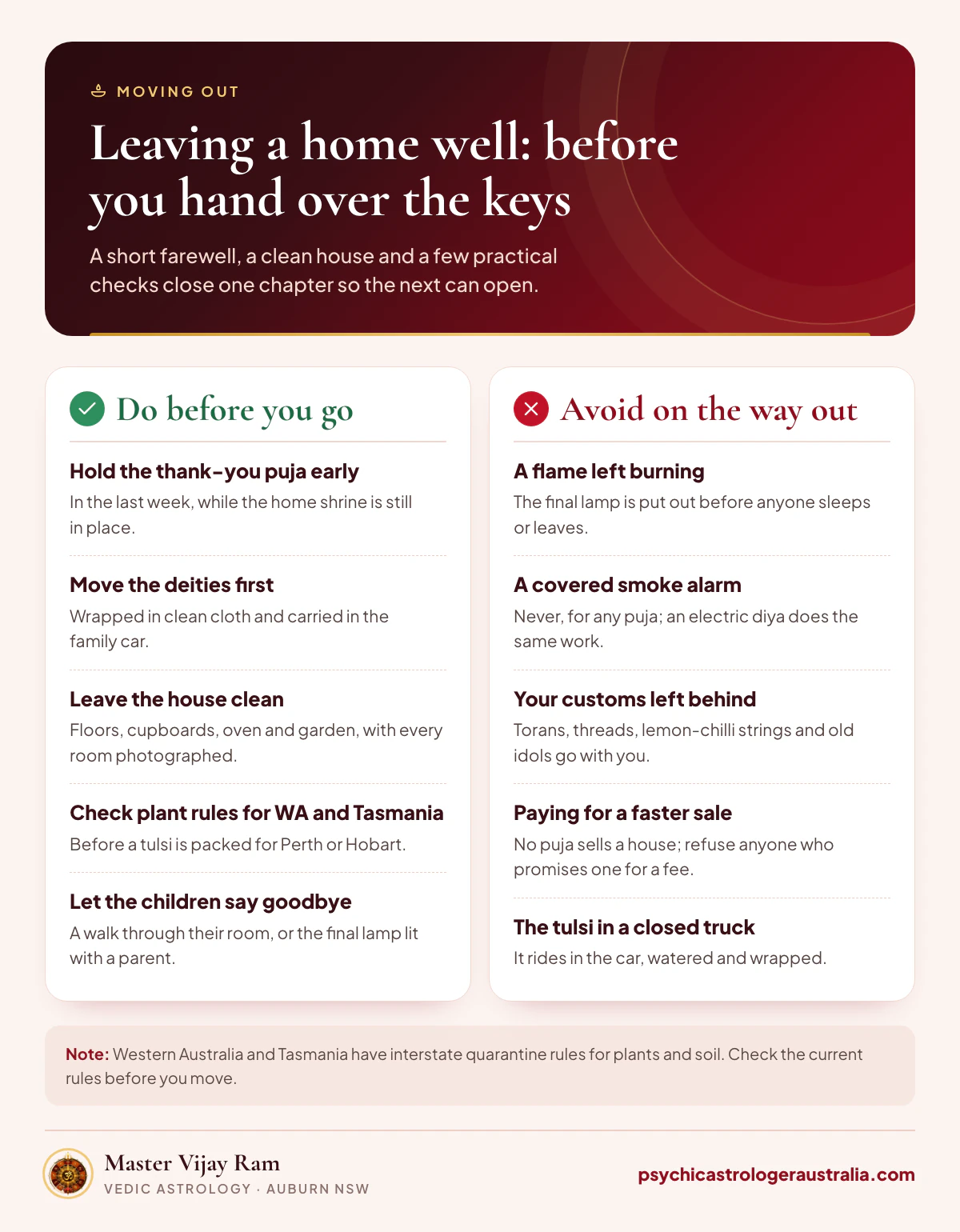
First and respectfully. Many families wrap the murtis, pictures and kalash in clean cloth, pack them in a box of their own and carry them in the family car, on someone's lap if possible, rather than in the removalist's truck.
The deities leave the old house with the family and are the first things set up in the new one. Anything chipped or worn out is not left behind in a cupboard for the next family to find; it goes to a temple collection or is laid to rest in the family's own way.
The last evening: lighting the final lamp
Many families keep a single lamp for the last night in the house, lit at dusk where the shrine stood or just inside the front door. It is the last puja in the old house, and it is often the moment the move finally feels real.
The lamp is put out before anyone goes to sleep, and certainly before the house is left. A flame is never left burning in an empty house, a smoke alarm is never covered or disabled for it, and an electric diya does the same work where the alarms are sensitive or the house is already full of boxes.
Why does leaving it clean matter?
Cleanliness is itself an offering in the tradition, and a house handed over clean is the last courtesy a family pays it. Floors washed, cupboards wiped, the oven cleaned and the garden tidied tell the next family that the house was cared for.
Take down every sign of your own customs as well: the toran, the lemon-and-chilli string, a thread tied round a tap, a yantra above a door, a rangoli sticker on the step. A family arriving to find them may be frightened by what were only your habits of protection.
Renters have a practical reason too. The bond depends on the condition report, so patch what the lease requires, deal with any mould on the bathroom ceiling, and photograph every room on the way out; mould, damp and the other real causes explains what to look for.
Can the tulsi come too?
Usually, and it should travel in the car rather than a closed truck, watered the day before, its pot wrapped so the soil stays put. Many families treat the tulsi as a member of the household, and leaving it behind feels wrong to them.
Moving interstate needs a check first. Western Australia and Tasmania have interstate quarantine rules for plants and soil, so look up the current rules before packing a tulsi for Perth or Hobart; if it cannot travel, give it to a neighbour or a friend who will care for it, and start a new one at the new home.
What if the house holds hard memories?
Not every move leaves a happy home. A family leaving after a separation, an illness, a death or a run of bad years may find gratitude hard to feel, and the tradition does not ask anyone to pretend.
A shorter farewell suits such a house: a lamp, a prayer for peace for everyone who lived there, and the door closed gently. If the memories keep pressing after the move, a GP or a counsellor helps as much as any ritual.
How can children say goodbye?
Let them. Children often feel a move more sharply than adults expect, and a goodbye they take part in helps: a walk through their own room, a photograph at the front door, a drawing of the house to keep.
A child can light the final lamp with a parent beside them, or carry a small picture of Ganesh to the car. The leaving a house ritual that children remember is usually the simplest one.
Selling, renting out or leaving a rental: does the puja change?
The thanks are the same; the practical frame differs. A family selling hands the house to buyers through the agent, a family renting it out hands it to tenants who deserve a clean, uncluttered start, and a family leaving a rental hands it back to its owner with the bond at stake.
A word on cleansing before selling a house: a puja does not sell a house. Price, presentation and the market do, and a family that holds a thank-you puja is expressing gratitude, not running a marketing campaign; anyone who promises a faster sale for a fee should be refused.
Leaving for a rebuild, or staying to renovate?
A knockdown-rebuild begins with exactly this farewell. The family thanks the old house before the machines arrive, and the new building starts with bhoomi pujan on the cleared land.
Families who decide to stay and extend instead face a different question: the house is changing around them rather than being left. Vastu shanti after a renovation or extension covers that path.
What about the new house?
The farewell and the welcome belong together. The deities that left the old house first enter the new one first, and the entry itself follows the kind of house it is, new or established, on a muhurat chosen for the family.
How a house-warming puja is done in Australia explains that ceremony in full, so it is not repeated here. If the new place feels strange for the first weeks, that is common after a move and usually passes with time, light and routine.
Moving to another city or state?
A family leaving Darwin for a job in Perth, or Townsville for Hobart, crosses time zones and quarantine lines as well as distance. The muhurat for the new home is worked out on the new city's own clock, and Perth, for one, sits two or three hours behind Sydney depending on the season.
Consultations carry on by phone or video wherever the family lands, as readings for Darwin families describes. Long moves carry real grief too, a temple, a grocer and a circle of friends left behind, so name it, keep in touch, and give the new place a season before deciding it is wrong.
What does it cost?
A family's own thank-you puja costs only the sweets and the oil for the lamp. Where a family wants the muhurat for the move or the new griha pravesh chosen, the consultation is $50 by phone, video or WhatsApp.
A havan or fuller puja performed for the family begins at $250, with the figure agreed before anything is performed, and the online puja and havan service describes how a family joins from the house it is leaving. He does not visit homes, old or new, and these moving out rituals belong mostly to the family itself.
What can a farewell puja not do?
It cannot hurry a settlement, return a bond, sell a house or make a hard move painless. The agent, the conveyancer, the condition report and time do those jobs, and a family that is struggling after a move should talk to a GP or a counsellor as readily as to a priest.
Vijay Ram ji offers this as faith and gratitude, not as legal, financial or medical advice, and no result follows from it as a promise. What it gives a family is a good ending, and a good ending makes the next beginning easier.
Read next
- A Home Cleansing Kit in Australia: What to Keep and What to SkipA home cleansing kit for Australian homes: the short list of puja items worth keeping, how to store them, where they …
- Cleansing the Home After a Death: Sutak, the Thirteen Days and ShuddhiSutak after a death, gently explained: what a Hindu home pauses for ten to thirteen days, the lamp, the terahvi, the …
- Diwali 2026 House & Aura Cleansing: Clear the Year's Heavy EnergyDiwali 2026 house and aura cleansing done honestly: clean first, use the Five-Lamp Check, and learn when heaviness is…
Frequently asked questions
Is there a Hindu ritual for leaving a house?
Many families hold a short thank-you puja in the last week: the shrine cleaned, Ganesh remembered, a lamp lit, thanks offered for the years in the house and forgiveness asked for anything done amiss, then sweets shared with the family and the neighbours. It is a custom of gratitude rather than a rule, and traditions differ between regions and families.
When should we do the puja before moving out?
In the last week, while the home shrine is still set up and before the removalists arrive. Sellers usually hold it before the final inspection and settlement, and renters before the final clean and the return of the keys. Many families also keep a single lamp for the last evening, put out before anyone sleeps.
How should we move our murtis and pictures of the deities?
First and respectfully. Wrap them, with the kalash, in clean cloth, pack them in a box of their own and carry them in the family car rather than the removalist’s truck. They leave with the family and are the first things set up in the new home. Anything broken goes to a temple collection rather than being left behind.
Can we take our tulsi plant to another state?
Often, but check first. Western Australia and Tasmania have interstate quarantine rules for plants and soil, so look up the current rules before packing a tulsi for Perth or Hobart. If it cannot travel, give it to a neighbour or a friend who will care for it and start a new one at the new home. Within a state, carry it in the car.
Should we remove our toran, threads and lemon-chilli string before leaving?
Yes. Take down the toran, the lemon-and-chilli string, any thread on a tap, a yantra above a door and rangoli stickers on the step. They were your customs, and a family arriving to find them may be frightened by them. Leaving the house clean and clear of your own protective objects is part of leaving it well.
Will a cleansing help our house sell faster?
No puja sells a house; price, presentation and the market do. A thank-you puja before a sale is gratitude for the years lived there, not a marketing step, and anyone who promises a faster sale or a better price in return for a fee should be refused. Present the house well, follow the agent’s advice, and hold the puja for its own sake.
Can Master Vijay Ram perform the farewell puja for us?
Yes, if the family wants a fuller havan. He performs it himself in Auburn, his only place of practice, at a chosen hour, and the family can join on video from the house it is leaving. He does not visit homes. A family’s own simple thank-you puja needs no priest at all, and many families prefer it that way.
What does it cost?
A family’s own farewell costs only the sweets and the lamp oil. A consultation to choose the muhurat for the move or for the griha pravesh at the new home is $50, and a havan or fuller puja performed for the family begins at $250, with the figure agreed before anything is performed. Nothing else is charged.
People also ask
What should I do before leaving my old house in Hinduism?
Clean the shrine and the house, light a lamp, thank the home for the years of shelter and ask forgiveness for anything done amiss, then share sweets with family and neighbours. Pack the deities first and carry them yourself. Take down your toran, threads and other customs, and leave the house clean for the next family.
Can I do a puja in a rented house before moving out?
Yes. A thank-you puja needs no nails, no smoke near the alarms and nothing that marks the property: a clean shrine, a lamp in a safe holder or an electric diya, a prayer and sweets. Hold it before the final clean so the house can be left spotless for the condition report and the bond.
Should you leave anything behind when moving house?
Leave the house clean and the fixtures the contract or lease includes, but take your religious objects and protective customs with you: deity images, the kalash, torans, threads and lemon-and-chilli strings. A new family may be unsettled by finding them. Old or broken religious items go to a temple collection rather than a cupboard.
Do you need a muhurat to move out of a house?
It is not required. Many families simply move when the contract or lease says they must, and keep the muhurat for the entry into the new home. Families who prefer a good day and hour for leaving as well can have both chosen in one consultation, in the clock of each city.
References & further reading
Serving clients across Australia
Confidential consultations by phone, video & WhatsApp — including: