

Quick answer
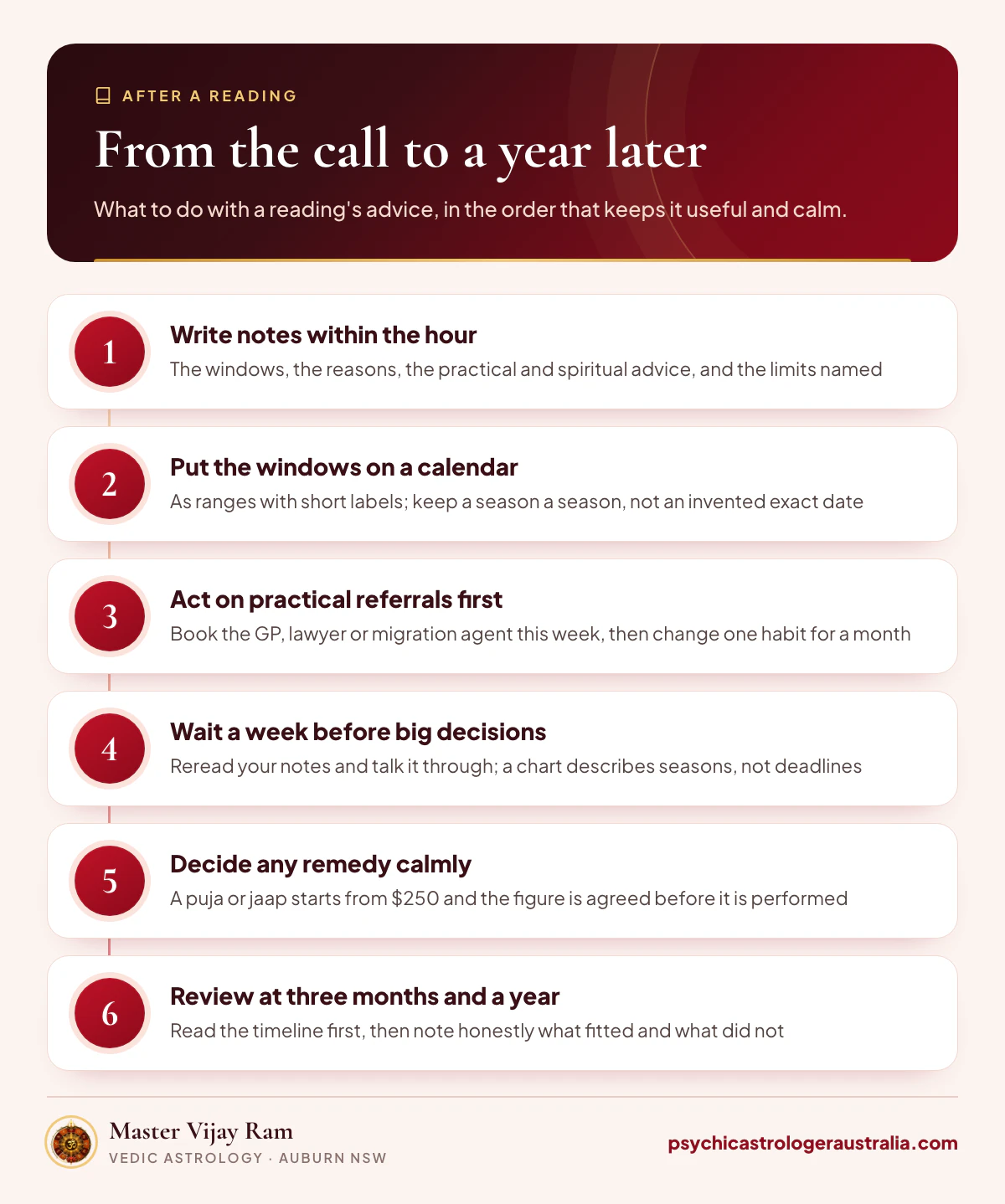
After a reading, write down what was said within a day, turn any time windows into a simple dated timeline, and note which advice is practical, which is spiritual and which needs a professional. Make no big decision in the first week, and review your notes after a few months and again at a year.
What should you do in the first hour after a reading?
Write it down. The after-reading period is the stretch, usually a few days, in which a person decides what the advice means for them, and memory starts editing it straight away; within an hour the parts that frightened or flattered you grow, and the qualifications shrink. Ten minutes with a notebook while the voice is still in your ear is the most useful thing you can do after an astrology reading.
That applies whether the reading was online by phone or video or in person in Auburn. Note the periods named, the reasons given, any practices suggested, and anything you were told to take to a doctor, lawyer or counsellor.
What belongs in your notes?
Four headings are enough. First, the windows: "the next eight months look slow for job changes; the period after that is more open." Second, the reasons, in a phrase: "Saturn period, tenth lord under strain." Third, the advice, split into practical and spiritual. Fourth, the limits Vijay Ram ji named, such as "see the GP about the sleep."
Use his words where you remember them. Notes from a reading are most useful when they record what was actually said rather than what you hoped was said, and that difference matters later.
How do you turn windows into a timeline?
A reading speaks in periods, not appointments: "from around the middle of next year", "through the rest of this antardasha", "once Saturn moves on". Put each one on a calendar as a range, with a short label. A one-page timeline on the fridge or in your phone does more than a long voice memo nobody replays.
Where a reading mentions a date from the ephemeris, such as a transit, copy it exactly. Where it gives only a season, keep it as a season; turning "around mid-year" into "the third week of June" is precision the reading did not give.
Which advice should you act on first?
The table is a simple way to sort what you heard. The order matters: practical steps first, then conduct and daily practice, and only then anything that costs money.
| Kind of advice | An example | What to do with it | When |
|---|---|---|---|
| Practical referral | See a GP about exhaustion; talk to a migration agent | Book it | This week |
| Timing | A better window for applying opens later in the year | Mark the range on a calendar; prepare in the meantime | Before the window |
| Conduct | Speak less in anger during this period; visit your father more | Pick one change and keep it for a month | Now |
| Daily practice | A short mantra, a Saturday lamp, a weekday fast if your GP agrees | Start small and keep it steady | When you are ready |
| Paid remedy | A puja or jaap for a specific period | Decide calmly, with the figure agreed first | After a few days |
What does a useful page of notes look like?
Here is an illustration, not a real client. A primary teacher in Adelaide asks whether to apply for a deputy principal role. Her notes, written on the tram home, read: "Current antardasha favours steady work, not a big step. Opening looks better from roughly the second half of next year. Use the year to finish the leadership course. Talk to Dad more; ninth house. Mantra on Thursdays if I want one. No remedy needed."
That is six lines, and every one can be checked or acted on. She knows what to do this month, what to prepare for, and what was not suggested, which is just as useful to remember.
Why should big decisions wait a week?
Because a reading stirs feelings, and feelings move faster than judgement. People sometimes resign the next morning, end an engagement, or move money because a period sounded difficult. Then the notes show the reading said "this is a slow period; consolidate," which is close to the opposite advice.
Give any big decision at least a week, talk it through with someone you trust, and reread your notes before you act. A chart describes tendencies and seasons, never a fixed fate, and nothing in it requires a decision within days.
What if the reading frightened you?
Go back to your notes and look for what was actually said. Often a phrase such as "a testing period for health" has been heard as "something terrible will happen". A good reading names difficulty and also names what helps and when it eases.
If fear is staying with you, ring and ask for the part that is worrying you to be explained again; a short clarification is better than weeks of dread. If the worry has become constant, or sleep and appetite are suffering, speak to your GP or ring Lifeline on 13 11 14. No reading is worth that.
What about a suggested remedy?
Treat remedies after a reading as a separate decision. Many readings suggest only conduct and timing; where Vijay Ram ji does suggest a puja, havan or jaap, he explains why and for which period, and the amount, from $250, is agreed before anything is performed at his place of practice in Auburn. How an online puja or havan works covers joining by video.
Take a few days. A remedy you chose calmly is one you will keep with care. If you have started one and feel nothing has changed, when remedies do not seem to work is the honest guide to what that may mean.
When should you review the reading?
Twice is enough for most people: at about three months and again at a year. At three months, check the practical steps and the conduct change. At a year, check the windows: did the slow period feel slow, did the opening come roughly when it was described?
Be honest in both directions. Write down what fitted and what did not, rather than remembering only the hits. Whether readings are accurate explains why checkable statements matter and why a vague reading can feel right whatever happens.
How do you avoid seeing only what you expect?
The mind looks for confirmation. Once you are told a period favours change, every small change feels like proof, and the things that stayed still are forgotten. That is ordinary human thinking, not a flaw in you, and the answer is the written timeline.
When you review, read the timeline before you think about the year. It keeps the reading honest, and it keeps you honest about the reading.
What if you followed the advice and it did not fit?
Then say so, to yourself and, if you return, to the astrologer. Perhaps the birth time was off, perhaps the window opened later than described, perhaps the reading simply missed. A good astrologer would rather hear that than be told everything came true, because it is how a chart's timing gets refined.
A reading that did not fit is not a reason for a stronger remedy or a more expensive one. It is a reason to check the birth details, look again at the method, and weigh how much trust to give the next forecast.
When is a follow-up worth booking?
A follow-up reading earns its place when something genuinely new happens: an offer arrives, a relationship changes, a family decision comes up that the first reading did not cover. A follow-up for the same question a fortnight later, because the answer was not the one you wanted, rarely helps. How often to get a reading sets out a sensible rhythm.
Many people find one yearly check-in around their birthday is enough, and a yearly Varshphal forecast is built for that. Each consultation is $50.
What if a second opinion says something different?
It happens, and it is not always a sign that one astrologer is wrong. Different ayanamsas, birth times and methods can give different answers. When two astrologers disagree explains how to compare them without shopping for the answer you prefer.
How do you share the reading with family?
Carefully, and only what is yours to share. A parent may want to know what was said about your marriage; you can tell them the gist without handing over every line. Avoid quoting the reading in an argument: "the astrologer said you are the problem" is never what a good reading says, and it never ends a quarrel well.
For a family in Queensland or anywhere else, the simplest approach is to share the timeline and the practical steps, and keep the rest for yourself. Clients can see how readings for Brisbane clients are timed on Queensland's clock.
What can the advice from a reading not do?
It cannot make a decision for you, and it is not medical, legal, financial or psychological advice, because it describes periods and tendencies in your chart. Used well, it helps you choose when to push and when to wait; used badly, it becomes a reason to stop thinking. Your notes, your timeline and your own judgement are what turn it into the first kind.
Read next
- Punjabi Astrologer in Australia: Consultations in PunjabiPunjabi astrologer in Australia: consultations in Punjabi by phone, video or WhatsApp with Master Vijay Ram, the word…
- Online Astrology Consultation in Hindi: How It Works From AustraliaOnline astrology consultation in Hindi from Australia: how booking, birth details, the reading and parents joining fr…
- Spiritual Cleansing Service: What to Expect From Start to FinishWhat a spiritual cleansing service involves from first call to follow-up: the stages, what you are asked for, and why…
Frequently asked questions
What should I do immediately after an astrology reading?
Write notes within the hour. Record the time windows mentioned, the reasons given, the practical and spiritual advice, and any limits such as seeing a doctor. Use the astrologer's words where you remember them. Memory changes quickly, and notes keep what was actually said separate from what you feared or hoped to hear.
Should I make a big decision straight after a reading?
It is wiser to wait at least a week. A reading stirs feelings, and people sometimes resign, end relationships or move money because a period sounded difficult, only to find their notes said the opposite. Reread your notes, talk to someone you trust, and remember that a chart describes tendencies and seasons, not deadlines.
How do I record the timing from a reading?
Put each period on a calendar as a range with a short label, such as a slower stretch for job changes or a more open window for marriage talks. Keep seasons as seasons rather than inventing exact dates. A one-page timeline is easier to review later than a long recording.
What if the reading made me anxious?
Reread your notes for what was actually said, because worrying phrases are often heard more harshly than they were meant. Ask for the part that worries you to be explained again. If anxiety persists or affects your sleep or appetite, speak to your GP or ring Lifeline on 13 11 14. A reading should never leave you in dread.
Do I have to do the remedy that was suggested?
No. A remedy is a separate decision and you are free to decline. Many readings suggest only conduct and timing. Where a puja or jaap is suggested, it starts from $250, the figure is agreed before anything is performed, and it is done personally by Master Vijay Ram at his place of practice in Auburn.
When should I look back at my reading?
Around three months, to check the practical steps and any change in conduct, and again at a year, to check the time windows. Read your written timeline before thinking about the year, so you judge the reading on what was said rather than on what you remember. Record what fitted and what did not.
How soon should I book a follow-up reading?
Book a follow-up when something genuinely new happens, such as a job offer, a change in a relationship or a family decision the first reading did not cover. Asking the same question again within weeks because you disliked the answer rarely helps. Many people find a yearly check-in around their birthday is enough.
Should I tell my family what the astrologer said?
Share what is yours to share, such as the timeline and practical steps, and keep personal details to yourself if you prefer. Avoid quoting a reading in an argument or using it to blame someone, because a good reading does not hand out verdicts on relatives and quoting it that way only hardens a dispute.
People also ask
How do you use astrology advice?
Sort it into practical referrals, timing, conduct, daily practice and paid remedies, and act in that order. Put timing windows on a calendar as ranges, change one habit at a time, and decide on any remedy calmly. Review against your notes after a few months and at a year, and keep your own judgement in charge.
How long does it take for an astrology prediction to happen?
Vedic readings usually speak in periods, such as a dasha, an antardasha or a transit, which can run from months to years. A prediction describes a tendency within that period, not a fixed event on a fixed day. Reviewing your notes at the end of the period is the fair way to judge it.
Is it normal to feel confused after a reading?
Yes. A reading covers a lot in a short time, and some of it is technical. Writing notes straight afterwards and turning the timing into a simple calendar helps. If something remains unclear, ask for that point to be explained again rather than guessing, and avoid acting on a half-understood phrase.
Should I record my astrology reading?
If you would find a recording useful, ask before you start; it is courteous and keeps everyone clear. Many people find short written notes more useful, because they can be reread in a minute and turned into a timeline. Keep any recording private, as it contains personal details about you and possibly your family.
References & further reading
Serving clients across Australia
Confidential consultations by phone, video & WhatsApp — including: