

Quick answer
Birth time rectification is the work of narrowing an uncertain birth time by testing candidate times against the dates of real events in a life. It can turn a vague "morning" into a working window of minutes, but it remains an estimate, and two astrologers can disagree. Much of a chart, including the Moon sign and most planets, is readable without it.
What is birth time rectification?
Birth time rectification is a method that estimates an unknown or uncertain birth time by testing several possible times against the dates of things that have actually happened in a person's life. The time whose chart, dashas and transits fit those events best is taken as the working time. It is detective work, not calculation, and it always ends with an estimate rather than a certainty.
People with an unknown birth time come to it for ordinary reasons. A mother remembers "around breakfast", a certificate from India has no time on it, or a family janam patri and a hospital record disagree by an hour. A full kundli reading is only as precise as the time underneath it, which is why the question deserves care.
Why do a few minutes matter so much?
Different parts of a chart move at very different speeds. The slow planets barely shift in a day, so an approximate birth time leaves Saturn and Jupiter where they were. The rising sign, the lagna, is another matter: it moves through all twelve signs in a day, about one every two hours, so a birth near the edge of a sign can change lagna with a small error.
| Part of the chart | How fast it changes | What an error of an hour can do |
|---|---|---|
| Slow planets (Saturn, Jupiter, Rahu, Ketu) | Days to years per degree | Almost nothing |
| Sun, Mercury, Venus, Mars | About a degree a day or less | Very little, unless one sits at a sign edge |
| Moon | About 13° a day | Half a degree; can shift the nakshatra pada and move dasha dates by months |
| Lagna and houses | One sign in about two hours | Can change the lagna, and every house with it |
| Navamsa (D9) lagna | About every 12 minutes | Several different D9 charts |
| Dasamsa (D10) lagna | Faster still, parts of 3° | Career chart unreliable |
The Moon's speed matters for timing. The dasha balance at birth comes from how far the Moon has travelled through its nakshatra, so an hour's error can move every dasha date in a life by weeks or months. How Vimshottari dasha timing works shows that calculation in full.
Have you checked the records first?
Rectification is a last resort, not a first step. Hospital records, a state registry of births, a family janam patri written soon after the birth, a baby book or a letter sent home can all hold a recorded time, and a written time almost always beats an estimated one. Finding your birth time in records walks through where to look in Australia and India.
Even a rough record helps. "Between the morning shift change and lunch" narrows the search enormously, and a remembered detail, such as the call to prayer, a power cut or the doctor's arrival, can be checked against sunrise or known events.
Is the time wrong, or is the time zone?
Many apparently wrong birth times are really wrong conversions. A time recorded correctly in a Sydney hospital becomes an hour off when an app ignores daylight saving, or applies it in a summer when Queensland did not use it. A birth in India entered with an Australian time zone, because the phone supplied it, can move the lagna by several signs.
Before anyone rectifies a time, the place, the time zone in force on that date and any daylight saving should be checked. Older charts from India sometimes used local mean time or a regional standard of the era rather than Indian Standard Time, which a careful astrologer allows for. A correction at this stage often settles the matter with no rectification at all.
How do astrologers rectify a birth time?
The main method is event matching. The astrologer sets up charts for several candidate times across the uncertain window and checks which one produces dashas, sub-periods and transits that line up with dated events: a marriage, the birth of a child, a parent's death, a move overseas, a serious accident. A time whose chart shows a seventh-house period at the wedding and a fourth-house transit at the house move is preferred over one that does not.
Several classical checks are used alongside. Some traditions test the lagna against the Moon's nakshatra through methods such as the Kunda calculation, and others use Pranapada or the sex of the child as a check; these vary between schools and astrologers weigh them differently. Physical appearance and temperament are matched to the lagna by some, though that is the weakest evidence, because people rarely fit a textbook description.
The divisional charts serve as a fine adjustment once the lagna is settled. The navamsa is read for marriage and the dasamsa for career, so a candidate time whose D9 and D10 agree with the life is favoured. Because those charts change every few minutes, they are where rectification narrows a window most.
Which life events help most?
Events with exact dates and a clear house meaning are the most useful. Vague memories of "a hard year" help very little. The list below is what Master Vijay Ram asks for before attempting a rectification.
- Marriage, engagement or the start of a long relationship, with dates.
- Births of children, and any pregnancy losses the person is comfortable sharing.
- Deaths of parents, grandparents or siblings.
- Moves between countries and major house moves.
- Job starts, promotions, redundancies and business openings.
- Serious accidents, surgeries or hospital stays.
- Graduations and the start of higher study.
Six to ten well-dated events usually give enough to test candidate times. Two or three rarely do, and very young people may not yet have enough events for a confident result.
What does a rectified time look like?
A careful rectification ends with a window rather than a single minute, perhaps a range of ten or twenty minutes, sometimes with a preferred time inside it. Where two candidate times both fit, an honest astrologer says so and explains which parts of the reading depend on the choice. You should be told the method used and which events carried the most weight.
The result is a working time. It is used for readings until a better record turns up, and it is revisited if later events fail to fit.
Can a rectified time be wrong?
Yes. Rectification works backwards from events, and a skilled reader can find some astrological match for almost any date if they look hard enough. That is a real weakness, and it is why the best practice uses many events, tests the time against events not used to find it, and treats the result as provisional.
Two astrologers can rectify the same birth to different times, especially when the records are thin. Neither result should be presented as certain. A reading built on a rectified time describes tendencies and timing within those limits, and no reading of any kind can decide a medical, legal or financial question.
What is still readable without an exact time?
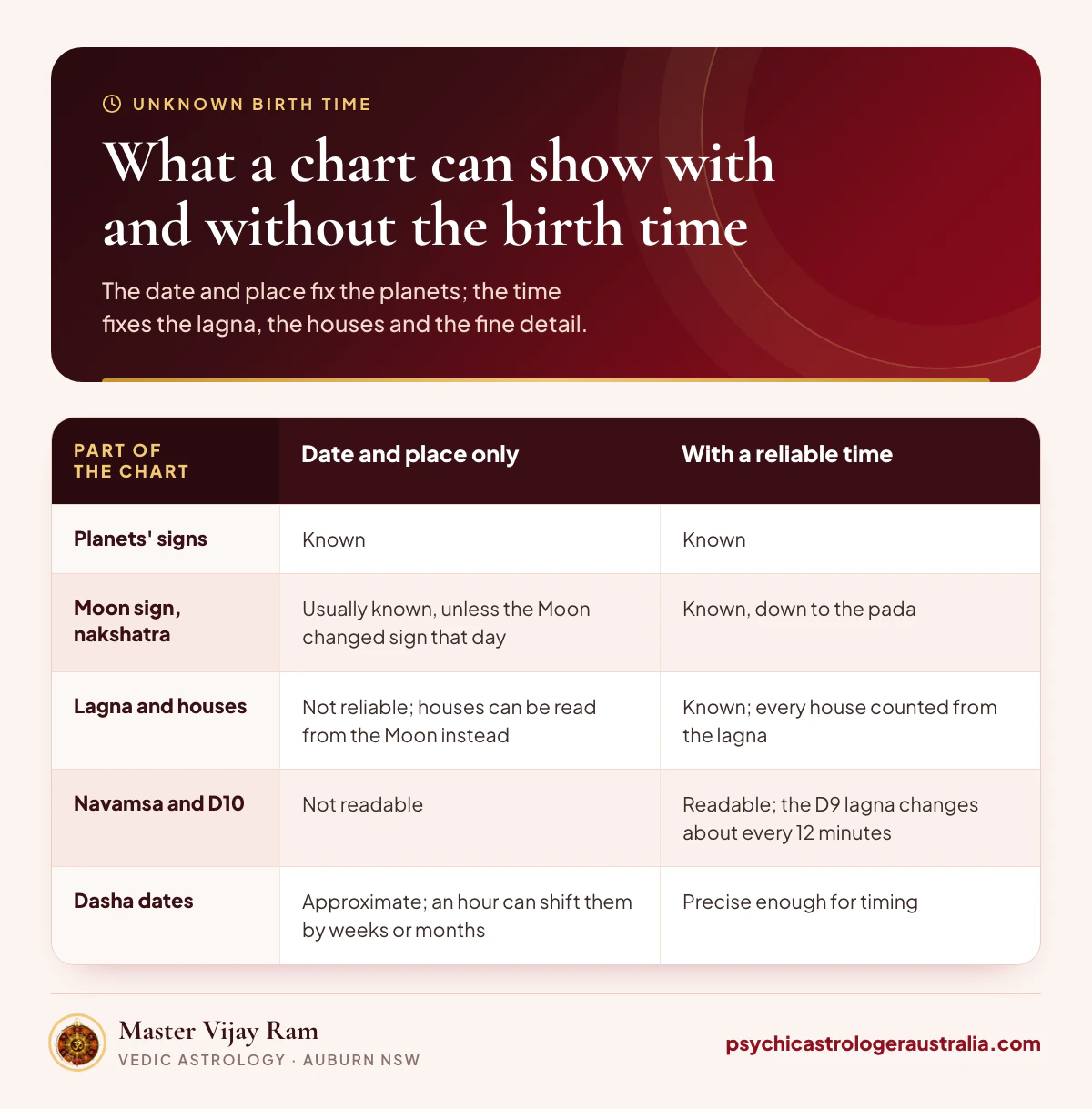
More than many people expect. With the date and place alone, the signs of all the planets are known, and the Moon's sign is known unless the Moon changed sign that day. The Moon's nakshatra is usually known, Sade Sati can be read from the Moon sign, and the slow transits for the coming years apply as usual.
What cannot be read with confidence is the lagna and the house each planet occupies, the divisional charts, and precise dasha dates. Many astrologers then read the houses from the Moon, a method called Chandra lagna, which gives a useful second view even when the true lagna is unknown. The lagna explained covers why the rising sign carries so much weight.
When is a prashna better than rectification?
When the question is specific and urgent and there are few dated events to work with. A prashna chart is cast for the moment a sincere question is asked, so it needs no birth time at all. It answers one matter, such as whether to accept a job offer, rather than describing a whole life.
Prashna, the question chart explains how it works. Many people with an unknown time use a prashna for pressing questions and a Moon-based reading for the broader picture, and skip rectification altogether.
What about twins?
Twins born minutes apart share almost every planetary position, and their charts can be identical at the lagna level. The tradition turns to the finest divisions, which change within minutes, and to the recorded order and times of birth. Hospital records usually note each twin's time separately, so this is one case where the record is especially worth finding.
Even with exact times, twins' lives differ in ways no chart fully explains. That is a useful reminder of what any chart can and cannot do.
How does a rectification consultation work?
Send the date and place of birth, the window of possible times, any record or family memory, and your list of dated events. Master Vijay Ram tests candidate times before the call and then talks through the result, the events that decided it and the parts of the chart that remain uncertain. A consultation is $50, by phone, video or WhatsApp, in English, Hindi or Punjabi; a complicated case may need a second session, and that is agreed in advance.
Clients across Sydney, Melbourne, Brisbane and Perth use the same process, and an online astrology reading is how most rectifications are done. If a document turns up later, the time is checked again.
Read next
- Finding Your Birth Time: Records in Australia and IndiaHow to find your birth time: hospital records, state registries, baby health books, Indian certificates and the ghati…
- When Is the Best Time to Get an Astrology Reading?When to book an astrology reading: your birthday, a dasha change, Saturn's sign changes on 3 June and 20 October 2027…
- Kundli Reading Explained: What Your Birth Chart RevealsWhat a Kundli reading reveals about your life, personality, career and destiny. Master Vijay Ram explains Vedic astro…
Frequently asked questions
What is birth time rectification in astrology?
It is the process of estimating an uncertain birth time by setting up charts for several candidate times and checking which one's dashas, transits and divisional charts best match dated events in the person's life. The result is a working window, often ten or twenty minutes wide, used for readings until a better record turns up.
How accurate is birth time rectification?
It is an estimate. With many well-dated events and careful checks it can narrow a vague time to a window of minutes, but two astrologers can reach different times, especially when records are thin. A good rectification tells you the method, the events used and which parts of the reading depend on the chosen time.
What information do I need for rectification?
The date and place of birth, the possible window of time, any record or family memory, and six to ten dated life events: marriage, children's births, deaths of parents, moves between countries, job changes, accidents or surgeries and graduations. Exact dates matter more than descriptions, and very young people may not yet have enough events.
Can my kundli be read without a birth time?
Partly. The signs of all the planets, usually the Moon sign and nakshatra, Sade Sati and the slow transits can be read from the date and place alone. The lagna, the houses, the divisional charts and exact dasha dates cannot. Many astrologers read the houses from the Moon in that case, and a prashna can answer specific questions.
How much does a one-hour error change a chart?
It barely moves the slow planets, but the lagna moves through a sign in about two hours, so an hour can change it near a sign edge. The navamsa lagna changes about every 12 minutes. The Moon moves about half a degree, which can shift dasha dates by weeks or months across a whole life.
Is a rectified time as good as a recorded one?
No. A time written down at or soon after the birth, in a hospital record, registry or family janam patri, is almost always better than a rectified estimate. Rectification is a fallback when no record exists, and if a record later appears, the reading should be checked against it.
Why did two astrologers give me different rectified times?
Rectification works backwards from events, and different astrologers weigh different events and methods. With thin records several candidate times may fit reasonably well. Ask each which events decided their choice and which parts of the reading depend on it. When results disagree, treat the lagna as uncertain and lean on what both charts share.
How much does birth time rectification cost with Master Vijay Ram?
It is done within a consultation at $50, by phone, video or WhatsApp, in English, Hindi or Punjabi. A complicated case with many candidate times may need a second session, and that is agreed with you in advance rather than added later. Sending your records and dated events beforehand makes the session far more useful.
People also ask
What happens if birth time is wrong in a kundli?
Depending on the size of the error, the lagna and every house may be wrong, the divisional charts will be unreliable, and dasha dates can shift by weeks or months. The planets' signs and usually the Moon sign stay correct. Readings built on a wrong time can describe the wrong life areas, which is why checking the time matters.
Can astrology find the exact birth time?
Not with certainty. Rectification can narrow an uncertain time to a working window by testing it against dated life events, but it remains an estimate that different astrologers may set differently. A recorded time from a hospital, registry or family document is always preferable.
Which is more important, birth date or birth time?
Both matter, for different things. The date fixes the planets' signs and usually the Moon sign; the time fixes the lagna, the houses and the divisional charts, and fine-tunes the dasha dates. With only a date, a Moon-based reading is still possible, but the house-level detail needs the time.
How long does birth time rectification take?
It depends on how wide the uncertain window is and how many dated events are available. A narrow window with good events can be tested before a single consultation. A window of several hours with few events may need more than one session, and some cases end with two candidate times rather than one.
References & further reading
Serving clients across Australia
Confidential consultations by phone, video & WhatsApp — including: