
Quick answer
For most people, one astrology reading a year is enough, ideally around the birthday when the Varshphal (yearly chart) begins, plus an extra reading at a genuine turning point such as a marriage decision or a change of dasha. Readings every week or month, or for every small choice, are a sign of dependence rather than guidance.
How often does a person really need a reading?
Reading frequency is the rhythm at which someone consults an astrologer, and for most people a good rhythm is slow. A birth chart does not change, and the periods that shape a life, the dashas and the slow transits of Saturn and Jupiter, run for months and years. Asking how often to get an astrology reading is really asking how often anything new happens in those periods, and the answer is: not every week.
Master Vijay Ram's own advice to regular clients is usually one reading a year and an extra one when life genuinely turns. An online astrology reading by phone or video makes it easy to book more often, which is exactly why it helps to know when not to.
Why is once a year a sensible rhythm?
Because Vedic astrology has a yearly chart built in. The Varshphal, or annual chart, is cast for the moment the Sun returns to its birth position each year, which falls around your birthday. It is read for the twelve months that follow, alongside the dasha you are running and the year's transits.
A yearly reading at that point gives a map for the year: the stretches that look busier or quieter, the months that suit a move, the periods to be patient. The yearly forecast and Varshphal reading is designed for exactly this.
When is an extra reading worth having?
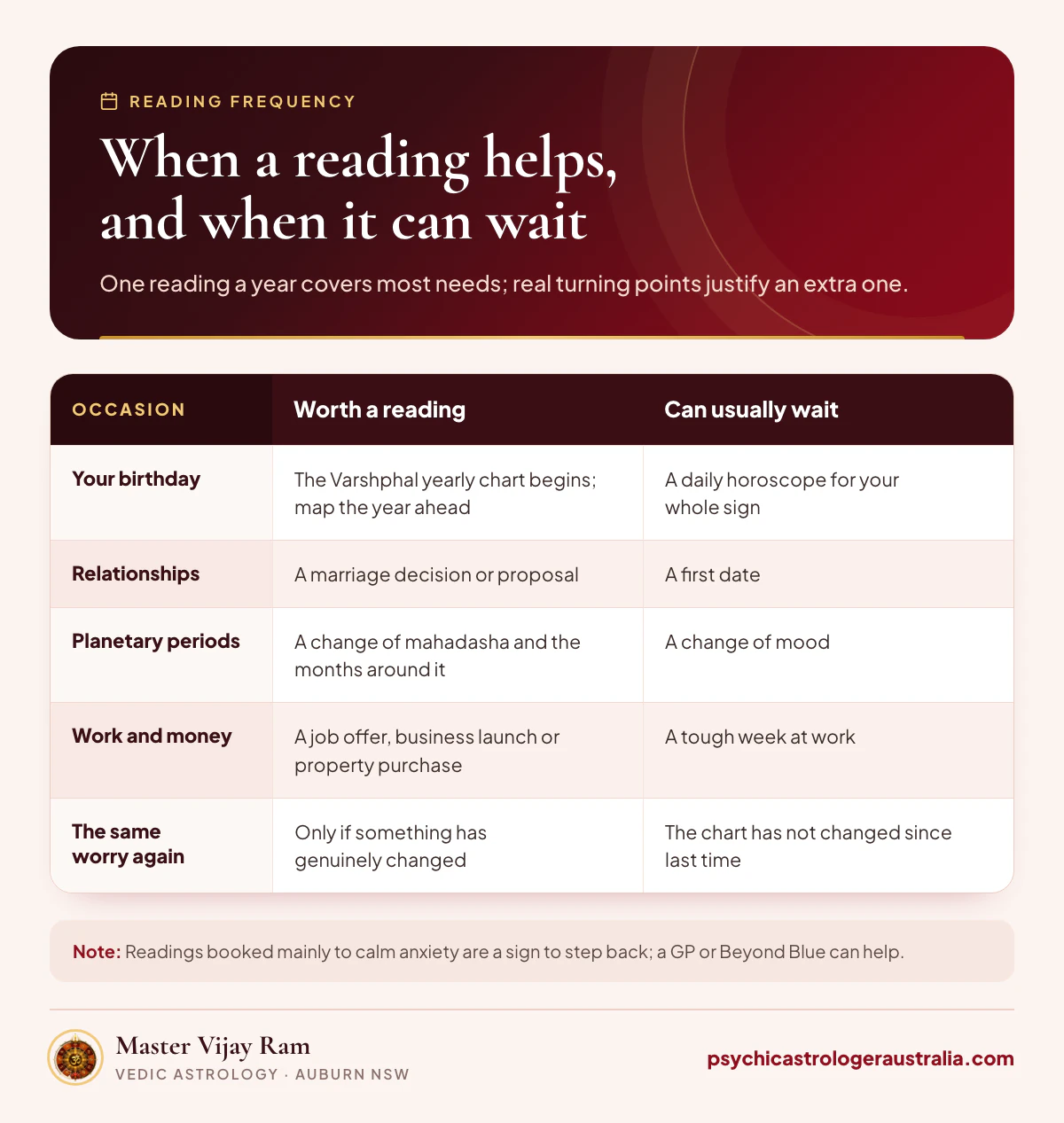
Real turning points justify a reading outside the yearly rhythm. The table separates the occasions that usually warrant one from those that usually do not.
| Usually worth a reading | Why | Usually can wait | Why |
|---|---|---|---|
| A marriage decision or proposal | Matching and timing are classic uses | A first date | Too early; nothing to decide yet |
| A change of mahadasha | A new period with a new ruler begins | A change of mood | Moods pass faster than periods |
| A job offer, business launch or property purchase | A real choice with a timing element | A tough week at work | Weekly ups and downs are not dasha events |
| A muhurat for a wedding, griha pravesh or ceremony | Choosing a time needs the charts | Which day to buy groceries | Not every choice needs a chart |
| A major loss or upheaval, once the first shock passes | A reading can give the season a shape | The same worry, asked again | The chart has not changed since last time |
The best time to get a reading looks at the calendar side of this: birthdays, Saturn changing sign, the dasha change and the festival points in the year.
Why does a change of dasha matter?
The Vimshottari dasha divides life into long periods ruled by different planets, and each mahadasha is divided again into antardashas. When one mahadasha ends and the next begins, the emphasis in a life often shifts, and the months around the change, called dasha sandhi, can feel unsettled.
That is a natural point for a reading, even if the yearly one is months away. Dasha sandhi, the changeover between periods explains why that junction is read with care.
Can you have too many readings?
Yes, and it is worth being plain about it. Some people come to rely on readings the way others rely on checking their phone: a reading for every decision, a second astrologer when the first answer is unwelcome, a call whenever anxiety rises. The chart cannot change between those calls, so the answers cannot either.
Frequent readings also crowd out your own judgement. A person who asks an astrologer which job to take, which suburb to rent in and whether to reply to a message has handed over choices that are theirs to make.
What are the signs that readings have become a habit?
- You book a new reading before you have acted on the last one.
- You ask the same question to several astrologers, hoping for a different answer.
- You feel unable to make small decisions without consulting a chart or an app.
- Readings are the main way you calm anxiety.
- Spending on readings or remedies is causing strain or secrecy at home.
If several of these fit, step back. A GP, Beyond Blue (1300 22 4636) or a counsellor can help with anxiety that keeps reaching for reassurance. If spending has got out of hand, the National Debt Helpline (1800 007 007) offers financial counselling.
How does Master Vijay Ram respond to frequent requests?
He will tell a client when a reading is not needed. If someone rings a month after a full reading with the same question, the honest answer is usually: nothing has changed, keep to what was agreed, and check in at the next real turning point. He would rather lose a fee than encourage too many readings.
A consultation is $50 whenever it happens. He sells no stones or beads, and a puja or jaap, if one is suggested, starts from $250 and is agreed before it is performed at his place of practice in Auburn; it is never sold as a monthly subscription.
What should you do between readings?
Live the advice. Keep the notes from your last reading, mark its time windows on a calendar, and review them after a few months. What to do with the advice after a reading sets out a simple way to do that.
If you were given a daily practice, such as a mantra, a weekday fast your GP is happy with, or a lamp at dusk, keep it steadily rather than adding more. A practice kept quietly for a year often does more than a new reading every month.
What if a remedy does not seem to be working?
That is a common reason for a quick return call, and sometimes a fair one. Before booking, check how long it has been and what was actually suggested; many practices are meant to be kept over months. When remedies do not seem to work covers the honest reasons and what to do next.
Where a puja or havan is concerned, how an online puja is performed explains what happens and why it is a one-off act rather than a recurring charge.
Does the right rhythm change at different stages of life?
A little, because young adults deciding on study, career and marriage may have more genuine turning points in a few years than at any other time. People in a settled middle stretch often need only the yearly reading. Older people may want a reading around retirement, a move or a health change, alongside their doctor's advice.
Shift workers and people on rosters, such as a nurse in Darwin or a miner flying in and out of the Pilbara from Perth, should simply pick a rested day each year. Clients in the Top End can see how readings for Darwin clients are timed.
How often is a second opinion reasonable?
For a major decision, one second opinion is sensible, especially for marriage matching or a worrying prediction. Beyond that, extra opinions tend to add noise rather than clarity. When two astrologers disagree explains how to compare two readings properly instead of collecting a third and a fourth.
What does a healthy rhythm look like over a few years?
An illustration, not a real client: a physiotherapist on the Central Coast has a reading each year a week or two after her birthday, and in one year adds a reading when a proposal arrives and a muhurat reading once the families agree.
The next year she has only the birthday reading. The year after, her mahadasha changes, and she books one extra call in the months before it.
That is four or five readings in three years, each tied to something real. Between them she keeps her notes, a Thursday practice she enjoys, and her own counsel.
What about daily horoscopes and apps?
Daily horoscopes written for a whole Sun or Moon sign are entertainment, and they are not a substitute for, or a reason for, a personal reading. Apps that refresh a forecast every morning can feed the habit described above. If you enjoy them, read them lightly; if you find yourself anxious about them, it is a good sign to stop.
Is a reading every few months ever right?
Occasionally, for a defined stretch: a couple planning a wedding may need a matching reading, a muhurat reading and a check before the date. A family dealing with a parent's illness may want a reading at the start of a hard period and another when it shifts. These are chains of genuine decisions, not a routine, and they end when the decisions do.
What is the honest limit on any rhythm?
No number of readings makes the future certain. A chart describes tendencies and timing, not fixed events, and astrology is faith-based guidance, not medical, legal, financial or psychological advice. A yearly reading, extra ones at real turning points, and your own judgement in between is a rhythm that keeps astrology useful without letting it take over.
Read next
- Signs It’s Time to See an Astrologer (and When to See Someone Else)Ten signs it is time to see an astrologer, the quiet moments a reading repays most, and when a GP, counsellor, lawyer…
- Punjabi Astrologer in Australia: Consultations in PunjabiPunjabi astrologer in Australia: consultations in Punjabi by phone, video or WhatsApp with Master Vijay Ram, the word…
- Win Your Ex Girlfriend or Boyfriend Back: Vedic RemediesVedic remedies to win back an ex girlfriend or boyfriend, explained plainly: what an honest quote covers, what nobody…
Frequently asked questions
How often should I get my horoscope read?
For most people, once a year is enough, ideally around the birthday when the Varshphal, the yearly chart, begins. Add a reading at genuine turning points, such as a marriage decision, a property purchase or a change of mahadasha. More frequent readings rarely add anything, because the birth chart does not change and the main periods run for months or years.
Is it bad to get astrology readings often?
It is not harmful in itself, but frequent readings can become a habit that replaces your own judgement or calms anxiety only briefly. Signs of this include booking before acting on the last reading, asking several astrologers the same question, and feeling unable to decide small things without a chart. Stepping back is wise if these sound familiar.
Why is a reading around my birthday useful?
Vedic astrology casts a yearly chart, the Varshphal, for the moment the Sun returns to its birth position, which falls around your birthday. Reading it with your current dasha and the year's transits gives a map for the twelve months ahead, showing which stretches look busier, quieter or better suited to particular decisions.
Should I get a reading when my dasha changes?
It is a sensible time. When one mahadasha ends and another begins, the emphasis in a life often shifts, and the months around the change can feel unsettled. A reading near the change can explain what the new period tends to bring. If your yearly reading is close, the two can be combined.
What should I do between readings?
Keep the notes from your last reading, mark its time windows on a calendar, and review them after a few months. Keep any daily practice you were given steadily rather than adding more. Book a new reading when something genuinely new happens, not because the last answer was unwelcome.
How much does a yearly reading cost?
A consultation with Master Vijay Ram is $50, whether it is a yearly reading or one at a turning point. If a puja or jaap is suggested and you choose it, it starts from $250 and the figure is agreed before anything is performed. Nothing is sold as a subscription or a recurring package.
Can I ask the same question again if I did not like the answer?
You can, but the honest answer is unlikely to change, because your chart and its periods have not. Asking repeatedly, or asking several astrologers until one agrees with you, adds no accuracy. It is better to review the reasons you were given and wait for the period to unfold.
Are daily horoscopes a substitute for a reading?
No. Daily horoscopes are written for everyone who shares a Sun or Moon sign and cannot reflect your full chart or dasha. They are best read lightly, if at all. If daily forecasts make you anxious or drive frequent bookings, that is a good reason to set them aside.
People also ask
How many times a year should you see an astrologer?
Once a year suits most people, ideally around the birthday. An extra reading at a genuine turning point, such as a marriage decision, a job offer or a change of dasha, is reasonable. Monthly or weekly readings are rarely useful, because the chart and its main periods change slowly.
Can you become dependent on astrology?
Some people do come to rely on readings to make small decisions or calm anxiety. Signs include frequent bookings, asking several astrologers the same question and feeling unable to choose without a chart. A GP or counsellor can help with the underlying anxiety, and a good astrologer will say when a reading is not needed.
What is a Varshphal reading?
Varshphal is the Vedic annual chart, cast for the moment the Sun returns to its exact birth position each year. It is read for the following twelve months alongside the running dasha and the transits, giving a forecast for the year ahead. Many people make it their one regular reading.
When is the best time to consult an astrologer again?
Return when something has genuinely changed: a decision with a timing element, a new dasha, a major life event once the first shock has passed, or your next birthday. If nothing has changed since the last reading, the most useful step is usually to act on what you were told.
References & further reading
Serving clients across Australia
Confidential consultations by phone, video & WhatsApp — including: