
Quick answer
Two astrologers disagree for four main reasons: they computed different charts (ayanamsa, birth time, house system), they used different methods (Parashari, KP, Lal Kitab, Western), they weighed the same factors differently, or one was simply wrong. Compare the charts first, then the reasons given. A second opinion is sensible; shopping for the answer you want is not.
Why would two astrologers read the same birth differently?
A disagreement between astrologers is a difference in the reading of one birth that comes from the chart, the method or the judgement behind it. People are often unsettled by it, and understandably: if the sky at your birth was one sky, why are there two answers? The short answer is that every reading involves choices, and astrologers disagree most often because they made different ones without saying so.
Master Vijay Ram is often the second or third astrologer a family consults, by phone, video or WhatsApp, and the way an online astrology reading is run makes it easy to compare charts on screen. This post explains how to sort a real disagreement from a technical one.
Is it the chart or the interpretation?
Start here, because it splits the problem in half.
Ask each astrologer, or check on the printouts, for three things: the lagna (ascendant) sign, the Moon's sign and nakshatra, and the mahadasha you are running now. If those match, the two astrologers are reading the same chart and differ in judgement. If they do not match, the disagreement began before anyone said a word.
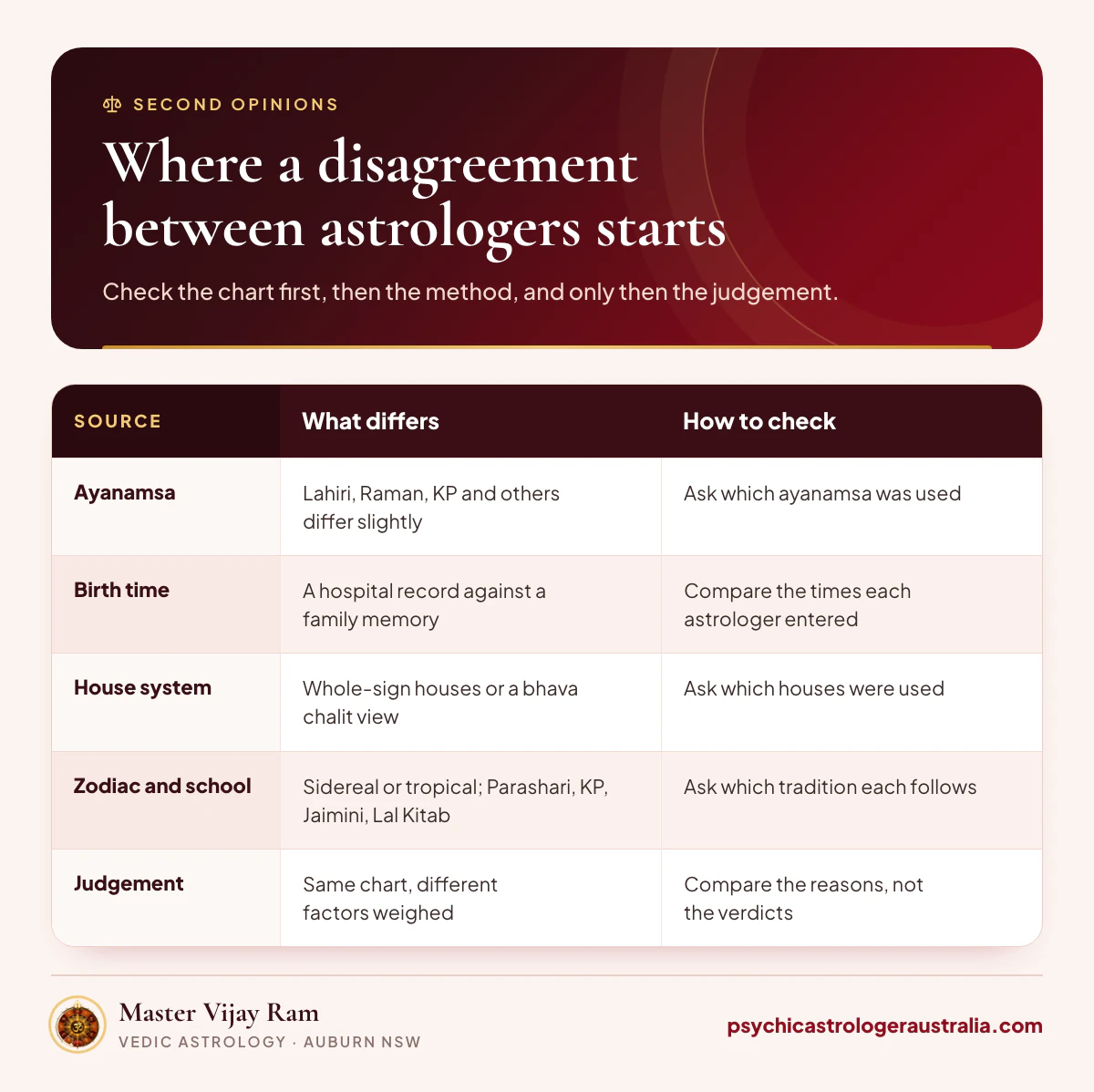
Most conflicting kundli readings that families bring turn out to be the second kind. The table lists the usual technical causes.
| Cause | What differs | How to check |
|---|---|---|
| Ayanamsa | The correction from tropical to sidereal; Lahiri, Raman, KP and others differ slightly | Ask which ayanamsa was used |
| Birth time | A family memory versus a hospital record; a time rounded to the hour | Compare the times each astrologer entered |
| Birthplace and daylight saving | Coordinates and whether daylight saving was applied correctly for that year and state | Check the place and time zone on the printout |
| House system | Whole-sign houses or a bhava chalit, cusp-based view | Ask which houses were used |
| Zodiac | Sidereal (Vedic) or tropical (Western) signs | Look at the Sun sign: a Western chart often shows the next sign |
| Node | Mean or true Rahu and Ketu | Usually minor; ask if a node sits near a sign edge |
How much does the ayanamsa matter?
The ayanamsa is the correction that turns tropical positions into sidereal ones. The Lahiri ayanamsa, used across most of India and on this site, stood at 24°14′ on 1 January 2027. Other ayanamsas differ from it only slightly, but a planet sitting near the edge of a sign, or a Moon near the edge of a nakshatra, can cross over, and the dasha balance at birth shifts with the Moon.
That can move every dasha date by months. It is the commonest reason two Vedic astrologers name different periods for the same event, and it is a setting, not a matter of skill.
What about a different birth time?
The lagna moves through a whole sign in about two hours, so a time that one astrologer took from a hospital record and another from a grandmother's memory can produce two different ascendants. Every house, and so every house lord, changes with it. Divisional charts such as the navamsa are more sensitive still.
If your birth time is uncertain, the honest course is to say so to both astrologers. Birth time rectification explains how a doubtful time can be tested against events in your life.
Can the house system make a difference?
Yes. Most Vedic astrologers read whole-sign houses, where each sign is one house counted from the lagna.
Some also use the bhava chalit, a cusp-based view in which a planet near the edge of a sign can shift into the neighbouring house. One astrologer may say Saturn is in your seventh house and another in your eighth, and both are describing the same Saturn. The bhava chalit chart shows why.
What if one astrologer is Western and the other Vedic?
Then they are using different zodiacs, and almost every planet will be in a different sign in the two charts.
The tropical zodiac is tied to the seasons; the sidereal zodiac to the stars. Neither is a corrupted version of the other, but their answers cannot be compared line by line. Vedic and Western astrology compared explains the difference in plain terms.
What about different methods within Vedic astrology?
Vedic astrology has several schools. Parashari astrology, the main tradition, reads houses, lords, yogas and the Vimshottari dasha.
KP (Krishnamurti Paddhati) uses sub-lords and its own ayanamsa and is often used for precise timing. Jaimini uses sign-based dashas and karakas. Lal Kitab offers a distinct set of readings and household remedies.
Nadi traditions work from their own texts, and Western astrologers, as above, from another zodiac altogether.
Two astrologers from different schools can both be competent and still reach different emphases. It is worth knowing which school each belongs to before deciding that one of them is mistaken.
And when the chart and method match?
Then the disagreement is about judgement, and that is where astrology is a craft rather than a calculation. One astrologer may weight a strong Jupiter aspect more heavily; another may give more weight to a difficult dasha lord. One may read a delay in marriage as a matter of timing; another may see a dosha that cancels on closer reading.
Here, the reasons matter more than the verdicts. An astrologer who can say "I read it this way because the seventh lord is in the eighth but aspected by Jupiter, and the navamsa supports it" is giving you something to weigh. One who says "trust me" is not.
How do you get an honest second opinion?
Bring the same birth details to both, and say plainly that you want a second opinion. Share the first astrologer's chart or printout if you have it, so the second can check whether the charts match, but you do not have to share the first conclusion if you would rather hear an independent reading.
- Ask each for the lagna, Moon nakshatra and current dasha, and compare them.
- Ask what the reading is based on, not just what it predicts.
- Ask what would change the reading: a different birth time, a different ayanamsa.
- Write both readings down the same day.
A consultation with Master Vijay Ram is $50, and a full kundli reading starts by confirming the chart itself.
What does a disagreement look like in practice?
An illustration, not a real family: a couple in Wollongong are told by one astrologer that their son's marriage window opens next year, and by another that it is three years away. Laid side by side, the printouts show different Moon nakshatras. The first used a birth time from the hospital card; the second used "about seven in the morning" from memory.
Nothing about either astrologer's judgement is in question yet. Once both use the hospital time, the two readings name much closer windows, and the remaining difference is a matter of emphasis the family can weigh.
Why is shopping for the answer you want a trap?
Because a fifth astrologer who finally says what you hoped is not more accurate than the first four; he is simply the fifth. People do this most around marriage matching and around a frightening prediction, ringing round until someone says the match is fine or the danger is not real.
The difficulty is that it trains you to stop listening. If three astrologers using the same chart all see a difficult period, that is information. If they disagree because of technical settings, that is a different kind of information, and neither is improved by a sixth call.
What if one reading is frightening and the other is not?
Be wary of any reading that announces a curse, an untimely death or a disaster and then offers an expensive way out. That is a known sales pattern, not a reading, and the patterns behind astrology scams describes it. A genuine reading of difficulty names the period, explains the reason and talks about conduct and support, with no pressure to pay that day.
Where a remedy is suggested here, it starts from $250 and the amount is agreed before anything is performed. You are free to take a few days and to ask someone else.
What do you do once you have both readings?
Lay them side by side and mark where they agree, because agreement between two careful readings of the same chart is worth more than either alone. Where they differ, note the reason each gave, and watch the period they disagree about; a year's experience usually shows which reading fitted. What to do with the advice afterwards sets out a simple way to keep notes for that review.
Clients in the ACT can see how readings for Canberra clients are arranged, and the same comparison works from anywhere.
What can no second opinion settle?
No number of astrologers can turn a tendency into a certainty. Astrology is faith-based guidance, and its claims are not settled by experiment the way scientific claims are. Where two readings disagree about something that matters medically, legally or financially, the decision belongs with a doctor, lawyer or accountant, and the readings belong beside that advice, never above it.
Read next
- Savings and Wealth: The Second and Eleventh HousesWealth astrology without promises: how the second house of savings and the eleventh of income are read together, dhan…
- A Psychic Said You Are Cursed: What to Do NextA psychic said you are cursed and offered to remove it? Why that is a red flag under consumer law, what to do next, a…
- Black Magic vs Bad Luck: How to Tell the DifferenceBlack magic or a plain bad run? Use the three-S test of spread, start line and stall, and rule out the ordinary medic…
Frequently asked questions
Why do different astrologers give different predictions?
Usually because they used different charts or methods. The ayanamsa, birth time, birthplace, daylight-saving correction and house system all affect the chart, and schools such as Parashari, KP and Lal Kitab read it differently. When the chart and method match, differences come from judgement about which factors weigh most. Occasionally one astrologer is simply wrong.
How can I tell if two astrologers used the same chart?
Ask each for three things: the lagna sign, the Moon's sign and nakshatra, and the mahadasha you are running now. If all three match, they are reading the same chart and differ in interpretation. If any differs, the disagreement began with the calculation, usually the ayanamsa, birth time or a daylight-saving error.
Which ayanamsa is correct?
There is no universally agreed answer. The Lahiri ayanamsa is the most widely used in India and is the one used on this site; others such as Raman and KP differ slightly. What matters is that the astrologer tells you which one was used, so that charts can be compared fairly.
Is it wrong to get a second astrology opinion?
Not at all. A second opinion is sensible for important decisions, especially marriage matching or a worrying prediction. Bring the same birth details, ask for the reasons behind each reading, and compare them calmly. What helps least is ringing round until someone gives the answer you hoped for, because that adds no accuracy.
Can a Western and a Vedic astrologer both be right?
They are using different zodiacs, tropical and sidereal, so planets fall in different signs and the two readings cannot be compared line by line. Each works within its own system. If you want to compare readings, compare two Vedic readings or two Western ones, and ask which ayanamsa or house system each used.
What if one astrologer says I am cursed and another says I am not?
Be cautious with any reading that announces a curse or disaster and then asks for a large payment to remove it. That is a known pressure pattern. A genuine reading names a difficult period, explains why, and talks about conduct and support. Take your time, and remember that consumer protection agencies take complaints about misleading practices.
Does a different birth time really change the reading?
It can change it a great deal. The lagna moves through a sign in about two hours, so a time out by an hour may give a different ascendant and therefore different house lords. The Moon's position and dasha dates can shift too. If your birth time is uncertain, tell every astrologer you consult.
How much does a second opinion cost?
A consultation with Master Vijay Ram is $50, whether it is a first reading or a second opinion on another astrologer's work. If a puja or jaap is suggested, it starts from $250 and the figure is agreed before anything is performed. You are welcome to bring another astrologer's chart for comparison.
People also ask
Why are astrology predictions different?
Predictions differ because astrologers use different ayanamsas, birth times, house systems, zodiacs and schools of interpretation, and because judgement varies in how factors are weighed. Checking whether two readings used the same lagna, Moon nakshatra and dasha shows whether the difference is technical or interpretive.
Which is more accurate, KP or Parashari astrology?
They are different methods rather than better and worse versions of one method. Parashari reads houses, lords, yogas and the Vimshottari dasha; KP adds sub-lords and its own ayanamsa and is often used for precise timing. Skilled practitioners of either can give useful readings, and they may emphasise different things.
Should I trust the astrologer who agrees with me?
Agreement with what you hoped is not a sign of accuracy. Trust the reading whose chart is correct and whose reasons you can follow, and keep notes to see which fits over time. Readings that agree with each other on the same chart are worth more than one that agrees with your wishes.
How do I compare two kundli readings?
First check that both used the same chart: same lagna, Moon nakshatra and current dasha. Then list what each predicted and the reason given. Mark where they agree, note where they differ and why, and review both after the period in question to see which description fitted your experience.
References & further reading
Serving clients across Australia
Confidential consultations by phone, video & WhatsApp — including: