
Quick answer
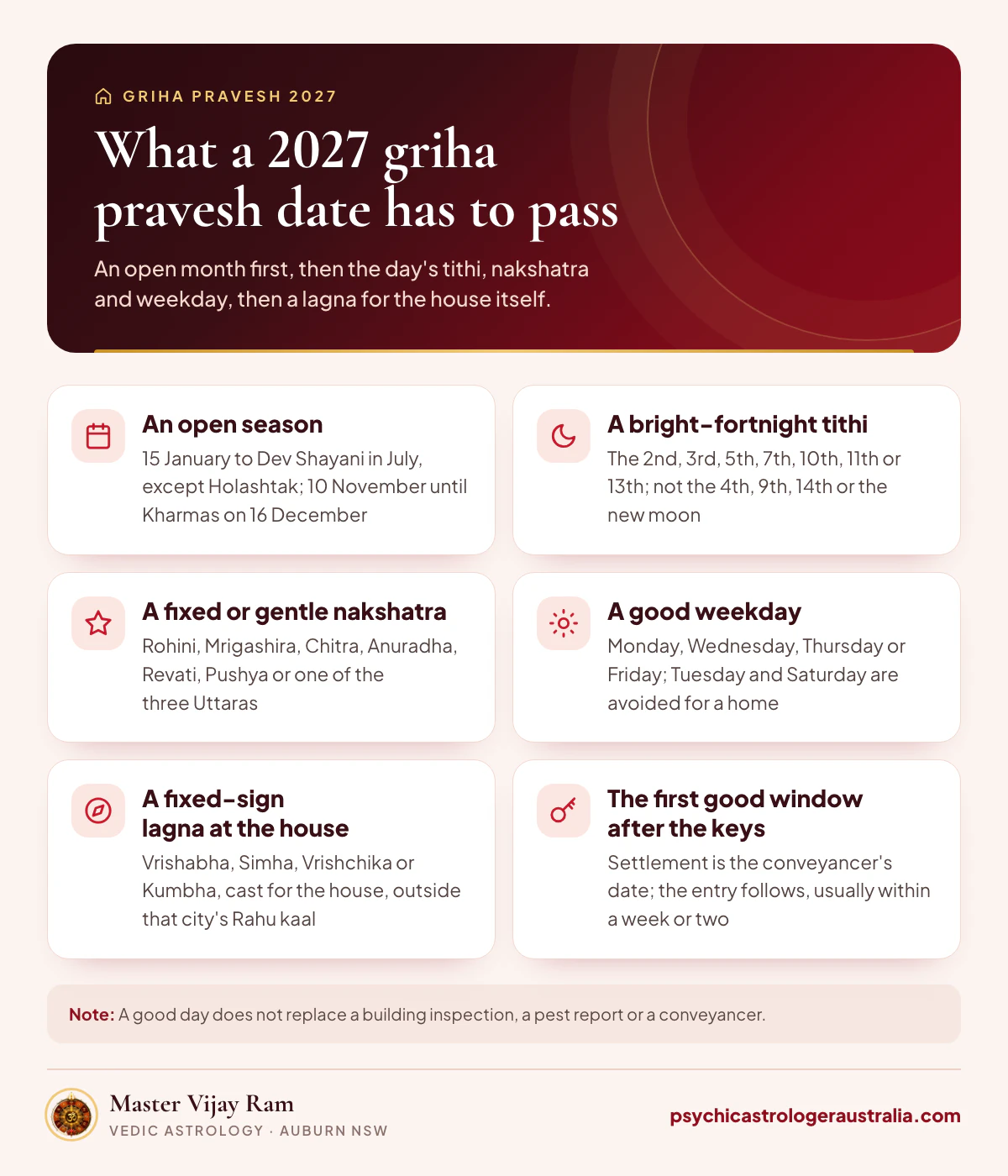
A griha pravesh muhurat is the window for the first entry into a home. In 2027 the open season runs from 15 January to the start of Chaturmas in July, and reopens after Dev Uthani Ekadashi on 10 November until Kharmas begins on 16 December. A bright-fortnight tithi, a fixed nakshatra, a good weekday and a fixed-sign lagna then fix the hour.
Griha pravesh muhurat 2027 at a glance
A griha pravesh muhurat is the window of time chosen for a family's first entry into a home: the moment the kalash is carried over the threshold, the first lamp is lit and the first milk is boiled. It is one of the three muhurats most Australian families ever ask for, with the wedding and the business opening, and it is the one most often squeezed by a settlement date nobody can move.
This guide sets out how a griha pravesh muhurat in 2027 is chosen: the months that are open, the tithis, nakshatras and weekdays that are used, the self-evident days that need no checking, and how the whole thing is fitted around keys, removalists and a Thursday settlement. The method is the one behind the griha pravesh and home blessing Master Vijay Ram performs, and a muhurat consultation is where it is applied to your own house and chart.
Which kind of griha pravesh is yours?
The tradition recognises three entries, and the strictness of the muhurat follows the kind.
| Kind | When it applies | How strict the muhurat is |
|---|---|---|
| Apoorva (first entry) | A newly built house or apartment nobody has lived in | The full method: month, tithi, nakshatra, weekday, lagna and the family's charts |
| Sapoorva (re-entry) | An established home bought from a previous owner, or a return after a long absence | The same checks, with more weight on cleansing the house first and less on the month |
| Dwandwa (entry after disruption) | After a renovation, a fire, a flood or a death in the house | A shorter list of nakshatras and a vastu shanti before the entry |
Rentals and share houses are a modern fourth case. The old texts did not imagine a tenant, and the sensible practice is a light sapoorva: a good day, a lamp, boiled milk and a short prayer, without holding the move hostage to the calendar.
Which months are open for a house entry in 2027?
The classical griha pravesh months are Magha, Phalguna, Vaishakha and Jyeshtha, with Ashadha allowed until Dev Shayani Ekadashi and Kartika and Margashirsha used after Dev Uthani. In Australian dates for 2027 that gives two seasons. The first opens when the Sun enters Makara on 15 January and ends the Kharmas pause, and runs through late January, February, March, April, May and June, skipping Holashtak, the eight days before Holi on Tuesday 23 March, and the Mesha Sankranti day itself on 14 April. It closes with Dev Shayani Ekadashi in July, when Chaturmas begins.
The second season opens with Dev Uthani Ekadashi on Wednesday 10 November 2027 and runs until the Sun enters Dhanu on 16 December 2027, when Kharmas returns. The festival calendar below gives the anchors for every city.
| Festival | Sydney / Melbourne | Brisbane | Adelaide | Perth | Darwin | India |
|---|---|---|---|---|---|---|
| Vasant Panchami | Fri 12 Feb | Fri 12 Feb | Fri 12 Feb | Thu 11 Feb | Fri 12 Feb | Thu 11 Feb |
| Maha Shivratri | Sat 6 Mar | Sat 6 Mar | Sat 6 Mar | Sat 6 Mar | Sat 6 Mar | Sat 6 Mar |
| Holika Dahan | Mon 22 Mar | Mon 22 Mar | Mon 22 Mar | Mon 22 Mar | Mon 22 Mar | Sun 21 Mar |
| Holi (Rangwali) | Tue 23 Mar | Tue 23 Mar | Tue 23 Mar | Tue 23 Mar | Tue 23 Mar | Mon 22 Mar |
| Chaitra Navratri / Ugadi / Gudi Padwa | Thu 8 Apr | Thu 8 Apr | Thu 8 Apr | Thu 8 Apr | Thu 8 Apr | Wed 7 Apr |
| Ram Navami | Thu 15 Apr | Thu 15 Apr | Thu 15 Apr | Thu 15 Apr | Thu 15 Apr | Thu 15 Apr |
| Hanuman Jayanti | Wed 21 Apr | Wed 21 Apr | Wed 21 Apr | Tue 20 Apr | Wed 21 Apr | Tue 20 Apr |
| Akshaya Tritiya | Sun 9 May | Sun 9 May | Sun 9 May | Sun 9 May | Sun 9 May | Sun 9 May |
| Nag Panchami | Fri 6 Aug | Fri 6 Aug | Fri 6 Aug | Fri 6 Aug | Fri 6 Aug | Fri 6 Aug |
| Raksha Bandhan | Tue 17 Aug | Tue 17 Aug | Tue 17 Aug | Tue 17 Aug | Tue 17 Aug | Tue 17 Aug |
| Krishna Janmashtami | Wed 25 Aug | Wed 25 Aug | Wed 25 Aug | Tue 24 Aug | Wed 25 Aug | Tue 24 Aug |
| Hartalika Teej | Fri 3 Sep | Fri 3 Sep | Fri 3 Sep | Fri 3 Sep | Fri 3 Sep | Fri 3 Sep |
| Ganesh Chaturthi | Sat 4 Sep | Sat 4 Sep | Sat 4 Sep | Sat 4 Sep | Sat 4 Sep | Sat 4 Sep |
| Sharad Navratri begins (Ghatasthapana) | Fri 1 Oct | Fri 1 Oct | Fri 1 Oct | Fri 1 Oct | Fri 1 Oct | Thu 30 Sep |
| Durga Ashtami | Fri 8 Oct | Fri 8 Oct | Fri 8 Oct | Fri 8 Oct | Fri 8 Oct | Thu 7 Oct |
| Dussehra (Vijayadashami) | Sat 9 Oct | Sat 9 Oct | Sat 9 Oct | Sat 9 Oct | Sat 9 Oct | Sat 9 Oct |
| Dhanteras | Wed 27 Oct | Wed 27 Oct | Wed 27 Oct | Wed 27 Oct | Wed 27 Oct | Wed 27 Oct |
| Diwali (Lakshmi Puja) | Fri 29 Oct | Fri 29 Oct | Fri 29 Oct | Fri 29 Oct | Fri 29 Oct | Fri 29 Oct |
| Govardhan Puja | Sat 30 Oct | Sat 30 Oct | Sat 30 Oct | Sat 30 Oct | Sat 30 Oct | Sat 30 Oct |
| Bhai Dooj | Sun 31 Oct | Sun 31 Oct | Sun 31 Oct | Sun 31 Oct | Sun 31 Oct | Sun 31 Oct |
| Dev Uthani Ekadashi | Wed 10 Nov | Wed 10 Nov | Wed 10 Nov | Wed 10 Nov | Wed 10 Nov | Wed 10 Nov |
Each festival follows the rule its tradition uses — the tithi present at sunrise, midday, afternoon, midnight or after sunset — applied on the city's own clock; where the tithi meets none of those moments locally, the day it covers most of the daylight is shown. Makar Sankranti is a solar date (see the Vedic sun-sign table). Computed with the Swiss Ephemeris (Lahiri ayanamsa for Vedic positions) and checked against US Naval Observatory data. Times are rounded to the minute.
Two cautions. The Pitru Paksha fortnight before Sharad Navratri, which begins on Friday 1 October 2027 here, is kept for the ancestors and not for entries; and the Diwali week, though it falls inside Chaturmas, is widely used for a first entry because the tradition treats Dhanteras and Lakshmi Puja as self-evident days for a home. Stricter families wait for Dev Uthani, eleven days later.
Which tithis, nakshatras and weekdays are used?
Within an open month the day is chosen from the panchang's limbs, and the general method applies with a house-specific list.
- Tithi: the 2nd, 3rd, 5th, 7th, 10th, 11th and 13th of the bright fortnight are preferred, and the same tithis of the dark fortnight up to about its tenth day are accepted. The 4th, 9th and 14th, the new moon and most of the 8th and 12th are passed over.
- Nakshatra: the fixed and gentle stars suit a dwelling: Rohini, Mrigashira, Chitra, Anuradha, Revati, Pushya, and the three Uttaras, Uttara Phalguni, Uttara Ashadha and Uttara Bhadrapada. Shatabhisha and Swati are allowed by some lineages; Bharani, Krittika, Ardra, Ashlesha, Magha, Jyeshtha and Mula are not.
- Weekday: Monday, Wednesday, Thursday and Friday. Tuesday, ruled by Mars, is avoided for a home because of its association with fire and dispute; Saturday for its heaviness; Sunday is accepted by some and avoided by others.
A day that passes all three is already uncommon, which is why a month usually yields three or four candidates rather than a dozen.
Why is a fixed-sign lagna chosen for a home?
The hour is fixed by the sign rising in the east at the venue, and for a dwelling the fixed signs are preferred: Vrishabha, Simha, Vrishchika and Kumbha, because a house is meant to stay. Within that window the eighth house from the lagna should be empty, benefics should sit in the kendras where possible, and the Rahu kaal of that day in that city is avoided outright. The Abhijit period around local solar noon is a reliable fallback when the fixed-sign window is awkward.
The lagna is reckoned from the longitude and latitude of the house, not of the astrologer. A window computed for Delhi is worthless on the Gold Coast, and a Melbourne window is two hours adrift in Perth before daylight saving is even considered.
Which days in 2027 need no checking?
The tradition keeps a handful of abujha days on which a house entry is held auspicious without the tithi and nakshatra tests. In Australian dates for 2027 they are Vasant Panchami on Friday 12 February (Thursday 11 February in Perth and India), Akshaya Tritiya on Sunday 9 May, Vijayadashami on Saturday 9 October, Dhanteras on Wednesday 27 October, Lakshmi Puja on Friday 29 October and Dev Uthani Ekadashi on Wednesday 10 November.
Akshaya Tritiya is the most sought-after, and on a Sunday it suits families who need the weekend. Even on these days the Rahu kaal is avoided and a lagna is chosen; "self-evident" describes the day, not every hour of it.
How do settlement day, the keys and the puja fit together?
In Australia the conveyancer sets settlement, the agent hands over keys in the afternoon, and the removalist is booked by the hour. None of that is a muhurat, and it does not have to be. The entry the muhurat governs is the ceremonial one: the family crossing the threshold with the kalash, right foot first, before the house is lived in.
The workable pattern most families use is to take the keys on settlement day, keep the house empty or nearly so, and hold the griha pravesh on the first good window after it, which is usually within a week or two. Where the window falls before settlement it is simply not available, and the next one is taken. If furniture must go in first, the tradition allows it; the bed is left unmade and the kitchen fire unlit until the entry, which is the old way of saying the house has not yet been started.
What happens at the griha pravesh puja?
The puja itself is older than any of the dating. A Ganesh puja opens it, a vastu puja asks the guardians of the plot and the directions for their blessing, the navagraha are pacified, the kalash is set up and the havan is performed; then milk is boiled until it rises over the pot, the first lamp is lit and the first sweet is made in the new kitchen. The step-by-step guide to the puja walks through it for a family doing most of it themselves.
Master Vijay Ram performs the vastu shanti and havan personally at his own place of practice in Auburn on the chosen muhurat, with the family joining by video and carrying out the threshold entry at the house as he guides them. A puja performed this way starts from $250 and the figure is agreed before anything is performed; the consultation that fixes the date is $50.
What about Mercury retrograde and the contract?
The entry is a Moon and lagna matter; the contract is a Mercury matter. Where a family can choose the day they sign or settle, Vijay Ram ji prefers it outside the 2027 retrogrades, which run from 10 February to 3 March, 11 June to 5 July and 8 to 29 October in Sydney time, and outside the fortnight after each station. Where the settlement date is fixed, the signing goes ahead with the documents read twice, and the griha pravesh is given its own good day afterwards.
This is a modern refinement rather than a classical rule, and the retrograde dates for every time zone are set out separately so you can check your own settlement against them.
Is a muhurat needed for a rental, a unit or a student share house?
A light one. Students arriving in Melbourne or Brisbane for a February semester, and families moving between rentals every couple of years, cannot plan a move around Vaishakha. The sensible practice is a good weekday outside the Rahu kaal, a lamp, a pot of milk boiled over and a short prayer at the door, done on the first day the place is yours. The full method is for a home a family expects to keep.
What a rental does deserve is a cleansing, especially where the previous tenancy ended badly; why a new home can feel wrong explains what to do before blaming the house.
What a griha pravesh muhurat cannot do
A good day does not replace a building inspection, a pest report or a conveyancer, and it does not promise that the family will be happy there. Vedic astrology is faith-based guidance, not legal, financial or medical advice. A house with a genuine vastu defect needs a vastu consultation rather than a better hour, and a house that worries the family for other reasons deserves an honest look at those reasons first; a vastu consultation covers the first, and the guide to protecting a new house covers the fears that sometimes attach to a second-hand home.
Most families find the muhurat does something simpler and more valuable: it gives the move a beginning everyone remembers, with the elders present on the call from India and the children carrying the lamp.
How does Master Vijay Ram choose your griha pravesh date?
Master Vijay Ram has chosen house-entry dates for Australian families for more than forty years, by phone, video and WhatsApp, in English, Hindi and Punjabi. He asks for the settlement or handover date, the address of the house, the birth details of the owners, and the days the family can gather; he returns two or three windows in the clock of that city, with the reasoning for each, and says plainly if the month should be avoided. Clients in Brisbane and on the Gold Coast get Queensland time, with no daylight-saving conversion to trip over.
His only place of practice is Auburn, by appointment. Everything else, the date, the puja and the guidance on the day, is done remotely, which is how most house warming muhurats for families from Newcastle to the Sunshine Coast are now arranged.
Read next
- Moving Into a Rental: A Simple Muhurat and BlessingMoving into a rental: how to pick the best day inside the dates your lease allows, and a short blessing with no nails…
- Vivah Muhurat 2027: Wedding Season for Australian FamiliesVivah muhurat 2027 for Australian families: the two wedding seasons, the closed periods, nakshatras and tithis, the p…
- Signs of Jinn Disturbance at Home and How Ruqyah HelpsJinn disturbance at home: which signs matter, which have ordinary causes, what ruqyah really is, and how a settled ho…
Frequently asked questions
Which months are good for griha pravesh in 2027?
In Australian dates: from 15 January, when the Sun enters Makara and Kharmas ends, through June, with the eight days before Holi on 23 March and the sankranti days themselves skipped; then from Dev Uthani Ekadashi on Wednesday 10 November until 16 December, when the Sun enters Dhanu. Chaturmas, from Dev Shayani Ekadashi in July to Dev Uthani, and the Pitru Paksha fortnight before Navratri on 1 October are closed, though the Diwali week is widely used as an exception.
Is Akshaya Tritiya a good day for griha pravesh?
It is the best-known abujha day for a house entry, held auspicious without the usual tithi and nakshatra checks. In 2027 it falls on Sunday 9 May in every Australian city and in India, which suits families who need a weekend. The Rahu kaal of the day, which on a Sunday is the last eighth of the daylight, is still avoided and a lagna is still chosen for the hour.
Can griha pravesh be done on Diwali or Dhanteras?
Many families do, and the tradition supports it: Dhanteras, Wednesday 27 October 2027, and Lakshmi Puja, Friday 29 October, are treated as self-evident days for a home even though they fall inside Chaturmas. Stricter lineages wait for Dev Uthani Ekadashi on Wednesday 10 November, when Chaturmas ends. Either way the entry is made in daylight outside the Rahu kaal, with the Lakshmi Puja in the evening.
What if settlement falls in Chaturmas or Kharmas?
Take the keys and settle as planned; the conveyancer's date is not the muhurat. Keep the house unlived-in where you can, or move the furniture and leave the bed unmade and the kitchen fire unlit, and hold the ceremonial entry on the first good window after the closed period. Where a family cannot wait, a sapoorva-style entry with a cleansing and a lamp is done on the best available day and the full puja follows later.
Which nakshatras are good for house entry?
Rohini, Mrigashira, Chitra, Anuradha, Revati, Pushya and the three Uttaras: Uttara Phalguni, Uttara Ashadha and Uttara Bhadrapada. Some lineages add Shatabhisha and Swati. Bharani, Krittika, Ardra, Ashlesha, Magha, Jyeshtha and Mula are avoided for a dwelling. The nakshatra is read at the venue's own sunrise, so a star that rules the day in Delhi can have given way to the next one by the time Melbourne wakes.
Why is Tuesday avoided for griha pravesh?
Tuesday belongs to Mars, whose nature is heat, haste and contention, none of which a family wants built into a home's beginning. Saturday is avoided for Saturn's heaviness and delay. Monday, Wednesday, Thursday and Friday are the working days for a house entry, and Thursday, Jupiter's day, is the most sought after when its tithi and nakshatra cooperate.
Does the muhurat differ between Brisbane and Melbourne?
Yes, often by an hour or more and sometimes by a day. The tithi and nakshatra are read at local sunrise, the Rahu kaal is an eighth of local daylight, and the lagna depends on the house's longitude. Brisbane also keeps standard time while Melbourne is on daylight saving until 4 April and again from 3 October 2027, so a window must be cast for the city of the house in that city's clock.
Do I need a griha pravesh muhurat for a rental?
A light one is enough. The classical method is for a home a family means to keep; for a rental or a student share house the sensible practice is a good weekday outside the Rahu kaal, a lamp at the door, milk boiled over and a short prayer on the first day the place is yours. A cleansing is worth more than a perfect hour where the previous tenancy ended badly.
What does a griha pravesh muhurat consultation cost?
The consultation is $50 and includes the date windows, the reasoning and the guidance for the day. If the family wants the vastu shanti and havan performed, Master Vijay Ram does that personally at his place of practice in Auburn on the chosen muhurat, with the family joining by video; that starts from $250 and the figure is agreed before anything is performed. Nothing is performed that the consultation has not first found warranted.
People also ask
What is the best month for griha pravesh?
The classical months are Magha, Phalguna, Vaishakha and Jyeshtha, roughly late January to June in Australian dates, with Ashadha allowed until Dev Shayani Ekadashi in July. Kartika and Margashirsha, after Dev Uthani Ekadashi in November until mid-December, form a short second season. Within those months Vaishakha, which holds Akshaya Tritiya, is the most sought after.
What time of day should griha pravesh be done?
In daylight, during a window with a fixed sign rising, Vrishabha, Simha, Vrishchika or Kumbha, outside that day's Rahu kaal for that city. The Abhijit period, about 24 minutes either side of local solar noon, is the usual fallback when the fixed-sign window is inconvenient. An evening entry is accepted on Dhanteras and Diwali, when the Lakshmi Puja follows.
Can we move furniture in before the griha pravesh?
Yes. The tradition treats the ceremonial entry, with the kalash, the lamp and the boiled milk, as the start of life in the house, so furniture can go in beforehand provided the family does not sleep there and the kitchen fire is not lit until the entry. In practice many families settle, move, and hold the pravesh on the first good window within a week or two.
Is griha pravesh done differently for a resale house?
The entry into an established home is a sapoorva pravesh, with the same tithi, nakshatra and lagna checks but more emphasis on cleansing the house first: a vastu shanti, salt water across the floors, camphor and loban through the rooms, and the previous occupants' traces removed. The month rules are applied a little more loosely, which suits the Australian market, where most families buy established homes.
What should be done first when entering a new house?
Enter in the chosen window with the right foot first, carrying the kalash of water with mango leaves and a coconut, followed by the lamp. Light the lamp in the kitchen or the puja corner, boil milk in a new pot until it rises over the brim, and make the first sweet. The Ganesh and vastu puja and the havan frame all of this, and the elders' blessing closes it.
References & further reading
Serving clients across Australia
Confidential consultations by phone, video & WhatsApp — including: