
Quick answer
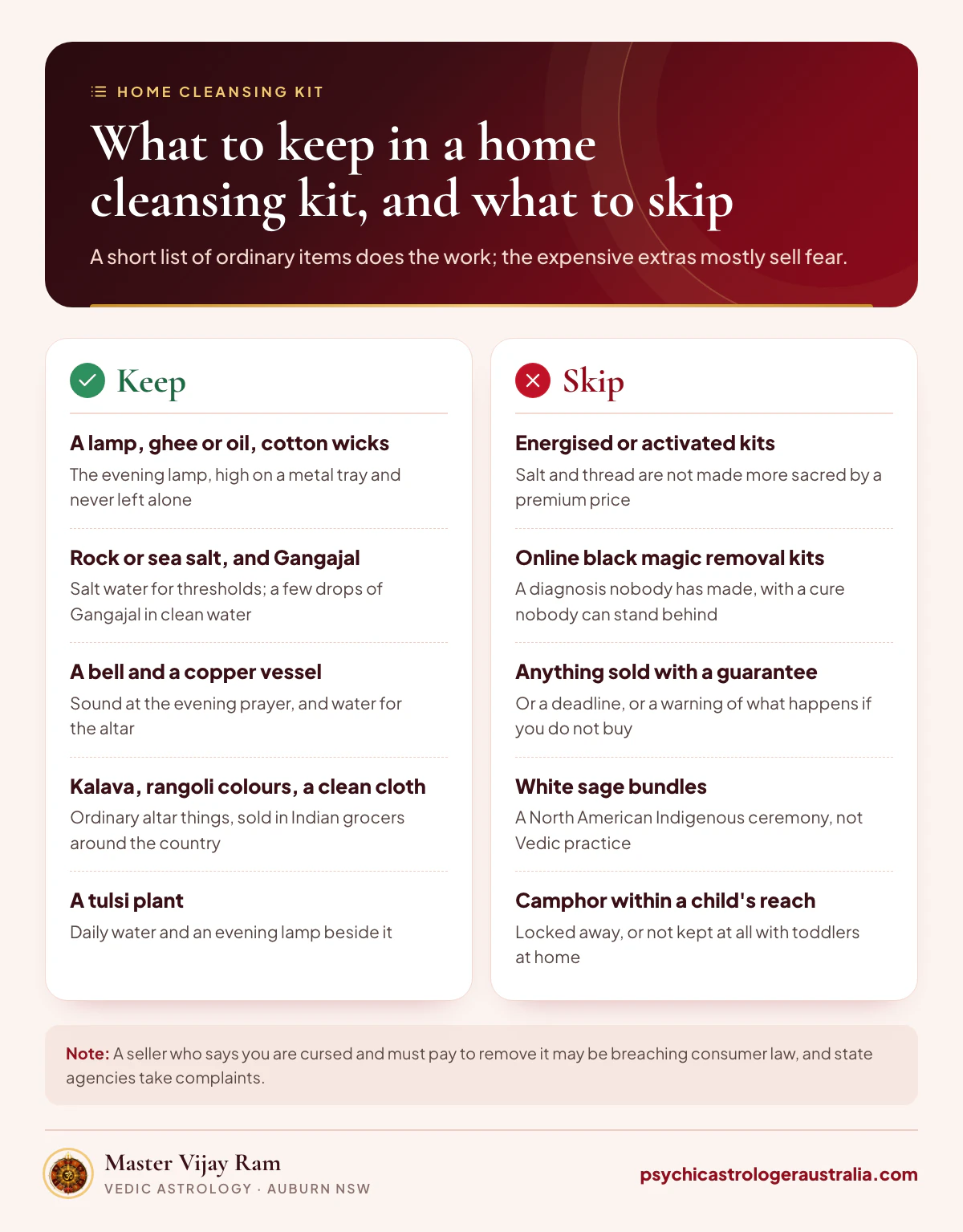
A home cleansing kit needs only a lamp with ghee or oil and wicks, camphor kept locked away, rock or sea salt, Gangajal, kalava, a bell, a copper vessel, rangoli colours, a tulsi plant, a clean cloth, and incense only where smoke is fine. Skip pricey “energised” kits, online black magic removal kits, anything sold with a guarantee and white sage.
What is a home cleansing kit, really?
A home cleansing kit is a small set of household puja items that supports a family’s own practice of keeping the home clean, lit and prayed in: a lamp, water, salt, a bell and a few things for the altar. It is not a remedy in a box, and nothing in it has to be bought as a set, blessed by a stranger or paid for at a premium. Most Indian kitchens already hold half of it.
Families ask about kits for two reasons. Some are setting up a first home in Australia and want to do things properly; others have been shown a glossy “protection kit” online and want to know whether they need it. The answer to the first is a short list, and the answer to the second is usually no.
Where a home still feels wrong after the ordinary fixes and the household customs, negative energy removal explains what Master Vijay Ram looks at, and it does not start with anything you buy.
What belongs in a basic kit?
The table is the whole list. Every item on it is ordinary, inexpensive by any sensible standard, and sold in Indian grocers around the country.
| Item | What it is for | How to keep it |
|---|---|---|
| A brass or clay diya, ghee or sesame oil, cotton wicks | The evening lamp at the altar or the threshold | On a metal tray, high, never left burning alone |
| Camphor tablets | Closing the aarti | Locked away from children; not kept at all with toddlers in the house |
| Rock salt or sea salt | Salt water for thresholds and floors; a small dish in a heavy room | Dry, in a lidded jar, out of reach of dogs |
| Gangajal | A few drops in a vessel of clean water for sprinkling | Capped, on the altar shelf |
| Kalava (mauli) thread | Tying on the wrist at a puja, or around the kalash | Rolled, with the puja things |
| A small bell | Sound at the evening prayer | On the altar |
| A copper vessel or kalash | Holding water for the altar and the sprinkling | Emptied daily, dried, polished now and then |
| Incense or dhoop | Fragrance at the altar, where smoke is fine | Sealed against damp; skipped near babies, birds and asthma |
| Rangoli colours | The threshold at festivals and on good days | Sealed tubs, away from small hands |
| A tulsi plant | Daily water and an evening lamp beside it | A sunny spot, brought inside in a cold winter |
| A clean cotton cloth | Wiping the altar and covering it | Washed weekly and kept for that use only |
Add a box of matches kept away from children and a broom that is used for the house, and the kit is complete. Nothing on the list needs to come from a particular shop, a particular holy place or a particular person.
Why is the list so short?
Because the tradition does most of its cleansing with things that cannot be packaged: a swept threshold, open windows in the morning, light at dusk, sound at the evening prayer and a family that keeps its word to each other. The items above only give those habits a shape. A household that keeps the habits with a single lamp is better protected, in the tradition’s own terms, than one that owns every product on the market and lights none of them.
That is also why the list does not grow with fear. A family going through a hard year does not need twice as many puja items for cleansing; it needs the same few used steadily, and sometimes a conversation about the year itself.
Where do Australians buy them?
Indian grocers carry nearly all the Hindu home cleansing items on the list, whether on Harris Park’s Wigram Street, Dandenong’s Foster Street, Brisbane’s southside or in Perth’s south-east. Temple counters sell lamps, wicks, kalava and incense, and festival stalls around Diwali and Navratri sell rangoli colours and diyas by the box. Many garden centres sell tulsi in spring and summer, often labelled holy basil.
No particular shop is better than another for any of this, and none is named here. Buy what looks clean and well sealed, and ask the grocer where the incense and camphor came from if it matters to you; a reputable shop will simply say.
What about bringing items from India?
Many families carry a bottle of Gangajal, kalava, rudraksha or havan samagri back in their luggage, and that is where Australian biosecurity comes in. Seeds, plant material, dairy and animal products are what the officers look at, and the rule for anything uncertain is to declare it and let them decide. Bringing puja items from India takes each thing in the puja bag in turn.
For most of the kit there is no reason to carry it at all. Lamps, wicks, salt, kalava, bells and copper vessels are sold here, and buying locally avoids both the airport queue and the chance of losing an item at the counter.
What should you skip?
Four things, plainly. First, “energised” or “activated” kits sold at a premium: salt, thread and a lamp do not become more sacred because someone online says they have been charged, and the tradition blesses items by using them in worship at your own altar. Second, online black magic removal kits, which sell a diagnosis you have never been given with a cure nobody can stand behind.
Third, anything sold with a guarantee, a deadline or a warning of what will happen if you do not buy it. Fourth, white sage bundles, which belong to a ceremony of the Indigenous nations of North America rather than to Vedic practice; camphor, loban and dhoop as the Hindu alternatives explains why the family’s own smokes are the better choice.
How do you tell a kit that is selling fear?
Look at what it asks you to believe before it asks for money. A listing that tells you that you are cursed, under attack or in danger before anyone has heard your story is selling the fear first and the kit second. So is one that promises results by a date, offers a “stronger” version for more, or warns you not to tell your family.
A practitioner who says “you are cursed, pay to remove it” may be engaging in misleading or unconscionable conduct under Australian consumer law, and NSW Fair Trading, Consumer Affairs Victoria, Queensland’s Office of Fair Trading and WA Consumer Protection take complaints. Keep the listing, the messages and the receipt if you decide to complain.
Do threads, yantras and kavach belong in a kit?
Kalava for a puja does, because it is simply part of worship. A kavach or a yantra does not, because in the tradition it is prepared for one person for one reason, not bought off a shelf with the incense. Master Vijay Ram sells no gemstones, beads, threads or kits, and a kavach is prepared only where a consultation finds it will help, as taweez and kavach protection explains.
Anyone who already owns an amulet bought online and is unsure about it will find the questions to ask in taweez and kavach, real ones and fakes. Owning one is nothing to be embarrassed about.
How should the kit be stored?
In one box or basket on a high shelf, with the camphor in a locked cupboard and the matches out of children’s reach. Camphor is the item that needs the most care, and the reasons, with what to do if a child swallows some, are in home cleansing with pets and toddlers.
Climate matters too. In a Darwin wet season or a Brisbane summer, salt clumps, incense softens, rangoli colours cake and wicks go limp, so everything goes into airtight jars; in a hot house, ghee is kept somewhere cool. A kit that is dry and tidy is one the family will actually use.
Do cleansing items need to be blessed before use?
Not by anyone you have to pay. The tradition’s own way is simple: place the new lamp, bell or vessel at your altar, say the family’s usual prayer, and begin using it. The rite of prana pratishtha belongs to a murti, not to a jar of salt.
Some families like to have new items first used at a festival puja or on an auspicious day, which is a lovely custom that adds neither expense nor worry. What the tradition never asks is a fee to make salt work.
When does a kit stop being enough?
When the heaviness in a home began on a date you can name, has outlasted the ordinary fixes and a month of the household customs, and lifts when the family is away. That pattern is read, not bought: Master Vijay Ram’s consultation by phone, video or WhatsApp costs $50, and many end with practical advice and the items already on your shelf.
When a cleansing is warranted, the work is done by him personally in Auburn rather than in your home, and you can join by video if you want to see it; a cleansing puja performed on request has a starting figure of $250, agreed with you beforehand. Families in Dandenong, Tarneit and Point Cook consult him just as Sydney families do, and negative energy removal for Dandenong families and readings for Melbourne families explain how the work reaches Victoria.
What can a home cleansing kit not do?
It cannot fix damp, mould, a faulty heater or a family argument, and it cannot protect anyone on its own. Spiritual cleansing supplies are aids to a practice, and a lamp that is never lit does nothing at all. Master Vijay Ram’s guidance is spiritual, and it never stands in for medical, legal or financial advice.
What a small, honest kit can do is make the daily practice easy to keep. That, more than any product, is what a home is cleansed by.
Read next
- Coming Home After a Hospital Stay: Gentle Cleansing for Patient and HouseComing home after a hospital stay: the discharge plan first, then a fresh smoke-free room, a recovery sankalp, prayer…
- Signs of Negative Energy in Your Home & How to Clear ItSigns of negative energy in a home, the ordinary causes to rule out first, and how nazar, heavier interference and me…
- House Cleansing for Negative Energy: A Room-by-Room Vedic GuideA room-by-room Vedic guide to house cleansing for negative energy: what to rule out first, what is safe to do yoursel…
Frequently asked questions
What do I need for a house cleansing at home?
A lamp with ghee or sesame oil and cotton wicks, rock or sea salt, a little Gangajal in a vessel of clean water, kalava, a bell, a copper vessel, rangoli colours, a tulsi plant and a clean cloth, with incense only where smoke is fine and camphor kept locked away. Add a broom and open windows, and the household has everything the tradition uses.
Where can I buy puja items in Australia?
Indian grocers in most cities carry lamps, wicks, ghee, camphor, kalava, incense, salt and rangoli colours, and temple counters sell many of the same things. Festival stalls around Diwali and Navratri sell diyas and colours in bulk, and many garden centres sell tulsi, often labelled holy basil, in the warmer months. No particular shop is needed for anything on the list.
Is it worth buying an energised cleansing kit online?
Usually not. Salt, thread and a lamp do not become more sacred because a seller says they have been charged, and the tradition blesses items by using them in worship at your own altar. A kit sold at a premium for its “energy”, with a guarantee or a warning attached, is selling reassurance at a price, and the plain items from a grocer do the same work.
Should I buy a black magic removal kit?
No. A kit that removes black magic presumes a diagnosis nobody has made, and it cannot stand behind the result it implies. If you are worried about black magic, the honest first step is to look at the ordinary causes and, if a pattern remains, to have it read. Nobody who has heard your story needs to sell you a box to answer it.
Can I use white sage instead of Hindu cleansing items?
For a Hindu household it is not the right choice. Smudging with white sage belongs to a ceremony of the Indigenous nations of North America, with its own meaning and people. The Hindu home already has its own smokes, camphor, loban and dhoop, and its own smoke-free customs of light, water, salt and sound, which do what families hope sage will do.
Does Master Vijay Ram sell cleansing kits?
No. He sells no gemstones, beads, threads or kits, and nothing on the basic list needs to come from him; a kavach is made only when a consultation shows it will help. The consultation is $50, and a warranted cleansing is performed by him at Auburn, starting from $250 with the amount agreed before the day.
How should I store camphor and other puja items?
Keep camphor in a locked cupboard, because swallowed camphor is dangerous to young children, and keep matches out of reach. The rest of the kit lives in one box on a high shelf. In humid months salt, incense, rangoli colours and wicks go into airtight jars, and ghee is kept somewhere cool, so everything is dry and ready when the family needs it.
Do puja items need to be blessed before I use them?
Not by anyone you pay. Place a new lamp, bell or vessel at your altar, say the family’s usual prayer and begin using it, or first use it at a festival puja if you like that custom. Prana pratishtha is a rite for a murti, not for salt or thread, and no tradition asks for a fee to make a household item work.
Someone sold me a kit and told me I was cursed. What can I do?
Keep the listing, the messages and the receipt. A seller who says you are cursed and must pay to remove it may be engaging in misleading or unconscionable conduct under Australian consumer law, and NSW Fair Trading, Consumer Affairs Victoria, Queensland’s Office of Fair Trading and WA Consumer Protection take complaints. Being frightened into a purchase is nothing to be ashamed of.
People also ask
What are the essential items for a Hindu home cleansing?
A lamp with ghee or oil and wicks, water with a little Gangajal, rock or sea salt, a bell and a copper vessel cover most of it, with kalava, rangoli colours, a tulsi plant and a clean cloth for the altar. Camphor is kept locked away and incense is used only where smoke is fine. The practice of light, sound, water and a clean threshold matters more than any item.
What is the best salt for cleansing a house?
Ordinary rock salt or sea salt is what the tradition uses, dissolved in water for wiping thresholds and floors or kept in a small dish in a heavy room and changed weekly. No special or expensive salt is needed. Keep it dry in a lidded jar, and keep dishes off the floor where a dog could eat the salt, because a dog that eats much salt can be seriously harmed.
Do I need Gangajal for home cleansing?
It is a treasured part of many kits but not essential. Families usually add a few drops of Gangajal to a vessel of clean water and sprinkle that, so even a little bottle goes a long way. Where there is none, clean water offered with the family’s prayer is used. Bringing Gangajal from India means declaring it when unsure and letting biosecurity officers decide.
What should I avoid when buying spiritual cleansing supplies?
Avoid anything sold with a guarantee, a deadline or a warning of what will happen if you do not buy it, “energised” kits at a premium, online black magic removal kits, and white sage for a Hindu home. Buy plain items from a grocer or temple counter, and be wary of any seller who diagnoses a curse before hearing your story.
References & further reading
Serving clients across Australia
Confidential consultations by phone, video & WhatsApp — including: