
Quick answer
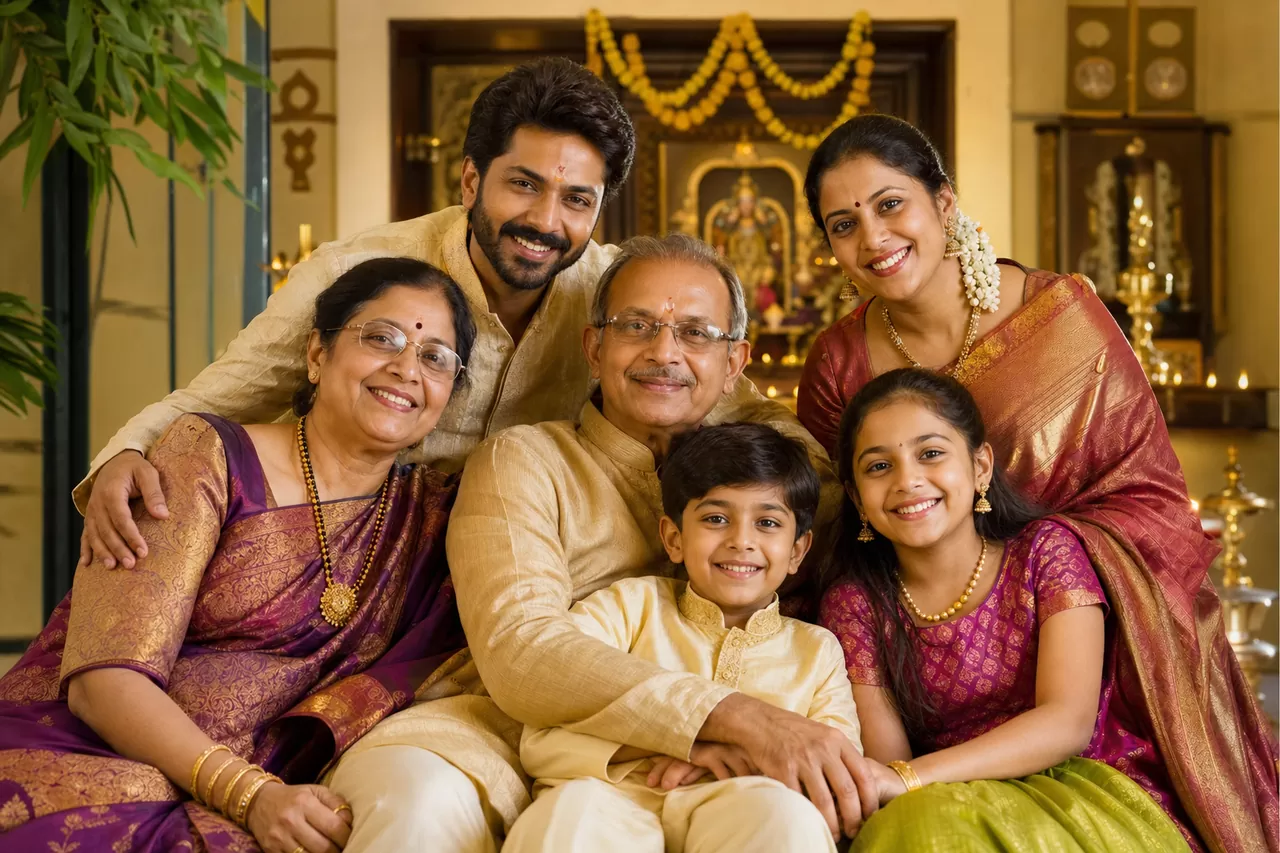
Family in India can join a reading by WhatsApp or video call. India is 4½ hours behind Sydney, Canberra and Hobart from April to October and 5½ hours behind in the daylight-saving months; Brisbane and the Gold Coast stay 4½ hours ahead all year. An Australian late afternoon or evening usually suits both households. Agree beforehand whose chart is discussed in front of whom.
Can parents in India join a reading held in Australia?
Yes: a shared family reading is a consultation in which relatives in two countries join the same call, so that parents in Jalandhar or Lucknow hear the same words as their children in Brisbane or Perth, and Master Vijay Ram gives these readings by WhatsApp and video, and an online astrology reading works the same way whether one household or three are on the line. What takes planning is the clock, the language and who hears what.
Many Indian Australian families still make big decisions together across the two countries: a marriage, a property in the home town, a parent's move. Bringing everyone onto one video call astrology session saves the game of telephone that follows when a reading is retold.
What is the time difference between Australia and India?
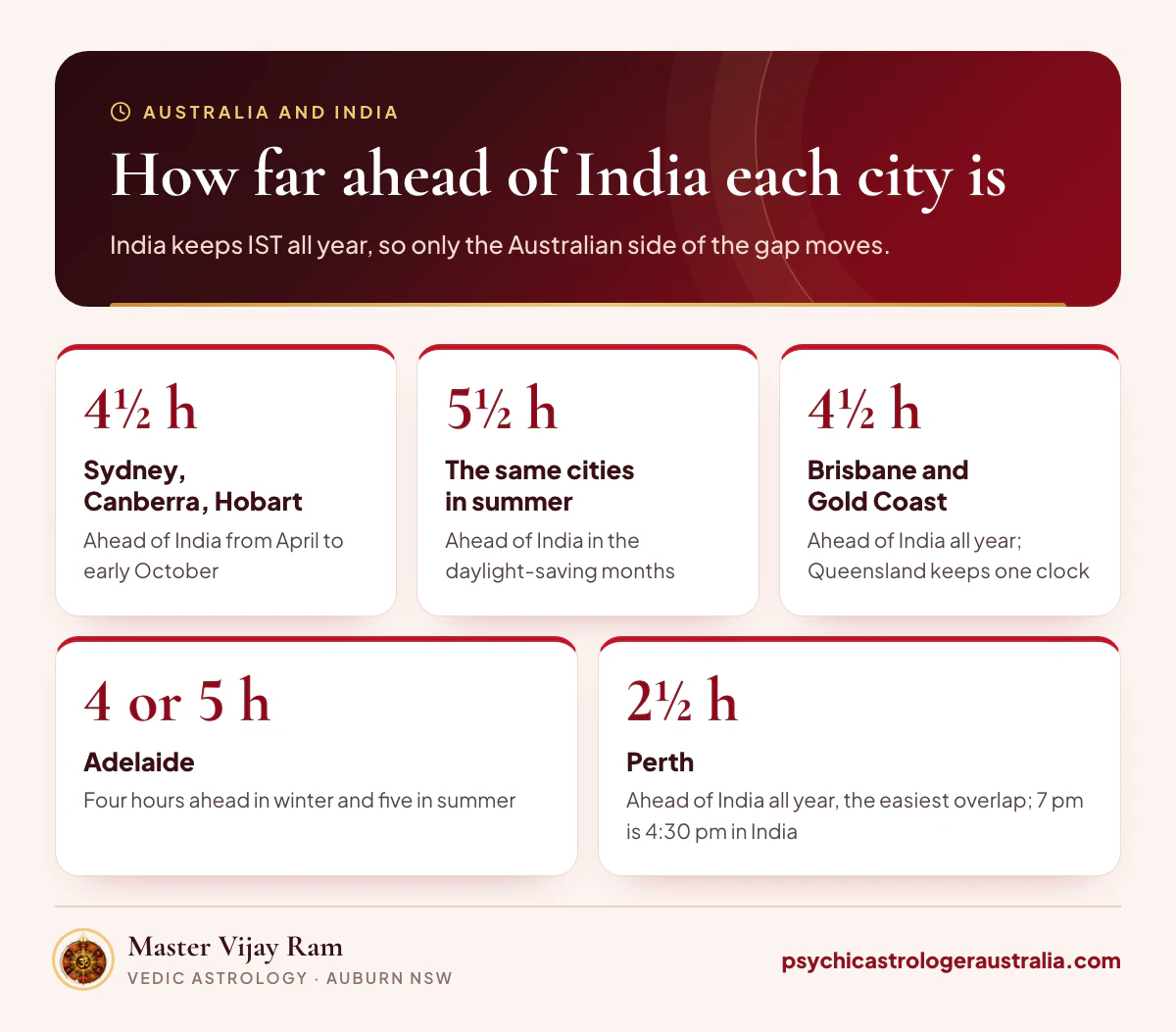
India keeps one time zone, IST (UTC+5:30), all year and has no daylight saving. Australia has three zones, and the south-eastern states move their clocks in summer, so the gap changes twice a year. The table below sets out the Australian zones against Sydney.
| Where you are | Standard time | Daylight saving | Compared with Sydney |
|---|---|---|---|
| NSW (incl. Central Coast), Victoria (incl. Geelong), ACT, Tasmania | AEST, UTC+10 | AEDT, UTC+11 | Same as Sydney all year |
| Queensland (Brisbane, Gold Coast, Sunshine Coast, Townsville, Cairns) | AEST, UTC+10 | None | Same April–October; 1 hour behind October–April |
| South Australia (Adelaide) | ACST, UTC+9:30 | ACDT, UTC+10:30 | 30 minutes behind all year |
| Northern Territory (Darwin) | ACST, UTC+9:30 | None | 30 minutes behind April–October; 1½ hours behind October–April |
| Western Australia (Perth) | AWST, UTC+8 | None | 2 hours behind April–October; 3 hours behind October–April |
In 2027 daylight saving ends on Sunday 4 April and begins on Sunday 3 October.
Against India, the working figures for the IST AEST time difference are these. Sydney, Canberra, Hobart and Melbourne are 4½ hours ahead of India from April to early October and 5½ hours ahead from October to early April. Brisbane and the Gold Coast are 4½ hours ahead all year, because Queensland does not change its clocks.
Adelaide is 4 hours ahead in winter and 5 in summer. Darwin is 4 hours ahead all year, and Perth 2½ hours ahead all year, which makes Perth the easiest Australian city to schedule with India.
Which hours suit both households?
Because Australia is ahead, an Australian evening falls in the Indian afternoon, and an Australian morning falls in the Indian night or very early morning. The table gives the same call in each place for a typical evening slot.
| Where you are | April to early October | October to early April | Notes |
|---|---|---|---|
| Sydney, Canberra, Hobart | 2:30 pm in India | 1:30 pm in India | Indian lunchtime in summer; fine for retired parents |
| Brisbane, Gold Coast | 2:30 pm in India | 2:30 pm in India | The same all year |
| Adelaide | 3:00 pm in India | 2:00 pm in India | Half an hour behind Sydney all year |
| Perth | 4:30 pm in India | 4:30 pm in India | Late afternoon in India; easiest overlap |
For families with working siblings in India, a later Australian slot moves the Indian end towards their evening: a 9 pm call from Perth is 6:30 pm in India. Weekend afternoons in Australia land in the Indian late morning, which often suits elders best.
What about the weekends the clocks change?
In 2027 daylight saving ends on Sunday 4 April and begins on Sunday 3 October in New South Wales, Victoria, the ACT, Tasmania and South Australia. India's clock does not move, so a call agreed for "7 pm Sydney" a week earlier will land an hour differently in India after the change.
Confirm the time again in the week of the change, and write it in both time zones in the family group: "7 pm Sydney / 1:30 pm India". That one line prevents most missed calls.
Whose clock is the booking made on?
The reading is arranged on the clock of the person who booked it, and it helps to name your city when you ask for a time. Clients in Western Australia can see how readings for Perth clients are timed against the eastern states, which matters when an Indian parent, a Perth daughter and a Sydney son are all joining.
Which language will the reading be in?
A WhatsApp reading with family can run in English, Hindi or Punjabi, and switching between them on one call is common: a son speaks English, his mother in Ludhiana answers in Punjabi, and the reading moves with them. Grandparents who follow technical terms better in Hindi often find the call far easier than a retold summary. Consultations in Hindi and Punjabi explains how that works.
For families whose elders speak Tamil, Telugu, Gujarati or another language, a family member can interpret on the call. Vijay Ram ji does not claim those languages, and an honest interpreter in the family is better than a reading half understood. An online consultation in Hindi covers the practical side for Hindi-speaking families.
Whose chart is discussed in front of whom?
This is the question families most often forget to ask. A reading about a daughter's marriage, with her parents in India and her brother in Melbourne all listening, discusses her chart in front of everyone. She should agree to that beforehand, and should decide whether some parts are better heard privately.
The same goes for a parent's health questions or a sibling's career. Agree in advance who is on the call and which charts will be read, and keep anything sensitive for a separate, private conversation. Birth details and privacy explains why a chart deserves that care.
What should the family prepare before the call?
Each person whose chart will be read needs a date, time and place of birth, and those details should come from them or with their agreement. Families often keep a handwritten janam patri in India; ask a parent to read the details out or photograph them for the one person who needs them, not for the whole group.
- One host who books the reading and sends the link or adds people to the WhatsApp call.
- The time written in both Australian and Indian time.
- The birth details of each person being read, with their consent.
- Two or three agreed questions, so the call does not become a family argument.
- A quiet room at each end, and headphones for any elder who struggles with speaker sound.
How do you keep a group call from going off course?
Agree the questions beforehand and let one person keep them. When five relatives each bring a question, the time is spread so thin that nobody gets a proper answer. A parents join reading call works best when the family has already decided the one or two matters it wants looked at, for example a proposal for a son or the timing of a parent's visit.
If a parent is coming to stay for months, long visits from parents in India covers the household side of that season.
What if relatives disagree on the call?
They sometimes do, and it is better that it happens with the reading in front of everyone than in a dozen phone calls afterwards. An illustration, not a real family: a software engineer in Hobart, her parents in Chandigarh and her uncle in Delhi join to discuss a proposal. The parents are keen; she is unsure; the uncle has opinions about the boy's family.
The reading cannot decide for them. What it can do is say what her own chart suggests about timing and readiness, so the conversation moves from whose voice is loudest to what the next sensible step is. Vijay Ram ji will speak to the person whose life it is, in whichever of his three languages suits, and will not take sides in a family quarrel.
If the call becomes heated, it is fine to end it and continue privately later.
What if the question is a wedding or ceremony in India?
Muhurat questions need one extra step: the time chosen is given for the place where the ceremony happens, on that place's clock. A wedding in Amritsar is timed in IST, and a griha pravesh in Brisbane in Queensland time. Planning a wedding in India from Australia goes through the practical and astrological steps, and choosing an auspicious muhurat explains how a time is selected.
What does a family reading cost?
A consultation is $50, wherever the relatives are joining from, and it covers the questions agreed for that call. If the family decides on a puja or jaap afterwards, it starts from $250, the amount is agreed before anything is performed, and Vijay Ram ji performs it personally at his place of practice in Auburn, with relatives in either country joining by video if they wish.
What practical problems should you expect?
Patchy connections, an elder who cannot find the unmute button, a call that drops when someone walks to another room. Test the call with the family the day before, and keep a phone number ready as a fallback. If a parent cannot join live, a written summary from the host afterwards is better than a forwarded voice note that circulates beyond the family.
What can a cross-border family reading not do?
It cannot settle a family disagreement by itself, and it is faith-based guidance, not legal, migration or medical advice. Property in India needs an Indian lawyer, a parent's visa needs Home Affairs or a registered migration agent, and an elder's health needs a doctor. What the reading can do is let everyone hear the same thing at the same time, which, across two countries and three clocks, is worth a great deal.
Read next
- Parents Visiting From India: Long Stays and Family HarmonyParents visiting from India for months: health insurance, routines, kitchen and grandchild questions, in-law tension,…
- Online vs In-Person Astrology Reading: Is Online as Good?Is an online astrology reading as good as in person? The chart is identical; here is what phone, video, WhatsApp and …
- Vashikaran for Marriage Approval: Softening Family ResistanceHow family resistance to a marriage really softens: what vashikaran addresses, a stage-by-stage timeline, the honest …
Frequently asked questions
What time is it in India when it is evening in Sydney?
From April to early October, India is 4½ hours behind Sydney, so 7 pm in Sydney is 2:30 pm in India. In the daylight-saving months India is 5½ hours behind, so 7 pm in Sydney is 1:30 pm in India. India does not change its clocks, so only the Australian side moves.
Can my parents in India join my astrology reading?
Yes. Readings with Master Vijay Ram run by WhatsApp and video, and relatives in India can be added to the call. Agree the time in both countries, decide beforehand which charts will be discussed, and make sure each person whose chart is read is comfortable with who is listening.
What is the best time for a reading with family in India and Perth?
Perth is 2½ hours ahead of India all year, so a Perth evening of 7 pm is 4:30 pm in India, and a 9 pm Perth call is 6:30 pm in India. That makes Perth the easiest Australian city for a shared call, with no daylight-saving changes on either side.
Will the reading be in Hindi or Punjabi?
It can be. Master Vijay Ram consults in English, Hindi and Punjabi, and a call can move between them as different family members speak. If an elder speaks Tamil, Telugu, Gujarati or another language, a family member can interpret. He does not claim languages other than those three.
Should my parents hear the reading about my marriage?
That is your decision. A family reading discusses your chart in front of everyone on the call, so agree beforehand what is read openly and what you would rather hear privately. Many people share the main timing with parents and keep personal questions for a separate conversation.
What happens when daylight saving changes?
In 2027 daylight saving ends on Sunday 4 April and starts on Sunday 3 October in New South Wales, Victoria, the ACT, Tasmania and South Australia. India's clock stays the same, so the gap changes by an hour. Confirm any call booked around those weekends and write the time in both zones.
How much does a family reading with relatives in India cost?
A consultation is $50, however many relatives join and from wherever they join, and it covers the questions agreed for the call. If a puja or jaap is chosen afterwards, it starts from $250 and the figure is agreed before anything is performed at Master Vijay Ram's place of practice in Auburn.
Can the reading cover a property or visa question for my parents?
A reading can talk about timing and the season the family is in, but it is not legal or migration advice. Property in India needs an Indian lawyer, and a parent's visa needs Home Affairs or a registered migration agent. The reading sits beside that advice and never replaces it.
People also ask
How many hours is India behind Australia?
It depends on the city and the season. India is 4½ hours behind Sydney, Melbourne, Canberra and Hobart in winter and 5½ in summer, 4½ behind Brisbane all year, 4 behind Darwin all year, 4 or 5 behind Adelaide, and 2½ behind Perth all year. India has no daylight saving.
Can you do a video astrology reading with family overseas?
Yes. A reading by WhatsApp or video can include relatives in another country on the same call. The practical steps are agreeing a time in both zones, choosing one host to set up the call, testing the connection beforehand, and agreeing which charts will be discussed in front of the whole family.
What is the best time to call India from Australia?
Australian late afternoon and evening fall in the Indian early to late afternoon, which suits most households, including working relatives who can step out briefly. Australian mornings fall in the Indian night. From Perth the overlap is easiest, because the difference is only 2½ hours all year.
Do I need my parents' consent to read their chart?
It is right to ask. A parent's birth details and chart are their personal information, and many elders enjoy being asked and joining the reading. If a parent cannot take part, the reading can use your own chart to look at the relationship and your role, without reading theirs.
References & further reading
Serving clients across Australia
Confidential consultations by phone, video & WhatsApp — including: