
Quick answer
Diwali cleansing is mostly an ordinary deep clean of the home, and only rarely spiritual clearing of heaviness that survives that clean. Use the Five-Lamp Check to find which layer of the house is actually heavy, and rule out medical, financial and relationship causes before any remedy.
What Diwali cleansing actually means
Diwali cleansing is two different things wearing one name. The first is ordinary housework done with intent: floors swept, cupboards emptied, broken things thrown out, the whole home put back in order before the lamps are lit. The second is spiritual work, which means clearing a heaviness that stayed in a house after a hard year and did not leave when the dust did. Most families need only the first. That is not a disappointing answer; it is the honest one. A home that feels wrong in spring usually feels wrong for reasons you can name, such as a death, a job lost, a long illness or six months of arguing. Cleaning shifts that more than people expect. The spiritual layer matters only when heaviness survives a genuine clean.
Why the Diwali season feels different in Australia
Diwali 2026 falls in early November, and it is worth checking your own panchang for the exact tithi in Australian time, because the day can shift by one depending on where the calculation is made. That timing does something quietly strange here. In north India the festival marks the turn into winter, lamps lit against a dark that is closing in. In Australia it lands in late spring, with long evenings and the heat still building. The festival's logic runs backwards against the season outside your window. Households who moved from Delhi, Lahore or Colombo often describe a dislocation they cannot name. It comes up in Canberra consultations most years: the cleaning is done, the lamps are lit, and something still feels out of step. That is usually the calendar, not the house.
What a home carries after a hard year
Ask what a home has carried and people list events, not energies. A pregnancy that ended. A parent's death overseas that nobody could travel for. Months of shift work where two people in the same house never saw each other awake. A business that quietly stopped working. These leave residue in a plain sense: rooms nobody enters, a spare bedroom that became storage, a kitchen where one hard conversation happened and which now feels cold. Sometimes what surfaces at Diwali is not the building but a relationship that has been failing all year, and no amount of sweeping addresses that. It is a different enquiry, closer to the work of a love spell specialist across South Western Sydney. Naming what actually happened is the first honest step. A house rarely holds anything its people are not still holding.
The Five-Lamp Check
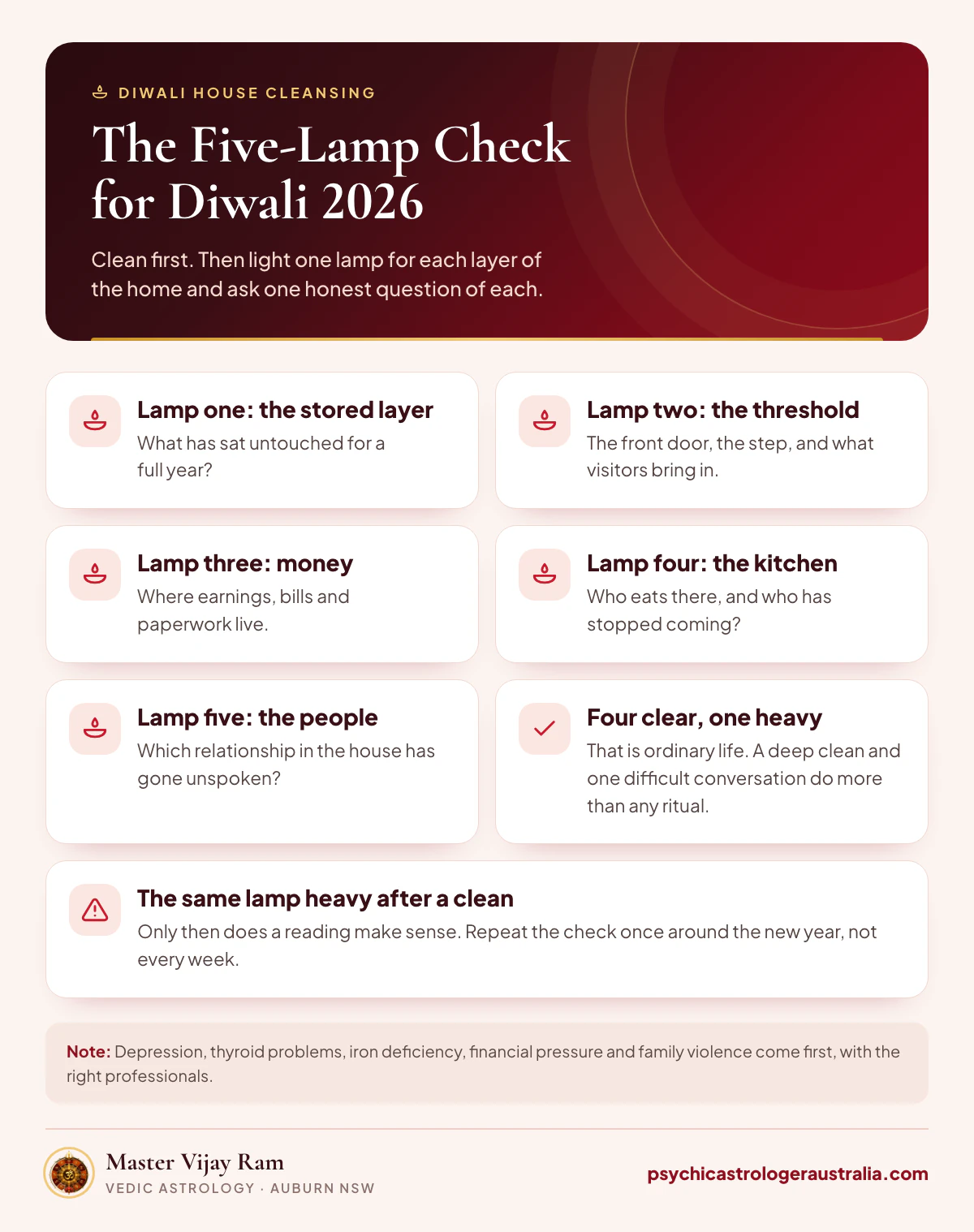
One discipline has proved useful across these enquiries, and it is called the Five-Lamp Check. Light one lamp for each of five layers of the home and ask one honest question of each. Lamp one is the stored layer: what has sat untouched for a full year. Lamp two is the threshold: the front door, the step, what visitors bring in. Lamp three is money: where earnings, bills and paperwork live. Lamp four is the kitchen: who eats there and who has stopped coming. Lamp five is the people: which relationship in the house has gone unspoken.
The rule that matters is simple. If four lamps come back clear and only one is heavy, that is ordinary life, and deep cleaning plus one difficult conversation will do more than any ritual. Only when the same lamp stays heavy after a thorough clean does a reading make sense, which is where aura and chakra cleansing belongs.
The Diwali season, stretch by stretch
The Diwali season is longer than the night itself. It begins around Navratri and does not settle until well after the last guest has gone. Each stretch brings its own trouble, and knowing which is which stops people mistaking ordinary festival strain for something darker. The Navratri weeks have a pattern of their own, set out more fully in Navratri & Dussehra 2026: Cleanse Your Home of Negative Energy.
| Time of year | What tends to surface | What to do about it |
|---|---|---|
| The Navratri weeks | Old grievances resurface; fasting and late nights leave people short-tempered | Keep the work practical; do not read tiredness as interference |
| The fortnight before Diwali | Dread about hosting, spending and family visits | Clear one room each weekend; write the guest list before the shopping list |
| Dhanteras and the days before Lakshmi Puja | Money fear peaks; old debts and unopened paperwork surface | Sort the paperwork first; buying metal does not settle an unpaid account |
| Diwali night itself | Grief for whoever is missing from the room | Say the name aloud and light a lamp, rather than working around the silence |
| The week after Diwali | A flat, hollow feeling once the guests leave | Expected. Air the house, rest, and book nothing this week |
| Late November into summer | Heat, holidays, and the question of whether anything changed | Repeat the Five-Lamp Check once; if one lamp is still heavy, then ask |
Clean first, cleanse second
There is an order to this, and skipping it wastes money. Clean the house properly first. Not a tidy, a clean. Empty the cupboard that has not been opened since you moved in. Throw out the cracked plates, the dead pot plant, the shoes nobody wears. Wash the curtains. Open every window on a warm spring morning and leave them open for hours. Get under the beds. People in older brick homes are often surprised how much the air changes. Do this before considering anything spiritual, because a genuine practitioner will ask whether you have, and an honest one will send you away to do it. A room-by-room method is set out in House Cleansing for Negative Energy: A Room-by-Room Vedic Guide. Most of what people call heaviness leaves with the rubbish.
The threshold and what visitors bring in
The front door does more work than any other part of a home at Diwali. It is where people arrive, where shoes come off, where the rangoli goes and where the first lamp usually sits. It is also where a whole year of visitors has come and gone. Vedic practice treats the threshold as the boundary of the household, which is why so much traditional attention goes there. Practically: clear the entry of stored junk, fix the light that has not worked since autumn, sweep the step, and make the first thing anyone sees an open space rather than a pile. Nazar after a crowded festival night is a common worry, and in Western Sydney, around Seven Hills and Doonside, it is the most frequent reason families get in touch. It is the mildest of these matters and usually the easiest to settle.
What a diya is really doing
A diya is not a machine. It does not extract anything from a room. What it does is more ordinary and more useful: it makes you stop, sit and pay attention to one specific corner of your own house for a few minutes. Attention is the active ingredient. Rows of lamps along a balcony rail do something practical too, drawing the household outside together at night, which many families have not done for months. Where the tradition asks for a lamp in the north-east, or one at the threshold left to burn out on its own, follow the instruction as given. Where anyone claims a particular lamp guarantees a particular outcome, ignore it. Structured clearing, when it is genuinely warranted, is separate work, aimed at energy that has settled on a person or a home.
Lakshmi Puja and money worry
Lakshmi Puja carries the heaviest expectation of the five days, and it is where most of the confusion arrives. A household under real financial pressure, whether a mortgage that moved, hours cut or a business quietly not working, will feel that pressure most sharply on the night it is asked to invite prosperity in. That feeling is not evidence of a spiritual block. It is evidence of a spreadsheet. Put the paperwork in one place, read it, and speak to a free financial counsellor if the numbers frighten you; such services exist in every state. Buying gold on Dhanteras does not settle an unpaid account. What Vedic practice offers here is steadiness and clearer judgment, not money from nowhere. Anyone promising that a puja will produce a sum by a date is not being straight with you.
Cleansing the people, not only the building
Houses do not get tired. People do. By late in the year most households here are running on very little: school terms, shift work, a long stretch without a break, and for migrant families the slow weight of parents ageing on the other side of the world. What gets described as a heavy home is very often four exhausted people inside it. The honest first step is rest, food, sleep and daylight, in that order, and it works more often than anything else does. It is worth separating the two before spending anything. If the heaviness is genuinely personal rather than structural, where one person is flat, guarded and waking at the same hour each night while everyone else is fine, that is a different question and the ground covered by spiritual protection and cleansing.
Rentals, sharehouses and homes you do not own
Many families reading this cannot repaint a wall, let alone light a havan in a courtyard. Renters, sharehouse residents and apartment dwellers ask the same thing: does any of this work if the place is not mine. It does, with adapting. Use enclosed candles or good LED lamps where open flame is prohibited, and check your lease and your building's fire rules before lighting anything on a balcony. Salt at a threshold, water, sound and open windows require nobody's permission. Most rentals that feel wrong are simply dark, damp or badly aired. Where a home seems to carry something older than your tenancy, a place that felt wrong from the first night or a room nobody wants, that is a specific enquiry and belongs to spirit or ghost disturbance. It is far rarer than the internet suggests.
What a genuine remote cleansing involves
The process is less dramatic than most people expect. It begins with a conversation, usually by phone or WhatsApp, in which you describe what has happened over the year in plain terms. Birth details are taken if a chart reading is warranted. Photographs of the home are sometimes asked for and sometimes not. Most enquiries end there, with a recommendation to clean, to rest, or to see a doctor. Where remedial work is warranted, Master Vijay Ram performs it himself at his own place of practice, which is why your suburb makes no difference to how it is carried out. A family enquiring about negative energy and evil eye removal across Melbourne's south-east receives exactly the same work as one living three streets from him. The terms are the same too: the consultation is $50, any remedy, from $250, is agreed before it is performed, and everything is kept strictly confidential.
When this is not the answer
Some of what gets called festival heaviness has a cause that must be treated first, and treated by someone else. Persistent low mood, loss of interest, early waking and hopelessness lasting more than two weeks describe depression, which is common and treatable. Thyroid disorders, iron deficiency, sleep apnoea and low vitamin D all produce exactly the exhaustion people bring to a Diwali reading. Hearing voices, believing you are being watched or controlled, or a sudden change in someone's personality needs urgent medical assessment rather than a ritual. Family violence and coercive control make a home feel unsafe and unclear, and that is a police and legal matter, with support services in every state. Grief after a death needs time and often counselling. Spiritual work sits alongside all of this. It never replaces it.
After the lamps go out
The week after Diwali is flat for almost everyone. The guests leave, the house is untidy again, and the lift people expected does not arrive. That is normal, and it is not a sign the cleaning failed. What keeps a home clear through an Australian summer is unglamorous: keep the entry clear, air the house on any mild morning, do not let one room become the dumping ground again, and repeat the Five-Lamp Check once around the new year rather than every week. Watching constantly for signs is its own kind of harm. Households who search for an astrologer in Hobart keep the same rhythm as those much further north, because the practice is about attention rather than climate. If one lamp is still heavy by February, that is the moment to ask.
Read next
- Signs of Negative Energy in Your Home & How to Clear ItSigns of negative energy in a home, the ordinary causes to rule out first, and how nazar, heavier interference and me…
- Negative Energy After a Breakup: Cleansing Your Space and Your AuraNegative energy after a breakup: grief first, a home that still holds a person, a seven-day practice for the rooms, a…
- House Cleansing for Negative Energy: A Room-by-Room Vedic GuideA room-by-room Vedic guide to house cleansing for negative energy: what to rule out first, what is safe to do yoursel…
Frequently asked questions
Does cleaning the house before Diwali do anything spiritually, or is it only tradition?
It does both, and the ordinary part carries most of the weight. Clearing objects you have not touched in a year changes how a room feels, how light moves through it and how people behave in it. The tradition is built on that. Treat the cleaning as the real work, and anything spiritual as a second step taken only if heaviness survives.
Our house still felt heavy after a full Diwali clean. What should we look at next?
Look at the people before the building. Ask who in the household is not sleeping, who has stopped eating with the others, and which conversation has been avoided all year. Then check for damp, poor ventilation and rooms that never get daylight. If all of that is genuinely settled and one specific room or person stays heavy, that is the point to ask a question.
Should the deep clean be finished before Dhanteras, or does it continue through the five days?
Finish the heavy work before Dhanteras if you can. The five days are meant for lamps, food and people, not for hauling boxes and arguing about what to discard. Doing it earlier also leaves the house aired and the rubbish gone before guests arrive. If you fall behind, finish one room properly rather than half-cleaning four.
There was a death in our family this year. Is it wrong to light lamps at all?
Families differ, and your own elders and traditions should guide the decision. Many households keep the first Diwali after a death quiet: no fireworks, no large gathering, perhaps a single lamp. That is a recognised choice, not a failure. Grief does not need to be swept out of a house. Lighting one lamp and saying the person's name aloud is enough.
Can Diwali cleansing be done properly in an apartment where open flame is not allowed?
Yes. Check your lease and building fire rules first, then use enclosed candles or good LED lamps on balconies and anywhere near curtains. The parts that matter most need no flame at all: clearing the entry, washing what can be washed, opening windows, sound, water and salt at the threshold. Nothing essential is lost by adapting.
How does the Five-Lamp Check work if I live alone?
The fifth lamp changes rather than disappears. Living alone, ask instead which relationship outside the house has gone unspoken, and whether you have been avoiding a particular call for months. The other four stay the same: storage, threshold, money and kitchen. People living alone often find the kitchen lamp heaviest, because cooking for one quietly stops.
Do I need to be at home while a remote cleansing is being performed?
No. Remedial work is performed by Master Vijay Ram at his own place of practice, so your presence in the house is not required and your suburb makes no difference. You will usually be asked to do something simple on your side, such as airing the home or keeping a particular evening quiet, and told plainly when nothing further is needed.
My relatives want a pandit and my partner wants a cleaner. Which comes first?
The cleaner, almost always. A ritual performed in a cluttered, unaired house rarely holds, and a straight practitioner will tell you the same. Do the physical work, live in the result for a week or two, and see what is left. If something specific remains after that, it is far easier to identify and far cheaper to address.
Must old belongings be thrown away, or can they be donated?
Donate wherever the item is still usable, because nothing in the tradition requires waste. What matters is that it leaves the house and does not sit in a bag by the front door for three months. Broken things, cracked vessels and anything closely tied to a bad period are better discarded outright than passed on to someone else.
Someone has offered to clear our home of negativity before Diwali for a set fee. How do I judge whether that is genuine?
Watch what happens when you ask questions. A genuine practitioner will ask what actually happened in your year, will tell you plainly when nothing spiritual is involved, and will not demand a large sum before hearing you or raise the fee with fear. Anyone naming the person who supposedly cursed you, promising a guaranteed outcome, or pressing for urgency before the festival should be declined.
What is the difference between a Diwali house cleansing and an evil eye remedy?
A house cleansing addresses the whole dwelling and the year it has been through, and it is mostly practical. An evil eye remedy addresses one person after a specific encounter, usually sudden, usually recent, and often following praise or unusual attention. One is seasonal maintenance for a building. The other is a response to a single event, and it is much smaller work.
Should children take part in the cleaning and the lamps, or does it frighten them?
Involve them in the cleaning, the rangoli and the lamps, which children generally enjoy. Do not involve them in discussions about curses, enemies or who may have wished the family harm. Children absorb that language and carry it far longer than adults expect. Keep the festival to light, food and family, and hold the rest for adult conversation.
Does a newly bought or newly rented home need cleansing before its first Diwali?
A thorough physical clean, yes, particularly a place that has stood vacant or been tenanted for years. A griha pravesh or house-warming observance is customary and worth doing for its own sake. Beyond that, only if the home itself feels wrong across the first nights in a way that airing, daylight and unpacking do not change.
My doctor has found a real medical cause for my exhaustion, but my family insists it is nazar. What should I do?
Follow the medical treatment. A diagnosis that explains your symptoms is the answer, and abandoning treatment because a relative is certain otherwise causes real harm. You can honour the family's concern with a small traditional observance if it keeps peace at home. Spiritual practice belongs alongside medicine, never in place of it, and a straight practitioner will say so.
What should I avoid doing when one room in the house keeps feeling wrong?
Avoid sealing it off and walking past it, which is what most households do and which makes the feeling worse. Avoid buying protective objects one after another. Avoid reading symptom lists online late at night. Open the room, clean it in daylight, use it for something ordinary for a fortnight, then judge. Most rooms settle.
People also ask
When is Diwali 2026?
Diwali 2026 falls in early November, with Lakshmi Puja on the Kartik amavasya. The exact date for Australian households can differ by one day from Indian calendars, because the tithi is calculated against local time. Check a panchang set for your own city, or ask family elders which day your household has always kept.
What should be cleaned first for Diwali?
Start with storage rather than surfaces. The cupboard, garage corner or spare room that has not been opened in a year does far more for how a house feels than wiping benches does. Work outward from there to floors, curtains and windows, and leave the entrance and threshold until last so it stays clear for the lamps.
Does the house have to be cleaned before the lamps are lit?
Traditionally yes, and the reason is practical as much as spiritual. The lamps mark a home that has been put in order, so lighting them over unopened boxes tends to feel hollow. Finish the heavy clearing before Dhanteras where possible. If time runs short, complete one room properly rather than half-finishing several rooms at once.
Can a house be cleansed of negative energy without a priest?
Most of it, yes. Deep cleaning, discarding what is broken, opening windows, salt and water at the threshold, sound, and light in dark corners are all household practices that need no officiant at all. A practitioner becomes useful when heaviness persists after every one of those, or when one person rather than the whole house is affected.
Why does a home feel heavy after a difficult year?
Because the people in it are carrying the year, and homes reflect their occupants. Rooms tied to bad news get avoided, avoided rooms get cluttered, clutter blocks light and airflow, and the whole place starts to feel closed in. Grief, illness and financial strain all show up this way. Naming the actual events usually explains most of the feeling.
References & further reading
Serving clients across Australia
Confidential consultations by phone, video & WhatsApp — including:
- Adelaide
- the Gold Coast
- Canberra
- Hobart
- Newcastle
- Wollongong