

Quick answer
To find your birth time, start with the hospital's medical records, then your state's Registry of Births, Deaths and Marriages, the baby health book and any family janam patri. In India, hospital or nursing home records and the patri written by the family pandit are the best sources. Old patris often record time as ghatis and pals after sunrise, which converts to clock time.
Where can you find your birth time?
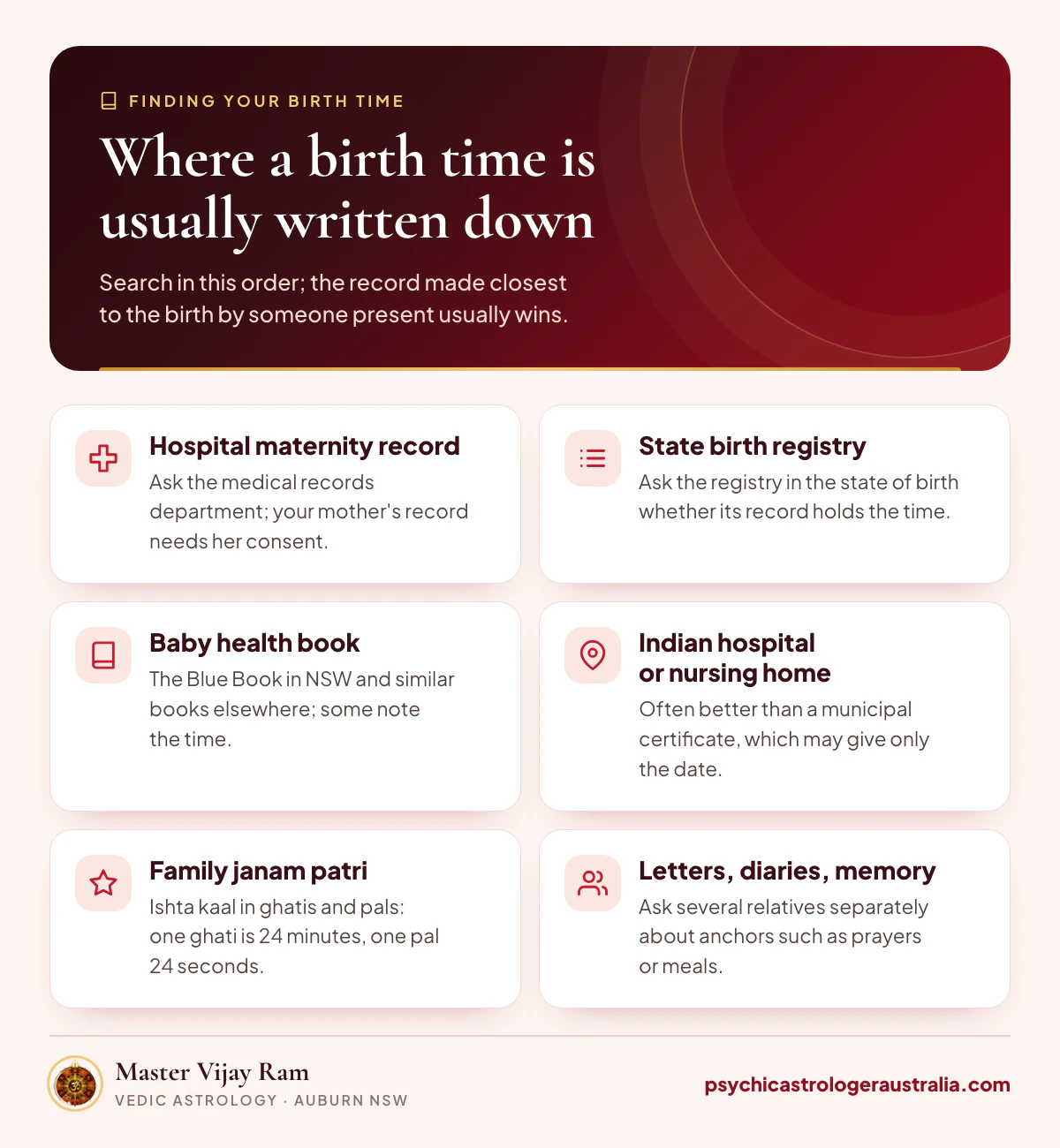
A recorded birth time is a time written down at or soon after the birth by someone who was there, and it is worth far more to an astrologer than any estimate made decades later. The usual places are the hospital's medical record, a state birth registry, the baby health book parents are given, a family janam patri and letters or messages sent home at the time. Most people who search find at least one of these.
This guide covers how to find your time of birth in Australia and India, how to read a time written in the older Indian style, and what to do when records disagree. Once you have it, a kundli reading built on a recorded time is on much firmer ground than one built on memory.
Why is a written time worth the effort?
The rising sign changes about every two hours, and the finer divisional charts every few minutes. A remembered "early morning" can cover two lagnas, while a written 6:40 am usually settles the matter. Families are often surprised how far a well-meant memory drifts over thirty years.
If no record exists at all, an astrologer can estimate a time from life events, which is explained in birth time rectification. That is a fallback. An afternoon spent on phone calls and forms is a better first step.
Does an Australian birth certificate show the time of birth?
It depends on the state, the era and the type of certificate, so ask rather than assume. Each state and territory has its own Registry of Births, Deaths and Marriages, and each decides what its certificates show and what its underlying registration records hold. The registration form completed at the time may contain more than the certificate printed from it.
Contact the registry for the state where you were born, not where you live now. Victoria's registry at bdm.vic.gov.au is one example; every state has an equivalent with its own forms, identity requirements and fees. Ask specifically whether the birth certificate time of birth is recorded for your registration, and if not, whether any other part of the record holds it.
How do you get your hospital birth record in Australia?
The hospital's health information or medical records department is the place to ask. Birth times are recorded carefully in maternity records, and a hospital birth record is often the most precise source there is. You will usually need to fill in a request form and prove your identity.
Australian privacy law gives people a right to ask for access to their own health records; public hospitals handle this under state law and private hospitals under the federal Privacy Act, and the Office of the Australian Information Commissioner explains the general rights. Two practical points help. Your time of birth may also sit in your mother's maternity record, which needs her consent to release, and very old records may have been archived or, after the required retention period, destroyed.
If the hospital has closed or merged, the state health department or the hospital that took over its services can usually say where the records went. Ask early, because archive searches take time.
What about the baby health book?
Many states give parents a personal health record book for each baby, the "Blue Book" in New South Wales being the best known. Its first pages record birth details filled in by hospital staff, and in some books and eras that includes the time. Ask your parents whether theirs survived a move or two.
Baby books bought by the family, christening or naming-day cards, a hospital wristband kept in a drawer and photographs with handwritten notes on the back are worth checking too. A grandmother's diary is a better source than it sounds.
How can you find a birth time from India?
Municipal and panchayat birth certificates in India record the date and place but often not the time, though some do. The hospital or nursing home where the birth took place is usually the better source, especially if a relative in India can visit in person with a request letter and identity documents. Small private nursing homes may have closed, and their records with them.
Many Indian states now issue birth certificates through online civil registration portals, which helps with the certificate but rarely with the time. The family's own records matter more: the janam patri written by the family pandit within days of the birth, a letter or telegram sent to relatives, or a note in a parent's diary.
How do you read the time on an old janam patri?
Many hand-written patris give the birth time not as clock time but as ishta kaal, the time elapsed since local sunrise, measured in ghatis and pals. This is a precise system, and it converts to clock time once you know sunrise for that place and date.
| Unit | Equals | In clock time |
|---|---|---|
| 1 pal (vighati) | one sixtieth of a ghati | 24 seconds |
| 1 ghati (ghatika, ghadi) | 60 pals | 24 minutes |
| 2½ ghatis | 150 pals | 1 hour |
| 60 ghatis | one day, sunrise to sunrise | 24 hours |
As an illustration, a patri reading "ishta kaal 10 ghati 30 pal" means 10.5 ghatis after sunrise, which is 252 minutes, or 4 hours 12 minutes. If sunrise that morning was 6:05 am, the birth was at about 10:17 am. The patri may also give the lagna and the Moon's nakshatra, which serve as a cross-check on the converted time.
Patris are often in Devanagari or Gurmukhi, sometimes in a grandparent's handwriting and with regional abbreviations. A consultation in Hindi or Punjabi lets Master Vijay Ram read it with the family on the call, and kundli terms in Hindi explains the vocabulary.
What if only family memory survives?
Memory improves with anchors. Rather than asking "what time was I born?", ask what was happening: was it before or after sunrise, the morning prayer, the milk delivery, a meal, a shift change, a particular radio programme, the doctor's rounds? Each anchor narrows the window, and two or three together can bring it to within half an hour.
Ask more than one person separately, then compare. Where a father, an aunt and a neighbour independently remember "just after the morning aarti", the agreement means more than any single account.
Which record wins when records disagree?
Records do conflict, often by half an hour or more. As a rule, the record made closest to the birth by someone present is the most reliable. The order most astrologers use is below, though every case is judged on its details.
- The hospital's maternity or birth record made at the time.
- A registry record based on the hospital's notification.
- A janam patri written within days, especially one with ishta kaal and lagna.
- The baby health book or a contemporary letter or diary.
- Family memory with anchors, agreed by several people.
When two good records disagree, an astrologer can test both times against life events, which is a small, focused rectification rather than a search across hours.
Are the place and time zone right?
Many "wrong" times are conversion errors. An app that uses your current location, a daylight saving setting applied in the wrong state, or an Indian time entered with an Australian time zone can shift the lagna even when the recorded time is perfect. The beginner's guide to reading a birth chart has a short check for place and clock.
Note the town or suburb of birth exactly as it appears on the certificate, and the hospital if you know it. For births in very large cities, the hospital's location can matter slightly; for most charts the town is enough.
What about adopted or donor-conceived people?
Adopted people in Australia can apply to their state's adoption information service for records, which may include the original birth registration and sometimes hospital details. Donor-conceived people may have access to information through state donor registers, depending on the state and the date. These are sensitive searches, and the services offer support along the way.
A reading can still help without a time, using the date and place, while a search continues. Nothing about the search needs to be rushed for astrology's sake.
How should you keep the record once you have it?
Scan it, note the source and keep the original somewhere safe. A birth record carries personal information that can be misused, so share the full document only where needed and send just the date, time and place for a reading. Your birth details and privacy looks at who really needs to see them.
Bring the record, or a photo of it, to your consultation. A reading is $50, by phone, video or WhatsApp, in English, Hindi or Punjabi, for clients from Hobart to Canberra. A chart describes tendencies and timing; it does not replace legal, medical or immigration documents, and only the registry or hospital can certify what a record says.
Read next
- When Is the Best Time to Get an Astrology Reading?When to book an astrology reading: your birthday, a dasha change, Saturn's sign changes on 3 June and 20 October 2027…
- Birth Time Rectification: When You Do Not Know the Exact TimeBirth time rectification explained: why minutes matter, how event matching narrows a time, its limits, and what a cha…
- How Long Does Black Magic Removal Take to Show Results?Black magic removal rarely runs to a fixed date. Here is the honest arc, what tends to shift first, what stretches it…
Frequently asked questions
How can I find out what time I was born in Australia?
Ask the hospital where you were born for your birth or maternity record through its medical records department, contact the Registry of Births, Deaths and Marriages in the state of birth, check the baby health book your parents were given, and ask family for any diary, letter or janam patri. The hospital record is usually the most precise.
Does an Australian birth certificate have the time of birth?
It depends on the state, the era and the type of certificate. Each state's registry decides what its certificates show and what its registration records hold, and the original registration may contain more than the printed certificate. Contact the registry for the state where you were born and ask specifically whether the time is recorded.
Can I get my hospital birth records?
Usually, yes. Australian privacy law gives you a right to ask for access to your own health records, through the hospital's health information or medical records department, with a request form and proof of identity. Your birth time may also be in your mother's maternity record, which needs her consent. Very old records may have been archived or destroyed.
My Indian birth certificate has no time. Where else can I look?
The hospital or nursing home where you were born may hold the time in its records, ideally requested in person by a relative in India. The family's janam patri written by the pandit soon after the birth is often the best source, along with letters, telegrams or diaries from the time. Many Indian certificates record only the date.
What does ishta kaal mean on a janam patri?
Ishta kaal is the birth time written as the time elapsed since local sunrise, measured in ghatis and pals. One ghati is 24 minutes and one pal is 24 seconds, so 10 ghatis 30 pals is 4 hours 12 minutes after sunrise. Adding that to the sunrise time for the place and date gives the clock time.
What if my parents only remember roughly when I was born?
Ask about anchors rather than the clock: whether it was before or after sunrise, a prayer time, a meal, a shift change or a radio programme. Ask several relatives separately and compare. Two or three agreeing anchors can narrow the time to within about half an hour, and an astrologer can test the remaining window.
Which is more reliable, the hospital time or the janam patri?
Usually the hospital record made at the birth, because it was written by staff present at the moment. A patri written within days with ishta kaal and lagna can be very good too. When they disagree, an astrologer can test both times against life events to see which fits better.
Should I send my birth certificate to an astrologer?
No need. Send only the date, time and place of birth, and keep the certificate itself private, because it carries personal information that can be misused. If a document is hard to read, such as an old patri in Hindi or Punjabi, a photo of the relevant section shared during a consultation is enough.
People also ask
How do I find my exact birth time?
Start with the hospital's medical records department, then your state's birth registry, then the baby health book and any family janam patri or letters from the time. In India, ask the hospital or nursing home and check the family patri. If nothing written survives, family memories with clear anchors can narrow the window.
Is time of birth on the birth certificate in India?
Some Indian birth certificates show the time, but many record only the date and place. The hospital or nursing home record is more likely to hold the time, and families often have it in the janam patri written by the family pandit soon after the birth.
How many minutes is one ghati?
One ghati, also written ghatika or ghadi, is 24 minutes. Sixty ghatis make a full day from sunrise to sunrise, and two and a half ghatis make an hour. Each ghati divides into 60 pals of 24 seconds each, which is the unit used for precise birth times on traditional patris.
Can a registry release my mother's hospital records?
Registries hold birth registrations, not hospital records. The hospital holds your mother's maternity record, which may include your time of birth, and releasing it to you normally needs her consent. Your own newborn record may also hold the time and can be requested in your name.
References & further reading
Serving clients across Australia
Confidential consultations by phone, video & WhatsApp — including: