
Quick answer
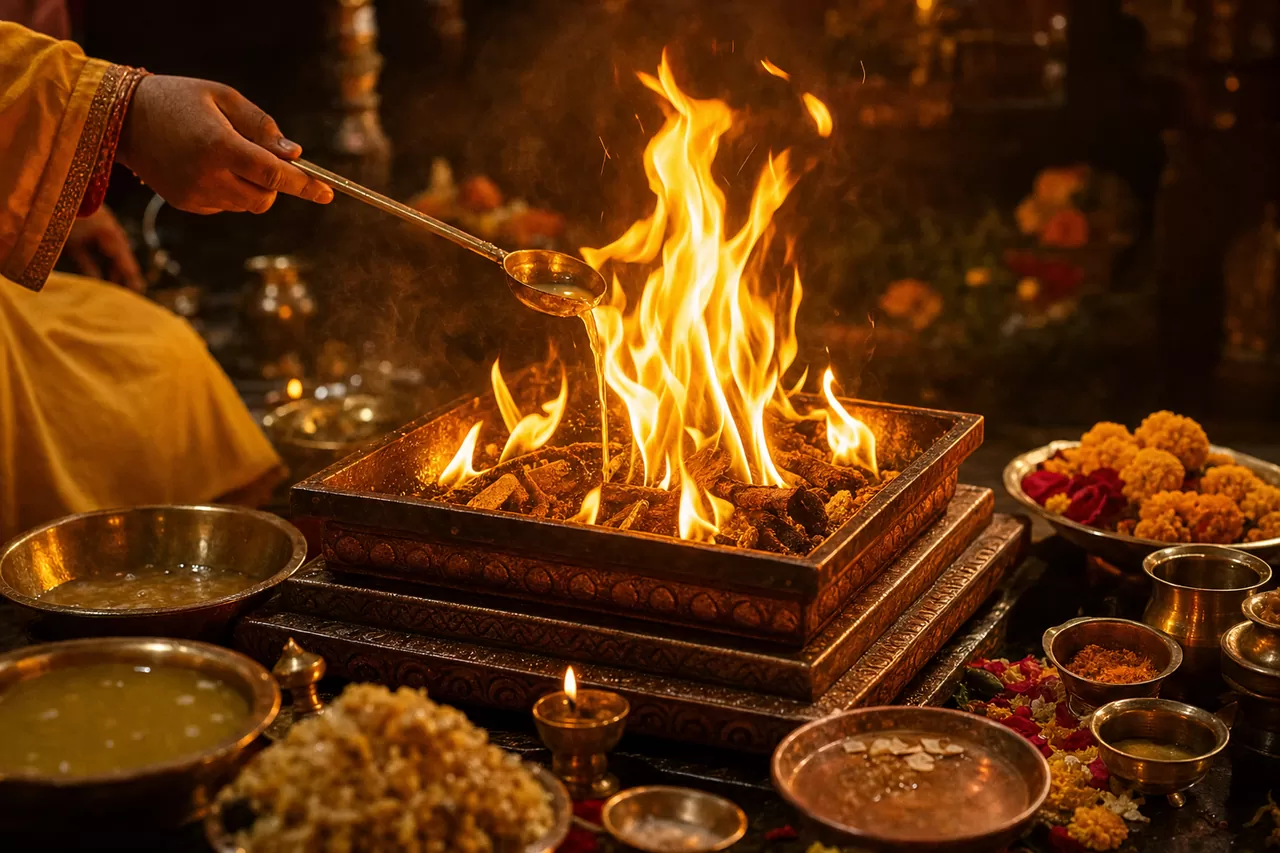
A Rudrabhishek is the bathing of a Shiva linga with water, milk, curd, ghee and honey while the Shri Rudram is chanted. Families choose it in Shravan, on Mondays, at Maha Shivratri or when a household is caught in quarrels, illness or a heavy planetary period, as a prayer for peace beside the practical help, never instead of it.
What is a Rudrabhishek, and why is it chosen for a troubled house?
A Rudrabhishek is a Shiva puja in which the linga is bathed in a steady stream of water, milk, curd, ghee, honey and other offerings while the Shri Rudram, an ancient Vedic hymn to Rudra, is chanted over it. The word joins Rudra, Shiva in his fierce aspect, with abhisheka, a ritual bathing. Of all the pujas a family might choose when the house itself feels caught in trouble, it is the one most often named for shanti, the settling of something that has been raging.
Master Vijay Ram is asked about it by households that have had a year of quarrels, a run of illness, a death, or a planetary period that seems to press on everyone at once. This guide explains what the rite involves and when it is chosen, and an abhishek performed on your behalf describes how he carries it out for families who cannot.
What is the Shri Rudram that gives it its name?
The Shri Rudram comes from the Krishna Yajurveda, in the Taittiriya Samhita at 4.5 and 4.7, and it has two parts. The Namakam is a long salutation, built on the word namah, and its eleven sections bow to Rudra in every place and every person: in the mountains and the fields, in the carpenter, the potter and the smith, even in the thief. Its very first line greets his anger, namaste rudra manyava, so that what is fierce is acknowledged before anything is asked of it.
The eighth section of the Namakam holds the words namah shivaya, the source of the five-syllable mantra most Hindus learn as children. The Chamakam, its companion, is built on cha me, and may this be mine: food, health, strength, long life, understanding, a home and its prosperity, asked for in eleven sections of its own. One part calms, the other asks, and that is exactly the shape of what a troubled household needs.
What is poured over the linga, and in what order?
Water comes first and last. Between them most priests pour milk, curd, ghee, honey and sugar, the five that together make panchamrit, and many add sugarcane juice, coconut water, sandal paste or rose water; families and regions keep their own order and their own reasons for each. Bilva leaves, offered in threes, white flowers and a little bhasma complete the offering, and where bilva cannot be found many priests accept white flowers and a sincere heart.
The linga sits on a base whose spout carries the liquid away, traditionally pointing north, and in a Shiva temple devotees walk around it only as far as that channel and turn back rather than step across it. Some families now use a small cup of milk rather than litres, and give the rest to people who need it; the tradition’s own logic, that the offering is about devotion and not quantity, supports them.
How large can a Rudrabhishek be?
The same rite scales from a family’s Monday morning to a temple event that runs for days. The traditional measure is the number of times the Namakam is recited, and each step up is eleven times the one before, which is why the larger forms need a team of priests rather than one.
| Form | What is recited | Usually performed by | Where families meet it |
|---|---|---|---|
| A simple abhishek | Om Namah Shivaya, repeated as the water flows | The family itself | At home on a Monday, or on Shivratri night |
| Rudrabhishek with the Rudram | The Namakam and the Chamakam once | A priest or a trained reciter | At home or at a temple, for a household occasion |
| Ekadasha Rudra | The Namakam eleven times, one section of the Chamakam after each | A priest or a small group | A temple, or a large home puja for a specific trouble |
| Laghu Rudra | The Namakam a hundred and twenty-one times | Usually eleven priests together | Temples, for big occasions and communal prayers |
| Maha Rudra and Ati Rudra | The Namakam 1,331 and 14,641 times | Many priests over several days | Rare temple events, often for the good of a whole community |
When is it chosen: Shravan, Mondays, Shivratri?
Monday is Shiva’s day, so a Monday morning is the ordinary time, and Shravan is the month above all others for it. A Rudrabhishek in Shravan follows whichever calendar the family keeps: in 2027 the north Indian Shravan runs from the Ashadha full moon of Monday 19 July to the Shravana full moon of Tuesday 17 August on the Sydney clock, while families on the amanta calendar, as in Maharashtra, Gujarat and much of the Deccan, count it from the new moon of Monday 2 August to the new moon of Wednesday 1 September.
Maha Shivratri, which falls on Saturday 6 March 2027 in every Australian city and in India, is the great night for it, and Maha Shivratri 2027 night timings gives each city’s nishita window and the four prahars. The twice-monthly Pradosh evenings and the monthly Shivratri are kept too, by their tithis, and a temple or family panchang gives those dates.
What makes a household troubled, and what comes before any puja?
The households that ask about a Rudrabhishek for negative energy describe the same few things: arguments that start over nothing, children who will not settle, one illness after another, a business that cannot get going, a heaviness since a death. Each of those has ordinary help that comes first, and it comes first because it works.
Constant fighting between partners is what Relationships Australia and a family counsellor are for, and any fear for someone’s safety is a 000 call, never a puja. Illness goes to the GP and the specialist, debt to a financial counsellor, damp and mould to a builder, and grief to the people who sit with grief. A Rudrabhishek can sit beside all of that as the family’s prayer for peace; it cannot take the place of any of it.
Why Shiva, for a house in trouble?
Because in the tradition Shiva holds both ends of the trouble. Rudra is the storm and the anger; Shiva, the same god, is the auspicious and the kind, and the Rudram moves deliberately from one to the other, greeting the fierce form and then asking for the gentle one. A household that has been shouting at itself recognises that movement.
Shiva is also the householder god as much as the ascetic, married to Parvati, father of Ganesha and Kartikeya, and his family is the one many homes keep on the altar. His guardian form, Bhairava, is the subject of Kaal Bhairav, Shiva’s guardian form, and the Rudrabhishek is the gentler, household side of the same devotion.
Is a Rudrabhishek part of graha shanti?
Very often. Shiva is held to be the lord of Saturn, and a Rudrabhishek is a traditional part of the remedies for a hard Saturn period, for a troubled Moon, and for Rahu and Ketu; Kaal Sarp dosh and its remedies describes how it sits inside the Rahu and Ketu shanti performed at the great Shiva temples in India.
Whether a particular chart needs it is a question for a reading. A $50 consultation by phone, video or WhatsApp looks at the dasha running for the head of the house and the person most affected, and graha shanti puja for a planet under strain explains when a fuller shanti is suggested and when nothing is needed at all.
Can a family do a simple Rudrabhishek at home?
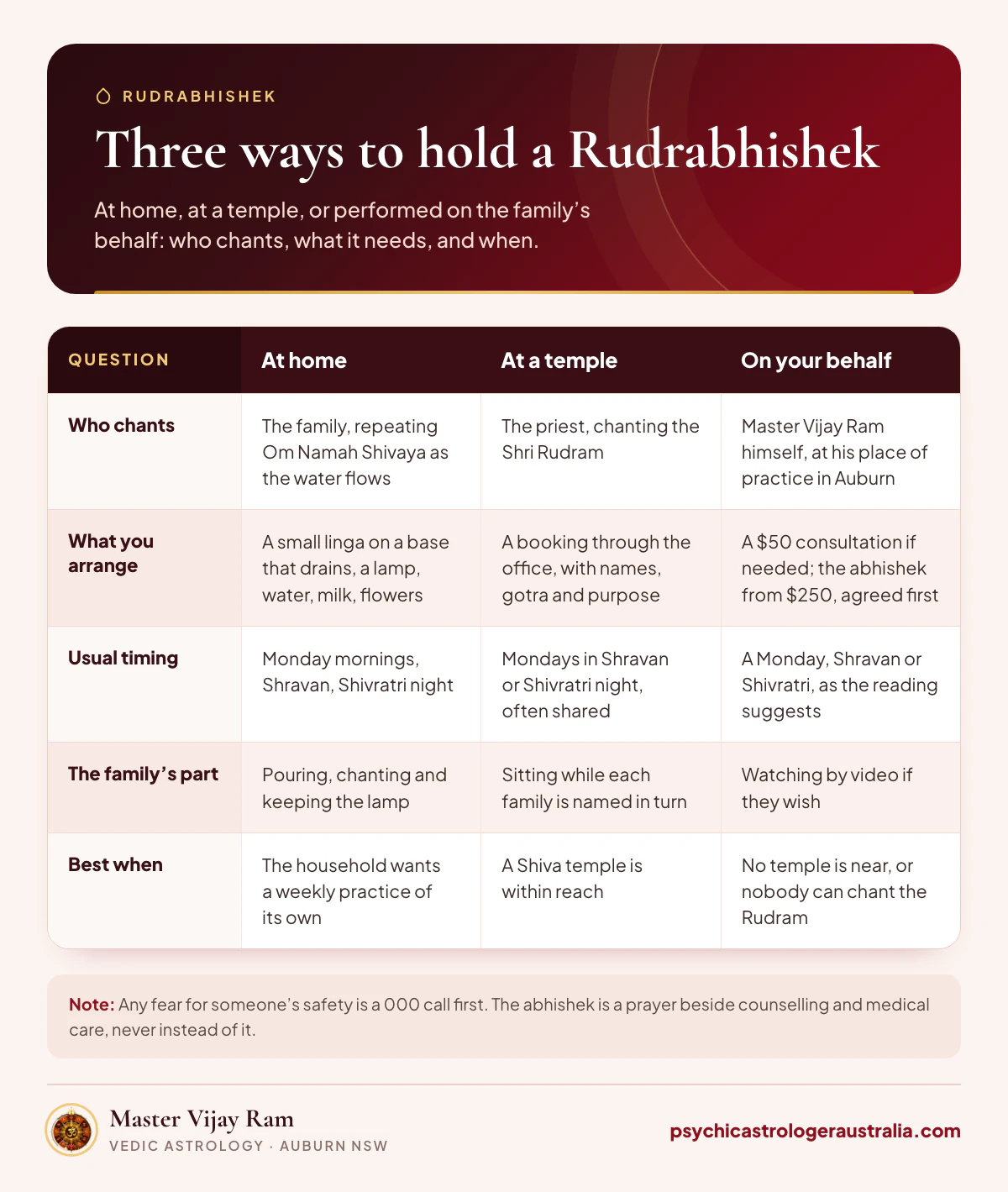
Yes, and many do every Monday. A Rudrabhishek at home needs a small linga, often a smooth Narmada stone, set on a plate or base that drains into a bowl, a lamp, water, a little milk, bilva or white flowers, and someone who can repeat Om Namah Shivaya steadily while the water is poured. Children love to pour, and a slow, careful child does it as well as anyone.
Two practical points are easy to miss. The liquid that has run over the linga is offered back to the earth, diluted and poured on the garden or a pot plant, never down the toilet and never into a creek, a river or the sea; and milk or curd that has stood for an hour is not drunk as tirtha, however sacred, because it spoils like any other milk. The Maha Mrityunjaya mantra is the other Shiva mantra families often add.
What happens at a temple Rudrabhishek in Australia?
At a temple the family usually books through the office, gives the names, the gotra and the purpose for the sankalp, and sits while the priest chants the Rudram and performs the abhishek. Some temples hold a communal Rudra abhishek puja on Mondays in Shravan or on Shivratri night, where many families share one rite and each is named in turn.
In Melbourne the Shri Shiva Vishnu Temple at Carrum Downs is the obvious place to ask; in Darwin the Sri Sithy Vinayakar Temple at Malak is the community’s home and the first place to enquire. In Cairns and Townsville, where the community still gathers in halls while a temple is built, and on the Central Coast, families either keep a simple abhishek at home or ask for one to be performed on their behalf; readings for Darwin families explains how consultations work at a distance.
When does it make sense to have one performed on your behalf?
When nobody in the family can chant the Rudram, when there is no Shiva temple within reach, or when a reading has pointed to a particular trouble and a particular day. Vijay Ram ji then performs the Rudrabhishek himself at his place of practice in Auburn, with the household’s names and gotra in the sankalp, on a Monday, in Shravan or on Shivratri as the reading suggests, and the family can watch by video.
This starts from $250, a figure agreed with the family before the abhishek is performed. Nothing is posted to the house that the family has not asked for, and the abhishek is not repeated or extended without a fresh conversation.
What should happen in the house afterwards?
Many families sprinkle a little of the abhishek water through the rooms and over the threshold, light a lamp on the following Mondays, and keep the five-syllable mantra going quietly at the altar. That is the tradition’s part, and it is small on purpose.
The rest is the household’s own work: the family meeting that has been put off, the counselling appointment that is actually kept, the doctor’s follow-up, the apology that has been owed for months. The Rudrabhishek benefits families describe afterwards are almost always that the house felt calm enough for those conversations to happen.
What can a Rudrabhishek not do?
It cannot heal an illness, end a family’s arguments by itself, fix a leaking roof or keep anyone safe from a violent partner, and no priest can honestly promise any result from it. This page offers faith-based guidance, not medical, legal, financial or psychological advice, and where anyone is unsafe the first call is 000.
What it can do is give a household a shared act of prayer at a hard time, in a form thousands of years old, and a quieter week in which to begin the practical repairs. That is a real gift, and it is the honest size of it.
Read next
- Signs of Negative Energy in Your Home & How to Clear ItSigns of negative energy in a home, the ordinary causes to rule out first, and how nazar, heavier interference and me…
- House Cleansing for Negative Energy: A Room-by-Room Vedic GuideA room-by-room Vedic guide to house cleansing for negative energy: what to rule out first, what is safe to do yoursel…
- Negative Energy at Home? A Spiritual Cleansing Guide for Sydney ResidentsNegative energy at home in Sydney: what to rule out first, a room-by-room practice with household items, and what a r…
Frequently asked questions
What are the benefits of a Rudrabhishek?
In the tradition, a Rudrabhishek calms what is fierce and invites Shiva’s gentle, auspicious form, so families choose it for peace in a troubled house, for health in a hard year and as part of Saturn or Rahu remedies. In practical terms it gives a household a shared act of prayer. It cannot heal illness or end quarrels by itself, and no one can promise a result.
Can a Rudrabhishek be done at home?
Yes. A simple home abhishek needs a small linga on a base that drains, a lamp, water, a little milk, bilva or white flowers, and someone repeating Om Namah Shivaya while the water is poured. A priest or trained reciter is needed only for the full Shri Rudram. Return the abhishek liquid to the garden and never drink milk that has stood out.
Which day is best for a Rudrabhishek?
Monday is Shiva’s day and the ordinary choice, and the month of Shravan is the most favoured time of the year. Maha Shivratri, Saturday 6 March 2027, is the great night for it, and many families also keep the Pradosh evenings and the monthly Shivratri by their tithis. Where a reading suggests a particular date, a muhurat can be chosen.
What is the difference between the Namakam and the Chamakam?
Both are parts of the Shri Rudram in the Taittiriya Samhita. The Namakam, at 4.5, is built on the word namah and bows to Rudra in every form, beginning with his anger; it also contains the words namah shivaya. The Chamakam, at 4.7, is built on cha me, may this be mine, and asks for food, health, long life and prosperity.
What is poured on the Shiva linga in a Rudrabhishek?
Water first and last, and between them most commonly milk, curd, ghee, honey and sugar, the five ingredients of panchamrit. Many families add sugarcane juice, coconut water, sandal paste or rose water, and offer bilva leaves in threes, white flowers and bhasma. The order and the extras vary by family and region, and a small amount offered with devotion is enough.
What do you do with the water after a Rudrabhishek?
Many families sprinkle a little through the house and over the threshold. The rest is diluted and poured on the garden or a pot plant, never down the toilet and never into a creek, river or the sea, where puja items can count as littering or illegal dumping. Milk or curd that has stood out for an hour should not be drunk.
What is a Laghu Rudra?
A Laghu Rudra is a large form of the Rudrabhishek in which the Namakam is recited a hundred and twenty-one times, usually by eleven priests together, each completing the Ekadasha Rudra form. Larger still are the Maha Rudra and Ati Rudra, rare temple events with many priests over several days. A household normally needs nothing on that scale.
How is a Rudrabhishek on our behalf arranged, and what does it cost?
After a reading, Master Vijay Ram carries out the Rudrabhishek himself in Auburn, naming the household and its gotra in the sankalp, and the family can watch by video. Prices start at $250 and are agreed with the family before it is performed; a $50 consultation first checks whether the chart calls for it at all.
Is a Rudrabhishek done for Saturn or Kaal Sarp dosh?
Often. Shiva is held to be the lord of Saturn, so a Rudrabhishek is a traditional part of remedies for a hard Saturn period, and it is included in the Rahu and Ketu shanti performed for Kaal Sarp dosh at the great Shiva temples in India. Whether a particular chart needs it is a question for a reading, and often the answer is no.
People also ask
Why is Rudrabhishek done in Shravan?
Shravan is the month most devoted to Shiva, and its Mondays are kept with fasts and abhishek across north India. Families who keep a Rudrabhishek once a year usually choose a Shravan Monday. In 2027 the north Indian Shravan runs from 19 July to 17 August on the Sydney clock, and the amanta Shravan from the new moon of 2 August to that of 1 September.
Can a Rudrabhishek remove negative energy from a house?
In the tradition it settles a household and invites Shiva’s auspicious form, which is why families choose it after quarrels, illness or a death. A house that feels heavy also needs its ordinary causes checked: damp, mould, a gas heater, too little sleep, unresolved conflict. The abhishek is the prayer beside those fixes, not a substitute for them.
Who can perform a Rudrabhishek?
Anyone can offer a simple abhishek with water and Om Namah Shivaya at home, and families do it every Monday. The full Shri Rudram is usually chanted by a priest or a trained reciter, because it is long and the Vedic pronunciation is exacting. Temples take bookings, and it can also be performed on a family’s behalf with their names in the sankalp.
What is the Shri Rudram?
The Shri Rudram is a Vedic hymn to Rudra from the Krishna Yajurveda, in the Taittiriya Samhita at 4.5 and 4.7. Its first part, the Namakam, salutes Rudra in every form and contains the words namah shivaya; its second, the Chamakam, asks for the good things of life. It is the hymn chanted during a full Rudrabhishek.
References & further reading
Serving clients across Australia
Confidential consultations by phone, video & WhatsApp — including: