
Quick answer
Griha pravesh is the house-warming puja performed before a family sleeps in a new home: cleaning, a kalash and Ganesh puja, havan and vastu shanti, milk boiled over, and entry at an auspicious hour. In Australia a priest does it at the house, or Master Vijay Ram performs it personally with the family joining by video. A consultation is $50; the puja starts from $250.
What griha pravesh is, and why Australian families still do it
Griha pravesh is the Hindu rite of first entry into a home, a puja that cleanses the dwelling, invites the deities and the vastu purusha to dwell in it kindly, and marks the moment a building becomes a family's house. Griha pravesh is older than any of the suburbs it is now performed in, and families in Perth, Canberra and Cairns do it for the same reason their grandparents did in Jalandhar or Ahmedabad: a house that is entered with prayer is a house the family has claimed, rather than one they have merely paid for.
Master Vijay Ram performs griha pravesh and the vastu shanti that often goes with it, personally, for families across Australia; his griha pravesh and home blessing page describes that service. This guide explains the rite itself, how the day is chosen, what to prepare, what an Australian apartment or rental allows, and what it costs.
The three kinds of griha pravesh
The texts distinguish three occasions for a house warming puja in Australia as anywhere else, and the distinction matters because the rules for the day differ.
| Kind | When it is done | Australian example | How strict the muhurat is |
|---|---|---|---|
| Apoorva (first entry) | A newly built home entered for the first time | A house-and-land package in Tarneit, Ripley or Ellenbrook handed over by the builder | Strictest: month, tithi, nakshatra and weekday all considered |
| Sapoorva (re-entry) | Returning to an existing home after a long absence, or moving into an established house that others have lived in | Buying a thirty-year-old brick home in Blacktown or Salisbury, or a rental | Moderate: a good tithi and weekday, with more latitude on the month |
| Dwandwah (re-entry after disruption) | After a calamity, a fire, a flood, a major renovation or a period of trouble in the house | Moving back after flood repairs in Ipswich, or after a renovation opened the walls | Lightest on timing; the cleansing and vastu shanti carry the weight |
Most Australian griha pravesh are sapoorva, because most families buy or rent an established home, and a sapoorva ceremony can be shorter and gentler than the full first-entry rite.
How is the day chosen?
A griha pravesh muhurat is chosen from the panchang against the family's charts, and the tradition has clear preferences: the brighter half of the lunar month, a tithi such as the second, third, fifth, seventh, tenth, eleventh or thirteenth, one of the fixed or gentle nakshatras, and a Monday, Wednesday, Thursday or Friday rather than a Tuesday. The months of Magha, Phalguna, Vaishakha and Jyeshtha are favoured for a first entry, the four months of Chaturmas from Dev Shayani to Dev Uthani Ekadashi are avoided for it, and Kharmas, the month or so from mid-December when the Sun sits in Dhanu, is set aside as well.
Australian life rarely cooperates with that calendar. Settlement falls on a date the conveyancer chose, the removalist is booked for a Saturday, and the lease starts on the first of the month, so the practical answer is to take possession when you must and hold the griha pravesh on the first good day afterwards, sleeping elsewhere or treating the interim nights as camping. How house-warming dates are chosen walks through the reasoning in detail, and a muhurat consultation fixes a day and an hour against your own charts rather than a generic list.
What to prepare before the day
Nothing on this list is exotic, and most of it is in a Harris Park or Dandenong grocer or already in the kitchen.
| Item | What it is for | Apartment-safe alternative |
|---|---|---|
| A kalash (brass or copper pot), water, mango leaves and a coconut | The kalash carried in at entry and set in the north-east | Any clean metal pot; the leaves from an Indian grocer |
| Ganesh and the family deities, or their pictures | The first puja, before any other | A printed image is enough |
| Rice, turmeric, kumkum, flowers, betel leaves, incense, camphor, ghee | Puja and havan offerings | Incense and camphor on the balcony, or omitted where alarms are sensitive |
| A new lamp and oil or ghee | The lamp lit at entry and kept burning through the day | An electric diya under a smoke alarm |
| Milk, a new pot and sugar or rice | Boiled until it overflows, for abundance; then kheer or sweet rice as prasad | Any stove, with the pot watched |
| A rangoli at the door and a toran of mango leaves or marigolds | Welcome at the threshold | A rangoli sticker or a small mat; a cloth toran that leaves no mark |
| Sweets and a meal | Prasad for the family and guests; feeding others is part of the rite | Ordered in, if the kitchen is not unpacked |
The griha pravesh vidhi, step by step
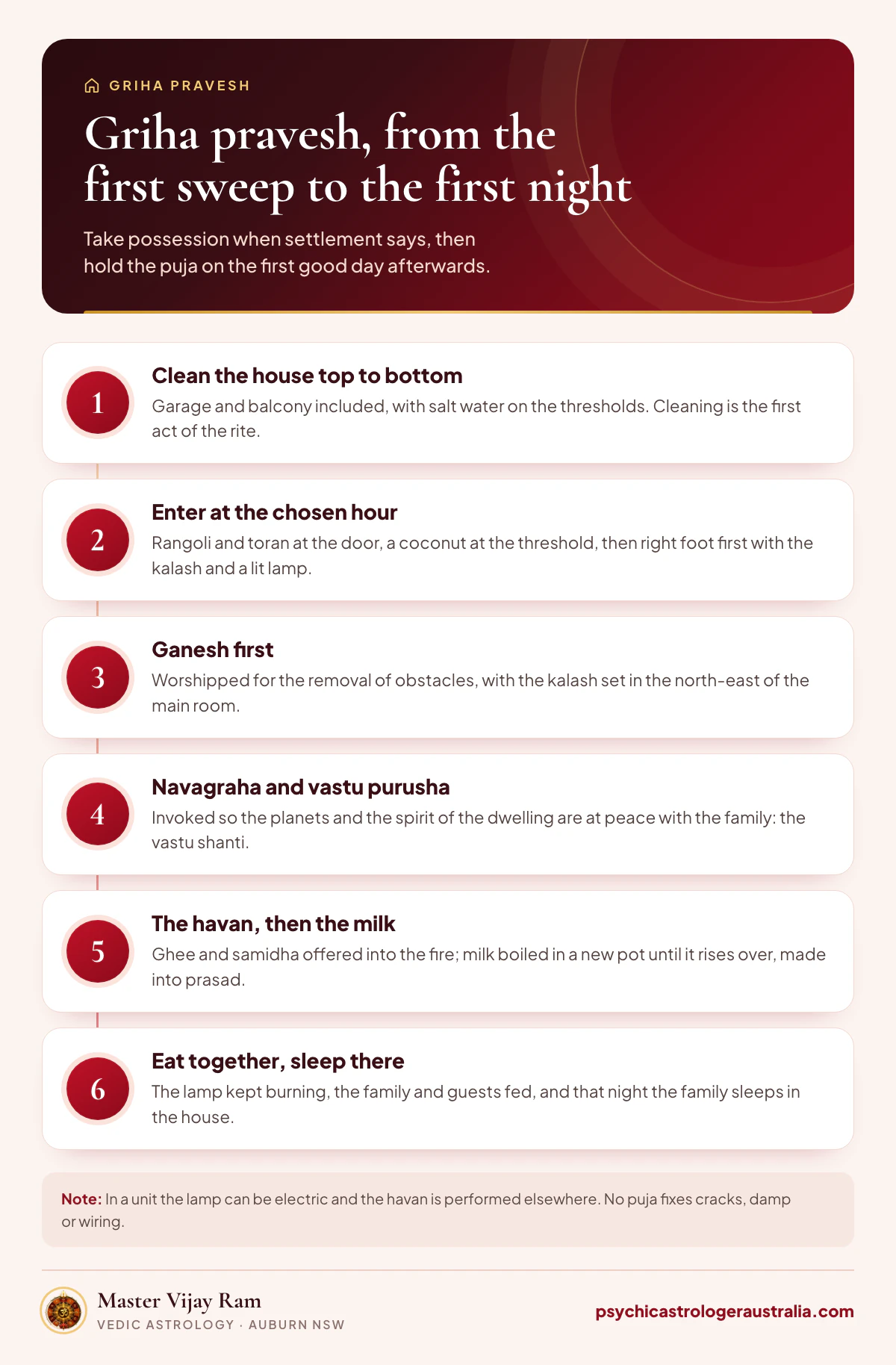
A priest will have his own order, and regional customs differ between a Gujarati, a Punjabi and a Tamil household, but the griha pravesh vidhi most families recognise runs like this.
- The house is cleaned top to bottom, including the garage and the balcony, with salt water on the thresholds; cleaning is itself the first act of the rite.
- A rangoli is drawn at the door and a toran hung, and the family gathers outside at the chosen hour.
- The householder breaks a coconut or offers one at the threshold, and the family enters with the right foot first, the woman of the house carrying the kalash and the man a lit lamp, or the other way about in some families.
- Ganesh is worshipped first, for the removal of obstacles, with the kalash set in the north-east of the main room.
- The navagraha and the vastu purusha are invoked, so that the planets and the spirit of the dwelling are at peace with the household; this is the vastu shanti, and the part a dosha in the layout is addressed through.
- The havan is performed with ghee and samidha, the family offering into the fire with the mantras.
- Milk is boiled on the stove in a new pot until it rises over, the first cooking in the house, and made into prasad.
- The lamp is kept burning, the family and any guests eat together, and that night the family sleeps in the house rather than returning to the old one.
Strata, smoke alarms and rentals: doing it in an Australian home
A havan in a Parramatta or Docklands apartment is usually impossible: the alarm is wired to the building, the by-laws forbid open flame on the balcony, and a neighbour will ring the fire brigade. Families do what the tradition has always allowed: the puja is performed with a small ghee lamp or an electric diya, the milk is boiled, the mantras are said, and the havan itself is performed elsewhere, by the temple or by Master Vijay Ram at his own place of practice on the same day.
A renter can hold a full sapoorva griha pravesh without touching a wall. The rangoli is a mat, the toran is cloth, the kalash sits on a shelf, and nothing is nailed, painted or burnt. A new house puja is about claiming the home for the time you live in it, not about owning the title, and plenty of families in Westmead and Clayton do it on a twelve-month lease.
Who performs it: your temple, your family, or Master Vijay Ram?
If your temple has a priest who comes to homes, book him; a griha pravesh performed in the house by someone who knows the family is the tradition at its best. Many Australian suburbs have no such priest within reach, the temple cannot spare one on a weekday, or the family wants the vastu shanti read against their own charts rather than performed from a standard script.
In that case Master Vijay Ram performs the griha pravesh and vastu shanti personally at his own place of practice in Auburn on the muhurat chosen for the family, with the sankalp in the householders' names and gotra, while the family does the home part of the rite at the same hour: the entry, the kalash, the lamp and the milk. The online puja and havan page explains how a rite performed personally is witnessed and what is sent afterwards. He does not travel to houses, in Sydney or anywhere else, and that is said plainly before anything is booked.
What a griha pravesh performed from Auburn involves for the family
The consultation comes first: the kind of entry, the house and its directions, settlement and removalist dates, and the birth details of the householders. From those he fixes the day and the hour in your own time zone, so a family in Perth is given Perth time and a family in Brisbane the Queensland clock.
On the day the family cleans and prepares as above, joins by video if they wish to watch the havan and the sankalp, and performs the entry, the kalash, the lamp and the milk at home at the hour given. Afterwards they keep the lamp burning through the day and sleep in the house that night. What arrives later is practical: a short daily practice for the first weeks, and where a kavach or prasad is part of the rite, it is posted.
Vastu shanti: when the house has a dosha you cannot change
An established house often has a layout the tradition dislikes: a kitchen in the north-east, a toilet over the brahmasthan, a main door in the south-west. The vastu shanti within the griha pravesh is the traditional answer where the fault cannot be moved, and it is paired with the ordinary fixes of use and arrangement. Vastu remedies without demolition lists those fixes, and a Vastu consultation reads the plan before the puja so the shanti addresses what is actually there.
Nobody should be told to knock down a wall before a house-warming. A consultant who says so is selling a renovation.
After the puja: the first night and the first week
The family sleeps in the house on the night of the griha pravesh, even on a mattress among boxes; a house entered with prayer and then left empty for a week has, in the tradition's view, been entered twice. The lamp is lit each evening for the first week, the kalash water is sprinkled through the rooms on the last day, and the first guests are fed.
If the house still feels wrong a month after all of that, the cause is almost never the rite. Why a new home feels wrong goes through the ordinary reasons, from the previous occupant to a sealed new build, and protecting a new house before moving in covers the rarer worry families bring to the phone.
What a griha pravesh cannot do
It cannot fix a building. Cracks, damp, wiring, a leaking roof and a settlement dispute belong to the building inspector, the electrician, the builder and the conveyancer, and a puja performed over them is a blessing on a problem. It cannot make a mortgage smaller, a commute shorter or an in-law kinder.
Griha pravesh is offered as guidance and a matter of faith, never as a substitute for medical, legal or financial advice, and a family that feels unwell in a new home is sent to a GP and an inspector before any rite is discussed.
What does a griha pravesh cost?
A consultation is $50, and spell or prayer work, where it is warranted, starts from $250. A griha pravesh with vastu shanti performed personally falls under that second figure, and the amount is agreed with you before anything is performed, after the kind of entry and the house have been discussed.
A temple priest who comes to the house sets his own dakshina, and families should ask it before the day. What should make anyone careful is a price that rises on the day, a list of expensive items that must be bought from the priest, or a griha pravesh sold as a cure for a house that has a leak.
Where families book from
Griha pravesh enquiries follow the new estates and the family suburbs: Perth's northern corridor and Canning Vale, the Canberra suburbs of Gungahlin, Cairns and Darwin, where no priest may be within a day's drive, and the Brisbane growth areas of Logan and Ipswich. The Perth page and the Brisbane page explain how the work reaches each city, and the rite is the same wherever the house stands.
Read next
- Energy Cleansing for a Car, a Shop and a Rental PropertyEnergy cleansing for a new car, a shop and a rental property: what the customs do, what a tenant may and may not do, …
- Moving Into a Rental: A Simple Muhurat and BlessingMoving into a rental: how to pick the best day inside the dates your lease allows, and a short blessing with no nails…
- Diwali 2026 House & Aura Cleansing: Clear the Year's Heavy EnergyDiwali 2026 house and aura cleansing done honestly: clean first, use the Five-Lamp Check, and learn when heaviness is…
Frequently asked questions
Can griha pravesh be done in an apartment with a smoke alarm?
Yes. The entry, the kalash, Ganesh puja, the mantras and the milk boiled on the stove all happen without open flame, an electric diya replaces the ghee lamp where the alarm is wired to the building, and the havan itself is performed elsewhere on the same day, by the temple or by Master Vijay Ram at his own place of practice. Strata by-laws are never breached and nothing is burnt on the balcony.
Settlement is on a Tuesday. Do we have to wait for a muhurat?
Take possession when the conveyancer says and treat the first nights as camping if you need to; the griha pravesh is held on the first good day afterwards. Tradition prefers a Monday, Wednesday, Thursday or Friday, a bright-fortnight tithi and a gentle nakshatra, and a muhurat consultation fixes an hour against your own charts. Settlement dates and removalists are the ordinary reality, and the rite accommodates them.
We are renting. Is a griha pravesh still appropriate?
Yes, and common. A sapoorva griha pravesh claims the home for the time you live in it, and nothing in the rite needs permission: a mat for the rangoli, a cloth toran, the kalash on a shelf, the lamp electric if the alarm demands it. Families on a twelve-month lease in Westmead or Clayton do this every week of the year, and it is often the moment a rental starts to feel like home.
What is vastu shanti, and do we need it?
Vastu shanti is the part of the rite that invokes the vastu purusha, the spirit of the dwelling, and the navagraha, so that the house and the planets are at peace with the family. It carries the weight where the layout has a fault that cannot be moved, such as a kitchen in the north-east or a main door in the south-west. A vastu reading of the plan before the puja tells you whether the shanti needs to address anything in particular.
Does Master Vijay Ram come to the house for the griha pravesh?
No. He performs the griha pravesh and vastu shanti personally at his own place of practice in Auburn on the chosen muhurat, with the sankalp in the householders' names, while the family performs the home part of the rite at the same hour and can join by video. If your temple has a priest who visits homes, that is a fine choice too; the two are not in competition, and he will say so.
What should we do the night of the puja?
Sleep in the house, even on a mattress among the boxes. A home entered with prayer and then left empty for a week is, in the tradition's view, entered twice. Keep the lamp lit each evening for the first week, feed the first guests, and on the last day sprinkle the kalash water through the rooms. After that the house is simply lived in.
Which months are avoided for griha pravesh?
For a first entry the tradition sets aside Chaturmas, the four months from Dev Shayani Ekadashi to Dev Uthani Ekadashi, and Kharmas, the month or so from mid-December when the Sun sits in Dhanu; Magha, Phalguna, Vaishakha and Jyeshtha are the favoured months. A re-entry into an established home has more latitude, which is why most Australian families are not held hostage to the calendar.
How much does a griha pravesh cost?
A consultation is $50, and spell or prayer work, where it is warranted, starts from $250; a griha pravesh with vastu shanti performed personally falls under that second figure and is agreed with you before anything is performed. A temple priest who visits sets his own dakshina, which you should ask about before the day. A price that rises on the day or a long list of items to buy from the priest is the pattern to avoid.
We moved in weeks ago without a puja. Is it too late?
No. The rite can be performed after the fact as a sapoorva entry; the family steps out and re-enters at the chosen hour with the kalash and the lamp, and the rest of the vidhi follows. Many families do exactly this once the boxes are gone and the parents have flown in. Nothing about a delayed griha pravesh is a problem for the house.
What if the house still feels wrong after the griha pravesh?
Look at the building and the move before the rite. A sealed new build, a previous occupant's smell, damp, a long commute and a large mortgage all make a new home feel wrong for a season, and none of them is spiritual. If several signs began with a specific event and have outlasted the ordinary causes, that is the point for a separate conversation; a cleansing is a different rite from a blessing.
People also ask
What is done in a griha pravesh puja?
The house is cleaned, a rangoli and toran are set at the door, the family enters right foot first with a kalash and a lit lamp, Ganesh is worshipped, the navagraha and the vastu purusha are invoked in the vastu shanti, a havan is performed, milk is boiled until it overflows and made into prasad, and the family eats together and sleeps in the house that night.
Which day is good for griha pravesh?
A day in the bright half of the lunar month, on a tithi such as the second, third, fifth, seventh, tenth, eleventh or thirteenth, under a gentle nakshatra, on a Monday, Wednesday, Thursday or Friday, outside Chaturmas and Kharmas for a first entry. The exact day and hour are fixed from the panchang against the householders' charts, not from a generic list.
Can griha pravesh be done without a pandit?
A family can perform a simple entry themselves: cleaning, the kalash and lamp carried in, Ganesh puja, the milk boiled over and a meal shared, with the mantras they know. The havan and the vastu shanti are the parts that call for a priest or a practitioner, and those can be performed for the family at a distance on the same day where no priest is within reach.
Is griha pravesh necessary for a rented house?
It is not compulsory, but it is common and appropriate. A sapoorva griha pravesh claims the home for the time the family lives in it, requires nothing to be nailed, painted or burnt, and is often the moment a rental starts to feel settled. Families in Sydney and Melbourne apartments do it on twelve-month leases without any difficulty with the agent.
How much does a griha pravesh puja cost in Australia?
A temple priest who visits sets his own dakshina. With Master Vijay Ram, a consultation is $50 and the griha pravesh with vastu shanti, performed personally and agreed before anything is performed, starts from $250. The items for the home part of the rite cost little and most are already in an Indian kitchen or a suburban grocer.
References & further reading
Serving clients across Australia
Confidential consultations by phone, video & WhatsApp — including: