
Quick answer
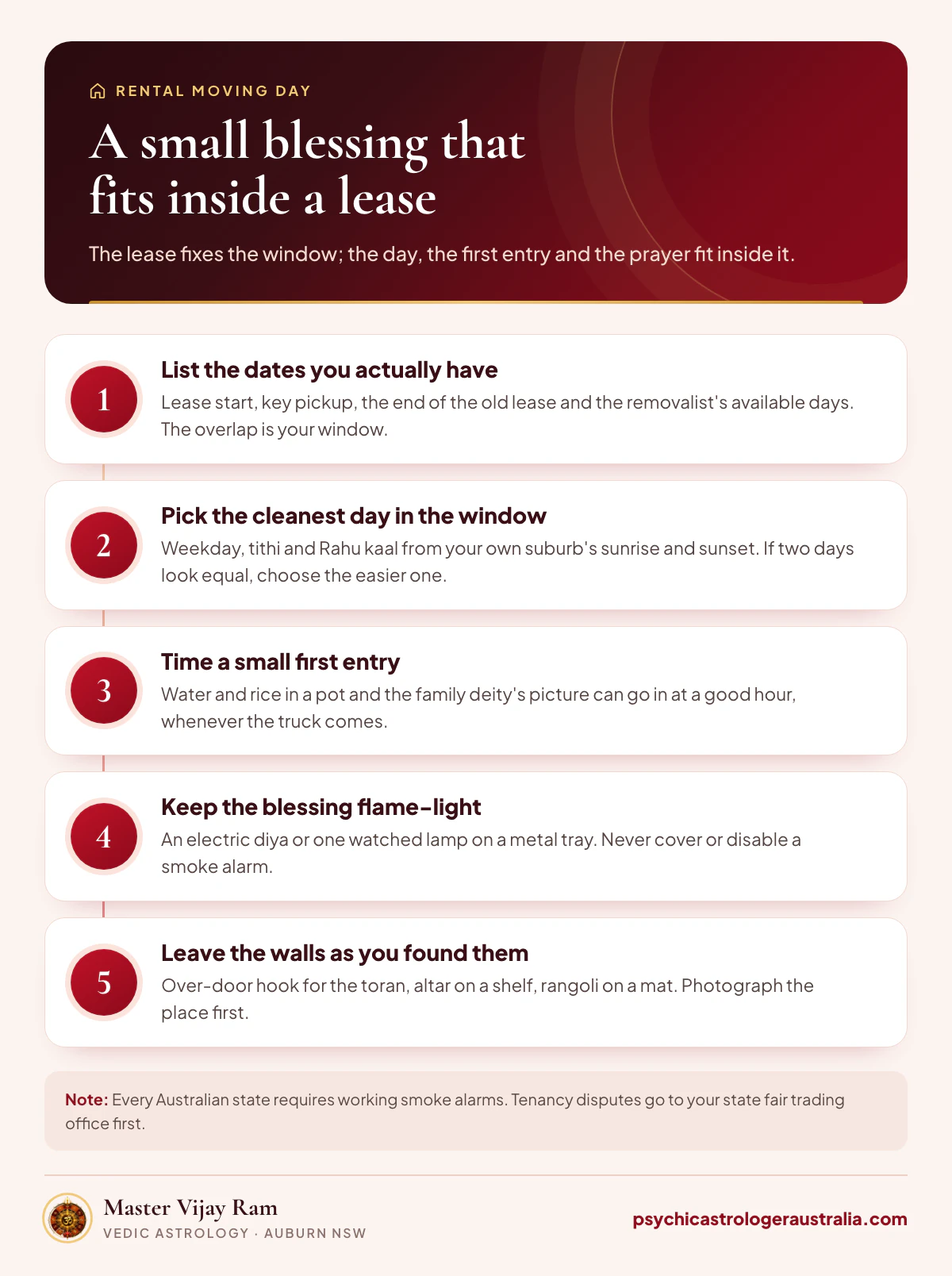
When you rent, the lease sets the dates and the muhurat works inside them. Take the days between getting the keys and the truck arriving, avoid Rahu kaal on the chosen day, and keep the blessing small: water at the door, a lamp that is electric or watched, milk warmed on the stove, a prayer. Nothing nailed, nothing burnt unattended, no alarm covered.
What is a rental muhurat, and why does it look different?
A moving into rental muhurat is a modest choice of day and hour that lets a tenant start a lease with a prayer, working inside the dates the agent and the lease have already fixed. An owner building a house can wait months for the right month and lagna. A tenant usually gets a start date by email, a key pickup time, and a removalist who can come on Thursday or not at all.
So the question changes. It is no longer “which day in the year is best?” but “which of the four or five days I actually have is the cleanest, and which hour on it?” That is a smaller question, and it has a calmer answer.
Does a tenant need a muhurat at all?
Need is too strong a word. Many families feel that entering any home, owned or rented, deserves a pause at the door, and many others move on whatever day the truck comes and say a prayer that night. Both are respectable, and neither changes how the next twelve months go on its own.
What a little timing does give is a sense that the move was begun deliberately rather than in a rush. For a family who has moved three times in four years, from a Parramatta unit to a Blacktown townhouse to a house in Box Hill, that feeling of a proper start is often the real thing they are asking for. The muhurat and auspicious date service can pick the day; this page shows how to do most of it yourself.
Which dates does the lease actually give you?
Start with the paperwork, not the panchang. Write down the lease start date, the earliest day you can collect keys, the day your old lease ends, and the days the removalist can come. The overlap is your window, and for most renters it is somewhere between two days and a fortnight.
If you are still choosing between two properties, the signing itself can be timed; timing the signing of a lease covers that step. Once the lease is signed, the start date is a fact of the contract, and the muhurat respects it rather than arguing with it.
How do you choose the best day inside that window?
Traditional choices for entering a home weigh the weekday, the tithi and the Moon’s nakshatra. For a short-term rental most families keep it to three simple preferences and let the rest go.
| What to look at | What families usually prefer | If the lease leaves no choice |
|---|---|---|
| Weekday | Many avoid Tuesday and Saturday for entering a home; Monday, Wednesday, Thursday and Friday are commonly favoured | Move on the day you have and keep the blessing for the first preferred day after |
| Tithi (lunar day) | Many avoid Amavasya and the fourth, ninth and fourteenth tithis for beginnings (traditions differ) | Bring the boxes in; do the threshold prayer on a better day |
| Rahu kaal | Cross the threshold for the first time outside it | Wait it out; it is only one-eighth of the daylight |
| Disha shool | Some families avoid travelling in the weekday’s blocked direction | Ignore it for a move across the suburb; it is a travel custom |
| Family events | Not within a death in the family’s mourning period | Ask the family elder or your temple priest |
Traditions disagree on several of these, and a Punjabi family and a Telugu family may weigh the same day differently. If two days in your window look equal, pick the one that is easier for the people moving; a calm, well-organised move is a better start than a hurried one on a theoretically better day.
Which hour on the day, and how is Rahu kaal worked out?
Rahu kaal comes from local sunrise and sunset, so it changes by city and by season, and it is never the same clock time in Perth as in Sydney. Daylight is divided into eight equal parts; Rahu kaal is the eighth part on Sunday, the second on Monday, the seventh on Tuesday, the fifth on Wednesday, the sixth on Thursday, the fourth on Friday and the third on Saturday.
Look up your suburb’s sunrise and sunset, divide the daylight by eight, and you have it. Rahu kaal, yamaganda and gulika explains the method in more depth, along with the two other daily periods some families also avoid.
The keys come on one day and the truck on another: which counts?
Most families count the first time a member of the household steps in with the intention of living there. That can be the evening you collect the keys, carrying in a small bag rather than the whole house. Many families send in something symbolic first: a pot of water, a little rice, the family’s picture of Ganesha or Lakshmi, or the gutka from the gurdwara.
That small first entry can be timed to the hour while the boxes arrive whenever the truck does. It is a practical way round the usual problem, and it is how a tenant griha pravesh is commonly kept by families who cannot control the removal date.
What does a simple rental blessing involve?
A rental house puja can be a fraction of a full house-warming. A complete sequence with kalash, toran and havan is described in griha pravesh as it is done in Australia; a renter can choose a short version and still feel the house has been received properly.
- Clean before you bless: sweep and wipe the entry, kitchen and the place the altar will go.
- Enter with water and rice in a steel or copper pot, right foot first if your family keeps that custom.
- Set up a small altar on a shelf or a cloth-covered box, facing east or north if the room allows.
- Warm milk in a new or freshly cleaned pan until it rises, the old sign of plenty in the home.
- Say a short Ganesha prayer, then a prayer of your family’s own, and share something sweet.
Twenty quiet minutes is enough. The point is attention, not equipment.
How do you keep the blessing smoke-alarm safe?
Every Australian state requires working smoke alarms in homes, and a blessing must never involve covering, disabling or removing one. Most new rentals are units or townhouses with photoelectric alarms that react quickly to incense and camphor, and some are linked to the whole building.
Use an electric diya, or a single ghee lamp on a metal tray away from curtains and directly under nobody’s alarm, and never leave it unattended. Skip camphor and loose incense on the first day, especially if anyone in the house has asthma. Smoke-free cleansing for units and renters sets out what can replace each smoke without losing the meaning.
If a havan is wanted, it is better performed elsewhere than in a strata unit with a shared alarm system. Master Vijay Ram performs havans personally at his place of practice in Auburn, and the family can join by video from the new home; the details are on the online puja and havan page.
What does the lease say about altars, hooks and toran?
Read it before the first nail, because a new rental blessing should never cost you part of the bond. Many leases need the landlord’s consent for picture hooks, adhesive strips that peel paint, or anything fixed to a wall, and the entry condition report records the state of every surface. A toran hung on an over-door hook, a rangoli on a mat or done in chalk, and an altar on furniture all leave the walls exactly as you found them.
Photograph the place before you set anything up; it protects the bond as much as any prayer. If a dispute about the property arises, the state fair trading office or tenants’ advice service is the right first call, not an astrologer.
What if the previous tenancy ended badly?
Sometimes a family hears that the last tenants left after a separation, an illness or a long dispute, and they worry the mood stays in the rooms. The ordinary steps come first: a thorough clean, open windows, fixed taps and lights, and time to make the place your own.
If, after a few weeks of living there, the house still feels heavy in a way the family cannot shake, a griha pravesh and home blessing can be arranged. Nothing about a rental needs to be feared before you have even unpacked.
Students, share houses and short leases
An international student arriving in Brisbane for a February semester rarely has any say over a move-in date, and may share a kitchen with people of three faiths. The custom adapts: a small picture on a desk, water at the door, a prayer said quietly in the room that is yours.
Nobody in a share house should be asked to tolerate smoke or ritual they did not agree to. A blessing kept within your own room, with an electric lamp, honours both the custom and the housemates. Students in Queensland who want the day checked can book through an astrologer for Brisbane clients by phone or video.
What can a muhurat for a rental not do?
It cannot make a bad landlord fair, fix a leaking roof, or protect a bond that was not documented. A good day is a good beginning, nothing more, and it does not outweigh a careful inspection, a signed condition report and a tenancy kept by the rules.
Equally, a move on an imperfect day does not doom a tenancy. Families move on the day they are given every week, and the prayer they say once settled counts as much as one said at the perfect hour.
How does Master Vijay Ram help with a moving day?
Send him the dates your lease allows, the suburb, and the birth details of the head of the household if you would like the day matched to the family chart. He will name the best day and window inside those dates, or say plainly that any of them will do. A consultation is $50, by phone, video or WhatsApp, in English, Hindi or Punjabi.
If a puja or havan is wanted, it is performed by him at his place of practice in Auburn, starting from $250 and agreed before it is performed. He does not visit homes; the family joins by video if they wish.
Read next
- Griha Pravesh Muhurat 2027: How House-Warming Dates Are ChosenGriha pravesh muhurat 2027 for Australian homes: which months are open, the tithis, nakshatras and lagna used, abujha…
- Muhurat for Starting a New JobA new job muhurat in Australia: the employer sets the start date, so time the signature, the resignation and leaving …
- Diwali 2026 House & Aura Cleansing: Clear the Year's Heavy EnergyDiwali 2026 house and aura cleansing done honestly: clean first, use the Five-Lamp Check, and learn when heaviness is…
Frequently asked questions
Is griha pravesh necessary for a rented house?
Not necessary, but many families keep a short version because they want to enter any home with a prayer. A rented home can be received with water and rice at the door, milk warmed on the stove, a small altar on a shelf and a Ganesha prayer. A full puja with a havan is usually kept for a house the family owns or expects to live in for many years.
What if my lease starts on a Tuesday or a Saturday?
Take the keys and move the boxes in when the lease and the removalist allow. Many families then keep the symbolic first entry and the small blessing for the next favourable weekday. The lease date is a contract; the custom about weekdays is a preference, and traditions differ on it, so there is no reason to lose rent or pay extra fees to avoid a particular day.
Can I light a diya in a rental apartment?
Usually yes, with care, but check the strata by-laws and the lease. Use a single lamp on a metal tray, away from curtains and not directly under a smoke alarm, and never leave it unattended. An electric diya avoids the question entirely. Never cover, disable or remove a smoke alarm for any ritual; every Australian state requires them to work.
Should I boil milk on the first day in a new rental?
Many families do, letting milk rise in a clean pan as the old sign of plenty. It is a kitchen task rather than a flame ritual, so it sits comfortably within any lease. Stay with the stove while it heats, and share the milk or use it for tea or something sweet afterwards rather than wasting it.
Does the muhurat count from the key pickup or the moving day?
Most families count the first time someone from the household steps in intending to live there. That can be a small entry with a pot of water and a picture of the family deity on the evening you collect the keys, timed to a good hour, while the furniture follows whenever the removalist arrives. Customs vary, so follow your family elder if they have a view.
Can I put up a toran or hang pictures of deities in a rental?
Yes, as long as the method leaves the walls as you found them. An over-door hook for a toran, an altar on a shelf or a cloth-covered box, and a chalk or mat rangoli all avoid damage. Check the lease before using nails or adhesive strips, since many need the landlord’s consent, and photograph the walls at the start for the bond.
How much does it cost to have a rental moving day chosen?
A consultation with Master Vijay Ram is $50, by phone, video or WhatsApp, and covers choosing the best day and window inside the dates your lease allows. If a puja or havan is wanted, it starts from $250, agreed before it is performed, and is done personally at his place of practice in Auburn, with the family joining by video if they wish.
What if the new rental feels uncomfortable after we move in?
Give it time and do the ordinary things first: a deep clean, fresh air, repairs reported to the agent, furniture arranged the way you like. A new place often feels strange for a few weeks. If a heavy feeling persists well beyond that, a reading can look at the family’s chart and timing, and a home blessing can be arranged if it would help.
People also ask
Which day is good for shifting to a new rented house?
Many families prefer Monday, Wednesday, Thursday or Friday and avoid Amavasya and Rahu kaal on the day itself, though traditions differ. For a renter, the real choice is among the few days the lease and the removalist allow, so pick the best of those and keep a short prayer for the first preferred day if the move must fall elsewhere.
What should be taken first into a new rented house?
Customs vary, but many families carry in a pot of water, a little rice or salt, and the picture or murti of the family deity before any furniture. Some bring a lamp or a copy of a scripture. The idea is that the household’s faith and nourishment enter first, and the boxes follow.
Is Rahu kaal the same every day?
No. It is one of eight equal parts of local daylight, and which part it is depends on the weekday: the eighth on Sunday, the second on Monday, the seventh on Tuesday, the fifth on Wednesday, the sixth on Thursday, the fourth on Friday and the third on Saturday. Because sunrise and sunset change with place and season, the clock times change too.
Can you do a house warming without fire?
Yes. Water, rice, milk warmed on the stove, flowers, a mat rangoli, mantras and a shared sweet carry most of the meaning, and an electric diya can stand in for a flame. Where a havan is wanted, it can be performed at a temple or by a priest elsewhere while the family joins by video from the new home.
References & further reading
Serving clients across Australia
Confidential consultations by phone, video & WhatsApp — including: