

Quick answer
A vastu shanti after a renovation is chosen when the shape, entrance, kitchen, water or centre of a house has changed, not for paint or new floors. Approvals, a licensed builder and, in older homes, an asbestos check come first; the shanti follows the final clean. The consultation is $50 and the puja, performed in Auburn, starts from $250.
Why does a renovation raise a vastu question at all?
A vastu shanti after renovation is a puja that asks the vastu purusha, the presiding spirit of a site, and the nine planets to accept a home whose shape or use has changed. It belongs to the weeks after the builders leave, and it is chosen when walls, footprints, doors or kitchens have moved, not when a hallway has been repainted.
Tradition pictures the vastu purusha lying face down across the land, head toward the north-east and feet toward the south-west, with the house resting on him. A house that has stood for years is said to have settled into that arrangement, and cutting a new doorway, digging footings or moving the stove to another corner unsettles it. The shanti is the household's way of acknowledging the change instead of pretending the house is the one it was.
Master Vijay Ram treats this as a question about the new plan, never about fear. His vastu consultation lays the old and new plans side by side and says which changes matter in the tradition's terms and which do not.
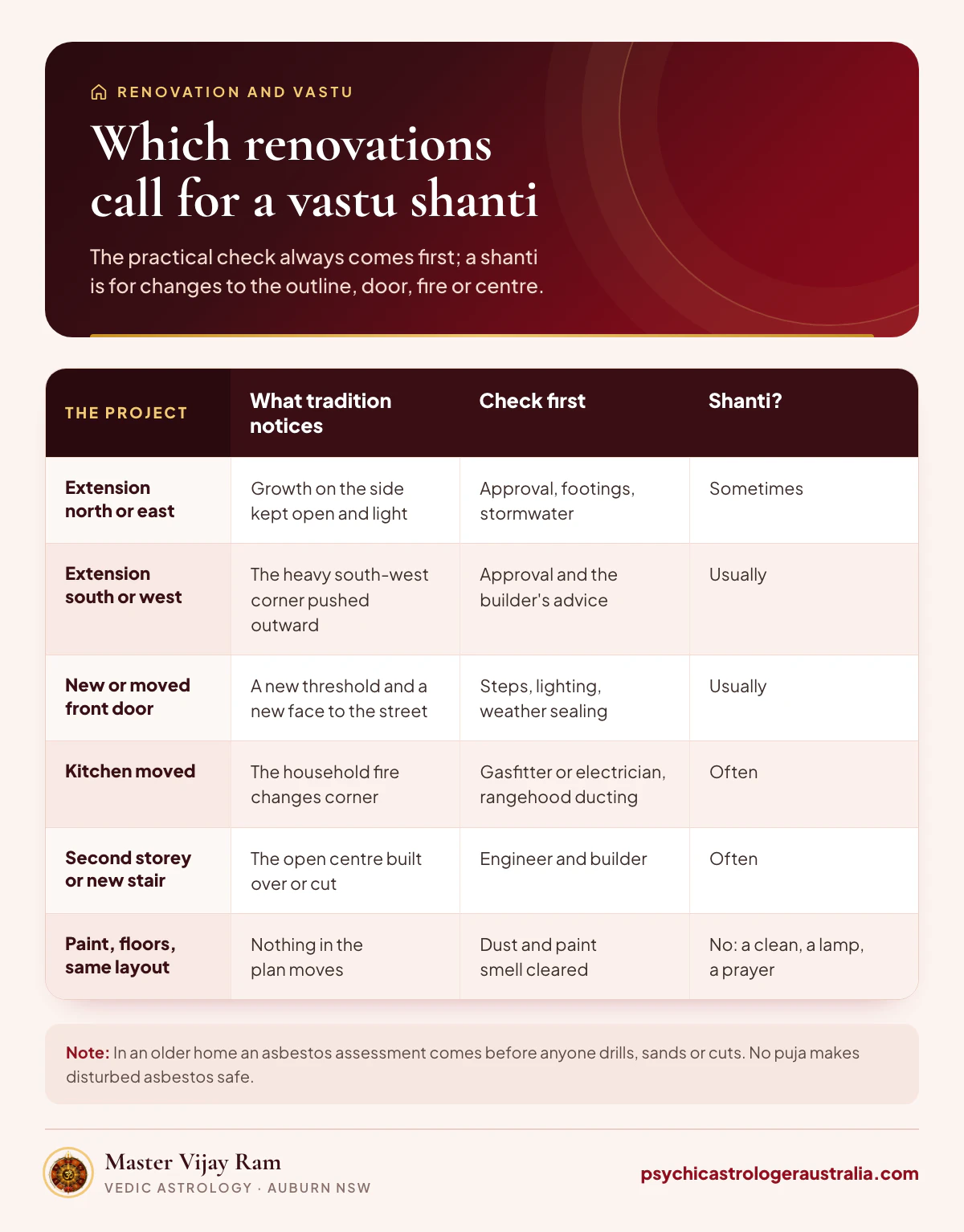
Which changes call for a shanti, and which need only a clean?
Most renovations are cosmetic in vastu terms. New carpet, replaced benchtops, fresh paint or a bathroom refitted where it always stood leave the plan exactly as it was, and a thorough clean, a lamp and a short prayer mark them well enough.
The changes the tradition notices are the ones that alter the house's outline, its threshold, its fire, its water or its centre. The table sets common Australian projects against what the tradition sees and the practical check that comes before any puja.
| The project | What the tradition notices | Check first | Shanti usually chosen? |
|---|---|---|---|
| Extension to the north or east | The house grows on the side vastu likes open and light | Approval, footings, stormwater | Sometimes; a short puja often suffices |
| Extension to the south or west | The heavy south-west corner pushed outward, which many texts dislike | Approval and a licensed builder | Usually, once the plan is read |
| A new or relocated front door | A new threshold and a new face to the street | Steps, lighting, weather sealing | Usually |
| Kitchen moved or cooktop turned | The household fire changes corner; the south-east is preferred | Licensed gasfitter or electrician; rangehood ducting | Often |
| Ensuite or toilet added in the north-east | Water and waste in the corner kept cleanest | Licensed plumber; waterproofing done properly | Often, alongside the no-demolition fixes |
| Second storey or a staircase through the middle | The brahmasthan, the open centre, built over or cut | Engineer and builder | Often |
| Granny flat in the back garden | A second dwelling on the same land | Approval for a secondary dwelling | An entry puja for whoever lives in it |
| Paint, floors, joinery, same layout | Nothing in the plan moves | Dust and paint smell cleared | No: a clean, a lamp, a prayer |
Most questions about home extension vastu come down to direction. Many texts welcome growth toward the north and east and are wary of a south-west that juts out, though traditions differ on the details, and the block, the setbacks and the council decide what can actually be built.
What must happen before any puja is booked?
The practical work comes first, and nothing spiritual replaces it. An extension, a new opening or anything structural usually needs approval from the council or a certifier, depending on the state and the job, and the work belongs with a licensed builder, with licensed electricians, plumbers and gasfitters for their parts. Ask the council or your builder what the project needs before anyone picks up a hammer.
Older homes bring one more question. An older house may contain asbestos, it cannot be identified by looking at it, and a licensed assessor checks before anyone drills, sands, cuts or demolishes. No mantra makes a disturbed asbestos sheet safe, and no reading should ever suggest skipping the assessment to save money.
Then the dust. Fine renovation dust settles in vents, wardrobes and carpets for weeks, and a house full of it smells stale and feels heavy. Wet-wipe every surface, run the exhaust fans, wash the soft furnishings and air the rooms before the family moves back, and if the heaviness lingers, work through the practical checks for mould, damp and gas before deciding the house needs anything else.
Can the start of the works have its own muhurat?
It can, and many families like the first blow of the hammer, or the first spade of soil for an extension's footings, to fall on a chosen day and hour. The builder's schedule decides when the crew arrives; the muhurat decides when the family offers a short Ganesh prayer at home and, with the builder's agreement, makes a first symbolic mark on the wall that is coming down.
Where an extension needs new footings, the ground-breaking is a small version of bhoomi pujan before you build. Choosing the hour belongs to a muhurat consultation: many families avoid starting during Kharmas, the month or so from mid-December when the Sun is in Dhanu, and traditions differ on whether the four months of Chaturmas that end at Dev Uthani Ekadashi are avoided too.
Once the site is handed to the builder it is a workplace, and the family enters on the builder's terms. A muhurat is never a reason to walk onto a live site without permission, a hard hat or closed shoes.
Where do the household deities go while the walls are open?
Many families move the home shrine before demolition starts. The murtis and pictures are wiped, wrapped in clean cloth and kept in a room the trades will not touch, or with relatives, and a small lamp continues at the temporary place each evening; an electric diya is the sensible choice in a dusty house or under a twitchy smoke alarm.
The shrine returns after the final clean, ideally on the day of the shanti, and families often take the chance to set it in the north-east or the east if the new layout allows. An image chipped in the move is cleaned and kept until a priest advises; it is not an omen.
What if the opened walls give up something strange?
Old houses surrender odd things when the plaster comes off: a newspaper, a bottle, a coin under a floorboard, a single worn shoe, a scrap of cloth. They are the leftovers of earlier builders, tenants and owners, sometimes their own customs, and none of them is a message aimed at your family.
Photograph the find if it interests you, put it out with the builder's waste, wash your hands and carry on. Nobody, whether a tradesperson, a previous owner or a neighbour, should be suspected because of it.
When should the shanti be held?
After the last trade has gone and the final clean is done, and before the family sleeps in the changed rooms if they moved out during the works. Families who lived through the renovation usually hold it on the next suitable muhurat once the kitchen is working, and many like the first proper meal in a rebuilt kitchen to be cooked after the prayer.
There is no deadline. A sensible order runs: final inspection and paperwork, the clean, the shrine back in place, then the shanti, so the prayer is offered for a house that is genuinely finished.
What does a vastu shanti after renovation involve?
The consultation comes first. Master Vijay Ram asks for the old plan and the new one, the compass bearing of the main entrance, photographs of the changed rooms and the birth details of the householders, then reads what moved: which corner grew, where the fire and the water now sit, and whether the centre of the house is still open.
The shanti follows the classical order. Ganesh is worshipped first, a kalash is established, the vastu purusha and the guardians of the directions are invoked, the nine planets are pacified and the havan carries the offerings, with a sankalp naming the address and the work done; he performs it personally at his place of practice in Auburn on the chosen muhurat, and the family may join by video.
At home the family's part is small: the last dust gone, the shrine back, and a lamp lit at the new threshold or in the new room at the hour of the puja. If the family moved out for the works, coming home is the dwandwah form of entry that the griha pravesh guide already covers, and nothing needs adding to it here.
Did we do wrong by renovating without one?
No. Plenty of families renovate, move back and live contentedly without any ceremony, and the tradition is not a penalty system that punishes an omission. A puja after renovation can be held months or years later, whenever the family feels the house has not quite settled or simply wants to mark the change.
What it should never be is a response to fear. A house that feels strange after a renovation is usually just unfamiliar: new sightlines, new echoes, a bedroom facing somewhere else, a kitchen that smells of paint instead of cooking.
The new layout breaks a vastu rule. What now?
Renovations are designed around light, budget and the block, and sometimes the result puts a toilet in the north-east or the main bedroom in the south-east. A renovation vastu dosh of that kind is handled in the order the tradition prefers: change how the room is used, rearrange what can move, add light, and only then let the shanti carry what cannot.
Nobody should be told to undo new work for vastu reasons. A reading that recommends tearing out a brand-new ensuite has stopped being guidance and become a second renovation quote.
Is a granny flat or a second storey a different case?
A granny flat is a second home on the same land, and the tradition treats it that way. Whoever moves in, often parents arriving from India or a grown child saving for a deposit, has a small entry puja of their own through the home blessing service, and the main house needs nothing unless the build changed its entrance.
A second storey is the larger change, because the house gains a floor, a staircase and often a new centre. A Brisbane family who lift an old Queenslander to build in underneath, to take one illustration, end up with a new ground floor, a new stair and frequently a new front door, and that combination is where a shanti is most often chosen.
Renovating to sell?
Many renovations are done to sell rather than to stay, and a shanti is not needed for a house you are about to leave. The gentler custom is a farewell, which a thank-you puja before moving out describes.
What does it cost, and who performs it?
The consultation is $50 and covers reading the before and after plans and saying plainly whether a shanti is warranted at all. Where one is, it starts from $250, the figure is agreed before anything is performed, and Vijay Ram ji performs it himself in Auburn, as the online puja and havan page explains.
He does not visit building sites or houses, here or interstate. A family in Adelaide, reading by phone or video renovating an old villa, or one in Perth moving the kitchen to the north-facing back of the house for the winter sun, sends the plans by WhatsApp and joins the puja on screen.
What can a shanti not do?
It cannot fix a defect, pass an inspection or make an unapproved extension lawful. Cracks, leaks, a sticking door in a new frame or a tripping circuit go back to the builder, and a dispute that will not resolve goes to your state's building or fair trading regulator, not to a priest.
A vastu shanti is faith-based guidance and prayer, not building, engineering, legal or medical advice, and no particular result from it can be promised. What it offers is a house deliberately welcomed back into use, and for many families that is the right last step after a long and expensive job; a cleansing after renovation that begins with a mop and ends with a lamp is often all a changed home needs.
Read next
- Vastu Remedies Without Demolition: Quick Fixes That WorkVastu remedies without demolition: the common doshas, the fixes of use, light and arrangement that need no builder, a…
- Coming Home After a Hospital Stay: Gentle Cleansing for Patient and HouseComing home after a hospital stay: the discharge plan first, then a fresh smoke-free room, a recovery sankalp, prayer…
- Diwali 2026 House & Aura Cleansing: Clear the Year's Heavy EnergyDiwali 2026 house and aura cleansing done honestly: clean first, use the Five-Lamp Check, and learn when heaviness is…
Frequently asked questions
Do we need a vastu shanti after every renovation?
No. Paint, new floors, replaced benchtops or a bathroom refitted in its old position leave the plan as it was, and a thorough clean, a lamp and a short prayer are enough. A shanti is considered when the outline of the house, its main entrance, the kitchen fire, a toilet in the north-east or the open centre has changed. The consultation reads the before and after plans and says which applies.
Which direction is best for a home extension in vastu?
Many vastu texts welcome growth toward the north and east, where the house is meant to stay open and light, and are wary of a south-west corner that juts outward. Traditions differ on the finer points. In practice the block, the setbacks and the council decide what can be built, so the plan is read once those limits are known, never in place of them.
Is asbestos really something to think about before a renovation?
In an older house, yes. Asbestos cannot be identified by looking at it, so a licensed assessor checks before anyone drills, sands, cuts or demolishes, and the builder follows that advice. This is a safety question, not a spiritual one, and no puja, mantra or reading makes disturbed asbestos safe. Book the assessment before the muhurat for the works, not after it.
How soon after the renovation should the shanti be done?
After the last trade has gone, the final inspection is done and the dust has been cleaned away, and before the family sleeps in the changed rooms if they moved out. Families who lived through the works usually hold it on the next suitable muhurat once the kitchen works. There is no deadline, and a shanti held a year later is just as valid.
Will Master Vijay Ram come and look at the renovated house?
No. He does not visit houses or building sites anywhere, and his only place of practice is in Auburn. He reads the old and new plans, the compass bearing of the entrance and photographs sent by WhatsApp or shown on a video call, and the shanti is performed in Auburn on the chosen muhurat with the family joining by video if they wish.
What does a vastu shanti after a renovation cost?
The consultation is $50, and it covers reading the plans and saying plainly whether a shanti is warranted. Where one is, it starts from $250 and the figure is agreed before anything is performed. Builders, assessors, electricians and plumbers are paid separately for their own work, which always comes first. Nothing is added on the day and nothing is sold to you.
Where should the home shrine go during the building work?
Many families wipe the murtis and pictures, wrap them in clean cloth and keep them in a room the trades will not touch, or with relatives, lighting a small lamp at the temporary place each evening. An electric diya suits a dusty house. The shrine goes back after the final clean, ideally on the day of the shanti, and often into the north-east if the new layout allows.
The builders found old objects inside a wall. Should we worry?
No. Old houses give up newspapers, bottles, coins, single shoes and scraps of cloth when the plaster comes off, left by earlier builders, tenants and owners. None of it is aimed at your family. Photograph anything that interests you, put it out with the builder’s waste and wash your hands. Nobody should be suspected because of a find in a wall.
Do we need another griha pravesh after renovating?
Only if the family moved out while the work was done. Coming home after major works is the dwandwah form of griha pravesh, the lightest on timing, and the vastu shanti is usually folded into it. A family that stayed in the house throughout needs only the shanti, if the plan calls for one, and the lamp at the new threshold.
People also ask
Is a puja necessary after a renovation?
Not after every renovation. Cosmetic work leaves the plan unchanged and a clean, a lamp and a short prayer are enough. Where the outline, entrance, kitchen, water or centre of the house has changed, many families choose a vastu shanti once the builders have gone. It is a custom of welcome, never an obligation, and no harm follows a family that skips it.
What is a vastu shanti?
A vastu shanti is a puja that asks the vastu purusha, the spirit of the site, and the nine planets to be at peace with a dwelling as it now stands. It includes Ganesh worship, a kalash, invocations to the guardians of the directions and a havan. It is chosen for a new home, a fault that cannot be moved, or a house changed by building work.
Can you extend a house according to vastu?
Yes. Many vastu texts favour extending toward the north or east and are cautious about pushing the south-west corner outward, though traditions differ. Council rules, setbacks and the builder’s advice decide what is possible first, and the plan is then read against the directions. A south or west extension is not forbidden; it is usually followed by a shanti.
When should construction not be started in Hindu tradition?
Many families avoid starting building work during Kharmas, the month or so from mid-December when the Sun is in Dhanu, and some also avoid the four months of Chaturmas that end at Dev Uthani Ekadashi. Traditions differ. A muhurat consultation chooses a day and hour from the family’s charts, while the builder’s programme decides when the crew actually arrives.
How do you cleanse a house after renovation?
Physically first: wet-wipe every surface, run the exhaust fans, wash curtains and cushions, and air the rooms until the dust and paint smell are gone. Then bring the shrine back, light a lamp at the new threshold or in the changed room, and offer a short prayer. A vastu shanti follows only where the plan itself changed in a way the tradition notices.
References & further reading
Serving clients across Australia
Confidential consultations by phone, video & WhatsApp — including: