

Quick answer
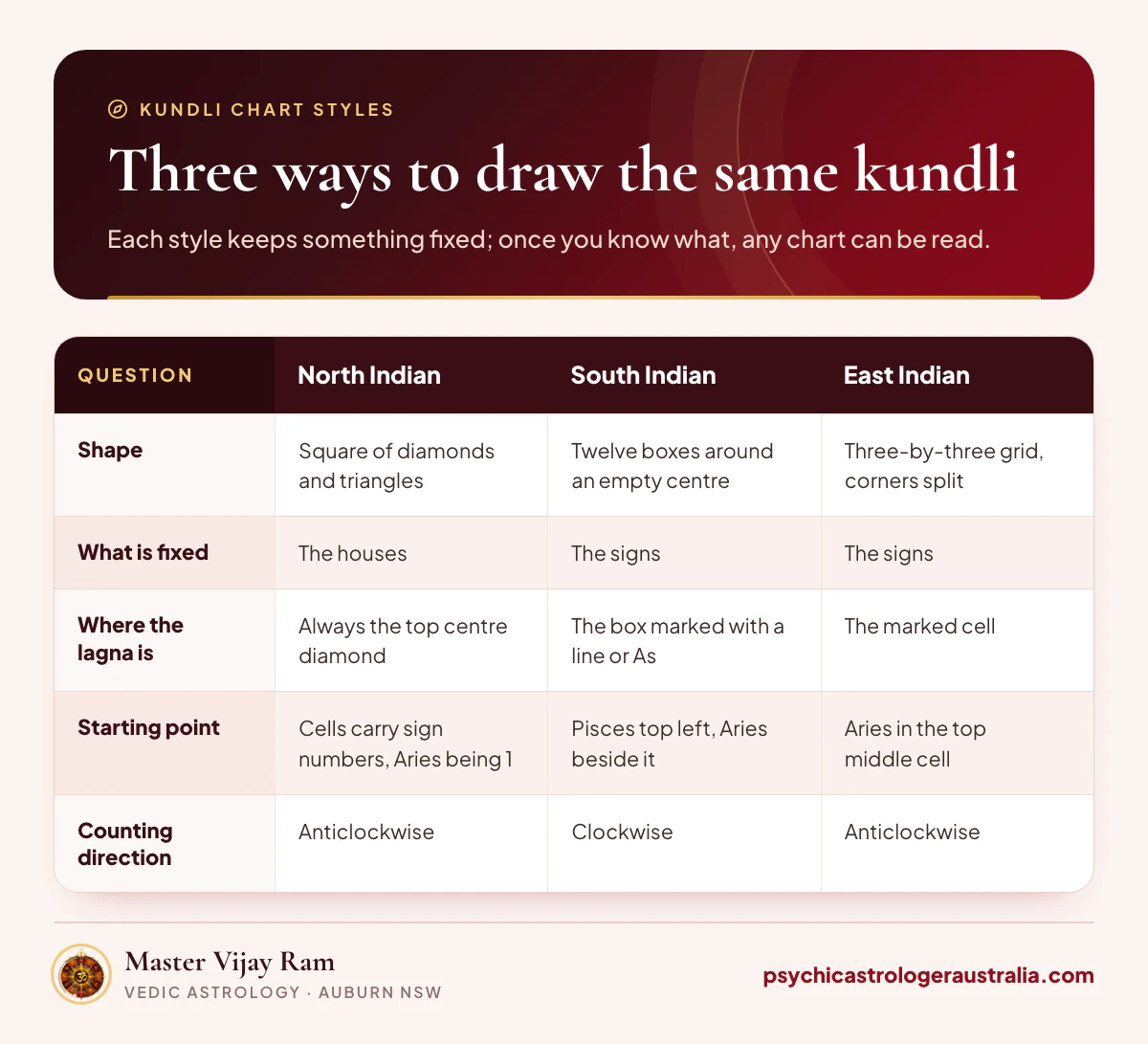
North and South Indian charts show exactly the same information drawn two ways. In the North Indian diamond chart the houses are fixed, the lagna is always the top centre diamond and the numbers are signs. In the South Indian square chart the signs are fixed, Pisces top left, and the lagna box is marked with a line or As. The reading is identical.
Why do kundli charts look so different?
A chart style is a way of drawing the same twelve houses, twelve signs and nine planets on paper, and India has three main ones. The North Indian chart is a square of diamonds and triangles, the South Indian chart is a square of twelve boxes around an empty centre, and the East Indian chart, used mainly in Bengal, Odisha and Assam, is a third arrangement. Families who move to Australia often bring charts in one style and meet astrologers or apps that use another.
The good news is that the information is identical. A planet in the seventh house in one style is in the seventh house in all of them; only the drawing changes. Once you know what each style keeps fixed, you can read any of them, and a kundli reading uses whichever style you are comfortable with.
What stays fixed in each style?
This is the single idea that unlocks every chart. In the North Indian style the houses never move and the signs rotate into them. In the South and East Indian styles the signs never move and the lagna, and with it the houses, moves around them. The table sets the three side by side, with the Western wheel for comparison.
| Style | What is fixed | Where the lagna is | What numbers mean | Direction of counting |
|---|---|---|---|---|
| North Indian (diamond) | The houses | Always the top centre diamond | Signs (1 Aries to 12 Pisces) | Anticlockwise |
| South Indian (square) | The signs | Whichever box is marked with a line or As | Usually none; signs known by position | Clockwise |
| East Indian | The signs | Whichever cell is marked | Usually none | Anticlockwise |
| Western wheel | The houses around a circle | Left side, at nine o'clock | Houses, with sign glyphs on the rim | Anticlockwise |
How is a North Indian chart laid out?
Draw a square, join its corners with two diagonals, and join the midpoints of its sides to form a diamond inside. That gives four diamonds and eight triangles: twelve cells. The top centre diamond is always the first house, the lagna, and the houses run anticlockwise from it, so the second house is the triangle to its upper left, the fourth is the left-hand diamond, the seventh is the bottom diamond and the tenth is the right-hand diamond.
The number written in each cell is the sign occupying that house: 1 for Aries through to 12 for Pisces. If the top diamond shows 5, the lagna is Leo, the second house holds 6, Virgo, and so on around. Planets are written inside the cell of the house they occupy, often with their degree beside them.
The great strength of the diamond chart kundli is that the houses are always in the same place. A reader sees at a glance that a planet is in the tenth or the seventh without counting. Its weakness is that the signs must be read from the numbers, which is where beginners slip.
How is a South Indian chart laid out?
Draw a square divided into a four-by-four grid and use only the outer twelve boxes; the centre four are left empty or hold the name and birth details. The signs are fixed. Pisces is the top left corner, Aries the box beside it, then Taurus, and Gemini in the top right corner, and the signs continue clockwise: Cancer, Leo and Virgo down the right side, Libra, Scorpio and Sagittarius along the bottom from right to left, and Capricorn and Aquarius up the left side.
The lagna is the box marked with a diagonal line across its corner, or with As, Asc, La or the Tamil Lagnam. Houses are then counted clockwise from that box, the lagna box being the first. Because the signs never move, a South Indian reader knows instantly that Saturn in the bottom left corner is in Sagittarius, whatever the lagna.
What about the East Indian chart?
The East Indian chart is a square divided into a three-by-three grid, with the four corner squares each split diagonally into two triangles. That gives four middle cells and eight triangles, twelve in all, with the centre left blank. Like the South Indian style it fixes the signs, but it places Aries in the top middle cell and runs anticlockwise.
Families from Bengal, Odisha and Assam are the ones most likely to hold an East Indian chart, often hand-drawn in a family patri. If yours is one and you are unsure, find the cell the astrologer marked for the lagna and the planet list beside the chart, and check the signs from that list.
How do you find the lagna in each style?
In a North Indian chart, look at the top centre diamond: the number there is the lagna sign. In a South Indian chart, look for the marked box; its fixed position tells you the sign. In an East Indian chart, look for the marked cell and read its sign from its position, counting anticlockwise from Aries at the top.
Always check the result against the planet table on the printout, where the lagna is listed as As or La with its sign and degree. If the chart and the table disagree, something has been misread. The lagna, or rising sign, explained covers why this one point carries so much weight.
A worked example: one chart in both styles
As an illustration, take a chart with Leo rising, the Moon in Taurus and Saturn in Aquarius. In the North Indian style, the top centre diamond shows 5 for Leo. Counting from Leo, Taurus is the tenth sign, so the Moon is written in the right-hand diamond, the tenth house, which carries the number 2. Aquarius is the seventh sign from Leo, so Saturn sits in the bottom diamond, the seventh house, numbered 11.
In the South Indian style, the lagna mark goes on the Leo box, the third box down the right-hand side. The Moon is written in the Taurus box, third along the top row, and Saturn in the Aquarius box, second down the left-hand side. Count clockwise from Leo to Taurus and you reach ten; from Leo to Aquarius, seven. The houses come out exactly the same: Moon in the tenth, Saturn in the seventh.
Doing this once with your own chart, converting it from one style to the other on a piece of paper, is the fastest way to stop being confused by either.
What are the common mistakes with each style?
The commonest North Indian mistake is reading the numbers as house numbers. A 7 in the top diamond does not mean the seventh house; it means the lagna is Libra. The commonest South Indian mistake is forgetting to find the lagna mark and reading the top left box as the first house, when it is simply Pisces.
Other slips are mixing styles mid-reading, counting in the wrong direction, and reading a Western wheel's signs with Vedic rules. The Western chart uses the tropical zodiac, about 24° away from the Vedic one, so its signs usually differ from both Indian charts. The beginner's guide to a birth chart covers that difference.
Does the style change the reading at all?
No. The positions, the houses, the aspects, the yogas and the dashas are the same whichever way the chart is drawn. Style is a matter of habit and region: many astrologers from the north read diamonds fastest and many from the south read squares fastest, and good software can print either.
What matters far more is that the birth details behind the chart are right. Two charts in different styles that disagree on the lagna are not a style problem; they come from a different time, place, time zone or ayanamsa. Check those before comparing anything else.
What if two families bring charts in different styles?
This happens often in Australian matchmaking, where a Punjabi family's diamond chart meets a Tamil family's square chart. Nothing is lost: the astrologer reads both, or redraws one in the other's style, and the matching proceeds from the Moon nakshatras and the houses as usual. Kundli matching for compatibility works with any style.
The divisional charts follow the same rule. A navamsa printed in the South Indian style is read exactly like one in the North Indian style, and the navamsa chart explained shows what it adds to marriage questions.
Which style should you use?
Use the one your family and your astrologer use, so everyone is looking at the same picture. If you are starting fresh, choose the style that feels easier: people who think in houses often prefer the North Indian diamonds, and people who think in signs often prefer the South Indian squares. Most apps let you switch with one setting.
Learning to read both takes an afternoon and saves confusion for years. A beginner's map of the kundli printout takes the next step, from the chart to the pages around it.
What can a chart style not tell you?
A chart in any style is a picture of positions, and it describes tendencies and timing rather than fixed outcomes. It cannot answer a medical, legal or financial question, and reading it well takes more than knowing the layout. When you want the positions weighed rather than located, that is the point to ask.
Master Vijay Ram reads charts in any style by phone, video or WhatsApp, in English, Hindi or Punjabi, and a consultation is $50. Clients send diamond charts from Adelaide and square charts from Hobart alike, and readings for the Gold Coast run the same way.
Read next
- Retirement Timing and the ChartRetirement timing and the chart: super and health first, then what the tenth, twelfth and ninth houses, Saturn and th…
- How to Read Your Own Kundli: A Beginner’s MapHow to read your own kundli printout page by page: birth details, the planet table and its symbols, the D1 chart, the…
- Kundli Reading Explained: What Your Birth Chart RevealsWhat a Kundli reading reveals about your life, personality, career and destiny. Master Vijay Ram explains Vedic astro…
Frequently asked questions
What is the difference between North Indian and South Indian charts?
They show the same information drawn two ways. The North Indian chart fixes the houses, with the lagna always in the top centre diamond and sign numbers written in each cell. The South Indian chart fixes the signs, with Pisces in the top left box, and marks the lagna box with a diagonal line or As. The reading is identical.
How do I find the ascendant in a North Indian chart?
Look at the top centre diamond. That cell is always the first house, and the number written in it is the lagna sign, from 1 for Aries to 12 for Pisces. A 7 there means Libra rising, not the seventh house. Check it against the lagna row in the planet table on the printout.
How do I find the lagna in a South Indian chart?
Look for the box marked with a diagonal line across its corner, or with As, Asc, La or Lagnam. Its fixed position gives the sign: Pisces top left, Aries beside it, and the signs continuing clockwise. Houses are then counted clockwise from that box, which is the first house.
What do the numbers in a North Indian chart mean?
They are sign numbers, not house numbers: 1 Aries, 2 Taurus, 3 Gemini, 4 Cancer, 5 Leo, 6 Virgo, 7 Libra, 8 Scorpio, 9 Sagittarius, 10 Capricorn, 11 Aquarius and 12 Pisces. The houses are fixed by position, the top centre diamond being the first and the rest running anticlockwise.
What is an East Indian chart?
It is the style used mainly in Bengal, Odisha and Assam: a square divided into a three-by-three grid with the corner squares split diagonally, giving twelve cells. Like the South Indian chart it fixes the signs, but it places Aries in the top middle cell and runs anticlockwise. The lagna cell is marked.
Does the chart style change the prediction?
No. The positions, houses, aspects, yogas and dashas are the same in every style. If two charts of the same person disagree on the lagna or the houses, the cause is different birth details, time zone or ayanamsa, not the style. Check those before comparing anything else.
Can kundli matching be done with charts in different styles?
Yes. An astrologer reads both or redraws one in the other's style, and matching proceeds from the Moon nakshatras, the houses and the rest of the chart as usual. In Australia this is common when families from different regions meet, and nothing is lost in the conversion.
Which chart style is better?
Neither is better; they carry the same information. The North Indian diamond makes the houses easy to see, and the South Indian square makes the signs easy to see. Use the style your family and astrologer use, and learn the other by converting your own chart once on paper.
People also ask
Why is the North Indian chart diamond shaped?
Joining a square's corners with diagonals and its side midpoints with a diamond produces twelve cells, four diamonds and eight triangles, with the first house at the top centre. The shape keeps every house in a fixed place, so a reader can see the house of each planet without counting.
Which box is Aries in a South Indian chart?
Aries is the second box of the top row, immediately to the right of Pisces in the top left corner. The signs then run clockwise: Taurus, Gemini in the top right corner, Cancer, Leo and Virgo down the right side, and so on around the square.
Is the Western birth chart the same as a kundli?
It is built from the same sky but uses the tropical zodiac, about 24° away from the sidereal zodiac of Vedic astrology, and it is drawn as a wheel with the ascendant on the left. Its signs usually differ from both Indian chart styles, so its sign placements should not be read with Vedic rules.
How do I convert a South Indian chart to North Indian?
Find the lagna sign from the marked box and write its number in the top centre diamond of a blank North Indian chart. Write the following sign numbers anticlockwise around the cells, then copy each planet into the cell carrying its sign number. The houses will match the original chart exactly.
References & further reading
Serving clients across Australia
Confidential consultations by phone, video & WhatsApp — including: