

Quick answer
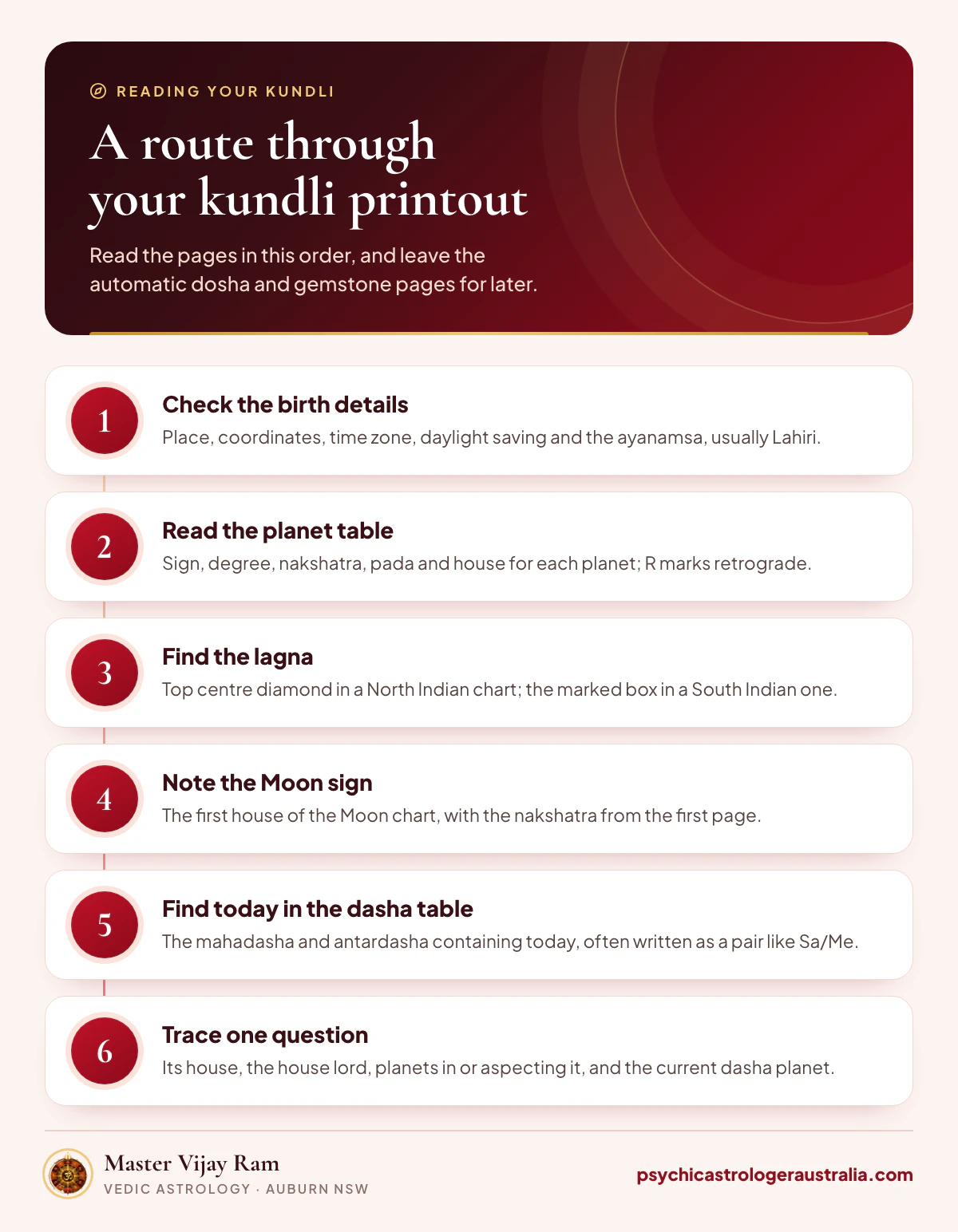
To read your own kundli, work through the printout in order: check the birth details page, read the planet table's columns, find the lagna in the main chart, note the Moon sign, then find today's row in the dasha table. Trace one question at a time through its house, the house lord and the running dasha, and leave the automatic dosha pages until later.
What is a beginner's map of a kundli?
A kundli printout is a set of pages that a pandit or a software program produces from your date, time and place of birth, showing the planets' positions, the charts drawn from them and the timing periods ahead. Most people are handed ten or twenty such pages and have no idea which one to look at first. This map is a route through those pages, in the order that makes sense, so you can read your birth chart yourself without getting lost.
The basic ideas, what the lagna, the houses and the nine grahas mean, are set out in the beginner's guide to reading a birth chart. This page assumes you have that open beside you and concentrates on the paper itself: what is printed where, what the abbreviations mean and how to trace one question through it. A full kundli reading goes much further, but a map makes that reading easier to follow.
What is on each page of a typical kundli printout?
Layouts differ between software and between pandits, but most printouts contain the same pages in roughly this order. The table shows what each holds and whether a beginner needs it now.
| Page | What it shows | For a beginner |
|---|---|---|
| Birth details | Date, time, place, coordinates, time zone, ayanamsa, sunrise, the panchang at birth | Read first, to check |
| Planet table | Each planet's sign, degree, nakshatra, pada and house | Read now |
| Lagna chart (D1) | The main birth chart | Read now |
| Moon chart | The same chart with the Moon's sign as the first house | Glance now |
| Navamsa (D9) and other vargas | Divisional charts | Later |
| Vimshottari dasha table | Planetary periods with start and end dates | Read now |
| Ashtakavarga and shadbala | Strength scores in numbers | Much later |
| Dosha reports, predictions, gemstones | Automatic text | Skip for now |
What should you check on the birth details page?
Everything else rests on this page, so check it before reading anything. The date and time should match your record, the place should be your birthplace rather than where you live, and the latitude and longitude should match that town. The time zone should be the one in force there on that date, with daylight saving applied only if that state used it that summer.
Look for the ayanamsa. Most Indian astrologers use Lahiri, and a printout using a different one can shift planets near a sign edge. The page usually also shows sunrise and the panchang at birth: the tithi, the Moon's nakshatra, the yoga and the karana. Write down the nakshatra; you will meet it again on the dasha page.
How do you read the planet table?
The planet table is the most useful page on the printout, because it gives exact positions that the chart diagrams only summarise. Each row is a planet, usually abbreviated: Su, Mo, Ma, Me, Ju, Ve, Sa, Ra and Ke, with As, Asc or La for the lagna. The columns normally give the sign, the degree within it, the nakshatra and its pada, and the house counted from the lagna.
Two small marks matter. An R beside a planet means it was retrograde, moving backwards from Earth's point of view, and some printouts mark a planet too close to the Sun with C, Ast or a similar note for combust. What retrograde, or vakri, really means explains why neither mark is a verdict.
Note any planet at the very start or end of a sign, below about 1° or above about 29°. Those are the positions most sensitive to a small error in the birth time, and an astrologer will treat them with care.
How do you find the lagna in the main chart?
The main chart, the D1 or rashi chart, is drawn in one of three styles, and the lagna is marked differently in each. In the North Indian diamond chart the lagna is always the top centre diamond, and the number written there is its sign. In the South Indian square chart the signs never move, and the lagna box is marked with a diagonal line or the letters As or La.
If you are unsure which style you have, North and South Indian chart styles shows how to read each. Once you have the lagna sign, check it against the As row of the planet table: they must agree. Then write down the lagna sign and its ruling planet.
What are the other chart diagrams?
Most printouts include a Moon chart, sometimes called Chandra kundli, which is the same set of positions redrawn with the Moon's sign as the first house. It is read for the mind and for transits such as Sade Sati, and it is a useful second view when the birth time is uncertain. Your Moon sign is simply the sign in its first house, and the Moon sign, or rashi, explained covers why it matters.
Then come the divisional charts: the navamsa (D9) first, and on fuller printouts the D10 for career and others besides. Leave them for later. They need an accurate birth time, they are read in support of the main chart rather than instead of it, and beginners who start with them tend to confuse themselves.
How do you find where you are in the dasha table?
The dasha table lists the Vimshottari periods of your life with dates. At the top is usually the balance of the first period at birth, worked out from the Moon's nakshatra you noted on the first page. Below it the mahadashas run in order, and each opens into antardashas with their own start and end dates.
Find today's date. The mahadasha and antardasha that contain it are the periods you are running now, often written as two abbreviations together, such as Sa/Me for Saturn mahadasha and Mercury antardasha. Write both down with their end dates. Of everything on the printout, this is the line that most often makes sense of the last few years.
How do you trace one question through the chart?
The practical answer to how to read a kundli is one question at a time. As an illustration, take the question "what does my chart say about work?" and follow it in five steps.
- Find the house. Career is read mainly from the tenth house, counted from the lagna.
- Note the sign in the tenth and its ruling planet, the tenth lord.
- Find where the tenth lord sits, in which house and sign, and whether it is retrograde, combust, exalted or debilitated.
- Note any planets in the tenth house, and any planet aspecting it.
- Look at the planet running your current dasha: does it rule, occupy or aspect the tenth, or connect with the tenth lord?
The answer will be a description, not a forecast: a tenth lord in the eleventh, for example, is traditionally read as work that brings gains through networks. The tenth house and career gives the meanings to check against. The same five steps work for marriage with the seventh house, home with the fourth and children with the fifth.
Which pages should you skip on day one?
Skip the automatic text. Kundli reading for beginners goes better without it. Software printouts often include pages of generated predictions, a list of doshas with alarming labels, and gemstone suggestions, all produced by simple rules without the weighing a human reader does. Read on day one, they cause more worry than understanding.
Skip the numbers too: the ashtakavarga scores and shadbala strengths are useful tools in practised hands, but they mean little until you know the chart well. Come back to them after you can describe your lagna, Moon and current dasha from memory.
What do the dosha warnings on a printout mean?
A software dosha check usually tests one condition, such as Mars in certain houses for Manglik dosha or all planets between Rahu and Ketu for Kaal Sarp, and prints a warning if it is met. It rarely applies the many cancellations the tradition recognises, so a large share of printed warnings would not survive a full reading.
Do not act on a printed dosha, and do not let anyone sell you a remedy on the strength of one. How a dosha is cancelled explains why the label alone says so little.
What should go on your one-page summary?
Once you can place the kundli houses and planets, a useful exercise is to reduce the printout to one page in your own handwriting. It might hold:
- Birth date, time, place and the source of the time.
- Lagna sign and lagna lord, with the lord's house.
- Moon sign and Moon nakshatra, with its pada.
- Each planet's house, with R or C marked.
- Any planet in its own, exalted or debilitated sign.
- Current mahadasha and antardasha with end dates.
- The one question you most want answered, traced through its house.
People who bring this page to a consultation get more from it, because the first ten minutes are not spent on basics.
When should you stop and ask an astrologer?
When the question needs weighing rather than looking up: two indications pulling in opposite directions, a decision with a deadline, or a period you cannot make sense of. Stop too if reading your own chart has made you anxious. A chart describes tendencies and timing; it does not decide health, legal or financial questions, and a GP, lawyer or adviser comes first for those.
Master Vijay Ram reads charts by phone, video or WhatsApp in English, Hindi or Punjabi, and a consultation is $50. An online astrology reading works the same for clients on the Central Coast as for those in Cairns.
Read next
- Reading Your Child’s Kundli: What to Look At and What to Leave AloneReading your child's kundli wisely: the strengths, temperament and school-year periods worth looking at, and the labe…
- How to Read Your Birth Chart: A Beginner’s Guide to the Vedic MethodHow to read your birth chart the Vedic way: find the lagna and Moon sign, learn the 12 houses and nine grahas, check …
- Kundli Reading Explained: What Your Birth Chart RevealsWhat a Kundli reading reveals about your life, personality, career and destiny. Master Vijay Ram explains Vedic astro…
Frequently asked questions
Where do I start reading my kundli?
Start with the birth details page and check the date, time, birthplace, coordinates, time zone and ayanamsa. Then read the planet table, find the lagna in the main chart and confirm it matches the lagna row in the table, note your Moon sign and nakshatra, and find the dasha period containing today's date.
What do the abbreviations in a kundli mean?
Planets are usually shortened to Su, Mo, Ma, Me, Ju, Ve, Sa, Ra and Ke for the Sun, Moon, Mars, Mercury, Jupiter, Venus, Saturn, Rahu and Ketu, and the lagna to As, Asc or La. An R beside a planet means retrograde, and many printouts mark a combust planet with C or Ast.
What is the planet table in a kundli?
It is the page listing each planet with its sign, exact degree, nakshatra and pada, and usually the house it occupies counted from the lagna. It is more precise than the chart diagrams, which only show the sign or house. Planets very close to the start or end of a sign are worth noting, as they are most sensitive to birth time errors.
How do I know which dasha I am in?
Open the Vimshottari dasha table and find the period whose start and end dates contain today's date. That mahadasha, and the antardasha within it, are your current periods. Printouts often write them as a pair of abbreviations, such as Sa/Me for Saturn mahadasha with Mercury antardasha. Note both end dates.
Should I worry about the doshas listed on my kundli printout?
No. Software usually checks a single condition and prints a warning without applying the cancellations the tradition recognises, so many printed doshas would not stand after a full reading. Do not act on a printed label, and be wary of anyone who tries to sell a remedy on the strength of one.
Do I need to read the navamsa chart as a beginner?
Not at first. The navamsa and other divisional charts need an accurate birth time and are read in support of the main chart, not instead of it. Learn the lagna chart, the Moon chart and your dasha first, then come back to the navamsa once you can describe those from memory.
Can I predict events from my own kundli?
A beginner can describe tendencies and see which period is running, but timing events means weighing many indications, divisional charts and transits together, which takes years of practice. A chart describes tendencies and timing rather than fixed outcomes, and no chart decides a medical, legal or financial question.
What should I bring to an astrologer after reading my own chart?
A one-page summary in your own words: birth details and the source of the time, lagna and its lord, Moon sign and nakshatra, each planet's house with retrograde or combust marks, the current mahadasha and antardasha with end dates, and the one question you most want answered. It lets the consultation start beyond the basics.
People also ask
How can I read my kundli by myself?
Work through the printout in order: check the birth details, read the planet table, find the lagna and Moon sign, and find your current dasha. Then pick one question, find its house, follow the house lord to where it sits and see whether the current dasha planet connects with it. Skip automatic predictions and dosha pages at first.
Which house in the kundli is for career?
The tenth house, counted from the lagna, is the main house of career, status and public work. A reader looks at its sign, its lord and where the lord sits, any planets in or aspecting the tenth, and whether the current dasha planet connects with it. The second, sixth and eleventh houses are read alongside for income and service.
What does R mean in a kundli?
R beside a planet means it was retrograde at birth, appearing to move backwards from Earth because of the relative speeds of Earth and that planet. The Sun and Moon are never retrograde, and Rahu and Ketu are normally treated as always retrograde. Retrograde is not a defect; it changes how the planet is read.
Is the software kundli accurate?
The calculations in reputable software are accurate if the birth details, time zone and ayanamsa are entered correctly. The weakness is in the automatic text: predictions, dosha warnings and gemstone suggestions generated by simple rules. Treat the positions and dasha dates as reliable and the generated paragraphs with caution.
References & further reading
Serving clients across Australia
Confidential consultations by phone, video & WhatsApp — including: