
Quick answer
The sixteen samskaras are the Hindu rites of passage that mark a life from before birth to after death: conception, pregnancy, birth, naming, first outing, first food, first haircut, ear piercing, first letters, sacred thread, study, first shave, graduation, marriage and the funeral. Lists vary between texts and families. In Australia most families keep five or six of them, timed by a muhurat.
What are the sixteen samskaras?
A samskara is a rite of passage that marks a change in a person’s life and, in the tradition’s words, refines or impresses something on the one who receives it. The sixteen samskaras, the shodasha samskara, are the best-known list: sixteen rites that run from before conception to after death. They come from the Grihya Sutras, the household manuals of the Vedic schools, and from later texts that summarised them.
Lists vary. Different texts give different numbers, some much longer, and families from Gujarat, Tamil Nadu, Punjab and Bengal keep different ones with different names. The list below is the one most commonly given. When a family wants a date for any of them, it is chosen through a muhurat consultation, never from a generic list.
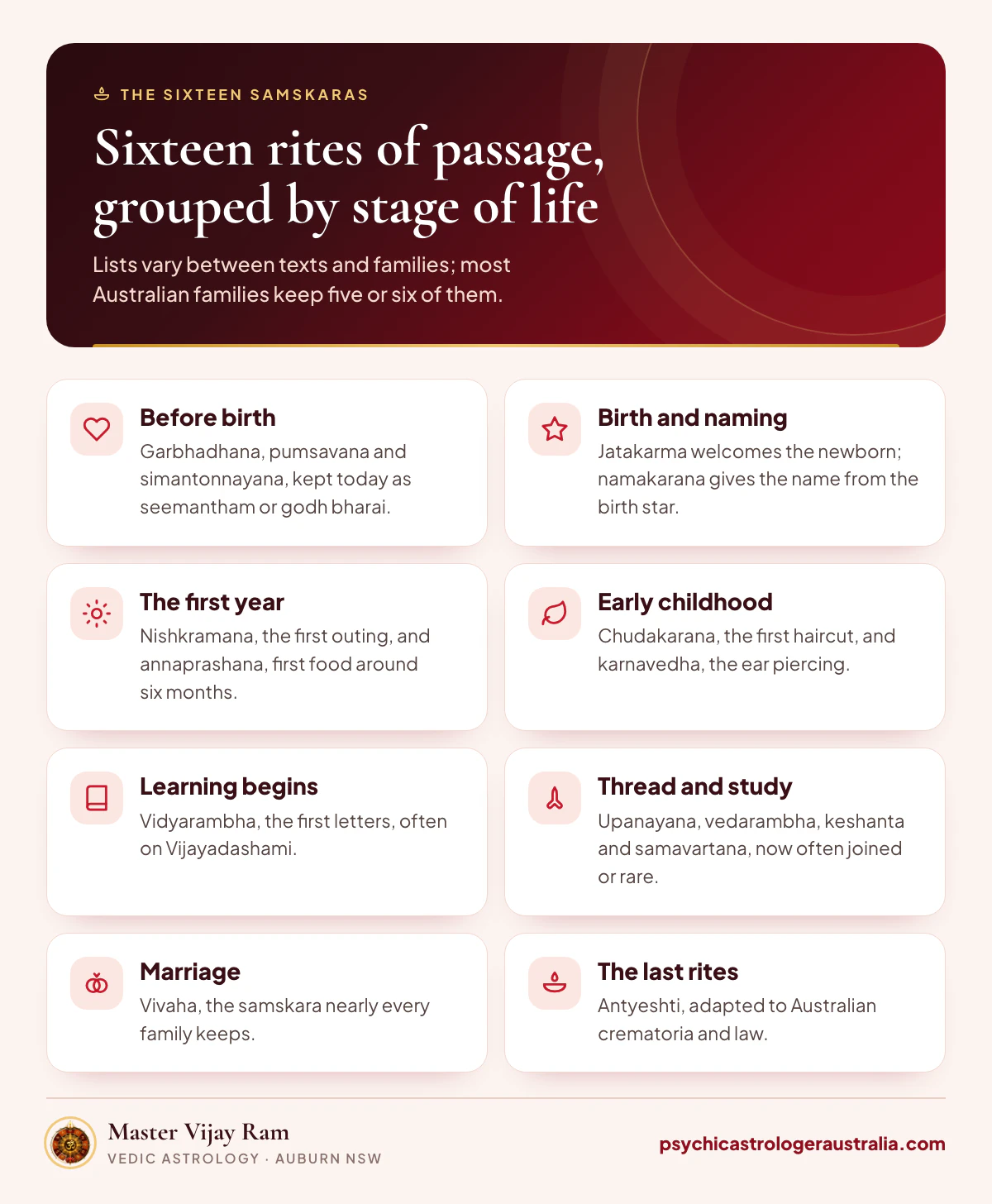
What are the sixteen, in order?
| No. | Samskara | What it marks | In Australia today |
|---|---|---|---|
| 1 | Garbhadhana | Conception; prayer for a child | Rare as a formal rite; kept privately by some couples |
| 2 | Pumsavana | Early pregnancy; prayer for the child’s health | Rare |
| 3 | Simantonnayana | Late pregnancy; blessing the mother | Common as seemantham, valaikappu or godh bharai |
| 4 | Jatakarma | Birth; welcoming the newborn | Simplified; a taste of honey and ghee is often skipped on medical advice |
| 5 | Namakarana | Naming | Very common |
| 6 | Nishkramana | The baby’s first outing, to see the Sun or the Moon or a temple | Often folded into a first temple visit |
| 7 | Annaprashana | First solid food | Common |
| 8 | Chudakarana | First haircut (mundan) | Common |
| 9 | Karnavedha | Ear piercing | Common in some regions; often done without ritual |
| 10 | Vidyarambha | First letters | Growing, especially at Vijayadashami and Vasant Panchami |
| 11 | Upanayana | The sacred thread and initiation into study | Kept by many Brahmin and some other families |
| 12 | Vedarambha | Beginning Vedic study | Usually joined to upanayana |
| 13 | Keshanta | First shave of the beard | Rare |
| 14 | Samavartana | End of study; return home | Rare; sometimes echoed at a graduation |
| 15 | Vivaha | Marriage | Universal |
| 16 | Antyeshti | The last rites | Universal, adapted to Australian law and crematoria |
Why sixteen, and why do lists disagree?
Sixteen is the number most often quoted, but it is a convenient summary rather than a fixed canon. Some older texts list many more rites, including daily and seasonal offerings, and some later lists drop vedarambha or keshanta and add others. Regional names differ too: annaprashana is mukhe bhaat in Bengal and choroonu in Kerala, and the late-pregnancy rite has at least four common names.
The disagreement is not a problem to solve. A family keeps the rites its own elders kept, in the way they kept them, and a priest or astrologer works within that.
Which samskaras happen before birth?
The first three. Garbhadhana is a prayer for a child, pumsavana a blessing in early pregnancy, and simantonnayana, the parting of the mother’s hair, a blessing in the last trimester. Today the third is the one families still celebrate: usually a gathering in the seventh or eighth month that feeds the mother’s cravings and showers her with gifts, called seemantham in the south and godh bharai in the north.
Anything involving food, herbs or fasting in pregnancy is checked with the midwife or GP first. The blessing is the point; nothing in the rite should put strain on the mother.
Which happen in the first year?
Jatakarma, namakarana, nishkramana and annaprashana. Jatakarma welcomes the newborn; the old custom of touching honey to the baby’s lips is now usually left out, because honey is not given to infants under twelve months. The naming follows, often around the eleventh or twelfth day in north Indian families, with the first syllable taken from the Moon’s nakshatra; choosing a name by nakshatra explains how. The naming day and the first weeks at home describes how families keep those first days.
Nishkramana, the first outing, is usually a first visit to the temple. Annaprashana, the first solid food, comes around six months, though customs differ by family and region; the first rice ceremony in Australia covers it in detail.
Which happen in early childhood?
Chudakarana, the first haircut, customarily falls between ages one and seven and is often done near a sacred river or at a temple; mundan in Australia explains how families keep it here. Karnavedha, the ear piercing, is done in infancy or early childhood depending on the family, and in Australia the practical rule is a qualified piercer or a GP with clean equipment.
Vidyarambha, the first letters, is often done around the age of two to five, and many South Indian families choose Vijayadashami for it. In 2027 Vijayadashami falls on Sat 9 Oct 2027, the same day in every Australian city.
What about the sacred thread and the years of study?
Upanayana is the initiation into study, the giving of the sacred thread and the Gayatri mantra, traditionally between about eight and sixteen depending on the family’s varna and custom. Upanayana for Australian families explains how it is done here and how communities are discussing who may receive it.
Vedarambha, the beginning of formal Vedic study, is now usually joined to the upanayana. Keshanta, the first shave, and samavartana, the ceremonial end of study, are rarely kept as separate rites; a few families echo samavartana with a small puja at a university graduation.
Marriage and the last rites
Vivaha, marriage, is the samskara nearly every family keeps, and its timing is one of the most common reasons families consult an astrologer. How a wedding muhurat is chosen explains the method; the rituals from haldi to vidaai are covered in a separate post.
Antyeshti, the last rites, closes the list. In Australia it is adapted to crematoria, funeral directors and the law, and families keep the thirteen days and the shraddha as their tradition directs. Why Hindus bathe after a funeral explains one of its customs in an Australian setting.
Which samskaras do most Australian families actually keep?
In practice, five or six: the late-pregnancy blessing, the naming, the first rice, the mundan, the wedding and the last rites, with ear piercing, first letters and the sacred thread kept by the families whose regions and communities emphasise them. That is not a falling away; it is what families did in India too, where few households keep all sixteen.
Living far from grandparents changes how they are kept. A naming may happen on a video call with the elders in Chandigarh; a mundan may wait for a trip to Haridwar or be done at a temple in Sydney. Both are honoured ways to keep the rite.
How is the timing of a samskara chosen?
Each samskara has its own traditional window, a number of days, months or years after birth, and within that window a muhurat is chosen from the child’s birth chart and the local panchang. The method weighs the tithi, the weekday, the nakshatra of the day against the child’s birth star, the lagna at the chosen hour, and avoids Rahu kaal and other periods families steer around.
Because sunrise and the clock differ between Hobart, Perth and Delhi, a date taken from an Indian calendar can be wrong here. Master Vijay Ram computes the panchang for the family’s own city. He never publishes a list of auspicious dates for samskaras; each is chosen for the child.
What do they mean in a modern family?
At their simplest, they are a family stopping to notice that a child has changed: the first food, the first haircut, the first letters. Each gathers relatives, slows the household down for a day, and gives a child a story about who they come from. That remains true whether the rite is elaborate or a ten-minute prayer in a living room in Wollongong.
The Hindu rites of passage are not tests a family passes or fails. Missing one, or doing it late, carries no curse, and Master Vijay Ram says so plainly to families who fear they have left something undone.
Can a samskara be performed for you?
Most samskaras are best done with the child and family present, at home or at a temple, and a local priest is the natural person to conduct them. Where a family wants a puja or havan performed alongside, for the child’s wellbeing or because elders are far away, Master Vijay Ram performs it personally at his place of practice in Auburn on the chosen muhurat, and the family joins by video if they wish. Puja and havan on a chosen muhurat explains how. A consultation is $50; a puja starts from $250, agreed before it is performed.
What can astrology not decide about a samskara?
It cannot decide whether a baby is ready for solids, whether a child’s ears are healthy enough to pierce, or whether a funeral can be delayed for a better day. Those belong to the child health nurse, the GP and the funeral director. The samskaras list is a frame for family life, and the chart only chooses the hour within it.
Families in Hobart, Canberra, Newcastle and Geelong book by phone or video; readings for families in Hobart explains how sessions work outside Sydney. Consultations are in English, Hindi or Punjabi, and he sees people in person only in Auburn, by appointment.
Read next
- Shashtipurti and Sathabhishekam: The 60th and 80th Birthday RitesShashtipurti at 60 and Sathabhishekam at 80: what the rites mark, how the day is chosen by nakshatra, planning in Aus…
- Vivah Muhurat 2027: Wedding Season for Australian FamiliesVivah muhurat 2027 for Australian families: the two wedding seasons, the closed periods, nakshatras and tithis, the p…
- Black Magic Signs in the Family Home: A Household ChecklistA calm household checklist for black magic signs in the family home: what to rule out first, the shared-roof test, an…
Frequently asked questions
What are the 16 samskaras in Hinduism?
The usual list is garbhadhana, pumsavana, simantonnayana, jatakarma, namakarana, nishkramana, annaprashana, chudakarana, karnavedha, vidyarambha, upanayana, vedarambha, keshanta, samavartana, vivaha and antyeshti. They run from conception to the last rites. Texts and regions differ, some listing more rites and some fewer, so a family’s own tradition is the right guide.
Do Hindu families have to perform all sixteen samskaras?
No. Very few households in India or Australia keep all sixteen. Most families keep the ones their elders kept, typically the pregnancy blessing, naming, first rice, first haircut, marriage and the last rites. Missing a rite, or doing it later than the traditional window, carries no curse or penalty in the tradition.
How is a date chosen for a samskara?
Each samskara has a traditional window after birth. Within it, a muhurat is chosen from the child’s birth chart and a panchang computed for the family’s city, weighing tithi, weekday, the day’s nakshatra against the birth star and the lagna, and avoiding periods such as Rahu kaal. It is chosen for the individual child through a consultation.
Can samskaras be performed in Australia?
Yes. Families hold them at home, at temples or in community halls, and many adapt the details to Australian life, such as a qualified piercer for karnavedha or a crematorium for antyeshti. Some wait for a trip to India for a mundan or upanayana. Both choices are honoured ways of keeping the rite.
What is the difference between upanayana and vidyarambha?
Vidyarambha is a young child’s first letters, often done between about two and five, frequently on Vijayadashami. Upanayana is the sacred thread ceremony and initiation into study with the Gayatri mantra, traditionally between about eight and sixteen depending on family custom. They mark different stages of learning.
Is a baby shower a samskara?
The modern baby shower echoes simantonnayana, the samskara of the last trimester. Today it is usually a gathering in the seventh or eighth month, called seemantham in South India and godh bharai in the north, that feeds the mother’s cravings and blesses her with gifts. Any food or fasting in pregnancy is checked with the midwife or GP.
Does Master Vijay Ram perform samskaras?
He chooses the muhurat for samskaras through a consultation, which is $50. Most samskaras are best conducted with the child present by a local priest. Where a family wants a puja or havan performed alongside, he does it personally at his place of practice in Auburn on the chosen muhurat, starting from $250, agreed before it is performed.
Why do some families keep samskaras on Vijayadashami?
Vijayadashami is traditionally regarded as an auspicious day to begin learning, which is why many South Indian families hold vidyarambha on it. In 2027 it falls on Saturday 9 October everywhere in Australia. A muhurat for the hour can still be chosen from the child’s chart within that day.
People also ask
What does samskara mean?
Samskara comes from Sanskrit and is usually explained as refinement or an impression made on the mind. As a rite, it marks a turning point in a person’s life, from pregnancy and birth through learning and marriage to death, and is meant to bless and shape the person at that stage.
Which samskara is done at six months?
Annaprashana, the first rice or first solid food ceremony, is usually held around six months, though customs differ by family and region. It is called mukhe bhaat in Bengal and choroonu in Kerala. The child health nurse or GP should confirm the baby is ready for solids.
What is the last samskara?
Antyeshti, the last rites, is the sixteenth samskara. It covers the cremation and the rites that follow, including the thirteen days and later shraddha. In Australia families adapt it to crematoria, funeral directors and local law while keeping the prayers and customs their tradition directs.
Are the samskaras the same in every Hindu community?
No. Texts give different lists, and regions use different names and emphasise different rites. A Tamil family may celebrate valaikappu while a Punjabi family keeps godh bharai, and some communities place great weight on upanayana while others rarely perform it. Each family follows its own elders.
References & further reading
Serving clients across Australia
Confidential consultations by phone, video & WhatsApp — including: