

Quick answer
Nazar during pregnancy is the family fear that admiring or envious eyes can trouble the mother or baby. The gentle customs, quiet news early, a loose black thread, a daily prayer, and godh bharai or seemantham in the seventh or eighth month, are safe to keep. Fasting, camphor, smoke and herbal remedies go past your midwife or GP first.
What is nazar in pregnancy, and why do families worry about it?
Nazar is the evil eye, the harm a family believes can follow an admiring or envious look, and a pregnant woman is said to draw more of it than almost anyone. The bump is visible, the news is precious, and everyone has an opinion, so the customs of nazar during pregnancy grew up as a polite way of saying “please don’t stare, please don’t ask”. Most of them are gentle, and the work of this page is keeping them that way.
Master Vijay Ram is rung by expectant mothers, by anxious husbands and very often by grandmothers in India who want to know what is being done. His answer begins with the midwife and ends with the family’s own customs, and evil eye and nazar removal describes the reading for a worry that will not settle once the medical side is in hand.
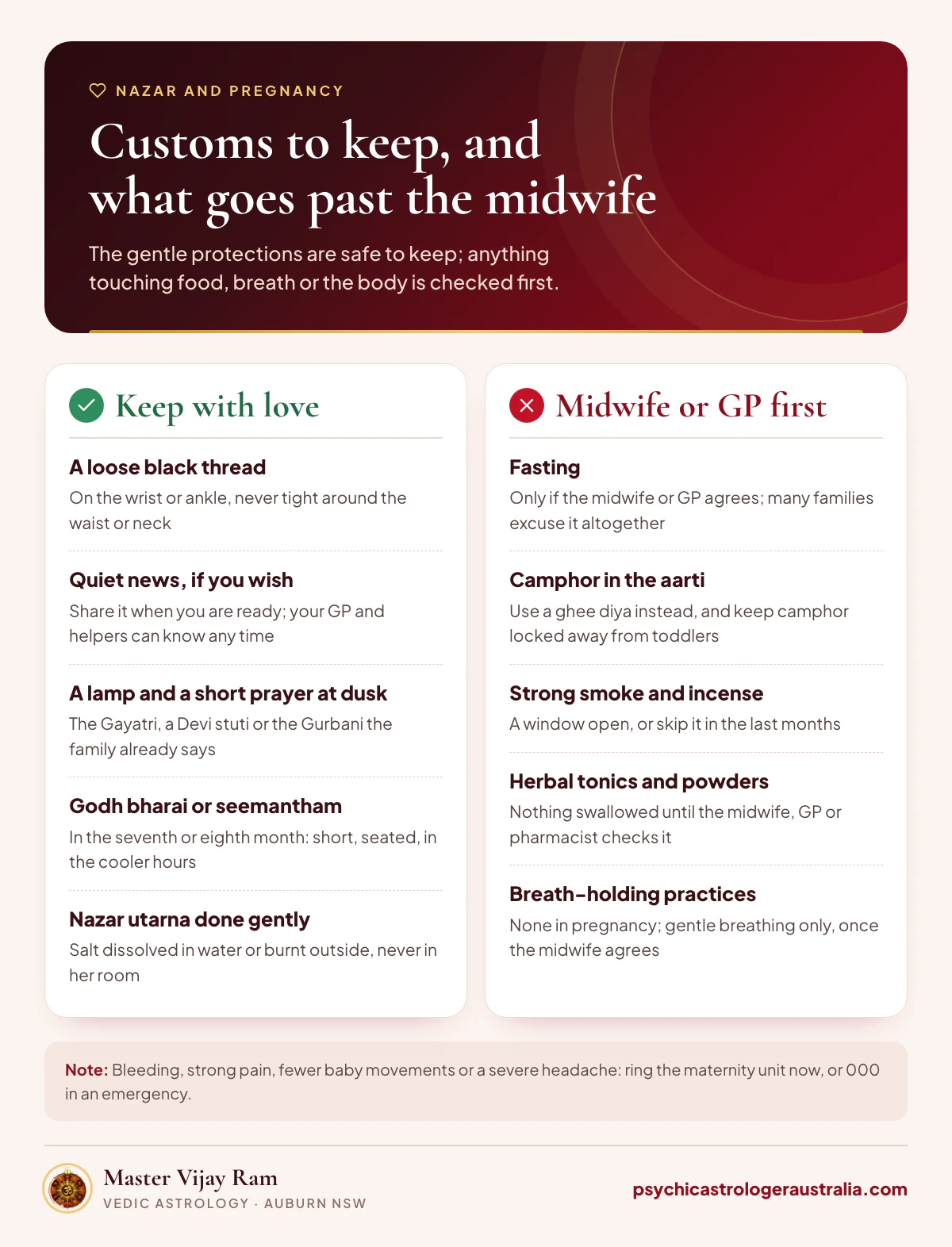
What comes first: the midwife, the GP and the warning signs
Before any custom, the people who look after the pregnancy. Your midwife, GP or obstetrician decides what you eat, whether you fast, what you take and how you exercise, and nothing below overrides them. If a tradition and their advice disagree, their advice wins, every time.
Some things are never nazar and never wait for a prayer. Ring your maternity unit or midwife straight away for:
- bleeding, or fluid leaking;
- strong or constant pain in the belly;
- the baby moving less than usual;
- a severe headache, blurred vision or sudden swelling of the face or hands.
In an emergency, call 000. A family that keeps every custom on this page and also keeps every appointment has done the tradition proud.
Why do families keep the news quiet in the early months?
In many households the pregnancy is not announced until the third month or later, and the custom is explained as keeping the most fragile weeks away from envious eyes. Many parents also simply want time to absorb the news and get through the first scans before the phone starts ringing. Both reasons are good ones.
Quiet news is a choice, not a rule. Telling your employer, your GP or a friend who will help is never a breach of custom, and a mother who needs support in the first months should have it, whatever the grandmothers say.
Which traditional protections are gentle and safe?
The everyday forms of pregnancy protection in Hindu homes are small and ask for very little: a black thread tied loosely on the wrist or ankle, and a kala tikka behind the ear on days when visitors are expected. Many families add a lamp lit at dusk with a short prayer they already know, whether the Gayatri, a Devi stuti or, in Sikh homes, the Gurbani recited every evening.
Nazar utarna can be kept too, with one change: the salt or the chillies are circled over the mother and then dissolved in running water or taken outside to be burnt, never burnt in the room where she sits. Chilli smoke is harsh on anyone’s lungs, and pregnancy is no time to test it.
A thread can usually stay on through appointments and scans. If a caesarean or a theatre visit means staff ask for it to come off, the blessing does not leave with the thread, and it can be tied again afterwards.
What is garbh sanskar, and what should you make of it?
Garbh sanskar is the idea that a child is shaped from the womb by what the mother hears, reads and feels, and the practice is gentle: devotional music, mantra, stories read aloud, and a calmer house. It draws on old stories such as Abhimanyu, who in the Mahabharata is said to have learned how to enter the chakravyuha while still in his mother’s womb.
Music at an ordinary volume, a nightly story and a quieter home harm nobody, and many mothers enjoy them. Be wary of paid courses that promise a cleverer, calmer or particular kind of baby, or sell powders and tonics alongside the lessons. The tradition offers blessing, not specification, and anything you swallow goes past your midwife first.
Which customs need the midwife’s yes first?
Some customs are harmless; a few touch the body, the food or the air, and those are the ones to check. The table sets them side by side.
| Custom | What it is for, in the tradition | What to check first |
|---|---|---|
| Fasting for Karva Chauth, Navratri or Ekadashi | Devotion and protection for the family | Never without the midwife or GP agreeing; many families excuse a pregnant woman altogether |
| Camphor in the aarti | Closing the prayer with a flame that leaves no ash | Use a ghee diya instead; camphor is kept locked away, especially with toddlers in the house |
| Loban, dhoop and incense | Cleansing the rooms at dusk | Keep strong smoke away from her; a window open, or skip it in the last months |
| Herbal tonics, powders and home remedies | Strength for mother and child | Nothing taken without the midwife, GP or pharmacist checking it, including imported products |
| Festival and ceremony food | Feeding the mother’s cravings | Ask the midwife for the food-safety list for pregnancy and share it with whoever is cooking |
| A black thread or amulet | Keeping the admiring eye off mother and baby | Loose, on the wrist or ankle, nothing tight around the waist or neck |
Breathing practices belong in the same column. There is no breath-holding in pregnancy, and gentle breathing with nothing held explains the only kind worth keeping, once the midwife agrees.
What are simantonnayana, seemantham and godh bharai?
Simantonnayana is one of the samskaras, a rite of the last trimester whose name refers to the parting of the mother’s hair. Today it is usually a gathering in the seventh or eighth month that feeds the mother’s cravings and showers her with gifts. In south Indian families it is the seemantham, and many Tamil families also call their version valaikappu, the bangle ceremony.
Godh bharai is the north Indian counterpart: the mother’s lap is filled with fruit, dry fruit, a coconut, sweets and gifts, the women of the family sing, and she is blessed for an easy birth. Both are celebrations first and protections second, which is part of what makes them so well loved.
How do you hold a godh bharai or seemantham safely?
Give the mother a comfortable chair rather than the floor, keep the formal part short, and let her leave the room whenever she needs to. In an Australian summer, hold it in the cooler part of the day with water close at hand; in a Hobart or Canberra winter, make sure the room is warm without a heater blowing on her.
Do the aarti with a ghee diya instead of camphor, keep incense outside or leave it out, and keep the havan fire, if there is one, small and well away from her. Share the midwife’s food-safety list with whoever is cooking. Among the many good pregnancy rituals in Australia, the best-run ones are those where the mother goes home tired from happiness rather than from standing.
Do eclipses matter in pregnancy?
In many homes an expectant mother is kept inside during an eclipse that can be seen, asked to rest, and kept away from knives and scissors, and that custom is gentle enough to keep if it comforts her. It is a matter of faith, not medicine. An eclipse does not harm a pregnancy, and no appointment, scan or birth plan should move for one.
Eclipses in 2027 and sutak explains which eclipses can be seen from Australia and why none of them calls for sutak here.
When is it worry rather than nazar?
A great deal of what families call nazar on an expectant mother is anxiety: sleepless nights, a dread that something will go wrong, tears that come from nowhere. Anxiety and depression in pregnancy are common and treatable, they can touch partners as well as mothers, and there is no shame in either. PANDA was set up for expecting and new parents in exactly this place, and a GP or midwife can refer you on.
If the low mood is deep, or there are thoughts of not wanting to be here, ring Lifeline on 13 11 14 or Beyond Blue on 1300 22 4636 tonight. A prayer is good company in a hard pregnancy; it is not a substitute for care.
What if a relative’s comments are the real trouble?
Sometimes the nazar has a face, usually a relative who comments on the size of the bump, guesses the sex or predicts problems. The tradition’s answer is not to accuse anyone. Share less, keep the visits short, let the partner or a parent set the boundary, and keep the thread on if it helps the mother feel steadier.
Nobody needs to be named, confronted or tested, and Vijay Ram ji will not do so on a family’s behalf. A pregnancy is not the season for a family rift, and most comments that sting are clumsy rather than cruel.
Can a reading or a puja help?
A reading can calm a worry that the customs have not settled. In a $50 consultation by phone, video or WhatsApp, Master Vijay Ram reads the mother’s chart, and the father’s if they wish, against the months of the pregnancy, names the ordinary explanations first, and suggests a simple daily prayer. Families in Adelaide and South Australia, Perth or on the Gold Coast are read in exactly the same way, from Auburn.
Where the family would like a prayer offered for mother and baby, he performs it himself at his place of practice in Auburn on a muhurat he chooses, from $250 and settled with the family beforehand; a puja performed for mother and baby explains how the family watches by video. Nothing is applied to the mother, given to her to swallow or done in her home.
Some families ask for a muhurat for a planned caesarean. The obstetric team’s timing always comes first, and he will say so; once the baby arrives, naming by nakshatra and the first weeks at home after the birth take over, with nazar on newborns for the gentle customs that follow.
What these customs cannot do
No thread, mantra or ceremony can guarantee a healthy pregnancy or an easy birth, and nobody should be sold one that claims to. This page is faith-based guidance, not medical advice, and the midwife, GP or obstetrician decides everything to do with your body and your baby. For couples still hoping for a child, remedies for couples trying to conceive draws the same line.
What the customs can do is surround a mother with care, give a nervous family something gentle to do with its love, and mark the months with celebration. Kept that way, they belong in an Australian pregnancy as naturally as the antenatal class.
Read next
- Evil Eye Removal in Melbourne: Nazar Utarna for Victorian FamiliesEvil eye removal in Melbourne: the signs Victorian families describe, nazar utarna at home, and how Master Vijay Ram …
- Taweez & Kavach for Protection: Real Ones vs FakesHow to tell a genuine taweez or kavach from a fake: what belongs inside one, what never should, which option suits yo…
- Visiting India: Nazar, Gifts and Protection When You Travel HomeVisiting India and nazar: small protections before you fly, taking praise without fear, gifts and biosecurity, jet la…
Frequently asked questions
Is it bad luck to announce a pregnancy early?
No. Many families wait until the third month or later, explaining it as keeping the most fragile weeks away from envious eyes, and many parents also prefer to get through the first scans privately. Both are good reasons, but quiet news is a choice rather than a rule. Telling your GP, your employer or a friend who will help you is never a breach of custom.
Can a pregnant woman wear a black thread for nazar?
Yes, worn loosely on the wrist or ankle. Nothing should be tight around the waist or neck. A thread can usually stay on through appointments and scans; if staff ask for it to come off before theatre or a caesarean, take it off without worry and tie it again afterwards. The blessing is in the intention, not the knot.
Should I fast for Karva Chauth or Navratri while pregnant?
Only if your midwife or GP agrees, and many families excuse a pregnant woman from fasting altogether. A fast that skips water or meals can be a real problem in pregnancy, whatever the tradition. A devotional alternative works just as well: the prayers, the story, the lamp and the evening with the family, without the fast itself.
Is camphor safe in the aarti during pregnancy?
It is better left out. Use a ghee diya for the aarti instead, and keep camphor locked away, especially if there are toddlers in the house, because swallowed camphor can cause seizures in young children. Strong smoke from loban, dhoop or incense is also best kept away from an expectant mother, with a window open or the custom skipped in the last months.
When is godh bharai or seemantham held?
Usually in the seventh or eighth month, as a gathering that feeds the mother’s cravings and brings gifts. Families choose the day with a muhurat or simply a weekend that suits everyone. Keep the formal part short, give her a comfortable chair, hold it in the cooler part of the day in summer, and share the midwife’s food-safety list with the cooks.
What is the difference between seemantham and godh bharai?
They are regional forms of the same idea. Seemantham comes from simantonnayana, a last-trimester samskara, and is the name used in many south Indian families, while godh bharai, the filling of the mother’s lap with fruit, sweets and gifts, is the north Indian counterpart. Many Tamil families call their version valaikappu, the bangle ceremony. All of them bless the mother before the birth.
Can nazar harm my unborn baby?
Families fear it, and the customs exist to soothe that fear, but a baby’s wellbeing is in the hands of your midwife, GP or obstetrician and the care you are already taking. If something feels wrong, such as fewer movements or pain, ring the maternity unit straight away. The customs are for comfort and celebration, and they work best without fear attached.
Does garbh sanskar work?
As a practice of devotional music, mantra, stories and a calmer house, it is gentle and many mothers enjoy it. It draws on stories such as Abhimanyu learning in the womb. Be wary of paid programmes that promise a particular kind of baby or sell tonics and powders, and check anything you would swallow with your midwife, GP or pharmacist first.
Can Master Vijay Ram choose a muhurat for a caesarean?
He can say what the panchang shows, but the obstetric team’s timing always comes first, and he will say so plainly. Medical safety decides the date of a planned caesarean. A $50 consultation can also cover the mother’s chart and a simple daily prayer, and the newborn’s naming by nakshatra follows once the baby is home.
People also ask
How do you protect a pregnancy from the evil eye?
Gently: share the news when you are ready, keep visits short, wear a loose black thread on the wrist or ankle, light a lamp with a short prayer at dusk, and do any nazar utarna with the salt dissolved in water or burnt outside, away from the mother. Fasting, camphor, smoke and herbal remedies go past the midwife or GP first.
What is the Hindu baby shower called?
In north India it is godh bharai, the filling of the mother’s lap with fruit, sweets and gifts; in south India it is seemantham, from the samskara simantonnayana, and many Tamil families call it valaikappu. It is usually held in the seventh or eighth month as a gathering that feeds the mother’s cravings and blesses her for an easy birth.
Should pregnant women stay indoors during an eclipse?
It is a family custom rather than a medical rule, and gentle enough to keep if it comforts the mother: rest indoors and put the sharp tools away. An eclipse does not harm a pregnancy, and no appointment or birth plan should move for one. In 2027 none of the eclipses calls for sutak in Australia.
What is PANDA?
PANDA, Perinatal Anxiety and Depression Australia, supports expecting and new parents, mothers and partners alike, through anxiety and depression in pregnancy and the first year. Perinatal anxiety and depression are common and treatable. The GP and midwife are the other doors, and Lifeline on 13 11 14 is there in a crisis.
References & further reading
Serving clients across Australia
Confidential consultations by phone, video & WhatsApp — including: