
Quick answer
Hindus bathe after a funeral because the tradition treats contact with death as ritual impurity, and the bath marks the line between the cremation and the home. Mourners commonly bathe before touching anyone or anything, and the clothes they wore are washed at once. In Australia a warm shower at home keeps the custom for children, elders and workers alike.
Why do Hindus bathe after a funeral?
The bath after a funeral is a custom that marks the line between the cremation and the home. In the tradition, contact with death brings a ritual impurity that every mourner shares for a time, and a full bath on returning, before touching anyone or anything in the house, is the first step out of it. It is kept, in one form or another, by Hindu families from Kashmir to Kerala, and it travels to Australia almost unchanged.
The bath is for the living. It does not imply that the person who died was unclean or dangerous, and families who keep it are not afraid of the one they have just farewelled. The heaviness a mourner carries home is grief, and aura cleansing is a different matter altogether, for a heaviness that stays long after the ordinary explanations have been tried.
This page is about the bath itself. The days that follow are covered in the thirteen days after a death, and what to do with the departed’s things in what to keep, give away and cleanse.
What do families do when they come home from the cremation?
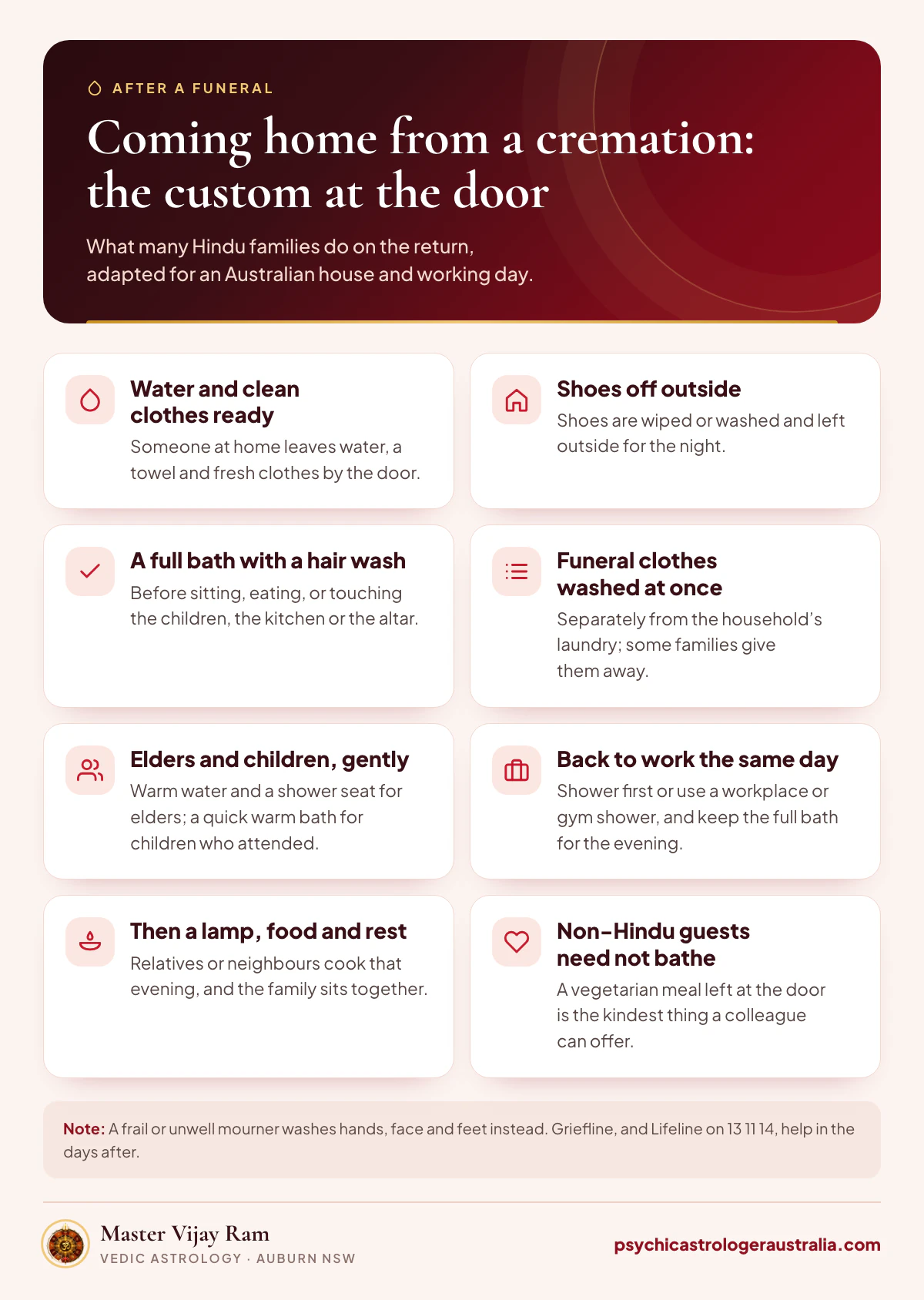
The common pattern is simple. Someone who stayed at home leaves a bucket of water, a towel and clean clothes by the door; mourners take off their shoes outside, go straight to the bathroom, and have a full bath with a hair wash before they sit down, eat, or touch the children, the kitchen or the altar.
The clothes worn to the cremation go straight into the wash, separately from the household’s laundry, and some families give them away afterwards. Shoes are wiped or washed and left outside for the night.
Regional customs add their own step at the door. Some families sprinkle water with neem leaves, some ask mourners to touch a lamp’s flame, a piece of iron or a stone before entering, and some chew a bitter neem leaf; traditions differ, and the family elders know which belongs to yours.
What reason does the tradition give?
Ritual impurity. The dharma texts describe a death as touching everyone close to it with ashaucha, the impurity that the family then keeps as sutak for the days of mourning, and they describe water as the first purifier. The bath after a funeral is how a mourner returns from the cremation ground, the place of the dead, into the house, the place of the living.
The meaning is a boundary, not a punishment. The same tradition asks the family to grieve, to feed the mourners and to keep a lamp for the departed, so the bath is one part of a larger kindness: wash, rest, eat, and let the house hold you.
Was there a practical reason too?
Very likely, and families often say so. In a hot country, before refrigeration, a body was cremated quickly on an open pyre, smoke and ash settled on everyone standing near it, and the illness that took the person could also reach those who washed and carried the body. A full bath and clean clothes before entering the house protected the people inside, especially the very young and the very old.
In Australia the funeral director has prepared the body, the cremation happens behind closed doors, and nobody comes home with ash in their hair. The practical reason has faded; the meaning has not, which is why the custom continues in families who would never call themselves strict.
Who should bathe, and does it include washing the hair?
In most families everyone who went to the cremation bathes, and especially anyone who carried the coffin or touched the body. Many families include those who attended only the service at the chapel, and some include anyone who visited the house of mourning that day. A full head bath, hair included, is the usual form.
| Who | What many families ask | In an Australian home |
|---|---|---|
| Mourners who attended the cremation | A full bath with a hair wash before touching anyone or anything | Straight to the shower; clothes into the wash |
| Those who carried the coffin or touched the body | The same, without exception in most families | The same, and shoes washed or wiped |
| Guests at the chapel service only | Many families ask for a bath; some do not | Follow the eldest person in the family |
| An elderly or frail mourner | Hands, face and feet washed, clean clothes | A warm shower with a seat and someone nearby, if they wish |
| Children who attended | A quick warm bath | A simple, unfrightening explanation |
| Relatives and babies who stayed home | Nothing | Nothing |
The table sets out this cleansing after a funeral as many families keep it. A relative who did not attend does not need to bathe, and nobody needs to bathe twice because they hugged a mourner who had not yet washed. When in doubt, ask the eldest person in the family, who will usually choose the kinder answer.
What about children and elderly mourners?
Gently, and with warm water. A grandmother of eighty does not need a cold bucket bath in a Canberra winter; a warm shower with a seat in it and someone nearby keeps the custom completely. For a frail or unwell elder, washing the hands, face and feet and changing into clean clothes is the usual allowance, and nobody should be bathed against their will.
Children who attended can have a quick warm bath, with a simple explanation: we wash to come home from the place where we said goodbye. A child who is frightened by the custom should hear that it is about saying goodbye, not about anything bad clinging to them. Babies who stayed home need nothing at all.
Can you go back to work the same day?
Many people in Australia have to. A nurse on night shifts in Townsville might attend a cremation at ten and start work at three; she showers at home, puts the funeral clothes in the wash and goes, and the custom has been kept. Where going home first is impossible, carry a change of clothes, wash at a gym or a workplace shower, and keep the full bath for the evening.
The period of mourning still applies at work in the tradition’s terms, and some mourners quietly skip an office birthday cake or a celebration for the next fortnight. A word to the manager covers it. Compassionate leave is usually shorter than the period, and many families keep the core of the custom around their working hours.
What can non-Hindu colleagues and friends do?
Say you are sorry and mean it; that is most of it. If you attend the funeral, plain white or light clothes are customary at many Hindu funerals and dark, plain clothes are also common in Australia; you may be invited to offer a flower or a few grains of rice, and you are welcome to stand quietly if you prefer.
Non-Hindu guests are not expected to keep the bath, though some do as a courtesy. A vegetarian meal left at the door in the first days is the most practical kindness, and a colleague who declines the Friday drinks for a couple of weeks is keeping a custom, not being unfriendly.
Does an Australian crematorium change anything?
A little. A crematorium is not a place to bathe, so most families rinse their hands and faces there and bathe properly at home, and a family whose rites are in a chapel follows the same pattern. Where mourners are going to the house of the person who died, many families bathe there or at their own homes before joining the others.
In Darwin’s build-up, or a Cairns summer, the bath is welcome for its own sake. In the Top End, the Darwin Sri Sithy Vinayakar Temple at Malak, home of the Hindu Society of the Northern Territory, is a natural place to ask about a priest, and readers there can find more in astrology readings for Darwin.
What should go into the bathwater?
Plain water is enough, and it is what most families use. Some add a few drops of gangajal or a handful of neem leaves steeped in hot water and cooled, and nothing else is required. The Hindu ritual bath for cleansing sets out what can be added safely and what is best skipped, for anyone who wants more.
Essential oils and strong salts are not part of this custom, and they can irritate the skin of children and elders. The point of bathing after cremation is water and a clean change, not a recipe.
What comes after the bath?
A lamp lit for the departed, something simple to eat, and rest. In many homes the mourners eat food cooked by relatives or neighbours that evening, and nobody is expected to cook. The Hindu funeral customs in Australia then follow the family’s pattern for the days of mourning, with the altar covered and celebrations put aside.
The first night home is often the hardest. Sit together, tell stories about the person, and let the youngest ask what they need to.
Is the bath just superstition?
It is better understood as a ritual, a meaningful act that marks a change, than as a belief about germs or spirits. Many cultures keep some washing after a funeral, from hands rinsed at a cemetery gate to salt at a doorway, because the body seems to know that something has ended and something else must begin. Keeping the custom does not require believing anything frightening.
Families who keep it loosely are not doing it wrong, and families who keep it strictly are not being fussy. Both are looking after each other at the hardest point of the day.
Where does Master Vijay Ram come in?
Mostly questions about custom. A family unsure what its own tradition asks, a mixed family that wants to honour both sides, or a son who could not fly home for the cremation can talk it through over a $50 consultation, held as an online reading by phone or video, in Hindi, Punjabi or English.
A puja for the departed is something he does only when a family asks for one. Vijay Ram ji performs it himself at Auburn, where he practises, starting at $250 with the figure settled beforehand, and relatives anywhere can watch on a video call; online puja and havan explains what is included. Families who want to understand the heaviness of grief in Vedic terms can read how aura cleansing works in Australia.
Does the bath lift the grief?
It cannot wash grief away, and no one should expect to feel lighter because they showered. The bath marks a boundary; the mourning is still to come. Vedic guidance is a matter of faith, and it does not stand in for a GP or a grief counsellor.
If the days after a funeral become too heavy, Griefline offers support to people who are grieving, Beyond Blue takes calls on 1300 22 4636, and Lifeline answers on 13 11 14.
Read next
- Cleansing the Home After a Death: Sutak, the Thirteen Days and ShuddhiSutak after a death, gently explained: what a Hindu home pauses for ten to thirteen days, the lamp, the terahvi, the …
- The Hindu Ritual Bath for Cleansing: What to Add and What to SkipThe Hindu ritual bath for cleansing: what to add (salt, neem, turmeric, Gangajal, tulsi), what to leave out, the snan…
- Navratri & Dussehra 2026: Cleanse Your Home of Negative EnergyNavratri and Dussehra 2026 land in an Australian spring. Here is what a home cleansing can honestly do at festival ti…
Frequently asked questions
Why do Hindus take a bath after a funeral?
Because the tradition treats contact with death as a ritual impurity that every mourner shares, and water is the first purifier. The bath marks the return from the cremation, the place of the dead, to the house, the place of the living. It does not mean the person who died was unclean, and it carries an older practical sense of protecting the household too.
Do you have to bathe before entering the house after a cremation?
Many families ask mourners to bathe before touching anyone or anything inside, so shoes are left outside and mourners go straight to the bathroom. Others bathe at a relative’s home first. In an Australian house with the bathroom inside, walking straight there and leaving the clothes in the laundry keeps the custom. Follow the eldest person in your family.
Should I wash my hair after a funeral?
A full head bath, hair included, is the usual form in most Hindu families for those who attended the cremation. A frail or unwell elder can wash hands, face and feet and change clothes instead, which most families accept. Someone who attended only the chapel service may or may not be asked to wash their hair; customs differ, so follow your family.
What do you do with the clothes worn to a Hindu funeral?
Wash them straight away, separately from the household’s laundry; an ordinary machine wash is enough. Some families give the clothes away afterwards, and some keep a set aside only for funerals. Shoes are wiped or washed and left outside for the night. White or light clothes are customary for the mourners at many Hindu funerals.
Do children need to bathe after attending a funeral?
Children who attended usually have a quick warm bath, with a simple explanation that the family washes to come home from the place where it said goodbye. Never frighten a child with talk of something clinging to them. Children and babies who stayed at home need nothing at all, and a hug from a mourner does not oblige anyone to bathe.
Can I go back to work after a funeral without bathing?
If you cannot go home first, carry a change of clothes, wash at a workplace or gym shower, and keep the full bath for the evening; that keeps the custom well. Tell your manager if you will skip celebrations during the period of mourning. Nobody at work is affected by your being in mourning, and the custom never asks you to stay away from colleagues.
Should non-Hindu guests bathe after attending a Hindu funeral?
They are not expected to, though some do as a courtesy. What matters more is attending respectfully: plain white, light or dark clothes, quiet presence, and an offered flower if invited. Afterwards, a vegetarian meal left at the family’s door in the first days is a kind gesture, and a simple “I am so sorry” is better than any explanation of the rites.
What can be added to the bath after a funeral?
Plain water is enough, and most families use nothing else. Some add a few drops of gangajal or a handful of neem leaves steeped in hot water and cooled. Essential oils and strong salts are not part of this custom and can irritate the skin of children and elders. The point is water and a clean change of clothes, not a recipe.
Does Master Vijay Ram advise on funeral customs?
He does, and most of these conversations need nothing more than talk. Over a $50 consultation, in Hindi, Punjabi or English, a family can settle what its own tradition asks, how a mixed family honours both sides, or what a son who could not fly home should keep. If a puja for the departed is wanted, he performs it at Auburn, starting at $250 with the figure settled beforehand, and relatives can watch on video.
People also ask
Why do you shower after going to a funeral?
In Hindu families the shower or bath marks the end of contact with death, which the tradition treats as ritual impurity, and the return to the home and the living. Many other cultures wash after funerals too. Today it is less about hygiene than about meaning: a clear moment that says the farewell is over and the family can rest.
What should you not do after coming back from a cremation?
In many families mourners do not touch the children, the kitchen, the food or the altar, and do not sit down or eat, until they have bathed and changed. Shoes stay outside and the funeral clothes go straight into the wash. Customs differ, and none of it involves fear; it is a short, orderly return to the house.
Is it bad luck not to bathe after a funeral?
The tradition does not threaten bad luck. It describes the bath as the way mourners step out of the ritual impurity of a death, and families who skip it from necessity, illness or frailty are not harmed by doing so. A wash of the hands, face and feet and clean clothes is the usual allowance when a full bath is not possible.
What do you wear to a Hindu funeral in Australia?
Plain white or light clothes are customary at many Hindu funerals, and plain dark clothes are also common in Australia. Avoid bright colours and showy jewellery. Shoes may come off for parts of the rites, and guests may be invited to offer a flower or rice, which they are welcome to decline by standing quietly.
References & further reading
Serving clients across Australia
Confidential consultations by phone, video & WhatsApp — including: