
Quick answer
A vivah muhurat is a wedding date and hour on which the panchang's five limbs, the tithi, weekday, nakshatra, yoga and karana, are favourable, the season is open, the Moon suits both charts and the lagna at the venue holds the rite. Australian weddings need it calculated for their own city, because a muhurat is a moment and the clock and the sunrise differ.
What is a vivah muhurat?
A vivah muhurat is a wedding date and hour that the panchang and the couple's charts agree on: a day whose tithi, nakshatra, weekday and yoga are favourable for marriage, inside a season the tradition permits, with a lagna rising at the hour of the ceremony that holds the marriage steady. It is older than any of the calendars that now print lists of good dates, and it is still calculated one couple at a time.
This page explains what wedding date astrology checks and why, how the wedding season works in 2027, why Australian families need the calculation done for their own city rather than copied from India, and what a muhurat can and cannot do. The muhurat and auspicious dates service does the calculation for a couple; a love and marriage prediction reading answers the question that usually comes before it, which is when.
Why does an Australian wedding need its own muhurat?
Because a muhurat is a moment, not a date, and the moment falls at different clock times in different places. A tithi that ends at 4 pm in Delhi ends at 9:30 pm in Sydney, 6:30 pm in Perth and 9 pm in Adelaide in summer, which can move the usable day by one; the lagna rising at a given hour depends on latitude and longitude, so a Delhi lagna window is simply wrong for Melbourne; and sunrise, which starts the Hindu day, is a different moment everywhere. Holi in 2027 is a plain example: Australia keeps it a day after India because the Purnima begins just before midnight Sydney time.
A family that copies a wedding date from an Indian panchang usually gets the date right and the hour wrong, and the hour is where the lagna lives. Perth families, two or three hours behind Sydney and two and a half hours ahead of Delhi all year, are the ones most often caught by it.
The five limbs of the panchang
A panchang has five limbs, and a shubh vivah muhurat needs all five in order. The tithi is the lunar day; the vara the weekday; the nakshatra the Moon's asterism; the yoga a calculated combination of Sun and Moon; and the karana the half-tithi. The table gives the classical preferences for a wedding, which vary a little between regional traditions and which a reading applies with the couple's own charts in hand.
| Limb | Favoured for marriage | Avoided |
|---|---|---|
| Tithi (lunar day) | Dwitiya, Tritiya, Panchami, Saptami, Dashami, Ekadashi, Trayodashi, and in many traditions Purnima | Chaturthi, Navami and Chaturdashi (the rikta tithis), Ashtami, Amavasya, and a tithi that is kshaya that day |
| Vara (weekday) | Monday, Wednesday, Thursday, Friday | Tuesday and Saturday in most traditions; Sunday is mixed |
| Nakshatra | Rohini, Mrigashira, Magha, Uttara Phalguni, Hasta, Swati, Anuradha, Mula, Uttara Ashadha, Uttara Bhadrapada, Revati | Bharani, Krittika, Ardra, Ashlesha, Jyeshtha, Purva Bhadrapada and the others not listed |
| Yoga | Most of the 27; Siddha, Shubha, Brahma, Indra, Priti and Ayushman are liked | Vyatipata, Vaidhriti, Vishkumbha, Atiganda, Shula, Ganda, Vyaghata, Vajra and the first half of Parigha |
| Karana | Bava, Balava, Kaulava, Taitila, Gara, Vanija | Vishti (Bhadra), and the fixed karanas Shakuni, Chatushpada, Naga and Kimstughna |
No single limb decides. A Thursday in Rohini on Trayodashi with Bhadra running is not a muhurat, and a muhurat with four limbs in order and the fifth merely neutral is often the best a busy venue calendar allows.
The wedding season: when weddings are and are not held
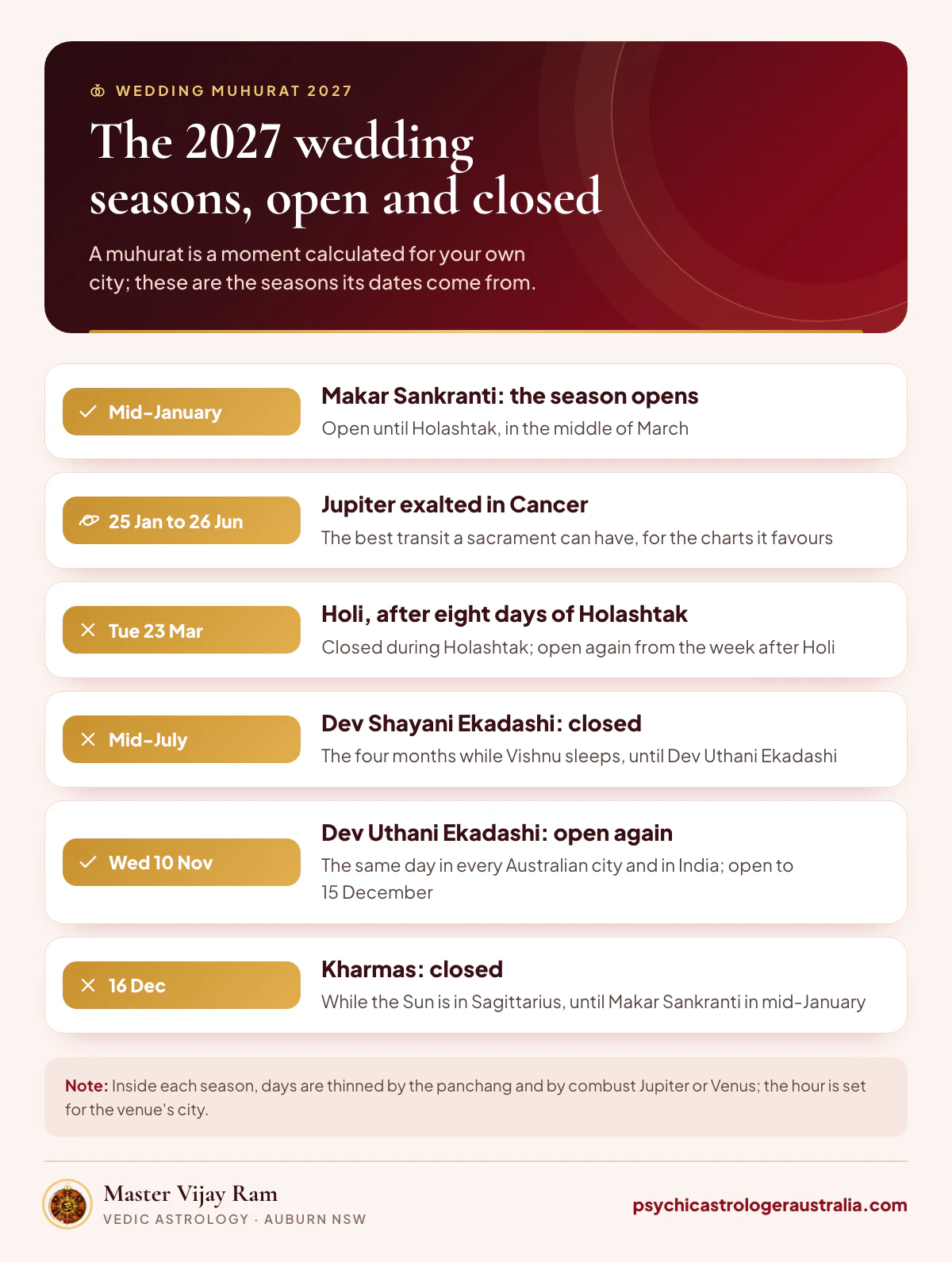
The tradition closes the wedding season for four months while Vishnu sleeps, from Dev Shayani Ekadashi in the middle of July to Dev Uthani Ekadashi, which in 2027 falls on Wednesday 10 November in every Australian city and in India. It closes again during Kharmas, the month the Sun spends in Sagittarius, from 16 December 2027 until Makar Sankranti in the middle of January, and for the eight days of Holashtak before Holi, which in 2027 is Tuesday 23 March in Australia. Weddings are also avoided while Jupiter or Venus is combust, too close to the Sun, and there is no adhik maas, no leap month, in 2027 to complicate the count.
That leaves three open seasons in 2027: from Makar Sankranti in the middle of January to Holashtak in the middle of March, from the week after Holi to the middle of July, and from 10 November to 15 December, each thinned by the combust periods and by the limbs above. The table below gives the 2027 festival calendar by city, Dev Uthani and Holi included, computed for the year.
| Festival | Sydney / Melbourne | Brisbane | Adelaide | Perth | Darwin | India |
|---|---|---|---|---|---|---|
| Vasant Panchami | Fri 12 Feb | Fri 12 Feb | Fri 12 Feb | Thu 11 Feb | Fri 12 Feb | Thu 11 Feb |
| Maha Shivratri | Sat 6 Mar | Sat 6 Mar | Sat 6 Mar | Sat 6 Mar | Sat 6 Mar | Sat 6 Mar |
| Holika Dahan | Mon 22 Mar | Mon 22 Mar | Mon 22 Mar | Mon 22 Mar | Mon 22 Mar | Sun 21 Mar |
| Holi (Rangwali) | Tue 23 Mar | Tue 23 Mar | Tue 23 Mar | Tue 23 Mar | Tue 23 Mar | Mon 22 Mar |
| Chaitra Navratri / Ugadi / Gudi Padwa | Thu 8 Apr | Thu 8 Apr | Thu 8 Apr | Thu 8 Apr | Thu 8 Apr | Wed 7 Apr |
| Ram Navami | Thu 15 Apr | Thu 15 Apr | Thu 15 Apr | Thu 15 Apr | Thu 15 Apr | Thu 15 Apr |
| Hanuman Jayanti | Wed 21 Apr | Wed 21 Apr | Wed 21 Apr | Tue 20 Apr | Wed 21 Apr | Tue 20 Apr |
| Akshaya Tritiya | Sun 9 May | Sun 9 May | Sun 9 May | Sun 9 May | Sun 9 May | Sun 9 May |
| Nag Panchami | Fri 6 Aug | Fri 6 Aug | Fri 6 Aug | Fri 6 Aug | Fri 6 Aug | Fri 6 Aug |
| Raksha Bandhan | Tue 17 Aug | Tue 17 Aug | Tue 17 Aug | Tue 17 Aug | Tue 17 Aug | Tue 17 Aug |
| Krishna Janmashtami | Wed 25 Aug | Wed 25 Aug | Wed 25 Aug | Tue 24 Aug | Wed 25 Aug | Tue 24 Aug |
| Hartalika Teej | Fri 3 Sep | Fri 3 Sep | Fri 3 Sep | Fri 3 Sep | Fri 3 Sep | Fri 3 Sep |
| Ganesh Chaturthi | Sat 4 Sep | Sat 4 Sep | Sat 4 Sep | Sat 4 Sep | Sat 4 Sep | Sat 4 Sep |
| Sharad Navratri begins (Ghatasthapana) | Fri 1 Oct | Fri 1 Oct | Fri 1 Oct | Fri 1 Oct | Fri 1 Oct | Thu 30 Sep |
| Durga Ashtami | Fri 8 Oct | Fri 8 Oct | Fri 8 Oct | Fri 8 Oct | Fri 8 Oct | Thu 7 Oct |
| Dussehra (Vijayadashami) | Sat 9 Oct | Sat 9 Oct | Sat 9 Oct | Sat 9 Oct | Sat 9 Oct | Sat 9 Oct |
| Dhanteras | Wed 27 Oct | Wed 27 Oct | Wed 27 Oct | Wed 27 Oct | Wed 27 Oct | Wed 27 Oct |
| Diwali (Lakshmi Puja) | Fri 29 Oct | Fri 29 Oct | Fri 29 Oct | Fri 29 Oct | Fri 29 Oct | Fri 29 Oct |
| Govardhan Puja | Sat 30 Oct | Sat 30 Oct | Sat 30 Oct | Sat 30 Oct | Sat 30 Oct | Sat 30 Oct |
| Bhai Dooj | Sun 31 Oct | Sun 31 Oct | Sun 31 Oct | Sun 31 Oct | Sun 31 Oct | Sun 31 Oct |
| Dev Uthani Ekadashi | Wed 10 Nov | Wed 10 Nov | Wed 10 Nov | Wed 10 Nov | Wed 10 Nov | Wed 10 Nov |
Each festival follows the rule its tradition uses — the tithi present at sunrise, midday, afternoon, midnight or after sunset — applied on the city's own clock; where the tithi meets none of those moments locally, the day it covers most of the daylight is shown. Makar Sankranti is a solar date (see the Vedic sun-sign table). Computed with the Swiss Ephemeris (Lahiri ayanamsa for Vedic positions) and checked against US Naval Observatory data. Times are rounded to the minute.
The lagna: the hour inside the day
The day gives the permission; the hour gives the marriage its chart. The vivah lagna is the sign rising at the moment of the main rite, the saptapadi or the kanyadaan, and the tradition asks for a fixed or dual sign on the ascendant, benefics in the kendras, the seventh house from the lagna empty, and no malefic in the lagna or the eighth. Because the ascendant changes roughly every two hours and depends on the venue's latitude, this is the part of a muhurat that cannot be copied from anywhere.
In practice he gives the couple a window of an hour or two inside the chosen day, and the priest and the venue work the ceremony to reach the main rite inside it. A Sydney wedding with a 4 pm start and a 6:15 pm saptapadi is a familiar shape.
The bride's and the groom's charts
A date is checked against two people, not against the calendar alone. The Moon's position on the day is read from each person's natal Moon: the day's Moon sign should be favourable from theirs, and the eighth sign from the natal Moon, ashtama chandra, is avoided for the main rite. Tara bala, the strength of the day's nakshatra counted from each person's birth star, is checked in the same way. The old texts add that Jupiter and the Sun should be well placed by transit for the bride and Venus for the groom, and that neither should be in a dasha that opposes the seventh house.
This is also where the muhurat meets compatibility. A muhurat does not fix a match; kundli matching and gun milan is the earlier question, and a relationship compatibility reading answers it before a date is sought.
Wedding muhurat 2027: the shape of the year
The wedding muhurat for 2027 has a particular shape. Jupiter is exalted in Cancer from 25 January to 26 June, which the tradition reads as the best transit a sacrament can have, so the autumn season is strong for families whose charts favour it. Jupiter is in Leo for the second half of the year and passes close to the Sun in late August and September, when weddings are avoided; and Dev Uthani on 10 November opens the summer season that runs to Kharmas on 16 December. Saturn's switch from Pisces to Aries on 3 June and back on 20 October changes which Moon signs it presses on through the year.
What this page will not do is print a list of auspicious wedding dates, because a date that is auspicious for one couple in Melbourne is ordinary for another in Perth. Vivah muhurat 2027 describes the seasons in more detail; the dates themselves come from a reading of two charts and one venue.
The registry, the temple and the date that counts
Australian couples usually have two dates, the legal ceremony with a celebrant or at the registry and the Vedic ceremony at a temple, a hall or a home, and families ask which one the muhurat is for. The muhurat is for the rite the couple regard as their marriage, which for most Hindu families is the saptapadi; the legal date is chosen for convenience and he does not time it unless asked. The legal side, notice periods and paperwork, is the celebrant's business and not astrological advice.
When the venue is already booked
Most couples come with a date, not for one. In that case the work is to find the best hour on the fixed day and to check the day for the limbs that can be rescued: a day in Bhadra can sometimes use the second half of the tithi, a weak nakshatra can be offset by a strong lagna, and a day that is plainly poor is said to be poor, with the nearest better day named. A muhurat reading on a booked date is not a verdict on the marriage; it is the best hour the day allows.
Interfaith and intercaste weddings
A muhurat is chosen the same way whatever the families' backgrounds, and he is often asked to find one for a couple where only one side will use it. The calculation is unchanged; what changes is the explanation, and he is used to giving it to a parent who has never heard the word tithi. Inter-religion marriage covers the family side of that conversation.
What a muhurat cannot do
It cannot make a marriage work, undo a poor match, or protect a couple from what they bring to the day. The tradition holds that beginning well helps, and that is all it holds; the marriage is the work of the two people in it. A muhurat is faith-based guidance, not legal or financial advice, and a wedding also needs a celebrant, a venue and a budget to agree with it.
How Master Vijay Ram chooses a wedding date
He takes both birth charts, the venue's city, the family's traditions and any fixed constraints, the venue, the visa, the relatives flying in, and works from the season to the day to the hour: the five limbs for the city's own clock, the Moon and tara bala for each person, Jupiter and Venus by transit, and the lagna window at the venue's latitude. You receive one to three dates with their hour windows, and the reasons, in writing you can hand to the priest. The consultation is $50, by phone, video or WhatsApp anywhere in Australia, in English, Hindi or Punjabi, or in person at Auburn by appointment.
Where a family also asks him to perform a pre-wedding shanti or a Ganesh puja on the chosen muhurat, that is spell or prayer work, from $250, agreed before it is performed, done personally at his own place of practice in Auburn with the family joining by video if they are elsewhere; online puja and havan explains it. A marriage muhurat in Australia is a small calculation with a long memory; most families remember the hour their wedding began for the rest of their lives.
Read next
- Vivah Muhurat 2027: Wedding Season for Australian FamiliesVivah muhurat 2027 for Australian families: the two wedding seasons, the closed periods, nakshatras and tithis, the p…
- Planning a Wedding in India From Australia: Dates and MuhuratPlanning a wedding in India from Australia: why the muhurat is set for the Indian venue, how leave and travel fit, an…
- Online Istikhara Service in Australia for Marriage & DecisionsHow online istikhara for marriage and other decisions works in Australia, what a genuine practitioner asks for, and t…
Frequently asked questions
What is a vivah muhurat?
A wedding date and hour on which the five limbs of the panchang, the tithi, weekday, nakshatra, yoga and karana, are favourable for marriage, the season is open, the Moon is well placed from both the bride's and the groom's natal Moons, and the lagna rising at the venue during the main rite holds the marriage steady. It is calculated for one couple and one place; a printed list of good dates is a starting point, not a muhurat.
Which months are good for a Hindu wedding in Australia in 2027?
The open seasons are from Makar Sankranti in the middle of January to Holashtak in the middle of March, from the week after Holi, which falls on 23 March in Australia, to the middle of July, and from Dev Uthani Ekadashi on 10 November to Kharmas on 16 December. Inside those, days are thinned by the combust periods of Jupiter and Venus and by the limbs of the panchang. Jupiter is exalted in Cancer from late January to late June, which strengthens the autumn season for the charts it favours.
Which tithi and nakshatra are best for marriage?
The tithis most traditions favour are Dwitiya, Tritiya, Panchami, Saptami, Dashami, Ekadashi and Trayodashi, with Purnima accepted in many regions, and the nakshatras are Rohini, Mrigashira, Magha, Uttara Phalguni, Hasta, Swati, Anuradha, Mula, Uttara Ashadha, Uttara Bhadrapada and Revati. The rikta tithis, Chaturthi, Navami and Chaturdashi, and Amavasya are avoided, as are Bharani, Krittika, Ardra, Ashlesha and Jyeshtha. Regional traditions differ a little, and the couple's own charts decide between the candidates.
Is Saturday a bad day for a wedding?
In most traditions Tuesday and Saturday are avoided for a wedding and Monday, Wednesday, Thursday and Friday are preferred, with Sunday mixed. Because Australian venues book Saturdays first, many families ask whether the rule can bend, and the honest answer is that a Saturday with a strong tithi, nakshatra and lagna is better than a Thursday in Bhadra, and that the weekday is the limb most often traded for the others. He says which trade a particular Saturday involves.
What is Bhadra, and why do weddings avoid it?
Bhadra is the Vishti karana, one of the eleven half-tithi karanas, which the tradition regards as the time of Shani's sister and avoids for any auspicious beginning, weddings above all. It occurs about four times a month for roughly half a tithi each time, and it is why a day can be favourable in every other limb and still be unusable for part of its hours. A muhurat reading places the rite outside Bhadra, often by moving the saptapadi a few hours.
Can I use a wedding date from an Indian panchang for a Sydney wedding?
The date is often right and the hour is almost always wrong. A tithi or nakshatra that changes at a given time in Delhi changes four and a half to five and a half hours later by the Sydney clock, which can move the usable day, and the lagna window printed for an Indian city does not apply at Sydney's latitude and longitude at all. The limbs are recalculated for the venue's own clock and sunrise, and the lagna for the venue's own sky.
What if the venue is only free on a date that is not auspicious?
Then the reading finds the best hour that day allows and says plainly what the day lacks. A day in Bhadra can sometimes use the second half of the tithi, a weak nakshatra can be offset by a strong lagna, and the main rite can be placed at the best available ascendant. A day that is plainly poor is called poor, with the nearest better day named, and the couple decide. A muhurat on a booked date is not a verdict on the marriage.
Does the legal ceremony need a muhurat as well?
Only if the couple want one. The muhurat is for the rite the couple regard as their marriage, which for most Hindu families is the saptapadi at the temple, hall or home; the registry or celebrant date is usually chosen for convenience and he times it only when asked. The legal requirements, notice periods and paperwork are the celebrant's business, and nothing in a muhurat reading is legal advice.
What does a wedding muhurat consultation cost?
The consultation is $50, by phone, video or WhatsApp anywhere in Australia, in English, Hindi or Punjabi, or in person at Auburn by appointment. You receive one to three dates with their hour windows and the reasons in writing. If the family also asks him to perform a pre-wedding shanti or a Ganesh puja on the chosen muhurat, that is spell or prayer work from $250, agreed before it is performed and done personally at Auburn with the family joining by video if they are elsewhere.
People also ask
What are the auspicious wedding dates in 2027?
There is no single list that is right for every couple, which is why this page does not print one. The open seasons in 2027 run from mid-January to mid-March, from the week after Holi to mid-July, and from Dev Uthani on 10 November to Kharmas on 16 December, thinned by the combust periods of Jupiter and Venus and by the panchang's limbs, and the dates inside them come from two charts and one venue.
How is a wedding muhurat calculated?
From the season to the day to the hour: the open wedding season first, then the five limbs of the panchang for the venue's own clock, then the Moon's strength and tara bala from each person's natal Moon, then Jupiter and Venus by transit, and finally the lagna window at the venue's latitude for the main rite. The result is one to three dates with hour windows and reasons.
What is vivah lagna?
The sign rising on the eastern horizon at the moment of the main wedding rite, the saptapadi or kanyadaan, which becomes the chart of the marriage. The tradition prefers a fixed or dual sign rising, benefics in the kendras, an empty seventh house and no malefic in the lagna or the eighth. It changes roughly every two hours and depends on the venue's latitude, so it cannot be copied from a printed calendar.
Which nakshatra is best for marriage?
Rohini, Mrigashira, Magha, Uttara Phalguni, Hasta, Swati, Anuradha, Mula, Uttara Ashadha, Uttara Bhadrapada and Revati are the eleven nakshatras most traditions accept for a wedding, with Rohini, Uttara Phalguni, Hasta and Revati the most liked. The best one for a particular couple is also the one that is strong by tara bala from both birth stars.
Is there an adhik maas in 2027?
No. The thirteen new moons of 2027 fall without a leap month, so the lunar months run in order and the wedding seasons are not interrupted by an adhik maas, during which weddings are avoided. The closures in 2027 are the usual ones: Chaturmas from mid-July to 10 November, Kharmas from 16 December, Holashtak before Holi, and the combust periods of Jupiter and Venus.
References & further reading
Serving clients across Australia
Confidential consultations by phone, video & WhatsApp — including: