

Quick answer
Mundan, or chudakarana, is the Hindu first-haircut ceremony, customarily held between ages one and seven, often in an odd year. The birth hair is said to carry impurities from a past life and is shaved on a chosen muhurat after a Ganesh puja. In Australia: a barber used to toddlers, a clean blade, a hat, and the hair buried or given to a temple.
What is mundan, and what is it said to clear?
Mundan, also called chudakarana, is the samskara in which a child’s birth hair is shaved for the first time, usually on a chosen day with a short puja before the razor comes out. The hair a child is born with is said to carry impurities from a past birth and from the womb, and removing it is said to clear the way for a clean start in this life. Many families add that the new hair grows back stronger, which is a hope more than a promise, as the last section explains.
It is one of the samskaras, the rites of passage that many lists count as sixteen, from conception to cremation. For an Australian family the questions are practical as well as sacred: when, where, who cuts, what happens to the hair, and how to keep a toddler safe. The first of those is a muhurat for the mundan, and the rest of this page takes the others in turn.
At what age is the mundan done?
Customarily between the ages of one and seven, and many families prefer an odd year: the first, the third or, less often, the fifth. Some keep the date to the first birthday or soon after; others wait until the child is steady on their feet and can sit still for a few minutes. Family custom decides more than any rule, and the grandparents usually know which way the family has always done it.
There is no bad luck in choosing the later end of the range. A child who is ill, teething hard or newly in childcare can wait a season, and the samskara loses nothing by it.
How is the day for a mundan chosen?
A mundan muhurat is chosen like any other: a suitable weekday, tithi and nakshatra in an open part of the year, then an hour that avoids Rahu kaal, checked against the child’s own birth chart. Many families avoid Kharmas, when the Sun is in Dhanu from mid-December to mid-January, and some also wait out Chaturmas. How a muhurat is chosen explains each of those filters in order.
The muhurat is cast for the place where the ceremony happens, in that place’s clock. A date picked from an Indian panchang for a ceremony in Townsville or Melbourne can land on the wrong tithi, which is one reason families ring Master Vijay Ram rather than copy a date from a relative’s message.
What happens at the ceremony, step by step?
Rites differ between regions and families, but most follow the same outline. The table sets out the traditional form beside what usually changes in an Australian home.
| Stage | The traditional form | In an Australian home |
|---|---|---|
| Sankalp and Ganesh puja | The family priest states the child’s name, gotra and purpose, and Ganesha is worshipped first | A priest at home or at the temple, or the family’s own short puja; a lamp and flowers are enough |
| The first cut | A few strands are cut ceremonially, often by the father or the child’s maternal uncle | The same, with small round-tipped scissors and a parent holding the child |
| The shave | The family barber, the nai, shaves the head with a razor | A barber or children’s hairdresser who is used to toddlers, often with clippers and a new blade |
| The tuft | Some families leave a small shikha at the crown; others shave everything | Unchanged: the family’s custom decides |
| After the shave | The head is washed, sometimes cooled with sandalwood or turmeric paste | Lukewarm water, any paste kept off the face and eyes and rinsed away, a hat before going outside |
| The hair | Offered at a temple or kept for a sacred river | Buried in the garden or given to a temple that collects offerings; never into a river, the sea or bushland |
Gifts, a family meal and sweets for the guests close the day in most households. The order matters more than the scale: puja first, the cut second, the celebration last.
Who makes the first cut, and who holds the child?
In many north Indian families the child’s maternal uncle, the mama, has a part to play, holding the child or catching the hair in a cloth; in others the father makes the first ceremonial snip and the barber does the rest. South Indian families often keep the ceremony at the temple of the family deity, where the temple’s own barbers do the shaving. None of these is more correct than the others.
What matters on the day is that the person holding the child is calm and the person with the blade is practised. A parent’s lap usually works better than a high chair.
What happens to the hair afterwards?
Tradition gives the hair back to something larger than the family: a temple, where hair offerings are collected, or a sacred river such as the Ganga, kept in a cloth or a ball of dough until the next trip home. That second custom stays in India. In Australia nothing from a puja goes into a creek, a river, the sea or the bush, where it may be treated as litter or illegal dumping.
The local equivalents keep the meaning without breaking the rules. Bury the hair in your own garden, under a tree or a tulsi pot, or ask your temple whether it accepts offerings for respectful disposal. Some families keep a small lock in the baby book, which harms nobody and pleases grandmothers.
How do you keep a mundan safe in Australia?
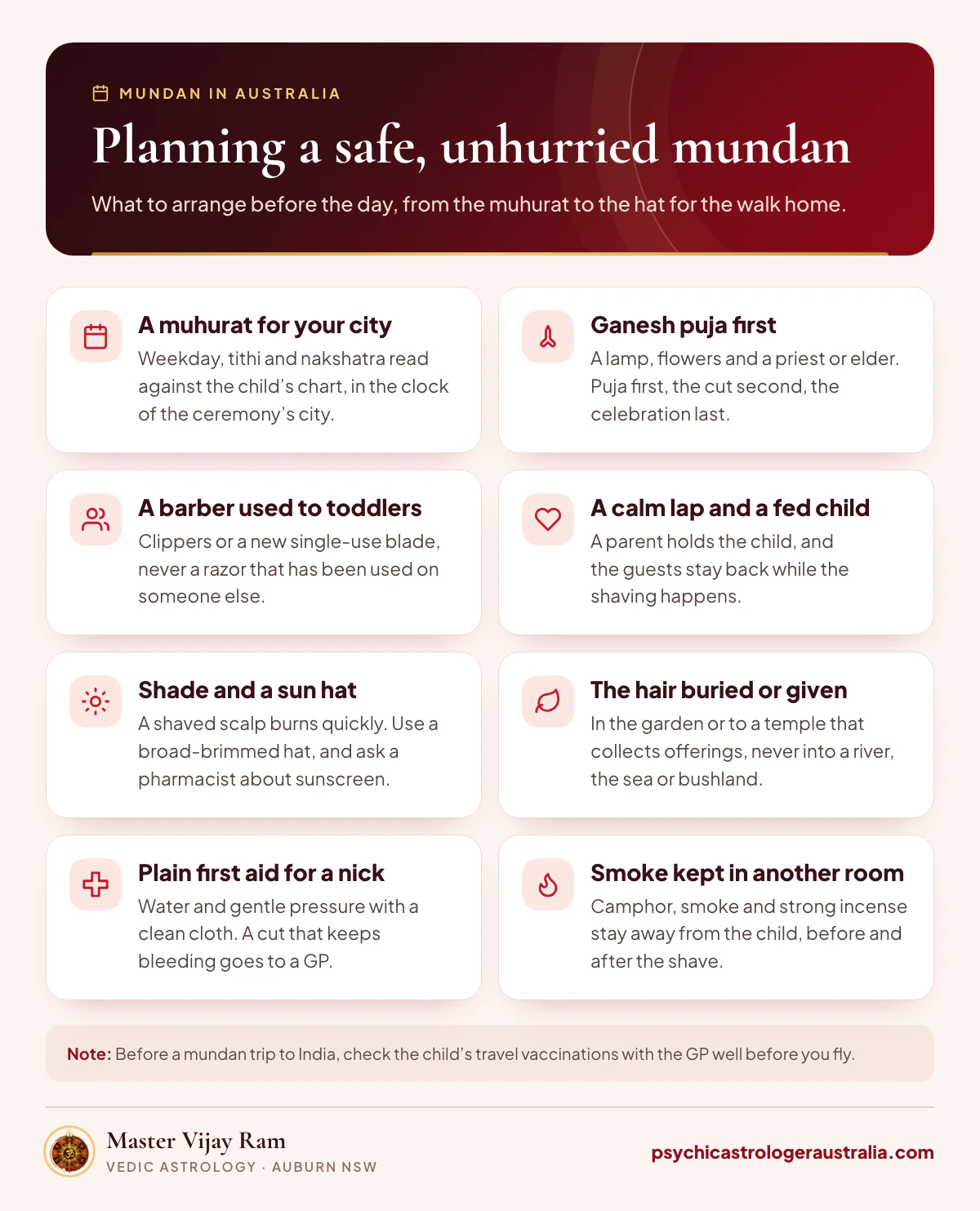
Book a barber or children’s hairdresser who is used to infants and toddlers, and ask them to use clippers or a new single-use blade, never a razor that has been used on someone else. A wriggling two-year-old and an open blade are a poor combination, so clippers for most of the head and a careful finish are a sensible compromise. If there is a nick, clean it with water and press gently with a clean cloth until it stops; a cut that keeps bleeding goes to a GP.
Then the sun. A freshly shaved scalp has no protection at all, and the Australian sun burns it quickly, so plan the day around shade and a broad-brimmed hat, and ask a pharmacist which sunscreen suits a toddler. In a Hobart or Canberra winter the opposite applies: a soft beanie for the walk home.
Choose an hour when the child is fed and rested, keep the guests back while the shaving happens, and leave camphor, smoke and strong incense in another room. A mundan that ends in tears can still be a good mundan, and one that ends in a cut needs only plain first aid.
Should the mundan wait for a trip to India?
Many families save it for a visit to the family temple or a river town, so the grandparents can be there and the hair can go where the custom says. That works well when the trip falls inside the age window, and the muhurat is then cast in Indian time for the place of the ceremony. Travelling home to India with children covers the wider preparation for the trip.
Weigh it honestly. Check the child’s travel vaccinations with the GP well before you fly, allow a few days for jet lag before the ceremony, and do not let a trip that keeps moving push the mundan past the age your family considers right. A mundan in Australia with the grandparents on a video call is still a mundan.
Can the mundan be held at a temple in Australia?
Some temples host samskaras or can recommend a priest who will come to your home, and it is worth asking the temple your family attends. Where there is no temple nearby, the ceremony at home is complete in itself: a lamp, a picture of Ganesha, a priest or an elder to lead the prayers, and the barber booked for straight afterwards.
A family in Cairns, where the community is still raising funds for a temple, might hold the puja at home and bury the hair in the garden; families in Darwin can ask at the Sri Sithy Vinayakar Temple at Malak. The muhurat travels with you either way.
What about nazar after the mundan?
A freshly shaved toddler collects compliments, and in many families that brings out the kala tikka behind the ear for a few weeks. It is a gentle custom and needs nothing more; gentle nazar protection for babies sets out the safe versions and the ones to leave behind.
A child who is unsettled after the day is usually tired, hot or overwhelmed by guests rather than troubled by anyone’s eye. Sleep and a quiet evening come first.
Do girls have a mundan too?
Traditions differ. Some families shave daughters exactly as they shave sons; some trim only a few locks with the same puja; some keep the full ceremony for boys alone. The texts on the samskaras were written for a different world, and many families now treat the first haircut of a daughter with the same care and the same prayers.
Whatever your family decides, decide it together before the day. A grandmother surprised at the barber’s chair is harder to manage than any toddler.
What if you skip it, or do it late?
Nothing bad follows. The mundan is a blessing a family chooses to give, not a debt that grows if it is missed, and anyone who says otherwise is selling fear. A child whose mundan was never done can have a short prayer and a ceremonial trim later, or simply grow up without one, loved all the same.
The household rules about which weekdays suit a haircut are a separate set of folk customs, and the folk rules on haircut days explains where they came from without any threat attached.
What part does Master Vijay Ram play, and what does it cost?
He chooses the muhurat. In a $50 consultation, held by phone, video or WhatsApp and in Hindi, Punjabi or English, he reads the child’s chart, checks the open windows in the months the family has in mind, and gives two or three choices in the clock of the city where the ceremony will happen. He does not cut hair, visit homes or attend ceremonies; anyone who wants to meet him comes to Auburn by appointment.
Some families also want a puja for the child. He performs a Ganesh puja or a shanti for health himself, at his place of practice in Auburn on a day he chooses, starting from $250 with the figure settled with you first; a puja performed on your behalf shows how parents can watch by video. If the child’s chart has not been cast yet, the newborn kundli and naming is the natural place to start, and the first days at home with a newborn covers the rites that come before the mundan.
What a mundan cannot do
A mundan ceremony cannot change a child’s health, temperament or future, and there is no good reason to expect thicker hair: hair grows from the root, which a razor never touches. The samskara is a blessing and a family memory, offered as faith-based guidance, not medical advice, and nobody can promise what it will bring.
What it does is gather a family around a small child at a chosen hour and say, in the oldest way they know, that this life is welcome. That is worth doing well, safely and without fear.
Read next
- Annaprashan: The First Rice Ceremony in AustraliaAnnaprashan in Australia: when the first rice ceremony is held, food safety with the child health nurse, regional cus…
- Karnavedha: The Ear-Piercing Ceremony and Its TimingKarnavedha, the Hindu ear-piercing samskara: when families hold it, why a qualified piercer or GP and good hygiene ma…
- Signs of Negative Energy in Your Home & How to Clear ItSigns of negative energy in a home, the ordinary causes to rule out first, and how nazar, heavier interference and me…
Frequently asked questions
At what age should a mundan be done?
Customarily between one and seven, and many families prefer an odd year, most often the first or the third. Some hold it soon after the first birthday; others wait until the child can sit steadily for a few minutes. Family custom decides more than any rule, and a child who is unwell or teething hard can simply wait for a later muhurat without any harm.
Is mundan done for girls as well as boys?
Traditions differ. Some families shave daughters exactly as they shave sons, some trim a few locks with the same puja, and some keep the full ceremony for boys only. There is no single correct answer, and many families now give a daughter’s first haircut the same prayers and care. Agree on it as a family before the day so nobody is surprised at the barber’s chair.
Can a mundan be done at home in Australia?
Yes. A lamp, a picture of Ganesha, a priest or an elder to lead the prayers, and a barber booked for straight afterwards make a complete ceremony. Some temples host samskaras or can recommend a priest who visits homes, so it is worth asking your own. The muhurat is cast for your city and your clock, wherever the ceremony takes place.
What should we do with the hair after a mundan?
In Australia, bury it in your own garden, under a tree or a tulsi pot, or ask your temple whether it accepts offerings for respectful disposal. Never put it in a river, a creek, the sea or bushland, where it may be treated as litter or illegal dumping. Families who want the river custom keep the hair in a cloth until a trip to India.
Should we wait and do the mundan in India?
It suits families whose trip falls inside the age window and who want the grandparents and the family temple involved. The muhurat is then cast in Indian time for the place of the ceremony. Check travel vaccinations with the GP well before flying, allow a few days for jet lag, and do not let a trip that keeps moving push the mundan beyond the age your family considers right.
Is a razor or clippers better for a toddler’s mundan?
For most toddlers, clippers for the bulk of the hair and a careful finish are the safer choice, because a child who wriggles near an open blade is easily nicked. If a razor is used it should be a new single-use blade, never one used on anyone else, held by a barber who is used to small children, with a parent holding the child on their lap.
How do we protect a freshly shaved head from the sun?
Keep the child in shade, put a broad-brimmed hat on before going outside, and ask a pharmacist which sunscreen suits a toddler’s scalp. A shaved head has no natural cover and burns quickly in the Australian sun, so plan the ceremony for the cooler part of the day. In a southern winter the opposite applies, and a soft beanie keeps the head warm.
Does mundan make a child’s hair grow back thicker?
It is a popular belief, but there is no good reason to expect it. Hair grows from the root under the skin, which a razor never touches, so the new hair comes back much as it would have anyway. The samskara is worth keeping for its meaning, the clearing of what the birth hair is said to carry, rather than for any promise about hair.
What does a mundan muhurat consultation cost?
The consultation is $50, held by phone, video or WhatsApp in English, Hindi or Punjabi, and it ends with two or three windows in your own city’s clock, read against the child’s chart. If the family would also like a puja for the child, Master Vijay Ram performs it himself at Auburn, starting from $250, and the figure is settled with you before anything is performed.
People also ask
Why is mundan done?
The tradition says the hair a child is born with carries impurities from a past birth and from the womb, and shaving it clears the way for a fresh start in this life. Mundan, or chudakarana, is one of the samskaras, the life-cycle rites of a Hindu family. Many families also see it as a day to gather and bless the child.
Which month is good for a mundan?
No month is fixed. The muhurat is chosen from the panchang for a suitable weekday, tithi and nakshatra, then checked against the child’s chart. Many families avoid Kharmas, when the Sun is in Dhanu from mid-December to mid-January, and some also avoid Chaturmas. In Australia the season matters too, since a shaved scalp needs shade in summer and warmth in winter.
Who holds the baby during the mundan?
Customs vary. In many north Indian families the maternal uncle, the mama, holds the child or catches the hair in a cloth, while in others a parent holds the child and the father makes the first ceremonial cut. What matters most is a calm lap and a practised barber, with the guests kept back while the shaving happens.
Is mundan compulsory in Hinduism?
No. It is a samskara many families value, not an obligation that brings misfortune if missed. A child whose mundan was never held can have a short prayer and a ceremonial trim later, or none at all. Anyone who says a skipped mundan will bring bad luck is selling fear rather than describing the tradition.
References & further reading
Serving clients across Australia
Confidential consultations by phone, video & WhatsApp — including: