

Quick answer
Upanayana is the samskara in which a child receives the sacred thread and the Gayatri mantra and formally begins study under a teacher. Age customs differ, commonly between about seven and twelve. In Australia families hold it at temples or at home, often in school holidays, with a muhurat chosen from the child’s chart. Communities still differ on who may receive it.
What is upanayana?
Upanayana is a samskara that brings a child to a teacher and begins a life of study, and it is marked by the giving of the sacred thread and the Gayatri mantra. The word means leading near: the child is led to the guru and, in the tradition’s language, to knowledge. It sits eleventh in the usual list of sixteen samskaras, and the sixteen samskaras in an Australian family places it in that sequence.
The thread is called the yajnopavita, and families know the ceremony by many names: janeu in the north, poonal in Tamil homes, jandhyam among Telugu families, munj in Maharashtra and upanayanam in much of the south. Families in Brisbane, Perth and Adelaide choose a day through a muhurat for samskaras, usually inside the school holidays.
What does the ceremony involve?
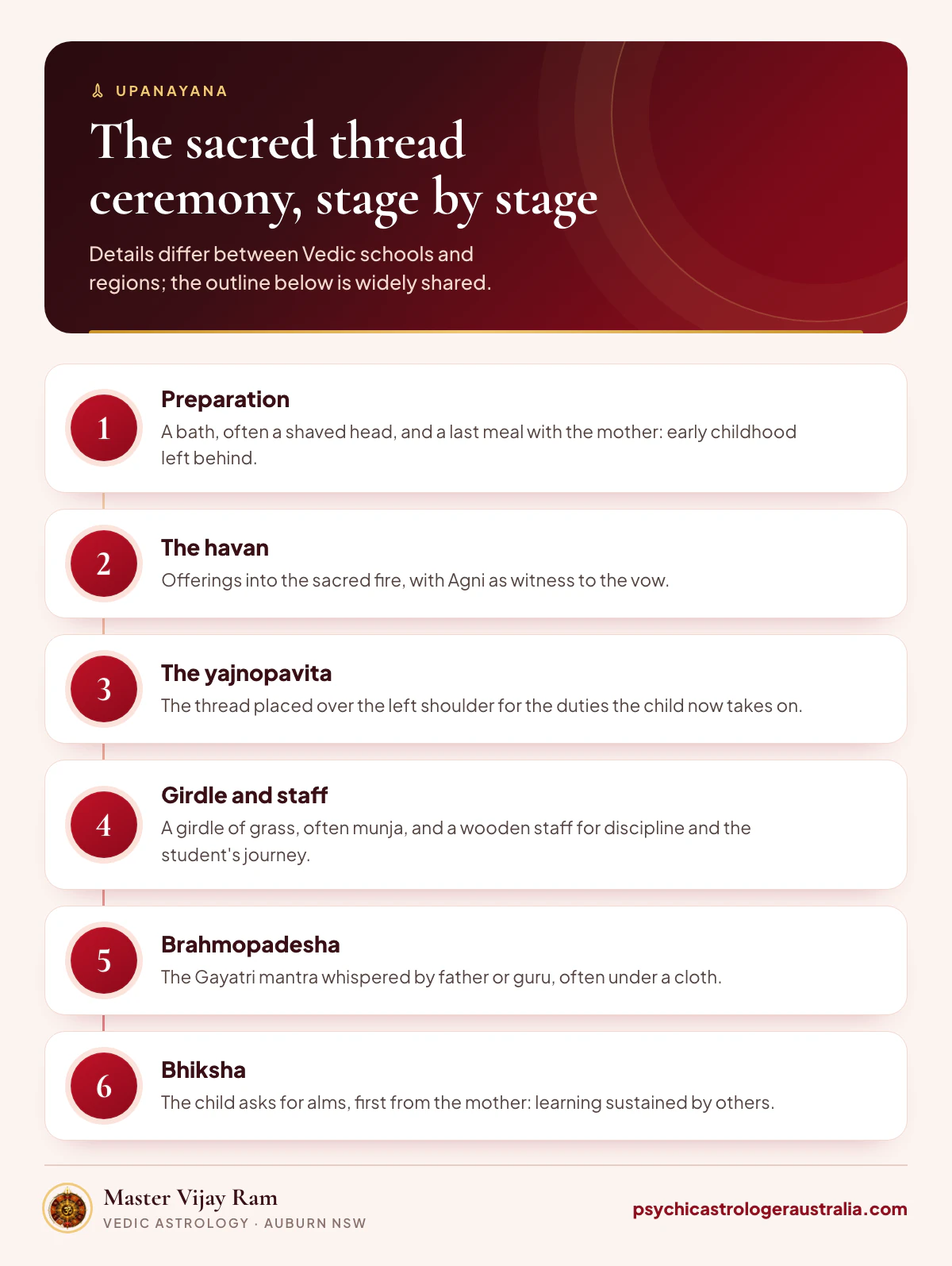
Details differ between Vedic schools and regions, but the outline is shared. The child is bathed and often has the head shaved, sometimes leaving a tuft; a havan is lit; the child is dressed in new cloth and given the thread, a girdle and a staff. Then comes the heart of it, the teaching of the Gayatri mantra, after which the child asks for alms, traditionally first from the mother.
| Stage | What happens | What it stands for |
|---|---|---|
| Preparation | Bath, often a shaved head, a last meal with the mother | Leaving early childhood behind |
| Havan | Offerings into the sacred fire | Agni as witness to the vow |
| The thread | The yajnopavita placed over the left shoulder | The duties the child now takes on |
| Girdle and staff | A girdle of grass, often munja, and a wooden staff | Discipline and the student’s journey |
| Brahmopadesha | The Gayatri mantra whispered by father or guru, often under a cloth | The first and central teaching |
| Bhiksha | The child asks for alms, first from the mother | Humility; learning sustained by others |
What is the Gayatri mantra, and why is it central?
The Gayatri mantra is a verse of the Rigveda addressed to Savitr, the sun as the source of light and life, asking that the light inspire our understanding. It is named after its metre, gayatri, of three lines of eight syllables. For many families it is the most important mantra a child will ever learn, and the upanayana is where it is formally given.
The giving is quiet and personal. A father or guru teaches it to the child, often under a cloth that shuts out the guests, and the child is expected to recite it daily afterwards, traditionally at the sandhya times of dawn, noon and dusk. Many modern families settle for morning and evening, which keeps the practice alive.
At what age is upanayana done?
Texts differ, and family custom matters more than any single rule. The Grihya Sutras give different ages for different varnas, with eight often cited for Brahmin boys and later ages for others, and outer limits beyond which the rite was said to be overdue. Today many families choose somewhere between about seven and twelve, before the teenage years, when a child can understand the mantra and still enjoys the ritual.
Some families hold it just before a wedding, for a young man who missed it in childhood. That is a long-established practice and not a lesser version.
Who may receive the sacred thread today?
This is where communities are having real conversations, and the honest answer is that they differ. In many families the rite is kept within traditional lines, for boys of particular communities. Some reform movements, the Arya Samaj prominent among them, offer upanayana to girls and to families of any background, and some scholars point to references to girls receiving the thread in the early period.
Master Vijay Ram does not settle that question for any family. He chooses a muhurat for whichever child the family and its priest or acharya have decided will receive the thread, and he treats every family’s choice with respect. A family unsure of its own tradition is best guided by its elders and its temple.
How is the muhurat chosen?
Traditions differ, and the method weighs several layers. Many prefer the Sun’s northern course, uttarayana, and spring in particular; most avoid the period when Jupiter or Venus is combust, and the Kharmas month when the Sun is in Dhanu. Jupiter’s strength in the child’s own chart is looked at, because Jupiter is the planet of the guru and of learning; a full kundli reading looks at that placement in detail.
Within the chosen season, the day is fixed from the tithi, the weekday, the day’s nakshatra counted from the child’s birth star, and the lagna at the hour, using a panchang computed for the family’s own city. Rahu kaal is avoided for the central moments. There is no published upanayana calendar from Vijay Ram ji: the hour belongs to one boy or girl and one family.
Where do Australian families hold it?
At a temple, at home or in a hired hall. Larger temples in Sydney, Melbourne, Brisbane and Perth can arrange priests from the right tradition, and some hold group ceremonies for several children at once, which shares the cost and the joy. Families in Hobart or on the Gold Coast often bring a priest to a home ceremony or travel to the nearest large temple.
Other families wait for a visit to India, so that grandparents and the family priest can take part, or hold the rite at a family temple there. Both choices are honoured. A havan held indoors needs the smoke alarms left working, a metal tray, windows open and a person watching the flame throughout.
How does a child live with the thread at school?
Most children wear it under their uniform and nobody notices. A quiet word with the school before term, explaining that it is a religious item worn under clothing, prevents most misunderstandings, and Australian schools are used to religious dress. If a child is teased, the school should hear about it promptly.
Families make their own decisions about swimming, sport and hospital visits; many traditions allow the thread to be worn around the neck or removed and replaced with a short prayer when practicality requires. Asking the family priest about these rules before the ceremony avoids worry later.
What changes after upanayana?
In the tradition, the child becomes a student with responsibilities: daily Gayatri recitation, respect for teachers and elders, and care of the thread, which is renewed each year in many communities at upakarma, around Shravana Purnima. Upakarma dates vary by Veda and region; follow your temple’s panchang.
In a modern family it is also a moment to talk about values: honesty, study, self-discipline and service. Parents who use the occasion to begin those conversations often find it shapes the teenage years. The bond with teachers that the rite begins is honoured again each year at Guru Purnima in Australia. Education astrology through the big school years looks at the chart side of a child’s study, and vidyarambha, the first letters covers the much earlier start to learning.
What if a child is reluctant?
Some children, especially older ones raised in Australia, are unsure about a shaved head, a ceremony in front of relatives, or a thread at school. Talking it through, explaining the meaning rather than only the rules, and letting the child have a say in details often brings them round. Forcing a frightened or embarrassed child through the rite rarely produces the devotion the rite is meant to awaken.
A delay of a year, or a ceremony without the head shave where the family’s tradition permits, is a reasonable compromise. The tradition values a willing student.
Can a puja be performed alongside?
The upanayana itself needs the child present, a priest or acharya and usually the father or a guru. Some families add a Saraswati or Ganesh puja, or a havan for the boy or girl, often because the grandparents cannot fly out; Vijay Ram ji performs that himself in Auburn at the same hour, and relatives anywhere can watch on video. A puja or havan performed for you explains how. A consultation is $50; a puja starts from $250, agreed before it is performed.
What can a reading not do?
It cannot decide whether a child is eligible for the thread, choose which Vedic school a family follows, or turn a reluctant child into an eager one. It will not promise success in study. The janeu ceremony is a family and community decision; the chart chooses a good hour for it. A thread ceremony conducted with love on an ordinary day is still a complete samskara.
Parents in Perth, Adelaide, Canberra and south-east Queensland usually sit the reading on a video call with the child’s birth details to hand; readings for Brisbane families sets out the Queensland timing. Hindi, Punjabi and English are all fine, and in-person meetings happen at Auburn alone, booked ahead. An upanayanam muhurat is one of the more detailed choices he makes, and he takes the time it needs.
Read next
- Vivah Muhurat 2027: Wedding Season for Australian FamiliesVivah muhurat 2027 for Australian families: the two wedding seasons, the closed periods, nakshatras and tithis, the p…
- Karnavedha: The Ear-Piercing Ceremony and Its TimingKarnavedha, the Hindu ear-piercing samskara: when families hold it, why a qualified piercer or GP and good hygiene ma…
- Black Magic Signs in the Family Home: A Household ChecklistA calm household checklist for black magic signs in the family home: what to rule out first, the shared-roof test, an…
Frequently asked questions
What is the right age for upanayana?
Texts differ. The Grihya Sutras give different ages for different varnas, with eight often cited for Brahmin boys. Today many families choose between about seven and twelve, when a child can understand the mantra. Some young men receive the thread just before their wedding, which is a long-established practice. Family custom and the family priest are the best guide.
Can girls have an upanayana?
Communities differ. Many families keep the rite within traditional lines for boys, while some reform movements, the Arya Samaj prominent among them, offer it to girls, and some scholars point to references to girls receiving the thread in the early period. Master Vijay Ram chooses the muhurat for whichever child the family and its priest have decided will receive it.
How is an upanayana muhurat chosen?
Traditions differ, but many prefer uttarayana and spring, avoid periods when Jupiter or Venus is combust and the Kharmas month, and look at the strength of Jupiter in the child’s chart. The day is then fixed from tithi, weekday, the day’s nakshatra against the child’s birth star and the lagna, using a panchang computed for the family’s city.
Can my son wear the janeu to school in Australia?
Most children wear it under their uniform without any issue. A brief word with the school before term, explaining that it is a religious item worn under clothing, avoids misunderstandings. Families decide their own rules about sport and swimming, and many traditions allow the thread to be adjusted or briefly removed with a prayer when needed.
Does the head have to be shaved for upanayana?
Many families shave the head, sometimes leaving a tuft, as part of the preparation. Customs vary, and some families or communities do not require it. For an older child who is distressed by it, asking the family priest whether a ceremony without the shave is acceptable in your tradition is a reasonable step.
Should we hold the upanayana in India or Australia?
Both are honoured. Holding it in India lets grandparents and the family priest take part, often at a family temple. Holding it in Australia lets school friends and the local community attend, and many larger temples can arrange priests from the right tradition. School holidays usually decide which is practical.
What is upakarma?
Upakarma is the annual renewal of the sacred thread and recommitment to study, kept in many communities around Shravana Purnima, with the exact day varying by Veda and region. Families follow their temple’s panchang for it. It is a good occasion for a child who has received the thread to remember the meaning of the vow.
Does Master Vijay Ram conduct upanayana ceremonies?
No. The ceremony needs the child in front of a priest or acharya, usually with the father. Vijay Ram ji’s part is the hour, worked out in a $50 reading. If the family wants a Saraswati or Ganesh puja or a havan held for the child alongside, he performs it himself in Auburn; that work begins at $250 and the amount is fixed with the family before it is done.
People also ask
What does upanayana mean?
Upanayana means leading near, the child being led to a teacher and, in the tradition’s language, to knowledge. It is the samskara that begins formal study, marked by the sacred thread, the yajnopavita, and the teaching of the Gayatri mantra. It is known as janeu, poonal, jandhyam, munj or upanayanam in different regions.
Why is the Gayatri mantra given at upanayana?
The Gayatri mantra, a verse of the Rigveda addressed to Savitr, asks that light inspire our understanding, which suits a ceremony that begins a life of learning. It is taught privately by the father or guru, often under a cloth, and the child is expected to recite it daily afterwards.
What are the three strands of the sacred thread?
The yajnopavita is made of three strands, which different traditions explain in different ways, often as the debts owed to the gods, the sages and the ancestors, or as reminders of discipline in thought, word and deed. It is worn over the left shoulder for ordinary religious duties.
Can upanayana be done as an adult?
Yes. Many young men receive the thread just before their wedding if it was not done in childhood, and reform movements perform it for adults. The ceremony is the same in outline, and the meaning, the beginning of disciplined learning and daily prayer, applies at any age.
References & further reading
Serving clients across Australia
Confidential consultations by phone, video & WhatsApp — including: