

Quick answer
The 2027 wedding season in Australia opens when the Sun enters Makara on 15 January and runs until Dev Shayani Ekadashi in July, then reopens from Dev Uthani Ekadashi on 10 November until Kharmas returns on 16 December. Within those months a vivah muhurat is chosen from the wedding nakshatras and tithis, the couple's charts and the lagna of the pheras, cast for the city of the mandap.
Vivah muhurat 2027 at a glance
A vivah muhurat is the window of time chosen for the binding moment of a Hindu wedding, the pheras or the kanyadaan, so that the marriage begins under a favourable sky. It is the oldest and most carefully worked branch of muhurta, and the one Australian families negotiate hardest, because the venue, the relatives' flights and the registry all have opinions of their own.
This guide explains how a vivah muhurat in 2027 is found: the two seasons the calendar allows, the periods that are closed, the nakshatras, tithis and weekdays a wedding uses, the lagna of the pheras, and how the couple's own charts decide between candidate days. It is the method applied in a muhurat consultation, and it starts, as a wedding should, with the two people rather than the calendar.
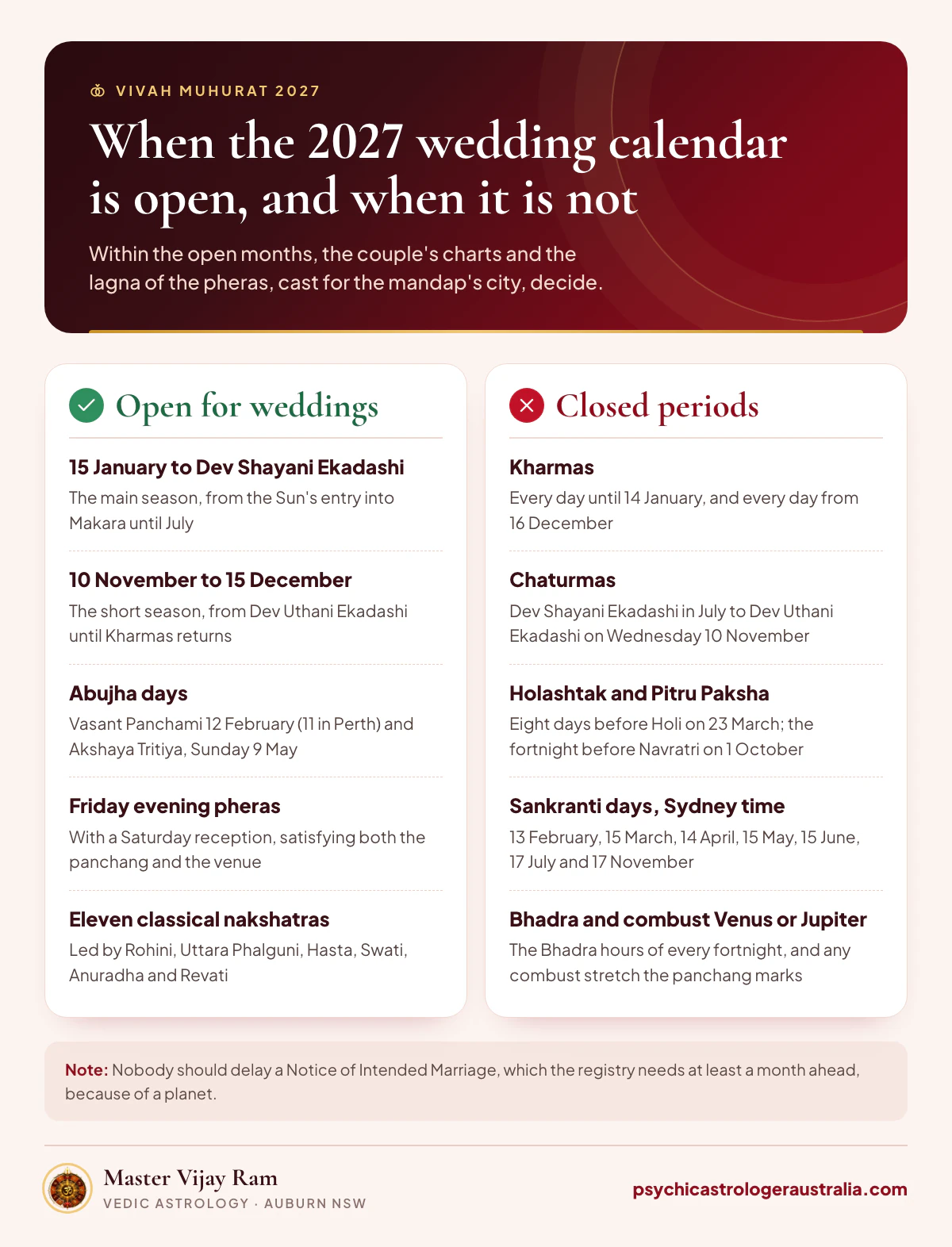
When is the 2027 wedding season in Australia?
Hindu weddings pause in two long stretches: Kharmas, while the Sun is in Dhanu, and Chaturmas, the four months of Vishnu's sleep. Everything else is open, subject to the day. In Australian dates that gives 2027 two seasons.
| Period | Status | Why |
|---|---|---|
| 1 January to 14 January | Closed | Kharmas: the Sun is in Dhanu from 16 December 2026 |
| 15 January to Dev Shayani Ekadashi in July | Open, the main season | The Sun enters Makara on 15 January; Magha, Phalguna, Vaishakha, Jyeshtha and early Ashadha are the classical wedding months |
| The eight days before Holi (Tuesday 23 March here) | Closed | Holashtak |
| Each sankranti day | Closed for the day | 13 February, 15 March, 14 April, 15 May, 15 June and 17 July are the Sun's sign changes in Sydney time |
| Dev Shayani Ekadashi in July to Wednesday 10 November | Closed | Chaturmas, ending at Dev Uthani Ekadashi |
| The fortnight before Navratri (Friday 1 October) | Closed | Pitru Paksha, kept for the ancestors |
| Wednesday 10 November to Wednesday 15 December | Open, the short season | Kartika and Margashirsha after Dev Uthani |
| From Thursday 16 December | Closed | Kharmas returns when the Sun enters Dhanu |
There is no adhik, or leap, month in 2027, so the lunar months and the seasons line up without the extra month that complicated 2026. Two shorter closures sit inside the open months as well: the hours of Bhadra in every fortnight, and any stretch when Venus or Jupiter is combust, which the panchang marks and a consultation checks for a specific date.
Which nakshatras, tithis and weekdays serve a wedding?
The classical wedding nakshatras are eleven: Rohini, Mrigashira, Magha except its first quarter, Uttara Phalguni, Hasta, Swati, Anuradha, Mula, Uttara Ashadha, Uttara Bhadrapada and Revati. Several lineages add Pushya, Punarvasu and Shravana; none uses Bharani, Krittika, Ardra, Ashlesha, Jyeshtha or Shatabhisha for a marriage.
The tithis are the 2nd, 3rd, 5th, 7th, 10th, 11th, 12th and 13th of the bright fortnight, with the same tithis of the dark fortnight accepted up to its tenth day; the 4th, 9th, 14th, the new moon and the 8th are avoided, and the full moon is used by some communities and not others. Monday, Wednesday, Thursday and Friday are the working weekdays. Tuesday is passed over by most north Indian families and Saturday by almost everyone, which is awkward in a country where every venue wants a Saturday.
What is the lagna of the pheras?
The hour is chosen by the sign rising at the mandap when the pheras begin, and the wedding muhurat stands or falls on this chart. The seventh house from the lagna is kept empty, because it is the house of the marriage itself; benefics are placed in the kendras and trikonas where the day allows; the lagna lord should be strong and not combust; Venus, the planet of marriage, and Jupiter, the planet of the vow, should both be visible in the sky rather than lost in the Sun's glare. The Rahu kaal of the day in that city is avoided outright.
In India this chart usually lands in the evening or the small hours, which is why so many weddings there run late into the night. Australian hotels and halls happen to offer evening slots too, so the two traditions meet more easily than families expect; the registry signing, which is a civil act, can sit anywhere in the day.
Which abujha days can host a wedding in 2027?
A few days are held auspicious for marriage without the nakshatra and tithi checks. In Australian dates for 2027 they are Vasant Panchami on Friday 12 February (Thursday 11 February in Perth and India), Akshaya Tritiya on Sunday 9 May, and Dev Uthani Ekadashi itself on Wednesday 10 November, which many families use as the first wedding of the short season. Phulera Dooj in Phalguna and Bhadali Navami in Ashadha are kept the same way in parts of north India.
Vijayadashami on Saturday 9 October is abujha for most beginnings, but it falls inside Chaturmas and traditional families do not marry on it. Even on an abujha day the lagna is chosen with care and the couple's charts are read; a self-evident day settles the date, not the hour.
How do Australian venues and the calendar meet?
Most Australian weddings are booked a year ahead for a Saturday, which the classical rules dislike, and the ceremony is often expected before a reception that the venue will not shift. The practical answers Vijay Ram ji gives are these. The muhurat governs the pheras, not the whole day, so a Friday evening lagna with a Saturday reception satisfies both the panchang and the hotel. Where only a Saturday is possible, the best lagna of that Saturday is chosen and the day's weakness is offset with a short puja beforehand. And the civil signing is separated from the rites, so the registrar's slot never dictates the sacred one.
The muhurat is always cast for the city of the mandap. A window computed for a Sydney wedding is two to three hours adrift in Perth, and a family in Brisbane in February is an hour behind their cousins in Melbourne until daylight saving ends on 4 April. Relatives in India watching the pheras on a video call are seeing a lagna chosen for Australia, which is as it should be.
Does Jupiter's year matter for a 2027 wedding?
Jupiter is the planet of the marriage vow, and the house it occupies from the bride's Moon sign in particular is a classical check: the 2nd, 5th, 7th, 9th and 11th are favoured. In 2027 Jupiter spends 25 January to 26 June in Cancer, its sign of exaltation, where it also turns direct on 13 April; it is in Leo for the rest of the year until it enters Virgo on 27 November. Which Moon signs Jupiter favours for marriage in 2027 works through the twelve signs.
A poor Jupiter house is not a veto. It is one weight on the scale beside the dasha, the lagna and the day, and the tradition has remedies for it that are far older than the internet's alarm.
How do the couple's charts decide between candidate days?
Once the calendar has offered its three or four windows in a month, the charts choose among them, and in vivah muhurta the bride's chart carries the greater weight. Tara bala and chandra bala are counted for both; the running dasha of each is read, since a wedding in a difficult antardasha for the groom is still a difficult season for the marriage; and the matching itself, the gun milan and the deeper layers behind it, has already been done. What a gun milan score means and which dasha periods bring a wedding explain the two checks that come before any date is proposed.
Families sometimes ask for the muhurat before the matching, because the venue is pressing. Vijay Ram ji will give a provisional window, but he says plainly that a date chosen before the couple's charts have been read is a date chosen for strangers, and the compatibility reading is the first step rather than an optional one.
What about the registry, the contract and Mercury retrograde?
The rites belong to the Moon and the lagna; the paperwork belongs to Mercury. Where the civil signing, the venue contract or the big deposits can move, Vijay Ram ji prefers them outside the 2027 Mercury retrogrades, which run from 10 February to 3 March, 11 June to 5 July and 8 to 29 October in Sydney time, and outside the fortnight after each station. Where they cannot move, the documents are read twice and signed in the Abhijit window of the day; the Mercury retrograde dates for every zone are published separately.
This is a modern refinement rather than a classical rule, and nobody should delay a Notice of Intended Marriage, which the registry needs at least a month in advance, because of a planet.
Which 2027 dates are already closed?
- Every day until 14 January, and every day from 16 December, for Kharmas.
- The eight days before Holi, which falls on Tuesday 23 March in Australia.
- The sankranti days: 15 January, 13 February, 15 March, 14 April, 15 May, 15 June, 17 July, 17 August, 17 September, 18 October, 17 November and 16 December in Sydney time, with Perth a day earlier for the January one.
- Chaturmas, from Dev Shayani Ekadashi in July to Dev Uthani on Wednesday 10 November, and the Pitru Paksha fortnight before Navratri on Friday 1 October inside it.
- The hours of Bhadra in every fortnight, and any stretch of combust Venus or Jupiter the panchang marks.
- No eclipse closes a 2027 date in Australia: the solar eclipses are not visible here and the lunar ones are penumbral.
Daylight saving ends on Sunday 4 April and starts on Sunday 3 October, which changes clock times, not the sky, but trips up families comparing a Brisbane window with a Melbourne one.
What a vivah muhurat cannot do
A good muhurat gives a marriage a clean beginning and the couple the confidence of having begun properly. It does not guarantee the marriage, and the tradition never said it did; the texts rank the couple's charts above the day and the couple's conduct above both. Vedic astrology is faith-based guidance, not legal, financial or medical advice, and no date replaces the registry's requirements, a celebrant's legal role or a counsellor's help where a relationship is already in trouble.
What families notice afterwards is simpler: a date chosen with care is a date the elders accept, the priest is comfortable with, and nobody argues about on the day.
How does Master Vijay Ram choose a wedding date?
Master Vijay Ram has chosen Hindu wedding dates for families in Australia for more than forty years, by phone, video and WhatsApp, in English, Hindi and Punjabi. The consultation is $50. He asks for both birth charts, the city of the mandap, the venue's available days and the families' travel, and returns two or three windows with the lagna times in that city's clock and the reasoning for each, saying plainly if a month should wait.
Where a family wants a graha shanti or a puja for the couple before the wedding, he performs it personally at his own place of practice in Auburn on a muhurat, with the family joining by video; a puja or havan starts from $250 and the figure is agreed before anything is performed. The wedding rites themselves are the family's own pandit's, and the wedding-date article shows the chart-level reasoning a single date goes through.
Read next
- Wedding Date Astrology: How a Vivah Muhurat Is ChosenWedding date astrology for Australian families: how a vivah muhurat is chosen from the panchang, the lagna, both char…
- Dev Uthani Ekadashi 2027 in Australia and the Wedding SeasonDev Uthani Ekadashi 2027 is Wednesday 10 November in every Australian city and India. Waking Vishnu, Tulsi Vivah, the…
- Vashikaran for Marriage Approval: Softening Family ResistanceHow family resistance to a marriage really softens: what vashikaran addresses, a stage-by-stage timeline, the honest …
Frequently asked questions
When is the Hindu wedding season in 2027 in Australia?
From 15 January 2027, when the Sun enters Makara and Kharmas ends, until Dev Shayani Ekadashi in July, when Chaturmas begins; then from Dev Uthani Ekadashi on Wednesday 10 November until 16 December 2027, when the Sun enters Dhanu and Kharmas returns. The eight days before Holi on 23 March, the sankranti days and the Pitru Paksha fortnight before 1 October are closed inside the open months.
Is Akshaya Tritiya 2027 a good wedding date?
It is the best-known abujha day for a wedding, held auspicious without the usual nakshatra and tithi checks, and in 2027 it falls on Sunday 9 May in every Australian city and in India. Venues fill early for it. The lagna of the pheras is still chosen with care, the Rahu kaal of the day is still avoided, and the couple's charts are still read before the date is confirmed.
Can a Hindu wedding be held on a Saturday?
Classical texts avoid Saturday for marriage, and most families prefer not to. Where a venue leaves no choice, the best lagna of that Saturday is chosen and a short puja beforehand offsets the day's weakness; another common solution is a Friday evening lagna for the pheras with the reception on Saturday, which keeps both the panchang and the venue happy. The civil signing can be on any day.
Why is the wedding muhurat usually in the evening?
Because the lagna chart of the pheras is what matters, and the sign rising in the east that gives an empty seventh house, strong benefics and a visible Venus and Jupiter often rises after sunset. Indian weddings run late for that reason. Australian evening venue slots usually fit it well; where a daytime lagna is cleaner, Vijay Ram ji will say so rather than default to the night.
Does Jupiter in 2027 affect wedding dates?
Jupiter's house from the bride's Moon sign is a classical check, with the 2nd, 5th, 7th, 9th and 11th favoured. In 2027 Jupiter is in Cancer, its exaltation sign, from 25 January to 26 June, in Leo for the rest of the year, and enters Virgo on 27 November, so the favoured Moon signs shift twice. A poor Jupiter house is weighed, not treated as a veto, and remedies exist for it.
What is Holashtak and does it apply in Australia?
Holashtak is the eight days before Holi, from the eighth tithi of the bright fortnight of Phalguna to the full moon, during which weddings and other beginnings are avoided in north India. In 2027 Holi falls on Tuesday 23 March in Australia, a day later than in India, so the eight days before it are the closed stretch here. South Indian families generally do not observe it.
Can we fix the wedding date before the kundli matching?
A provisional window can be given, but a date chosen before the couple's charts have been read is a date chosen for strangers. The matching, the dasha each is running and the bride's Jupiter house are what decide between the three or four windows a month offers, so the compatibility reading comes first and the muhurat follows. Families under venue pressure usually manage both inside a fortnight.
Does an eclipse close any wedding date in 2027?
Not in Australia. Sutak applies only where an eclipse is visible; the two solar eclipses of 2027 cannot be seen from Australia and the three lunar eclipses are penumbral, which carry no sutak in ordinary panchang practice. Families marrying in India should check their local panchang for the August solar eclipse, since visibility there differs from here.
What does a wedding muhurat consultation cost?
The consultation is $50 and includes the windows, the lagna times for the city of the mandap and the reasoning. A compatibility reading for the couple is a separate consultation at the same price. If the family wants a graha shanti or a puja performed for the couple before the wedding, Master Vijay Ram performs it personally in Auburn on a muhurat, from $250, agreed before anything is performed.
People also ask
Which months are auspicious for marriage in 2027?
In Australian dates, late January to early July, the classical months of Magha, Phalguna, Vaishakha, Jyeshtha and early Ashadha, and then mid-November to mid-December after Dev Uthani Ekadashi on 10 November. January before the 15th, the Chaturmas months from July to November and the days from 16 December are closed. There is no adhik month in 2027 to complicate the count.
Which nakshatra is best for marriage?
The eleven classical wedding nakshatras are Rohini, Mrigashira, Magha after its first quarter, Uttara Phalguni, Hasta, Swati, Anuradha, Mula, Uttara Ashadha, Uttara Bhadrapada and Revati. Rohini and Uttara Phalguni are the most sought after. The nakshatra is read at the sunrise of the city where the wedding is held, so the Moon's star in Delhi is not always the star in Sydney.
Which dates should be avoided for a Hindu wedding?
Kharmas while the Sun is in Dhanu, Chaturmas from Dev Shayani to Dev Uthani Ekadashi, the Pitru Paksha fortnight, Holashtak before Holi, the sankranti days, the 4th, 9th and 14th tithis and the new moon, the hours of Bhadra, any stretch of combust Venus or Jupiter, and days with a visible eclipse. Tuesday and Saturday are avoided by most families.
Is Dev Uthani Ekadashi 2027 a wedding date?
Yes. Dev Uthani Ekadashi, Wednesday 10 November 2027 in every Australian city, ends Chaturmas and is treated as an abujha day for marriage, which is why it opens the short second season each year. The lagna is still chosen and the couple's charts still read, and the short season that follows runs until the Sun enters Dhanu on 16 December.
Can a muhurat for a wedding in India be used in Australia?
No. The tithi and nakshatra are read at local sunrise, the lagna depends on the mandap's longitude and latitude, and the Rahu kaal is an eighth of local daylight, so a Delhi window can fall on a different tithi in Sydney and is hours out in Perth. A wedding in Australia needs a muhurat cast for the Australian city in that city's clock, daylight saving included.
References & further reading
Serving clients across Australia
Confidential consultations by phone, video & WhatsApp — including: