
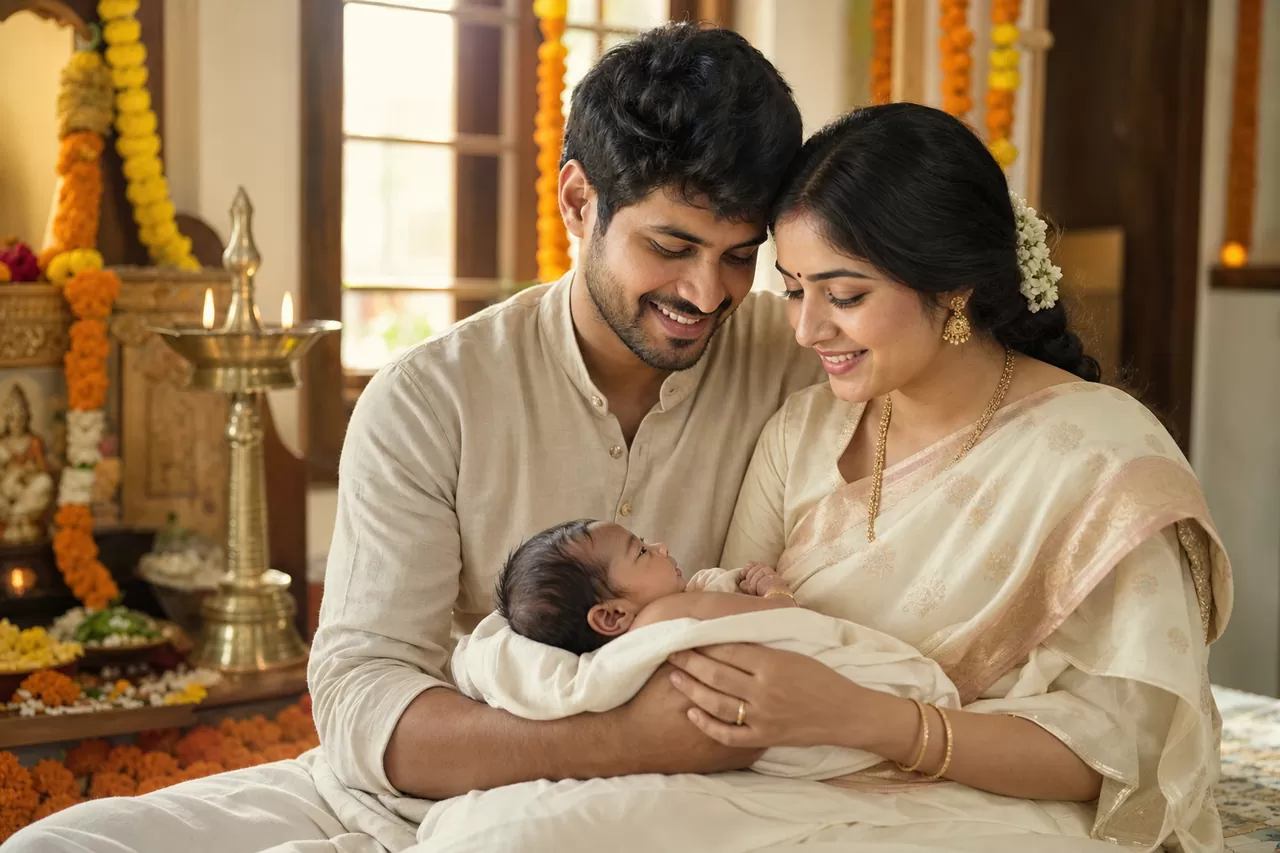
Quick answer
Sutak after a birth is the period, commonly ten to twelve days, when a Hindu household rests from temple visits and formal puja while mother and baby settle. It ends with a house cleansing and often the naming day. In Australia it is kept gently: no smoke or camphor near the baby, nothing on its face or eyes, and the midwife first.
What is sutak after a birth?
Sutak after birth is the period of ritual seclusion that a Hindu household keeps when a baby is born, commonly ten to twelve days, during which the family rests from temple visits, festivals and formal puja while the mother recovers and the baby settles. The old texts call it jananashaucha, the impurity of birth, but nothing about it is a judgement on the mother or the child; it is a fence the tradition puts around a new family so the world leaves it alone for a while.
Many families end it with a cleansing of the house and the naming of the baby, the naamkaran, and baby naming by nakshatra explains how the name is drawn from the birth star. This page covers what happens at home between the hospital and that day, and how to keep the customs safe for a newborn.
How long does it last, and who keeps it?
Ten days in many families, eleven or twelve in others, with the naming often falling at the end. The parents and the household keep it in full; grandparents and close relatives who share the home usually keep it too, while relatives living elsewhere often keep only a day or two, or nothing at all. Traditions differ, so ask the eldest person in the family what was kept when you were born.
The mother’s own rest is usually longer than the household’s sutak. Many families keep a period of about forty days in which she is cooked for, kept warm and asked to do nothing but feed, sleep and heal, and the sense in it is easy to see.
What is jatakarma, and what is safe to keep of it today?
Jatakarma is the birth rite, one of the sixteen samskaras, traditionally performed by the father soon after the birth: a prayer for the child’s long life and intelligence is whispered in the baby’s ear, and in the old form a touch of honey and ghee is placed on the tongue with a gold ring.
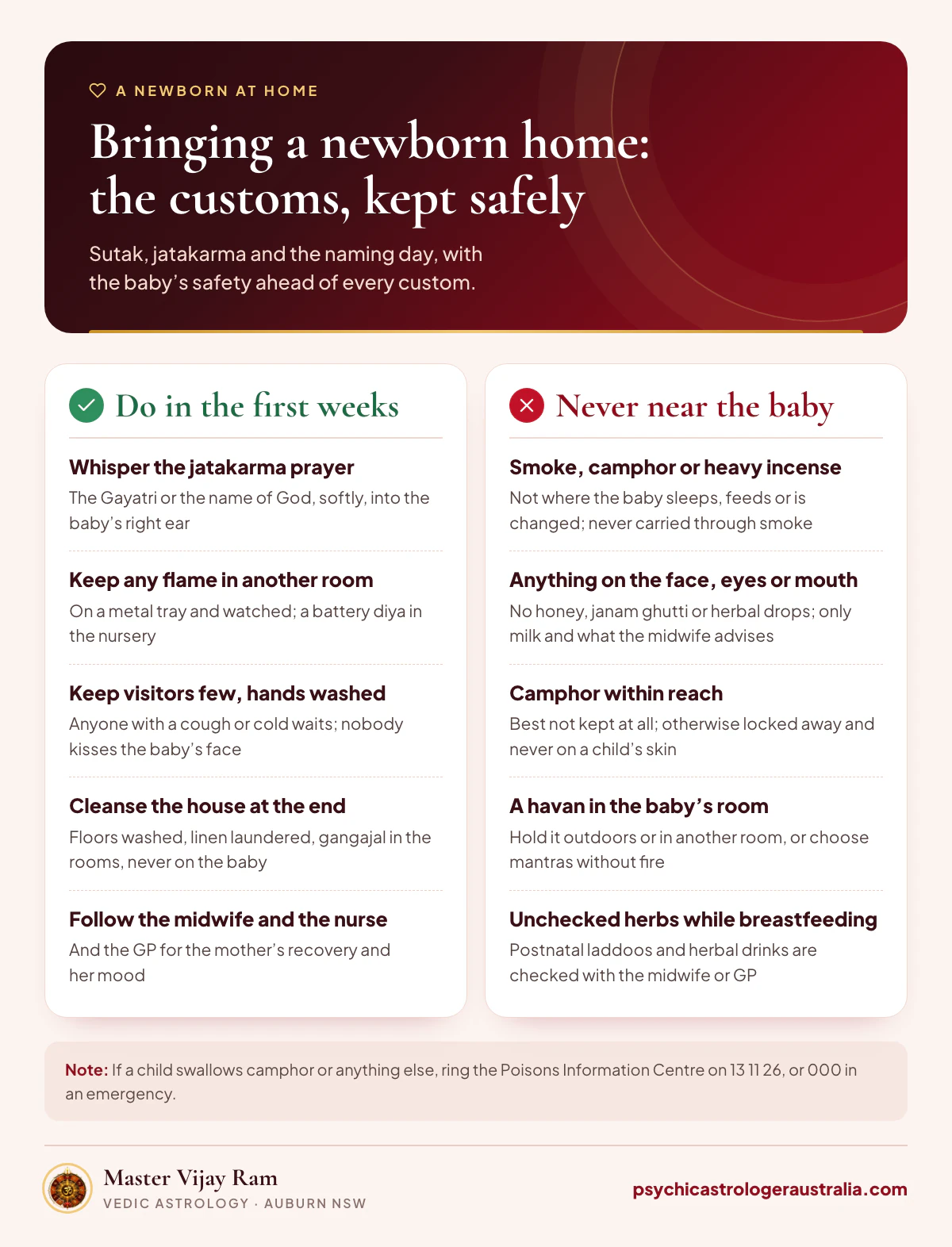
In an Australian hospital, and at home afterwards, the whisper is the part to keep. Nothing goes on a newborn’s face or eyes, and nothing into its mouth except milk and what the midwife or doctor advises; honey is not for babies, as any child health nurse will say. The same caution rules out janam ghutti and herbal drops, however long the family has used them.
Many fathers keep the rite by holding the baby and saying the Gayatri mantra or the name of God softly into the right ear, which is the oldest part of jatakarma and asks nothing of the baby but to listen.
What does the house do during the first days?
It slows down. The family stays away from temples, weddings and celebrations, and in many homes the altar is kept simply, with a lamp and a quiet prayer rather than a full puja; sweets are shared with friends and the temple once the period ends. Some families keep a lamp burning in the house through the days of sutak, a custom of welcome and protection.
Keep any flame in the living room or the kitchen, not the nursery, on a metal tray and only while someone is awake. A battery diya in the baby’s room keeps the custom without the smoke or the risk.
A mantra played softly, the Gayatri, the Hanuman Chalisa or a family bhajan, fills a quiet house well. Babies sleep through a great deal, and a calm, familiar sound is part of what the tradition means by protection.
Why do families keep visitors few in the first weeks?
Because a newborn needs sleep and feeding more than an audience, and a mother needs both even more. Families who keep the custom ask visitors to come after the naming day, to stay briefly, to wash their hands at the door and to stay away if they have a cough or a cold; nobody kisses the baby’s face.
Relatives in India can meet the baby by video in the meantime. A couple in Geelong whose parents are in Ludhiana can make the evening call part of the day without anyone flying in before the mother is ready.
The evil eye is the other reason elders give for keeping visitors few, and nazar on newborns and babies covers that side gently, with the child health nurse first.
Smoke, camphor and incense: what is safe near a newborn?
None of them near the baby. No smoke, camphor or strong incense is used in the room where the baby sleeps, feeds or is changed, and the baby is never carried through smoke or held near a flame. A dhoop or agarbatti at the altar is lit in another room, with a window open, and put out before the baby comes in.
Camphor needs special care in a house with children. In a young child a swallowed piece can bring on seizures, at times within minutes, which is why the Victorian Poisons Information Centre recommends keeping no camphor blocks or camphorated oil at home; any that stays in the house is locked up and kept off every child’s skin. For a swallowed tablet of anything, ring the Poisons Information Centre on 13 11 26, or 000 in an emergency.
The same caution covers pets and toddlers in the house, and home cleansing with pets and toddlers sets out the safe substitutes for every common cleansing material.
What does the mother need from the house?
Rest, warm food and help. The customs that grandmothers bring, warm water, light food, staying in, someone else doing the housework, are kind customs, and they work best when the family carries them out rather than the mother being asked to keep them. Anything she eats or drinks for healing, including the traditional postnatal laddoos and herbal drinks, is best checked with the midwife or GP, especially while she is breastfeeding.
Low mood, constant worry or feeling unable to cope after a birth are common and treatable. PANDA supports parents with perinatal anxiety and depression, and the GP or child health nurse can help too; reaching out is not a sign that the customs have failed.
When is the naming day, and how is the name chosen?
Traditionally the naamkaran falls at the end of sutak, commonly on the eleventh or twelfth day, with the first letter of the name taken from the syllable of the baby’s birth nakshatra and pada. In Australia many families hold the naming ceremony at home a few weeks later, on a weekend when the mother is ready and relatives can gather, and the tradition allows a later day.
The legal name has its own timetable. The birth registration form has a deadline, so many families choose the name early from the nakshatra syllables, register it, and hold the ceremony later; others register the name they already love and keep a separate rashi name for prayers. A muhurat for the naming day sets its day and hour in your own city’s clock.
How is the house cleansed at the end of the period?
Cleansing the house after childbirth is simple and practical. The floors get a proper wash, the sheets and curtains go through the machine, the mother has a full bath, often her first proper one in the tradition’s terms, and the altar returns to its full puja; many families sprinkle a few drops of gangajal through the rooms, never on the baby.
If the naming includes a havan, hold it outdoors, on a balcony or in a room the baby is not in, with the smoke alarm left on and a window open; a puja with mantras and no fire does the same work where that is not possible. A Ganesh puja, or a short Satyanarayan katha, is how many families mark the day.
The table brings the customs and the safe version together.
| Custom | What many families do | The safe version near a newborn |
|---|---|---|
| Jatakarma | A prayer whispered in the baby’s ear; honey and ghee in the old form | The whisper only; nothing on the face or in the mouth |
| The lamp | A lamp kept through the days of sutak | In another room, watched; a battery diya in the nursery |
| Prayer at home | A quiet altar; mantras and bhajans | Played softly; no incense in the baby’s room |
| Visitors | Few, and mostly after the naming day | Hands washed, anyone unwell stays away, no kissing the face |
| Cleansing at the end | Floors washed, gangajal sprinkled, the mother’s bath | Gangajal in the rooms, never on the baby |
| The naming day | A puja or havan with the family | Fire outdoors or in another room; mantras alone are enough |
What if the birth star is one the grandparents worry about?
A baby born with the Moon in one of the six gandmool nakshatras sometimes prompts anxious talk in the family. The tradition answers with a gentle shanti on a later return of the Moon to that star, not with fear, and nothing about the baby is unlucky.
Gandmool nakshatra explained calmly sets out the six stars and the shanti, and the naming reading confirms the baby’s star and pada from the hospital time.
Is this the same sutak as after a death?
The word is the same in many homes, and the shape is similar, a pause and then a cleansing, but the feeling is the opposite: one is a household withdrawn in grief, the other a household withdrawn in joy. In some north Indian homes the death period has its own word, patak, so that sutak can mean only a birth.
The days after a loss are covered in cleansing the home after a death, and families who have both in one year, a grandparent lost and a grandchild born, are not doing anything wrong by keeping each in its turn.
How does Master Vijay Ram help with the name and the puja?
From the hospital time he casts the newborn’s chart, confirms the nakshatra and pada, gives the syllables, suggests names that work in both languages, and sets the hour for the naming day. All of that sits inside one $50 consultation, by video or WhatsApp with the grandparents listening in. Parents in Cairns and Townsville book it the same way as those who find him through astrology readings in Geelong.
Some families also want a naming puja or a shanti for the baby. Vijay Ram ji performs it at Auburn, where he practises, starting at $250 with the amount fixed in advance, and the parents watch by video; online puja and havan explains what is included. Nothing is ever done to or over the baby, and no newborn needs to travel.
Where do the customs stop and the nurse take over?
They cannot replace the midwife, the child health nurse or the GP, and they are not a treatment for a baby who is unwell. A baby with a fever, breathing trouble, poor feeding or unusual sleepiness needs medical care at once, and 000 in an emergency. These customs are devotion, not medicine, and what they give a new household is a quiet fortnight and a beautiful reason to gather at the end of it.
Read next
- Cleansing the Home After a Death: Sutak, the Thirteen Days and ShuddhiSutak after a death, gently explained: what a Hindu home pauses for ten to thirteen days, the lamp, the terahvi, the …
- Why Hindus Bathe After a Funeral, and What to Do in AustraliaWhy Hindus bathe after a funeral: the custom at the door, the reasons tradition gives, children and elders, going bac…
- Signs of Negative Energy in Your Home & How to Clear ItSigns of negative energy in a home, the ordinary causes to rule out first, and how nazar, heavier interference and me…
Frequently asked questions
How long is the sutak period after a baby is born?
Commonly ten to twelve days for the household, with the naming often falling at the end. Grandparents and relatives who share the home usually keep it too, while relatives elsewhere often keep only a day or two. The mother’s own rest is usually longer, about forty days in many families. Traditions differ, so ask the eldest person in your family what was kept before.
Is the home altar used during sutak after a birth?
Many families keep the altar simply during the period, with a lamp and a quiet prayer rather than a full puja, and stay away from temples and celebrations. Mantras and bhajans played softly are welcome. At the end of the period the house is cleansed, the mother bathes and the full puja returns, often on the naming day with a Ganesh puja or a Satyanarayan katha.
What is jatakarma and how is it done today?
Jatakarma is the Hindu birth rite: the father whispers a prayer for the child’s long life and intelligence into the baby’s ear. In the old form honey and ghee were touched to the tongue with a gold ring, but nothing should go on a newborn’s face or into its mouth except milk and what the midwife advises, and honey is not for babies. The whispered prayer is the part to keep.
Is it safe to light incense or camphor with a newborn in the house?
Not near the baby. No smoke, camphor or strong incense goes in the room where the baby sleeps, feeds or is changed, and the baby is never carried through smoke. Light dhoop at the altar in another room with a window open. Camphor is best not kept at all, or locked away, because swallowed camphor can cause seizures in young children; the Poisons Information Centre is on 13 11 26.
When should the naming ceremony be held?
Traditionally on the eleventh or twelfth day, at the end of the birth sutak, with the first letter of the name taken from the baby’s nakshatra syllable. In Australia many families hold it a few weeks later, on a weekend when the mother is ready and relatives can gather, which the tradition allows. A muhurat for the ceremony is set in your own city’s clock.
Can we do a havan for the naming day with a baby in the house?
Yes, if the fire is kept away from the baby. Hold the havan outdoors, on a balcony or in a room the baby is not in, with a window open and the smoke alarm left on, and bring the baby in once the smoke has cleared. Where that is not possible, a puja with mantras and no fire does the same work, and many families choose it for a newborn.
How is the house cleansed after childbirth in Hindu custom?
When the period ends the floors get a proper wash, sheets and curtains are laundered, the mother has a full bath and the altar returns to its full puja. Many families sprinkle a few drops of gangajal through the rooms, never on the baby, and mark the day with the naming, a Ganesh puja or a Satyanarayan katha. Nothing more elaborate is needed.
Should visitors wait until after the naming day?
Many families ask them to, and it is sensible: a newborn needs sleep and feeding more than an audience, and the mother needs rest. Visitors who do come wash their hands at the door, stay briefly, stay away if unwell and do not kiss the baby’s face. Relatives in India can meet the baby by video in the meantime.
Does Master Vijay Ram perform the naamkaran?
The naming ceremony itself is the family’s, usually with their own priest. What he does is read the newborn’s chart from the hospital time, confirm the nakshatra and pada, give the syllables and set the hour, all in a $50 consultation. A naming puja or shanti, if wanted, is performed by him at Auburn from $250, the amount fixed in advance, while the parents watch by video. Nothing is done to or over the baby.
People also ask
What is not allowed during sutak after a birth?
In families that keep it, temple visits, festivals, weddings and formal puja wait until the period ends, and the household does not host celebrations. Customs differ by community. The tradition asks nothing that harms the mother or baby: no smoke near the baby, nothing on its face, and the mother fed, warm and resting.
Can the mother enter the kitchen or puja room after delivery?
Some families ask the mother to stay out of the kitchen and away from the altar for the period of sutak or longer, and the practical root of the custom is rest: someone else cooks and keeps house while she heals. Many modern families keep the rest and relax the rule. Ask the elders what they intend, and let the midwife’s advice on recovery come first.
What is the difference between sutak and patak?
Both words describe a period of ritual impurity that pauses temple visits and celebrations. In some north Indian usage sutak is kept for a birth and patak for a death, while many families simply say sutak for both. A birth sutak is commonly ten to twelve days and ends with the naming; the period after a death commonly runs ten to thirteen days.
Is it bad luck to name a baby before the naming ceremony?
No. Many Australian families must register the legal name before the ceremony because the birth registration form has a deadline, and the tradition does not treat that as unlucky. Some choose the legal name from the nakshatra syllables, others keep a separate rashi name for prayers. The ceremony blesses the name whenever it is held.
References & further reading
Serving clients across Australia
Confidential consultations by phone, video & WhatsApp — including: