
Quick answer
Annaprashan is the samskara that marks a baby’s first solid food, usually around six months, though customs differ by family. Here the nurse or GP says when the baby is ready. A muhurat is chosen from the baby’s chart and the local panchang, and the food is a few soft spoonfuls, never honey or anything a baby could choke on.
What is annaprashan?
Annaprashan is a samskara that marks the first time a baby eats solid food, and it is one of the happiest of the sixteen. The name joins anna, food or cooked rice, with prashana, eating. A parent or grandparent feeds the baby a few spoonfuls of sweet rice in front of the family, prayers are said, and the household celebrates a child moving from milk alone towards the family table.
Bengali families call it mukhe bhaat, Malayali families choroonu, and many North Indian families simply say the first rice. The rite sits seventh in the usual list of samskaras; the sixteen samskaras for Australian families sets it in that sequence. The day itself is chosen through a muhurat for family occasions.
When is annaprashan held?
Around six months is the usual answer, but customs differ by family and region. Many North Indian families follow a custom that boys have it in an even month, often the sixth or eighth, and girls in an odd month, often the fifth or seventh. Bengali families commonly hold mukhe bhaat around six months for boys and a little earlier or later for girls. Some Kerala families take the baby to Guruvayur or another temple for choroonu.
The modern guide sits alongside the custom. Australian health advice is that babies usually begin solid foods at around six months, when they show signs of readiness, and not before four months. If a baby is premature, unwell or not yet ready, the ceremony simply waits.
Who decides whether the baby is ready?
The child health nurse or the GP, not the calendar. Readiness signs commonly include good head control, sitting with support, interest in food and the ability to move food to the back of the mouth rather than pushing it out. A baby born early is often assessed by corrected age.
A baby with a known allergy, reflux, a feeding difficulty or a medical condition needs a specific plan from their doctor. In those families the ceremony can still be held with a single taste of whatever the doctor approves, or with a symbolic offering touched to the lips and then given to the elders as prasad.
What food is safe at an annaprashan?
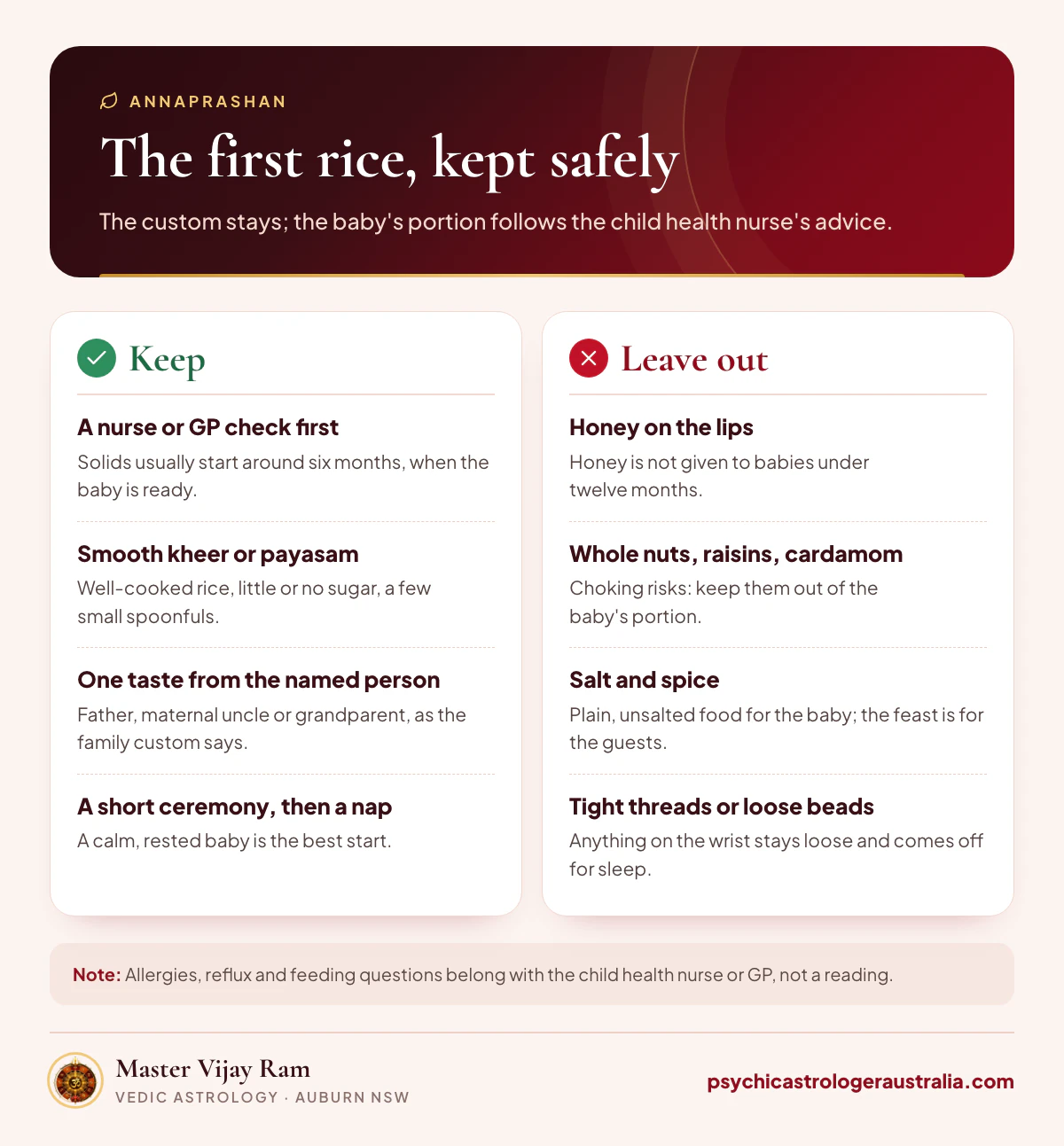
The traditional first food is kheer or payasam, rice cooked soft in milk and lightly sweetened, sometimes with dal or ghee rice beside it. For a baby of six months the practical rules are simple and they matter more than the recipe.
| Custom | Safe way to keep it in Australia |
|---|---|
| Kheer or payasam as the first taste | Smooth, well-cooked rice; little or no added sugar; a few small spoonfuls only |
| Honey touched to the lips | Leave it out: honey is not given to babies under twelve months |
| Cashews, almonds, raisins and cardamom | Keep whole nuts, dried fruit and pods out of the baby’s portion; they are choking risks |
| A spread of many dishes for the baby to taste | One or two soft foods for the baby; the feast is for the guests |
| Salt and spices in the dal or rice | Unsalted, plain food for the baby’s portion |
| Cow’s milk in the kheer | Check with the nurse or GP; a small amount in cooking is commonly fine, but not as a drink |
Silver spoons and bowls are a lovely tradition. Wash them thoroughly, and if they are old or decorated, check that nothing can flake or come loose.
Who feeds the baby first?
It depends on the family. In many North Indian homes the father feeds the first spoonful; in Bengali mukhe bhaat it is often the maternal uncle, and in some families the eldest grandparent. Where the person the custom names is in India, families now hold the spoon while the grandparent watches on a video call and gives the blessing.
One spoonful from each close relative can quickly become too much for a small baby. A single taste from the person the custom names, followed by symbolic touches from others, keeps the baby comfortable.
What is the tray game with the book, money and soil?
After the feeding, many families place a tray before the baby with a few objects: a book or pen, money or jewellery, a little earth, sometimes a toy tool or a small musical instrument. Whatever the baby reaches for first is laughed over as a sign of a future scholar, a businessperson, a landowner or an artist.
It is a game, and a loving one. No serious tradition reads a child’s future from it, and Master Vijay Ram would not read a baby’s chart from which object was grabbed. Keep small objects and coins out of reach afterwards, because babies put everything in their mouths.
How is the muhurat chosen?
Within the window the family and the nurse agree on, the day is chosen from the baby’s birth chart and a panchang computed for the family’s city. The tradition generally prefers a waxing Moon, avoids the rikta tithis (the fourth, ninth and fourteenth), and favours gentle or light nakshatras; Pushya, Hasta and Revati are among those often named, though texts differ. The weekday, the lagna at the hour and Rahu kaal are checked as well.
The day’s nakshatra is also counted from the baby’s own birth star, which is why a date that suits one baby may not suit a cousin born a month later. The baby’s nakshatra is already known from the naming; the baby’s nakshatra and name explains how it was found. That is why no ready-made annaprashan calendar appears on this site.
Should the ceremony wait for a trip to India?
Some families wait so that grandparents can hold the spoon, or so the ceremony can be held at the family temple. That is a valid choice, but a baby who is ready for solids at six months should start eating whatever the plans are. Many families begin solids quietly at the right time and hold the formal ceremony later as a celebration, which the tradition accepts.
Families travelling with a baby should check vaccinations and food safety with their GP before the trip. The ceremony is worth doing well, not worth risking a baby’s health for.
How do families hold it in Australia?
At home, at a temple, or in a hired hall, with as many or as few guests as the family wants. In Sydney and Melbourne many temples offer annaprashan; in Cairns, Townsville and Darwin families often hold it at home or in a community hall, with a local priest or with the elders leading the prayers. A quiet home ceremony with parents, grandparents on a video call and a lamp lit before the family deity is entirely complete.
The first rice ceremony does not need a large budget. What it needs is a calm baby, a soft spoonful and the people who love the child.
What about nazar on the day?
Many families worry that a crowd admiring the baby invites the evil eye. The custom of a small black dot behind the ear or under the hairline, or a black thread on the wrist, is common; keep anything on a baby’s wrist or neck loose, out of the mouth, and removed for sleep, because cords and beads are strangling and choking hazards. A tired, overwhelmed baby is the more likely cause of tears, and a short ceremony followed by a nap is the best protection there is.
Some families also have a mundan in mind for later; the mundan in Australia explains when that usually falls, and karnavedha and its timing covers the ear piercing that some families hold close to it.
Is there a puja that goes with it?
Families usually begin with a Ganesh puja and end with an aarti, and some hold a small havan. A local priest or the family elders lead these at the ceremony itself. A few parents also ask for a separate prayer for the baby’s health on the morning of the ceremony. Vijay Ram ji holds that himself in Auburn at the hour already chosen, and the family can switch on a video call to watch before the guests arrive; a puja or havan performed for you explains the process. His readings are $50, and puja work begins at $250, with the amount settled before anything is done.
What does annaprashan not do?
It does not protect a baby from illness, guarantee a good appetite or settle a fussy eater. It marks a moment and blesses it. Feeding advice, growth checks and allergies stay with the child health nurse, the GP and resources such as Pregnancy, Birth and Baby. An annaprashan muhurat chooses a good hour for the family to gather; the nurse decides what goes on the spoon.
Most parents in Far North Queensland, the Top End and the Central Coast never meet him in person: the reading happens on the phone while the baby naps. Readings for Cairns families covers the Queensland clock. He talks in English, Hindi or Punjabi, and anyone who wants to sit across the table from him comes to Auburn by appointment.
Read next
- Mundan in Australia: The First Haircut Ceremony and What It Is Said to ClearMundan in Australia: what the first haircut is said to clear, the usual ages, the muhurat and rite, the hair afterwar…
- Vidyarambha: Starting a Child’s Learning on an Auspicious DayVidyarambha, a child’s first letters: Vijayadashami on Sat 9 Oct 2027, Vasant Panchami, regional customs, the safe wa…
- What to Expect From a Vashikaran Specialist: A Full WalkthroughA plain walkthrough of a vashikaran consultation in Australia: what you are asked, what is read, what gets refused, a…
Frequently asked questions
At what age is annaprashan done?
Most families aim for about six months, but the custom shifts from home to home. Many North Indian families pick an even month for a boy, such as the sixth or eighth, and an odd month for a girl, such as the fifth or seventh. Australian advice is that solids start at around six months when the baby shows readiness, and not before four months, so ask the nurse first.
What food is given at an annaprashan?
Traditionally kheer or payasam, rice cooked soft in milk and lightly sweetened, sometimes with dal or ghee rice. For the baby’s portion keep it smooth, with little or no sugar and no salt, and leave out honey, whole nuts, raisins and cardamom pods. A few small spoonfuls are enough; the feast is for the guests.
Can honey be used in the annaprashan ceremony?
No. Honey is not given to babies under twelve months, so the old custom of touching honey to the lips is left out. The ceremony is complete without it. Families who want a sweet first taste can use a little smooth kheer made with minimal sugar, after checking with their child health nurse or GP.
How is the annaprashan muhurat chosen?
Within the window the family and nurse agree, the day is chosen from the baby’s birth chart and a panchang computed for the family’s city. Tradition usually prefers a waxing Moon, avoids the fourth, ninth and fourteenth tithis, favours gentle nakshatras and avoids Rahu kaal. The day’s star is counted from the baby’s birth star, so each baby’s muhurat is individual.
Who feeds the baby first at annaprashan?
It depends on the family. Many North Indian families have the father feed the first spoonful; in Bengali mukhe bhaat it is often the maternal uncle; some families choose the eldest grandparent. If that person is in India, a parent can hold the spoon while the grandparent blesses the baby on a video call.
What does it mean when the baby picks the book or the money?
The tray of objects after the feeding is a loving family game. Whatever the baby grabs is joked about as a sign of a future scholar, businessperson or landowner. No serious tradition reads a child’s future from it. Afterwards keep coins and small objects away from the baby, who will put anything in their mouth.
Should we wait to do annaprashan in India?
Some families wait so grandparents can take part or so the ceremony can be at the family temple. That is fine, but a baby ready for solids at six months should start eating anyway. Many families begin solids quietly and hold the formal ceremony later as a celebration, and check travel vaccinations and food safety with the GP before the trip.
Will Vijay Ram ji come and conduct our annaprashan?
No; he works from Auburn and does not visit homes or halls. In a $50 reading he picks the hour from the baby’s chart and your city’s panchang, and the ceremony itself is led at home or the temple by a local priest or the elders. Parents who also want a prayer for the baby’s health held on that hour can ask him; it begins at $250, settled beforehand.
People also ask
What is annaprashan called in Bengali and Malayalam?
In Bengal the first rice ceremony is called mukhe bhaat, often with the maternal uncle feeding the baby. In Kerala it is choroonu, and some families hold it at Guruvayur or another temple. North Indian families commonly say annaprashan or simply the first rice.
Is annaprashan done in the 5th or 6th month?
Many North Indian families follow a custom of an odd month, often the fifth or seventh, for girls and an even month, often the sixth or eighth, for boys. Other regions and families differ. In Australia the child health nurse confirms readiness, which usually comes at around six months.
Which nakshatra is good for annaprashan?
Gentle and light nakshatras are traditionally favoured, with Pushya, Hasta and Revati among those often named, though texts give different lists. The day’s nakshatra is also counted from the baby’s own birth star, so a muhurat is chosen for the individual baby rather than from a general list.
Can annaprashan be done at home?
Yes. A home ceremony with a lamp before the family deity, a Ganesh prayer, the first spoonful and an aarti is complete. Many families in Australia hold it at home or in a hired hall, with a local priest or the elders leading, and grandparents watching by video.
References & further reading
Serving clients across Australia
Confidential consultations by phone, video & WhatsApp — including: