
Quick answer
Shashtipurti is the Hindu rite for a completed sixtieth year, when the sixty-year cycle of named years returns to the birth year; Sathabhishekam marks eighty, about a thousand full moons. Both are kept on the day the birth nakshatra returns in the birth month, with homas, an abhishekam and often the couple renewing their marriage.
What are Shashtipurti and Sathabhishekam?
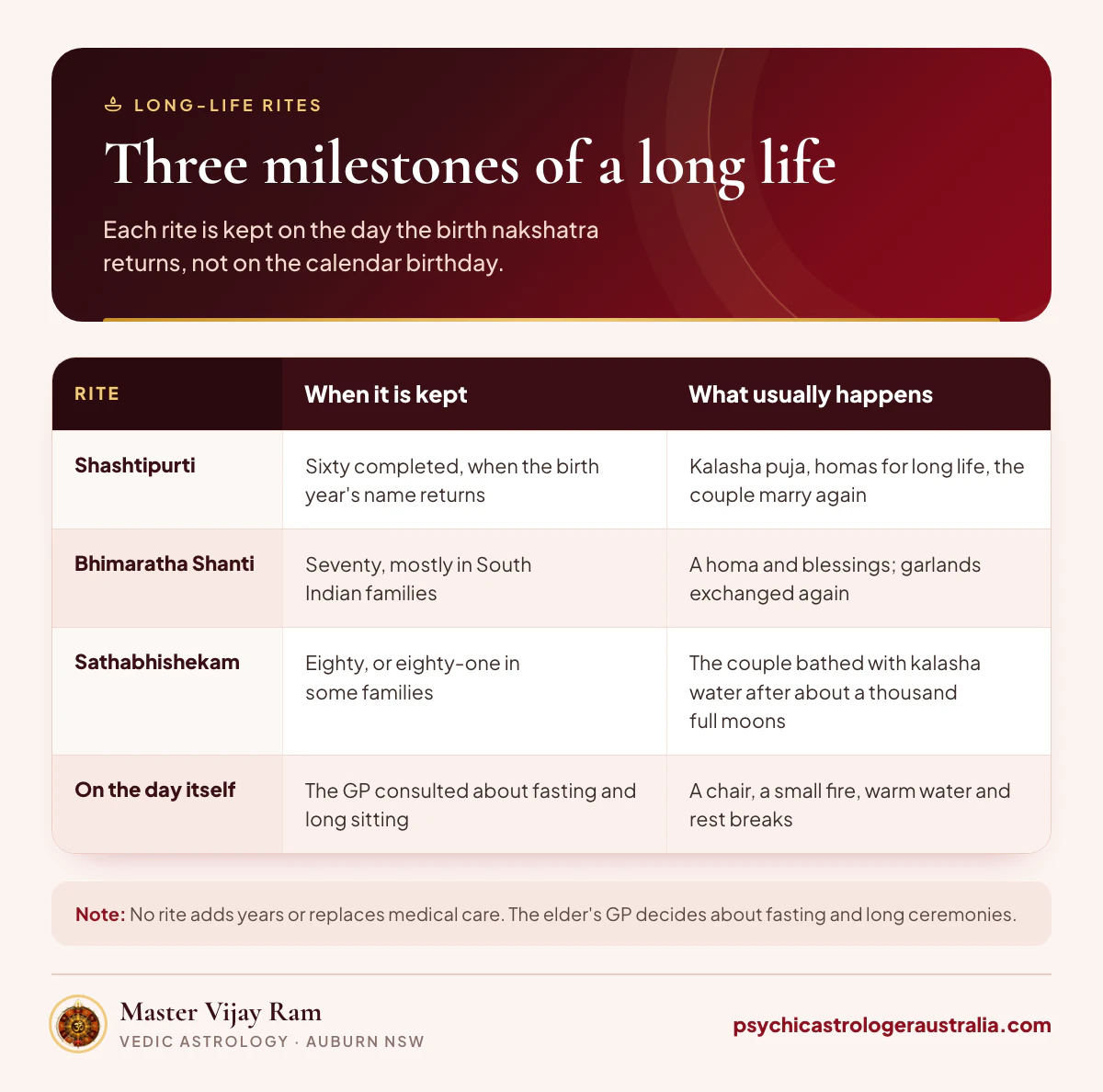
Shashtipurti is a Hindu rite that marks a completed sixtieth year, the point at which the sixty-year cycle of named years comes back to the year a person was born in. Sathabhishekam is the matching rite at eighty, kept for someone who is said to have seen about a thousand full moons. Between the two, many South Indian families also keep a rite at seventy, so a long life is honoured three times.
None of these is a birthday party with a priest added. Each is a thanksgiving for the years already lived, a prayer for health in the years ahead and, where both partners are living, a ceremony in which the couple marry each other again in front of their children and grandchildren. Choosing the day is the part a muhurat consultation for family rites handles, and it is rarely the calendar birthday.
Why sixty, and why eighty?
The Hindu calendar names its years in a cycle of sixty, from Prabhava to Akshaya, a cycle traditionally tied to Jupiter and Saturn coming back into roughly the same relationship with each other. By sixty a person has lived through every named year once, and the name of their birth year returns. That return is read as a second beginning, which is why the rite borrows so much from both a wedding and a birth.
Eighty rests on a different count. Sathabhishekam, which some families call Sahasra Chandra Darshana Shanti, honours a person who has watched roughly a thousand full moons rise over their life. Traditions differ on whether it falls in the eightieth or the eighty-first year and on how the moons are counted, so families follow their elders or their temple.
What are Ugraratha Shanti and Bhimaratha Shanti?
Some families mark the start of the sixtieth year, not its completion, with Ugraratha Shanti, and keep Shashtipurti a year later; others fold both into one day. Bhimaratha Shanti belongs to the seventieth year. Ratha means chariot, and at each stage the image is the same: a life that has carried its load this far is honoured and steadied for the next stretch of road.
Which of these a family keeps depends more on region and lineage than on any single text. Tamil, Telugu, Kannada and Malayali families keep the full set most widely, while many north Indian families mark a parent's sixtieth with a havan and a family meal and leave the shantis aside.
| Rite | When | What it marks | What usually happens |
|---|---|---|---|
| Ugraratha Shanti | Entering the sixtieth year (some families only) | The approach of the cycle's return | A shanti homa, often kept small |
| Shashtipurti (Shashtiabdapurti) | Sixty completed | The named year of birth coming round again | Kalasha puja, homas for long life, the couple's renewal of marriage |
| Bhimaratha Shanti | Seventy | A further stage of a long life | A homa and blessings; garlands exchanged again in many families |
| Sathabhishekam | Eighty, or eighty-one in some families | About a thousand full moons seen | The couple bathed with consecrated kalasha water; blessings given and received |
What actually happens on the day?
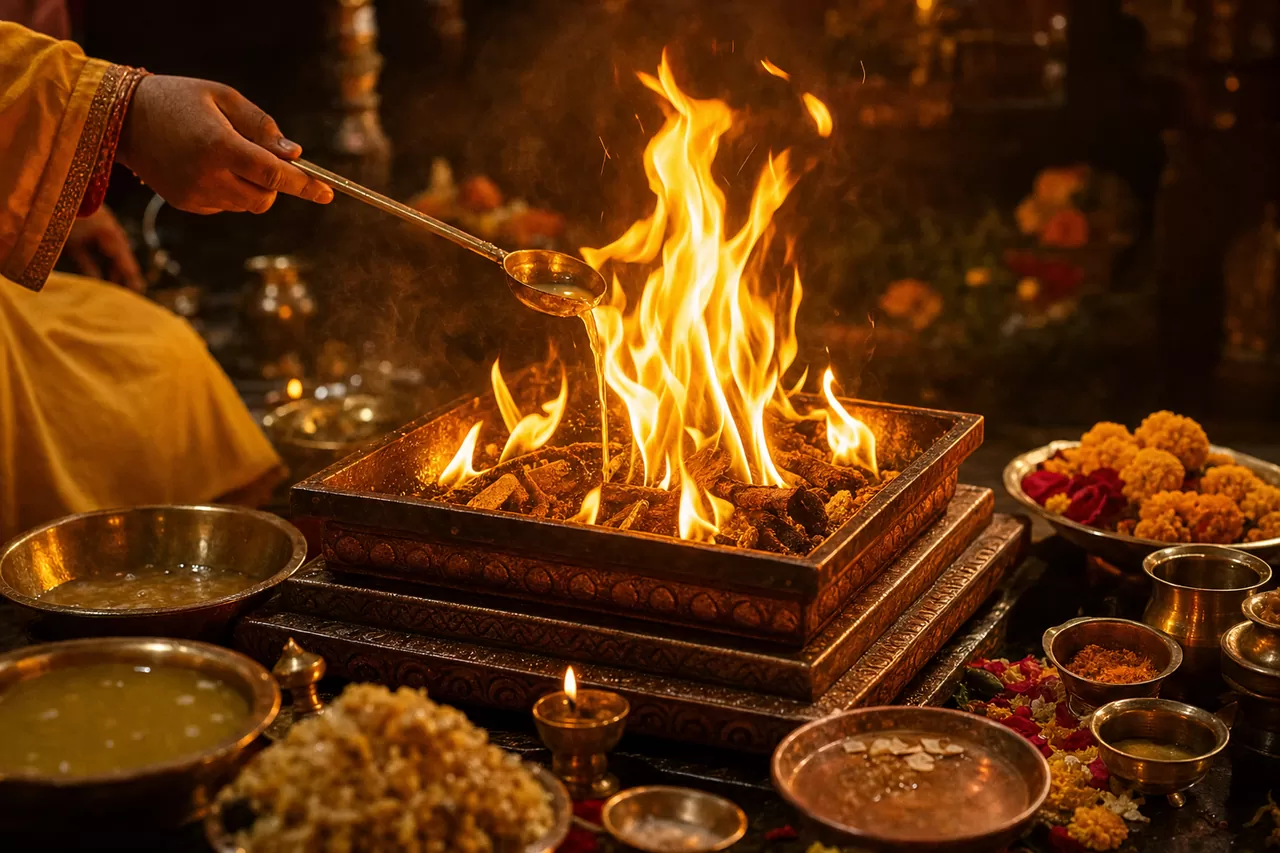
The order varies by family and priest, but most ceremonies open with Ganesh puja and a sankalpa that names the couple, the place and the occasion. Kalashas, water pots, are set up for the deities invoked, and homas follow: commonly an Ayushya homa for long life, a Mrityunjaya homa addressed to Shiva and a Navagraha homa for the nine planets. The water from the kalashas is then poured over the couple, which is the abhishekam that gives the eightieth its name.
In many families the husband then ties a new mangalsutra or thali, garlands are exchanged and the children wash their parents' feet or present new clothes. It is one of the few days on which grown children formally serve their parents in front of everyone, and elders often remember that more than the fire.
Where a spouse has died, the rite is still kept for the surviving parent without the marriage renewal. Priests adapt it gently, and nobody should be made to feel that the day is incomplete.
How is the date chosen?
Traditionally the rite falls on the day the person's birth nakshatra returns in their birth month, solar or lunar depending on the community, in the sixty-first year of life. Two parents born months apart may therefore need two different days, and siblings sometimes discover that the day they had planned around is simply the wrong star. The hour inside the chosen day is then fixed by the rising sign, outside the Rahu kaal, at a time the priest can keep.
If the traditional day cannot work, because the hall is taken or relatives cannot fly, the next suitable day in the same month is usually found; how an auspicious date is chosen sets out the general method. Where a parent's birth time was never recorded, the nakshatra can often still be fixed from the date alone, because the Moon spends about a day in each star, unless it changed stars on that very day.
How do families plan it in Australia?
Three questions come first: where to hold it, who can come and who will perform it. A temple hall is the natural choice where one is near, but plenty of these ceremonies happen in community halls, function centres and family homes, and a homa in a hired hall needs the venue's agreement about smoke and alarms before anything is booked.
The guest list is usually the harder part. A brother in Chennai, a son in Singapore and a daughter in Perth may not all get leave for the right star, so some families keep a small rite on the correct day and a larger gathering on a weekend. Many parents are on a long visit when the milestone comes round, which brings its own household questions; parents visiting from India for months goes through them.
In Hobart, Wollongong or Newcastle the priest who knows the full South Indian sequence may be some distance away. Part of the planning is simply finding that person early and agreeing in writing which homas will be performed and what they will cost.
What health points matter for elders on the day?
A ceremony designed for a sixty-year-old in a village can be hard on a seventy-nine-year-old with a new hip. Before the day, speak to the parent's GP if they live with heart disease, diabetes, a lung condition or a recent operation, and plan around what they can comfortably manage rather than how it was done for a grandfather.
- Seating: a low stool or a chair instead of hours cross-legged on the floor; priests are used to this.
- Fasting: many elders fast until the homa ends, but with diabetes or blood-pressure tablets the GP decides; a light meal earlier is no failure of devotion.
- Smoke: homa smoke can set off asthma and other lung conditions, so keep the fire small, the room aired and the person with a breathing problem away from the drift; never cover or disable a smoke alarm.
- Water and temperature: an abhishekam in a cold hall in a Canberra winter is a shock to an elderly body; warm the water, dry them quickly and keep dry clothes ready.
- Length: ask the priest which parts are essential and which can be summarised, and build in rest.
For a parent living with dementia, a familiar room, a few faces and a short ceremony usually serve better than a crowded hall, and Dementia Australia supports families thinking through occasions like this. The parent's comfort and dignity outrank the full sequence.
Does the birth chart matter for the rite?
It matters for the timing, and many families also ask what the coming years hold for a parent's health and for the couple together. Master Vijay Ram reads the running mahadasha and antardasha, the Moon's transits and Saturn's position, and says which stretches deserve extra care. That is guidance on tendencies, not a forecast of how long anyone will live; no honest reading gives a lifespan.
Where the chart shows a demanding period, the usual answer is prayer within the rite itself, a Mahamrityunjaya jaap or a graha shanti, alongside the medical care already in place. Health and wellbeing readings cover how he approaches those questions without frightening anyone.
What does it cost, and who performs it?
Vijay Ram ji chooses the date and hour in a $50 consultation by phone, video or WhatsApp, in English, Hindi or Punjabi. If the family wants a homa or jaap performed on the chosen muhurat, he performs it personally at his place of practice in Auburn, the family joining by video if they wish; a puja or havan performed on your behalf starts from $250, and the figure is agreed before anything is done.
He does not travel to run the full ceremony in a hall elsewhere. Many families keep the Shashtipurti with their own temple priest locally and ask him only for the date and a reading of the chart, which is a perfectly sound arrangement.
What if a parent does not want a fuss?
Some parents genuinely do not. A father who never liked being the centre of attention may agree to a quiet homa and a family lunch and nothing more, and that is still a Shashtipurti; the tradition marks the year, it does not demand a function centre.
Separated or divorced parents can each be honoured on their own day. Couples who married late, second marriages and parents who married across communities raise questions a priest can usually answer kindly, and what matters most is that the person being honoured feels comfortable.
Where does it sit among the samskaras?
Shashtipurti is not one of the classical sixteen samskaras, which run from conception to the funeral rites. It belongs to a later group of shantis for age and borrows heavily from vivaha, the wedding, which is why it feels so familiar to guests; the overview of the sixteen samskaras gives the main list.
For the children it often arrives alongside harder conversations about care, money and where a parent will live. Decisions about caring for ageing parents treats those honestly and practically.
What can a long-life rite not do?
A Shashtipurti or Sathabhishekam is gratitude and prayer. It does not add years, cure an illness or stand in for the cardiologist, and no test or treatment should wait for the ceremony. What it does well is gather a family around an elder, say aloud what that person has given, and begin the next years with a blessing.
Families on the Gold Coast, in Canberra and in South Australia often consult by phone for the date and keep the ceremony at home; the page for Adelaide families seeking an astrologer explains how readings work from there.
Read next
- The Sixteen Samskaras: An Overview for Australian FamiliesThe sixteen samskaras, the Hindu rites of passage from conception to cremation: what each marks, which families keep …
- Hindu Wedding Rituals From Haldi to Vidaai, ExplainedHindu wedding rituals in order, from haldi and mehndi to kanyadaan, the saptapadi vows and vidaai, with regional diff…
- How to Reverse a Love Spell SafelyReversing a love spell safely means lifting a binding, not casting a second one. Learn the settling phases, the hones…
Frequently asked questions
What is the difference between Shashtipurti and Sathabhishekam?
Shashtipurti marks a completed sixtieth year, when the cycle of sixty named Hindu years returns to the year of birth. Sathabhishekam is kept at eighty, or eighty-one in some families, for a person who has seen about a thousand full moons. Both include homas for long life and an abhishekam, and in many families both include the couple renewing their marriage vows.
Is Shashtipurti held on the 60th birthday itself?
Usually not. The traditional day is the one on which the person’s birth nakshatra returns in their birth month, solar or lunar depending on the community, in the sixty-first year of life. That day can fall weeks away from the calendar birthday, which is why families ask for the date to be worked out from the birth details and the city of the ceremony.
Can Shashtipurti be done if one spouse has passed away?
Yes. The rite is kept for the surviving parent, with the homas and the blessings but without the renewal of marriage. Priests adapt it with care, and families often add a quiet prayer for the parent who has died. The aim is to honour the person present, and nobody should feel the occasion is lesser for being kept alone.
What is Bhimaratha Shanti?
Bhimaratha Shanti is the long-life rite kept at seventy, mostly by South Indian families, between Shashtipurti at sixty and Sathabhishekam at eighty. It follows a similar shape: a sankalpa, homas for health and long life, blessings from the family, and in many families an exchange of garlands between the couple. Not every family keeps it, and that is a matter of custom, not obligation.
Can the ceremony be held at home in Australia?
Yes, and many are. A home, a community hall or a temple hall all work. Any homa indoors needs a small fire on a metal base, good airflow and working smoke alarms that are never covered, and a hired venue needs to agree to the fire before you book. Some families keep a short rite at home on the correct day and a larger gathering later.
Should an elderly parent fast for Shashtipurti?
Only if their doctor agrees. Many elders fast until the homa is finished, but with diabetes, blood-pressure medicine or other conditions a long fast can be unsafe. The GP decides, and a light meal earlier in the day is entirely acceptable in the tradition. Water, a chair instead of the floor and rest breaks matter more than strictness.
Does Master Vijay Ram perform the full Shashtipurti ceremony?
He chooses the date and hour in a $50 consultation and reads the chart for the years ahead. Where a family wants a homa or jaap performed on the muhurat, he does it personally at his place of practice in Auburn, from $250 agreed beforehand, with the family joining by video. Many families keep the main ceremony with their own temple priest locally.
Can the chart say how long a parent will live?
No honest reading gives a lifespan. The chart can show periods that deserve more care, through the running dasha and transits such as Saturn’s, and that guidance is about tendencies and timing. Health decisions belong with the parent’s doctors. Prayer, a jaap or a shanti within the rite sits alongside medical care and never replaces it.
People also ask
What is done in Shashtipurti?
Most ceremonies open with Ganesh puja and a sankalpa, then set up kalashas and perform homas for long life, commonly the Ayushya, Mrityunjaya and Navagraha homas. The kalasha water is poured over the couple, the husband often ties a new mangalsutra or thali, garlands are exchanged and the children honour their parents. Details vary by region and by the priest.
Why is the 60th birthday special in Hinduism?
The Hindu calendar names its years in a cycle of sixty, traditionally linked to Jupiter and Saturn returning to a similar relationship. At sixty the name of a person’s birth year returns for the first time, so the year is read as a second beginning and marked with prayers for health and a renewal of the marriage.
What is the 80th birthday ritual called?
It is usually called Sathabhishekam, and some families call it Sahasra Chandra Darshana Shanti, the rite for having seen a thousand moons. It is kept at eighty or eighty-one depending on the family’s custom, with homas, an abhishekam of the couple using consecrated kalasha water, and blessings given to and received from the gathered family.
What is Ugraratha Shanti?
Ugraratha Shanti is a rite some families keep on entering the sixtieth year, before Shashtipurti marks its completion. It is usually a smaller homa for protection and health. Other families combine it with Shashtipurti on one day, and many north Indian families do not keep it at all. The family’s own custom decides.
References & further reading
Serving clients across Australia
Confidential consultations by phone, video & WhatsApp — including: