
Quick answer
Body cleansing in the Vedic tradition, sharira shuddhi, prepares a person for prayer by cleansing body, breath, speech and mind together: a bath, three sips of water with a name of God, a few slow breaths, a mantra, a fast, a gift and simple food. It is devotion and discipline, not a detox, and it treats no illness.
What does body cleansing mean in the Vedic tradition?
Sharira shuddhi is the purification of the body that the Vedic tradition asks of anyone about to pray, and it was never meant to be done to the body alone. Water cleans the skin so that attention can turn inward, and the same word, shuddhi, is used for the breath, for speech and for the mind. A clean body is the first quarter of the work, not the whole of it.
People who ring Master Vijay Ram about a spiritual body cleanse usually have one of three things in mind: a bath that might lift a heaviness, a ritual sold to them online, or a grandparent’s habits they half remember and want to keep properly. This page maps all three, and the other posts in this series take each tool further. When the heaviness sits in the field around a person rather than on the skin, aura cleansing is the service that reads it.
Why does the tradition cleanse four things rather than one?
Because a washed body carrying a sharp tongue and a racing mind is, in the tradition’s own terms, barely begun. The four layers usually named are the body, the breath, speech and the mind, and each has its own means: water for the body, regulated breathing for the breath, truthfulness and silence for speech, and mantra and steady attention for the mind.
A verse in the Manusmriti’s chapter on purity says the same in one line: the limbs are cleansed by water, the mind by truthfulness, the embodied self by learning and austerity, and the understanding by knowledge. Patanjali’s Yoga Sutras put shaucha, cleanliness of body and of mind, first among the niyamas, the five observances a practitioner keeps.
What are the everyday tools of sharira shuddhi?
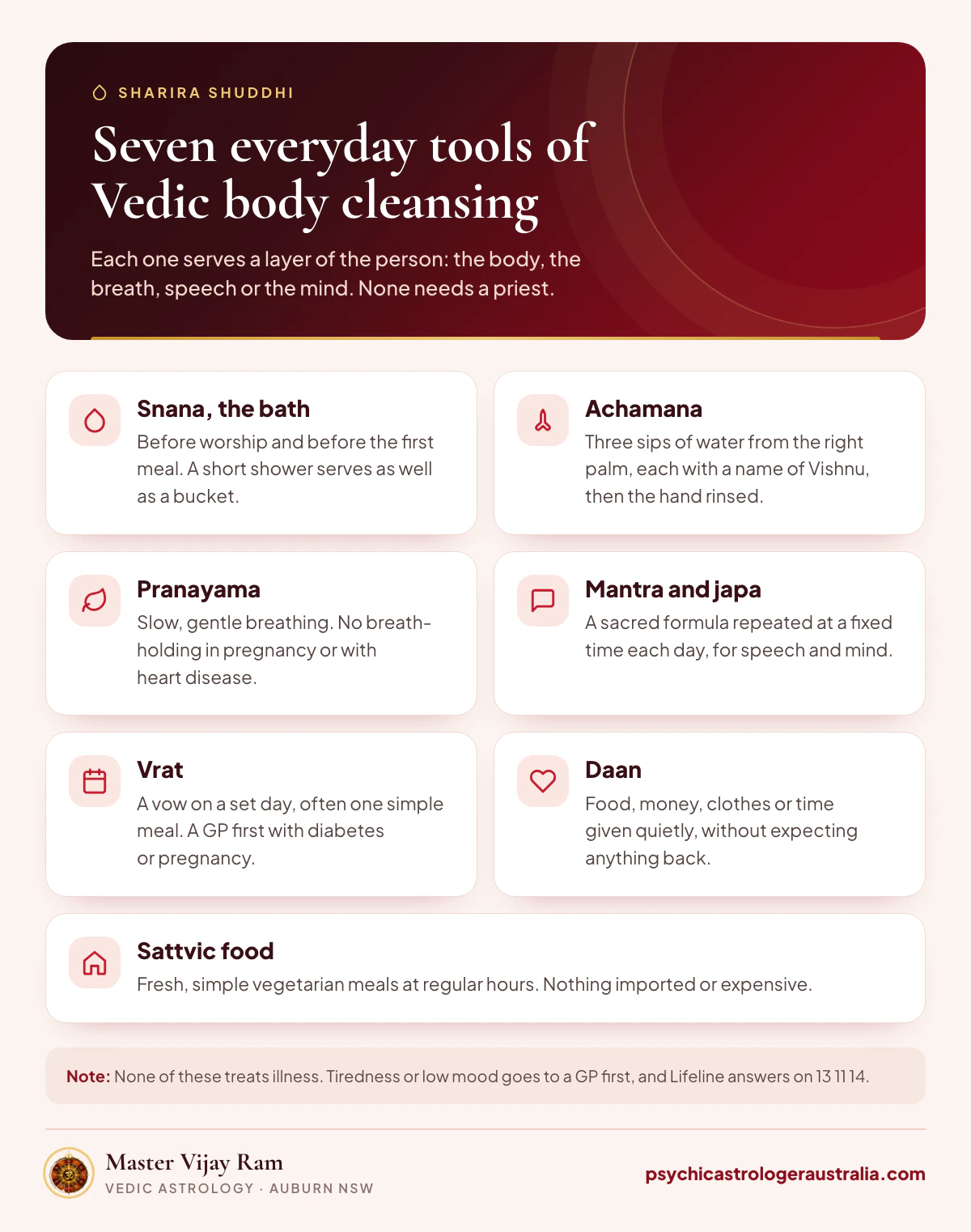
Seven tools turn up in Hindu households of every region and sect, and the table sets them out with the layer each one serves. The last column is the honest cost of each, which is mostly time.
| Tool | What it is | Layer it serves | What it asks of you |
|---|---|---|---|
| Snana | A bath, traditionally before worship and before the first meal | Body | A few minutes and clean clothes afterwards; a short shower counts |
| Achamana | Three sips of water from the right palm, each with a name of Vishnu | Body and speech | Ten seconds and a cup of clean water |
| Pranayama | Slow, regulated breathing, such as the alternate-nostril breath | Breath | Gentle forms only without a teacher; no breath-holding in pregnancy or with heart disease |
| Mantra and japa | A sacred formula repeated aloud or silently, often counted on a mala | Speech and mind | A fixed time each day, however short |
| Vrat | A vow on a set day, usually a fast or a changed diet joined to prayer | Body and will | A GP’s word first with diabetes, pregnancy or medicines taken with food |
| Daan | Giving food, money, clothes or time, without display | Mind | Something within your means, given quietly |
| Sattvic food | Fresh, simple vegetarian food eaten at regular hours | Body and mind | Planning rather than expense |
None of the seven needs a priest, a purchase or a special room, which is why grandparents kept them without ever calling them cleansing. They are taken below in roughly the order a morning puja follows.
How is the bath meant to work?
Snana is the plainest tool. Many families still keep the rule of bathing before worship and before eating, and a household that bathes at dawn and then lights the lamp is already practising Vedic body purification without naming it.
What goes into the water matters less than people expect. Salt, neem, turmeric and a few drops of Gangajal each have a place and a caution, and the Hindu ritual bath for cleansing takes them one at a time, with what to leave out. The festival form, a sesame-oil massage and a bath before dawn on Naraka Chaturdashi, is explained in abhyanga snan, the Diwali oil bath.
The tradition cares about intention and order, water first and prayer after, not about litres. A four-minute shower in a drought-minded Australian house serves the purpose as well as a bucket at a village well ever did.
Why sip water before a prayer?
Achamana is the smallest purification there is, and the one younger families most often skip because nobody showed them. A little clean water is poured into the hollow of the right palm and sipped three times, in many homes with the names Keshava, Narayana and Madhava, and the hand is then rinsed.
Traditions differ on the names, the number of sips and the moments it is done, and a family’s own way is the right one. The idea underneath is constant: the mouth that is about to pray should be clean as well as the hands.
In what order are the tools used before a puja?
Observant households follow a short sequence before any worship, and seeing it laid out explains why the tools belong together. Families vary the details; this is the common shape.
- Bathe, or wash the hands, face and feet when a bath is impossible.
- Put on clean clothes, ideally ones not slept in.
- Sip water three times in achamana.
- Sprinkle a few drops of water over the head with a purifying verse.
- Take three slow, easy breaths, without holding them.
- Make the sankalpa, the stated intention, and then light the lamp.
The whole sequence takes under five minutes. It is worth teaching to children exactly as it is, because the order carries the meaning: outside first, then breath, then intention.
What if someone cannot bathe?
The tradition expected this. A person who is unwell, on a long-haul flight or in a hospital bed can sprinkle a few drops of water over the head and say a verse many families use before any puja: Om apavitrah pavitro va sarvavastham gato’pi va, yah smaret pundarikaksham sa bahyabhyantarah shuchih. It says that whoever remembers the lotus-eyed Lord, in whatever state, is clean outside and in.
That verse is the tradition’s own answer to what body cleansing is for. A grandmother in an aged-care bed in Adelaide, say, who cannot be showered before her morning prayer has not lost anything: a wipe of the hands, face and feet, a sip of water and the verse are, on the tradition’s own account, enough.
Shaiva households keep a second substitute, a smear of holy ash once described as a bath in itself. The post on vibhuti, bhasma and holy ash explains how it is worn and what to check in a bought packet.
How are the breath and speech cleansed?
Pranayama is the breath’s purification, and the gentle forms, slow breathing and the alternate-nostril breath called nadi shodhana, are what most families mean by it. Simple pranayama for a heavy mind covers how they are learned. The one rule worth repeating here is that nobody holds the breath in pregnancy or with high blood pressure, heart disease or epilepsy.
Speech is cleansed mostly by restraint. The old tools are mauna, a set time of silence each week; satya, saying only what is true; and japa, repeating a mantra so that the tongue is kept busy with something worth saying.
A family that keeps an hour of silence on a Monday morning, or a commuter who says the Gayatri mantra under the breath on the train, is cleansing speech in exactly the old sense. Nobody else needs to know.
What do fasting, giving and food add?
A vrat is a vow kept on a set day, usually a fast or a changed diet joined to prayer. Which day suits which planet is covered in fasting by weekday and planet, and the cleansing point is narrower: a fast is a choice made by the will, so the tradition counts it as purifying the person who keeps it rather than emptying anything.
Daan, giving, works on the mind. The Bhagavad Gita calls worship, giving and austerity purifiers even of the wise (18.5), and counts a gift made without expecting anything back as the sattvic kind.
Sattvic food is the third: fresh, simple, mostly home-cooked vegetarian meals at regular hours, which the Gita’s seventeenth chapter describes as dear to a clear and steady temperament. Dal, rice, vegetables and fruit from any Australian supermarket qualify, and nothing imported or expensive is needed.
Is a spiritual body cleanse the same as a detox?
No, and the difference matters. Commercial detox teas, foot pads, juice cleanses and clay drinks have no good evidence behind them, and some sold with Sanskrit names on the packet are the same products relabelled. Shuddhi makes no claim about toxins at all: it prepares a person for prayer, and it treats no illness.
The yogic cleansing practices are where the confusion is greatest. The Hatha Yoga Pradipika lists six, the shatkarma, and three of them, dhauti, basti and nauli, belong only with a qualified teacher; the six yogic cleansing practices explains why a video is not a teacher.
Neti, the nasal rinse, is the one people try at home. It is done only with sterile or boiled-then-cooled water, never straight from the tap, because a rare and almost always fatal amoeba has followed rinses with untreated water.
Which materials belong in body cleansing?
Water first, then a short list the tradition has trusted for centuries: Gangajal, turmeric, sesame oil, neem leaves, holy ash and the red thread tied at the end of a puja. Each has a use and a caution. Turmeric stains, oil turns a tiled floor slippery, neem oil stays out of the mouth and out of children’s reach, and ash stays out of the eyes.
Neem, the bitter leaf hung in doorways and steeped in bathwater, has a post of its own on neem in home and body cleansing, safe use included. This series also takes up protection threads, cleansing a ring or mala before first wearing, and the folk rules about which days to cut hair and nails.
When is a body cleansing traditionally done?
Daily, first of all, and then at the turning points a family already marks. These are the moments most households keep:
- Every morning, before prayer and before food.
- Before a puja, a havan or the first day of a vrat.
- On festival mornings: the pre-dawn oil bath of Naraka Chaturdashi, and the sunrise bath many families take on Makar Sankranti.
- At the end of an eclipse, when many households bathe and change their clothes.
- After a funeral, which most families still mark with a bath before anything else.
- After an illness or a hospital stay, once the doctor says a wound or drip site may get wet.
None of these needs a priest. The questions families bring to Master Vijay Ram are usually about the heavier moments, and his answer is the same as for the daily bath: water, a mantra and a settled mind, done properly and without fear.
What can body cleansing not do?
It cannot treat an illness, clear an infection, lower blood sugar or lift depression, and anyone who says a bath or a thread will do those things is selling something. Tiredness, low mood and a body that feels heavy go to a GP first, and a person in distress can ring Lifeline on 13 11 14 at any hour.
It also cannot remove a curse on its own, and it should never be sold as if it could. What it can do is steady a person, mark a fresh start and keep a family’s practice alive, which the tradition counts as no small thing. Vedic practice is offered as faith-based guidance, not as medical, legal or financial advice.
When is a reading worth having, and what does it cost?
People looking for body cleansing for negative energy are often carrying something that began on a date they can name, has outlasted a month of daily practice, and has already been checked by a doctor. At that point Master Vijay Ram sets the chart against those dates in a $50 consultation, held by phone, video or WhatsApp in English, Hindi or Punjabi, and tells you plainly whether anything further is warranted.
If it is, the puja, havan or jaap starts from $250 and is agreed before it is performed; he carries it out himself at his place of practice in Auburn, and you may watch by video, as online puja and havan explains. No outcome is promised, and he sells no oils, threads, ash or kits.
Clients who find him through Vedic astrology readings in Perth are read on their own clock, two hours behind Sydney in winter and three in summer. Face-to-face appointments happen only in Auburn.
Read next
- How to Cleanse a Business or Office of Heavy EnergyHow to cleanse a business or office of heavy energy: rule out the ordinary causes, keep a daily practice at the thres…
- House Cleansing for Negative Energy: A Room-by-Room Vedic GuideA room-by-room Vedic guide to house cleansing for negative energy: what to rule out first, what is safe to do yoursel…
- Navratri & Dussehra 2026: Cleanse Your Home of Negative EnergyNavratri and Dussehra 2026 land in an Australian spring. Here is what a home cleansing can honestly do at festival ti…
Frequently asked questions
What is sharira shuddhi?
Sharira shuddhi is the purification of the body that the Vedic tradition asks of anyone about to pray. It is done with water, by bathing or at least washing the hands, face and feet, and it belongs with the cleansing of breath, speech and mind rather than standing alone. It prepares a person for worship; it is not a health treatment and makes no claim about toxins.
Is a spiritual body cleanse the same as a detox?
No. Detox teas, foot pads, juice cleanses and clay drinks have no good evidence behind them, and some carry Sanskrit names only as marketing. A spiritual body cleanse in the Hindu sense is preparation for prayer: a bath, achamana, a few slow breaths and a mantra. It treats no illness, and anyone worried about their health should see a GP rather than buy a cleanse.
What is achamana and how is it done?
Achamana is three small sips of clean water taken from the hollow of the right palm, in many homes with the names Keshava, Narayana and Madhava, followed by rinsing the hand. It is done before a puja or prayer so that the mouth is clean as well as the hands. Traditions differ on the names and the number of sips, and a family’s own custom is the right one.
What can I do if I cannot bathe before prayer?
Wipe the hands, face and feet, sip water three times, then sprinkle a few drops over the head and say the verse beginning Om apavitrah pavitro va. It says that whoever remembers the lotus-eyed Lord is clean outside and in, whatever their state. The tradition intended it for exactly this: illness, travel, a hospital bed or old age.
Which mantra is said when purifying the body?
The commonest is the apavitrah verse: Om apavitrah pavitro va sarvavastham gato’pi va, yah smaret pundarikaksham sa bahyabhyantarah shuchih. It is said while sprinkling a few drops of water over the head before a puja. Many families add the three names of Vishnu during achamana, and Shaiva households often say Om Namah Shivaya. Any of these, said with attention, is enough.
Does fasting cleanse the body spiritually?
In the tradition a vrat purifies the person who keeps it because it is a vow kept by the will, not because it empties the body. A single simple meal or a changed diet counts as fully as a hard fast. Anyone with diabetes, a pregnancy, an eating disorder or medicines that must be taken with food should speak to a GP before fasting at all.
Can a body cleansing remove negative energy or black magic?
A daily bath, a mantra and a lamp steady a person, and the tradition values that. They are not sold as removal of anything, and no bath, thread or powder should be bought on that promise. Where the heaviness has a clear starting date, has lasted through a month of practice and has been checked by a doctor, a reading says whether more is warranted.
Is it safe to do neti or other yogic cleanses at home?
Gentle neti is the only one commonly done at home, and only with sterile or boiled-then-cooled water, never straight from the tap, because a rare and almost always fatal amoeba has followed rinses with untreated water. Dhauti, basti and nauli are taught in person by a qualified teacher. Anyone recovering from surgery should ask their GP before any of them.
Does Master Vijay Ram sell cleansing oils, threads or kits?
No. He sells no oils, ash, threads, stones or kits. What he offers is a $50 consultation by phone, video or WhatsApp that reads the chart against the dates the trouble began, and, only where it is warranted, a puja, havan or jaap from $250, agreed before it is performed and done personally at his place of practice in Auburn.
People also ask
How do Hindus purify the body?
With water first: a bath before worship and before eating, or a wash of hands, face and feet when bathing is impossible. Then achamana, three sips of water from the right palm, and a few drops sprinkled over the head with a purifying verse. Breath, speech and mind are cleansed alongside, through pranayama, truthfulness and silence, and mantra.
What does shuddhi mean in Hinduism?
Shuddhi means purity or purification. It is used for the body, for the breath, for speech and for the mind, and for places and objects too: a house before a griha pravesh, a puja room, a new ring before it is worn. In each case it means making something ready for a sacred use, not making it hygienic in the modern sense.
How can I spiritually cleanse my body at home?
Bathe before your morning prayer, put on clean clothes, take three sips of water, sprinkle a few drops over your head with the apavitrah verse, take three slow breaths without holding them, and light a lamp with a short mantra. Keep it daily and brief. If tiredness or low mood persists, see a GP; a ritual is not a treatment.
What is the difference between outer and inner purity?
Outer purity, bahya shaucha, is the clean body, clothes and surroundings that water and care provide. Inner purity, abhyantara shaucha, is a mind clear of anger, envy and untruth, worked on through mantra, honest speech, giving and steady attention. The tradition holds that the first supports the second but never replaces it.
Is it wrong to pray without bathing?
No. The tradition prefers a bath before worship and makes generous room for anyone who cannot manage one: a wash of the hands, face and feet, achamana, and the apavitrah verse, which says remembrance of the Lord cleans a person outside and in. Illness, travel, a hospital stay and old age are exactly the situations it was meant for.
References & further reading
Serving clients across Australia
Confidential consultations by phone, video & WhatsApp — including: