

Quick answer
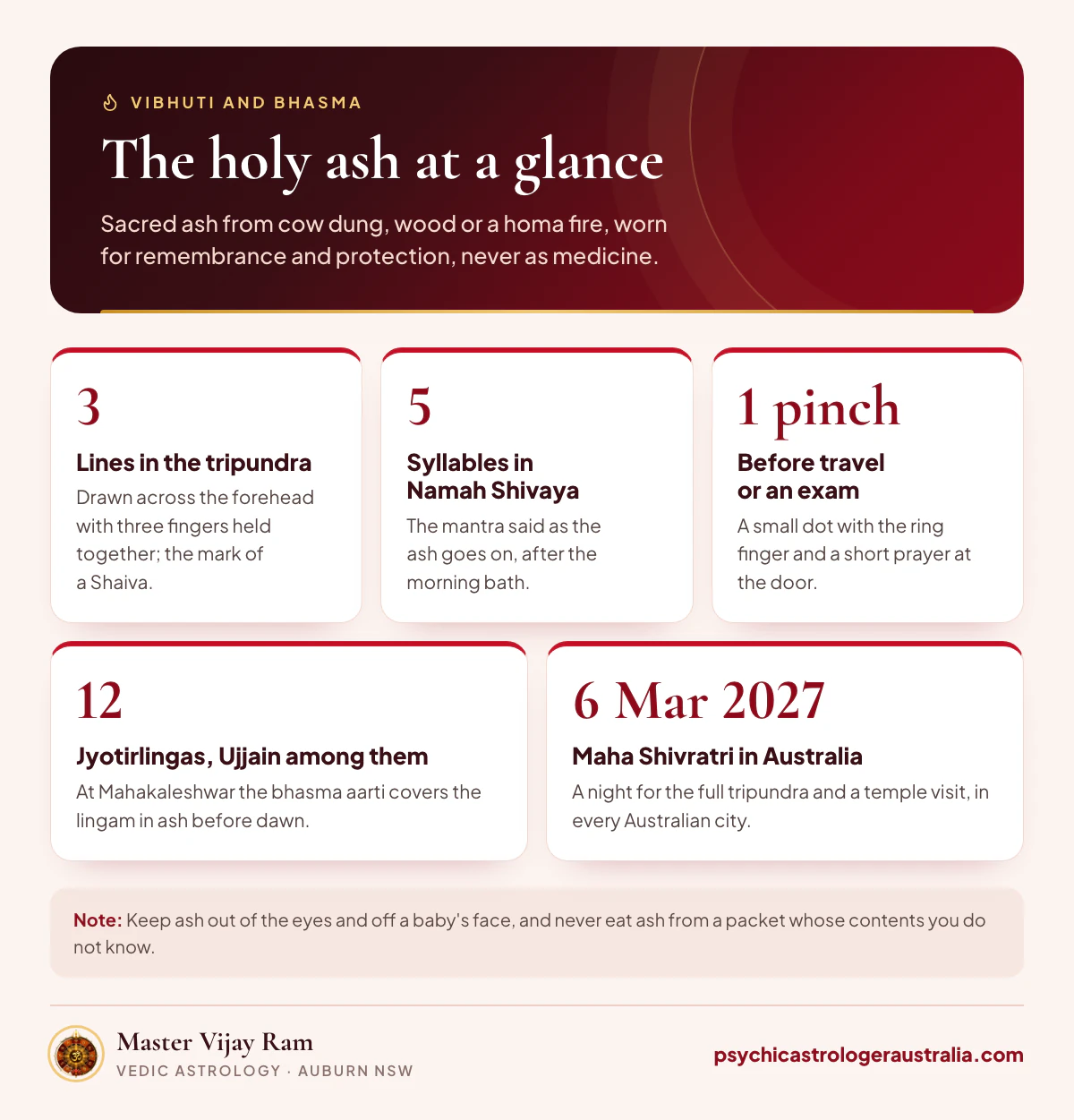
Vibhuti, also called bhasma or tiruniru, is sacred ash from burnt cow dung, wood or a homa fire. Shaivas wear it as the tripundra, three horizontal lines across the forehead, applied after the bath with Om Namah Shivaya. It is worn for remembrance and protection, kept out of the eyes, and never treated as medicine.
What is vibhuti, and what does bhasma mean?
Vibhuti is the sacred ash of Shaiva worship, ash from burnt wood or dried cow dung, or from the fire of a homa, that devotees wear on the forehead and that temples give as prasad. Bhasma simply means ash, vibhuti means glory or splendour, and in Tamil it is tiruniru, the holy ash; the three names describe one thing seen from three sides.
Families wear it for remembrance and as holy ash for protection, one of the few protective customs that asks for nothing but a pinch and a mantra. Where a household feels a heaviness the ash has not touched, negative energy removal, read honestly is where Master Vijay Ram looks at the timing first and the ordinary causes beside it.
How is vibhuti made?
In the Agamic temple tradition, dried cakes of cow dung are burnt slowly and the white ash is sieved fine, sometimes with a little water and further firing to purify it. Ash from the homa, the sacred fire of a havan, is kept the same way, and many families save a spoonful after a havan at home once it has cooled completely.
Ash from a fireplace or a barbecue is not vibhuti, whatever it looks like. What makes the ash sacred is the fire it came from and the worship that surrounded it.
What is the tripundra, and who wears it?
The tripundra is the mark of three horizontal lines of ash drawn across the forehead, worn by Shaivas, and often with a red dot of kumkum at the centre. Devout Shaivas also mark the upper arms, the chest and the throat.
The three lines are read in several ways: as the three gunas, as the three worlds, or, in Shaiva Siddhanta, as the three bonds of ego, karma and illusion that the devotee asks Shiva to burn away. Vaishnava families wear a different mark, the vertical namam of white clay, and Smarta families may wear either; a family that wears the namam has lost nothing by leaving the ash to others.
How do you apply vibhuti?
Learning how to apply vibhuti takes a minute. After the morning bath, take a pinch on the ring finger, the finger many traditions keep for tilak, and touch it to the centre of the forehead while saying Om Namah Shivaya, the five-syllable mantra of Shiva.
For the full tripundra, take a little more ash on the three middle fingers held together and draw them across the forehead in one stroke, leaving three lines. Some families moisten the ash with a drop of water so the lines hold through the day; others wear it dry and let it fade.
Keep it well above the eyebrows, and wipe away any loose powder before it can fall into the eyes. If ash does get into an eye, rinse it gently with clean water, and see a pharmacist or GP if it stays red or sore.
When do families wear vibhuti?
Daily for some, on chosen occasions for most. The table sets out the moments families mention most, how the ash is worn at each, and the care that goes with it.
| When | How it is worn | The care that goes with it |
|---|---|---|
| Every morning, after the bath | A pinch with the ring finger, or the full tripundra, with Om Namah Shivaya | Keep it above the eyebrows; wipe off loose powder |
| Before travel, an exam or a hard meeting | A small dot and a short prayer at the door | A sealed pocket packet travels well |
| Before visiting a hospital ward | A pinch at home before leaving | The ward’s hand-hygiene rules come first; no powder near patients |
| A child before school exams | A tiny dot high on the forehead from a parent | Never on a baby’s face |
| Mondays and Maha Shivratri | The full tripundra and a temple visit where possible | Temple vibhuti is the surest source |
| After a havan at home | The homa ash kept in a small jar as prasad | Only once it is completely cold |
None of these is compulsory, and a family that wears ash only on Maha Shivratri is keeping the custom as fully as one that wears it daily.
Why is ash worn for protection?
Because ash is what is left when fire has taken everything else, and the tradition reads that as a teaching rather than a gloom. In one telling Shiva burned Kama, desire, to ash with his third eye, and wears ash as the sign that nothing passing can rule him; the devotee who wears it borrows a little of that steadiness.
That is the sense in which families use vibhuti for negative energy: a pinch before travel, before an exam or a hard meeting, or at the door of a hospital ward, as a way of standing in Shiva’s protection. It is a reminder held on the skin, not a shield, and the household protections it sits among are set out in daily protection from black magic and fear.
What does the tradition say vibhuti does?
The vibhuti benefits families describe are devotional ones: steadiness, a sense of being looked after, a mind brought back to prayer each time a hand touches the forehead. Shaiva texts praise the ash highly, and the old Pashupata ascetics even bathed in it; many still count a smear of vibhuti as a kind of bath when water is impossible.
No health claim is made for it here. Ash on the forehead does not cool a fever, cure a headache or treat the skin, and any claim on a packet that it does is marketing.
Can vibhuti be put on a child?
For an older child, a tiny dot high on the forehead, applied by a parent with a short prayer, is a gentle and common custom, especially before school exams or a long trip. Many grandmothers also give a pinch of temple vibhuti against nazar, and evil eye and nazar protection covers that worry more fully.
A baby gets none of it: nothing goes on a baby’s face, near the eyes or near the mouth, where fine powder can be breathed in or swallowed. A prayer said over the cot keeps the custom without any risk.
What is the bhasma aarti at Ujjain?
At the Mahakaleshwar temple in Ujjain, one of the twelve jyotirlingas, the day begins before dawn with the bhasma aarti, when the lingam is covered in ash and worshipped with lamps and chanting. It is said that the ash once came from the cremation ground; today it is prepared from cow-dung cakes and wood, and the rite draws pilgrims from across India and the diaspora.
Families who travel to India often plan a visit around it, and those who cannot go keep the same idea at home on Mondays and on Maha Shivratri, which in 2027 falls on Sat 6 Mar 2027, the same night in Australia and in India. Maha Shivratri 2027 and its night timing gives the hours.
Where do Australian families get vibhuti?
From temples first, where it is given as prasad and often sold in small packets, and from Indian grocers. In Darwin the Sri Sithy Vinayakar Temple at Malak has served the community for decades, while Geelong has no permanent temple yet, so the nearest large ones, such as Melbourne’s Shri Shiva Vishnu Temple at Carrum Downs, are the places to collect it.
On the Sunshine Coast the community still meets in hired halls, and in Cairns the Hindu Samaj is raising funds for a temple, so a sealed packet from a city temple, used a pinch at a time, lasts a family a long while. Packets carried from India may be made from cow dung, an animal product, so declare them on the Incoming Passenger Card and let officers decide.
What should you check in a bought packet?
Read the label. Some packets are pure ash of cow dung or wood; others are bulked out with chalk or talc and scented, which may suit a forehead but is not what the tradition means, and the contents of some imported packets are not stated at all.
Buy from a temple or a shop you trust, and do not eat ash whose contents you do not know, even though some temples give a pinch on the tongue as prasad. Stop using any packet that makes the skin itch or redden.
When the packet is finished or the ash has gone damp, return it to the earth in the garden or a pot plant. It never goes into a river or the sea.
What can holy ash not do?
It cannot treat illness, keep a person safe from real danger, or undo a hard period in the chart, and it is never used against anyone. A forehead marked with ash still needs a seatbelt, a doctor when unwell, and the police when threatened, and the tradition never suggested otherwise.
All of this is offered in faith, as guidance, never as medical, legal or financial advice. The ash is a remembrance worn on the body, and that is honour enough.
What if the ash is not enough, and what does it cost?
Once a fear or a heaviness has a start date you can point to, has not lifted with the ash, the lamp and ordinary care, and a GP has looked at the body’s side of it, a reading of the chart against those dates is the next step. Vijay Ram ji gives it in a $50 consultation, which can be a phone call, a video call or a WhatsApp chat, and he often prescribes nothing more than a Monday practice and the Maha Mrityunjaya mantra and how to chant it.
A Rudrabhishek or other rite, where it is warranted, begins at $250, a figure agreed before it is performed, and he performs it himself in Auburn, with the family watching on video if they choose; online puja and havan describes the arrangement. He does not sell vibhuti, beads or kits.
Families who reach him through Vedic astrology for Geelong families share Sydney’s clock, and an in-person meeting is in Auburn, by appointment. The ash belongs with the other daily tools of Vedic body cleansing, from the morning bath to the sip of water before prayer.
Read next
- How to Remove Negative Energy From Yourself: Vedic MethodsVedic ways to clear negative energy from yourself: what to rule out first, safe home practices, the four-gate reset, …
- Cleansing, Clearing, Protection and Healing: Four Words People Mix UpCleansing, clearing, protection and healing defined plainly: what each word means in Vedic practice, the order they c…
- Camphor, Loban and Dhoop: The Hindu Home Cleansing Alternatives to SmudgingCamphor, loban and dhoop: what each does in a Hindu home cleansing, how the evening dhuni is done safely at home, and…
Frequently asked questions
What is vibhuti made of?
Traditionally, the ash of dried cow-dung cakes burnt slowly and sieved fine, or the ash of wood, or the cooled ash of a homa fire kept as prasad. Temples prepare it for worship and give it to devotees. Ash from a fireplace or barbecue is not vibhuti, because what makes the ash sacred is the fire it came from and the worship around it.
What is the difference between vibhuti and bhasma?
None in substance. Bhasma means ash, vibhuti means glory or splendour, and tiruniru is the Tamil name, holy ash. All three name the sacred ash of Shaiva worship; the words simply stress different things, the material, its meaning as Shiva’s glory, and its holiness. Families use whichever word their region and language prefer.
How do you apply vibhuti correctly?
After the morning bath, take a pinch on the ring finger and touch it to the centre of the forehead while saying Om Namah Shivaya. For the full tripundra, take a little more on the three middle fingers held together and draw them across the forehead in one stroke. Keep it well above the eyebrows and wipe off loose powder.
Which finger is used to apply vibhuti?
The ring finger, for a dot or a small smear, because many traditions keep that finger for tilak. For the three lines of the tripundra, the three middle fingers are held together and drawn across the forehead at once. Families differ on small details such as wet or dry ash, and each family’s habit is correct for that family.
What does the tripundra mean?
The three horizontal lines of ash are read in several ways: as the three gunas, as the three worlds, or in Shaiva Siddhanta as the three bonds of ego, karma and illusion that the devotee asks Shiva to burn away. It marks the wearer as a Shaiva. Vaishnava families wear a vertical namam instead, and Smarta families may wear either.
Can vibhuti remove negative energy?
In the tradition, a pinch of vibhuti is a way of standing in Shiva’s protection: before travel, an exam, a hard meeting or a hospital visit. It steadies and reminds; it is not a shield and removes nothing by itself. A heaviness that outlasts the ash, the lamp and ordinary care, and has been checked by a GP, is better read than met with more ash.
Can I put vibhuti on my child?
For an older child, a tiny dot high on the forehead with a short prayer is a gentle, common custom, often before exams or a long trip. Never on a baby: nothing goes on a baby’s face, near the eyes or near the mouth, where fine powder can be breathed in or swallowed. A prayer said over the cot keeps the custom safely.
Is it safe to eat vibhuti?
Some temples give a pinch on the tongue as prasad, and families who trust the source keep that custom. Do not eat ash from a packet whose contents you do not know, because some commercial vibhuti is bulked with chalk or talc and scented, and some imported packets list nothing at all. Anyone pregnant or unwell should leave it on the forehead.
Can women wear vibhuti?
Yes. Women in Shaiva households wear vibhuti daily, often as a small line or a dot, sometimes with kumkum at the centre, and temples give it to everyone who comes for darshan. Some families keep their own customs about particular days, and those are matters of family tradition rather than rules for everyone.
Does Master Vijay Ram sell vibhuti?
No. He sells no vibhuti, beads, threads or kits; a temple or a trusted Indian grocer is the place for ash. What he offers instead is a reading, $50 by phone, video or WhatsApp, for a heaviness that outlasts the household practices, and a puja such as a Rudrabhishek, from $250 and agreed before it is performed, only where the chart calls for one.
People also ask
What are the benefits of applying vibhuti?
The benefits the tradition describes are devotional: steadiness, a sense of Shiva’s protection, and a mind brought back to prayer each time the forehead is touched. Families wear it before travel, exams and hard days. No health benefit is claimed here; ash does not cool a fever or treat the skin, whatever a packet says.
Why do Shaivas apply ash on the forehead?
Because ash is what remains when fire has taken everything else, and wearing it is a reminder that nothing passing rules the devotee, as nothing ruled Shiva. The three lines of the tripundra mark a Shaiva and are read as the three gunas, the three worlds or the three bonds the devotee asks Shiva to burn away.
What is the bhasma aarti?
The pre-dawn worship at the Mahakaleshwar temple in Ujjain, one of the twelve jyotirlingas, in which the lingam is covered in ash and worshipped with lamps and chanting. It is said the ash once came from the cremation ground; today it is prepared from cow-dung cakes and wood. Many pilgrims plan a visit to India around it.
Can vibhuti be applied at night?
Yes. Many families put it on after the evening prayer, before sleep or before setting out on a journey at any hour, and the morning after the bath is simply the commonest time. Keep it well away from the eyes, especially when lying down, and wipe off loose powder first.
How do you dispose of old vibhuti?
Return it to the earth: sprinkle it in the garden or the soil of a pot plant, or give it to your temple. Ash that has gone damp or a packet that has passed its use is treated the same way. It never goes into a river or the sea, which in Australia can count as littering.
References & further reading
Serving clients across Australia
Confidential consultations by phone, video & WhatsApp — including: