
Quick answer
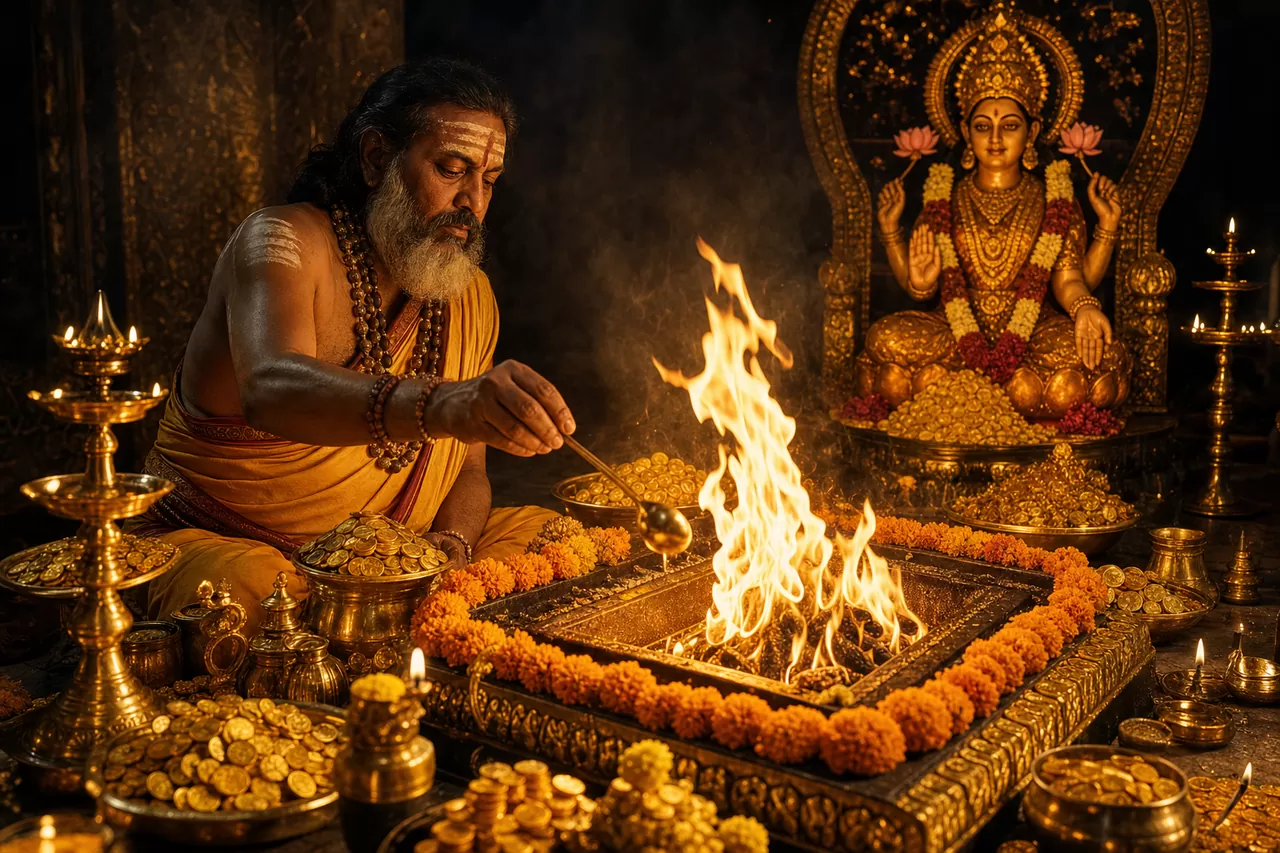
Abhyanga snan is the oil bath taken before dawn on Naraka Chaturdashi: warm sesame oil on the scalp and body, ubtan scrubbed off, a full bath, then clean clothes and a lamp. It recalls Krishna’s victory over Narakasura and clears the year’s heaviness before Lakshmi Puja. In 2027 check your temple panchang for the morning; Lakshmi Puja is Fri 29 Oct.
What is abhyanga snan?
Abhyanga snan is the oil bath that Hindu families take before dawn on Naraka Chaturdashi, the day before Lakshmi Puja in most years: warm sesame oil worked into the scalp and body, a paste of ubtan scrubbed off, a full bath while it is still dark, then clean or new clothes and a lamp. Abhyanga means anointing with oil and snan means bath, and the two together open the biggest days of Diwali.
Because the day is fixed by a tithi rather than a date, the first practical question is always when. Choosing the hour for a festival rite is the work of choosing an auspicious date and muhurat, and this post shows where the oil bath sits in the Diwali week of 2027 and how to keep it safe in an Australian bathroom.
Why is the oil bath taken on Naraka Chaturdashi?
In the commonest telling, Krishna, with Satyabhama beside him, killed the demon king Narakasura, freed the thousands of women he had held captive, and on returning at dawn was bathed in oil to wash off the battle. Some tellings give the final blow to Satyabhama, and Narakasura’s dying wish, that the day be remembered with lights, is one reason lamps are lit.
The bath re-enacts that homecoming. Families take the Narak Chaturdashi oil bath as Krishna did, early and thoroughly, so that the festival begins with the grime of the old year gone.
What is the oil bath meant to clear?
Not dirt, mostly. The name gives the clue: naraka means hell, and the tradition reads the demon as everything in a life that drags it downward, the sluggishness, the resentments, the bad habits of the year. The Diwali oil bath is meant to clear that residue before Lakshmi is welcomed into the house the following evening, or the same evening in years when the two fall together.
Regional customs show the same idea from different angles. In Gujarat and Rajasthan the day is Kali Chaudas and leans towards protection; in Bengal it is Bhoot Chaturdashi, when fourteen lamps are lit to keep restless spirits at bay; in Tamil Nadu Deepavali itself is kept on this morning, and the oil bath is greeted as Ganga snanam, a bath in the Ganga whatever the tap.
When heaviness clings to a person well beyond the festival, it is read differently, and aura cleansing for a lingering heaviness describes how. The festival bath asks less of you than that, and promises less.
Where does the oil bath fall in the Diwali week of 2027?
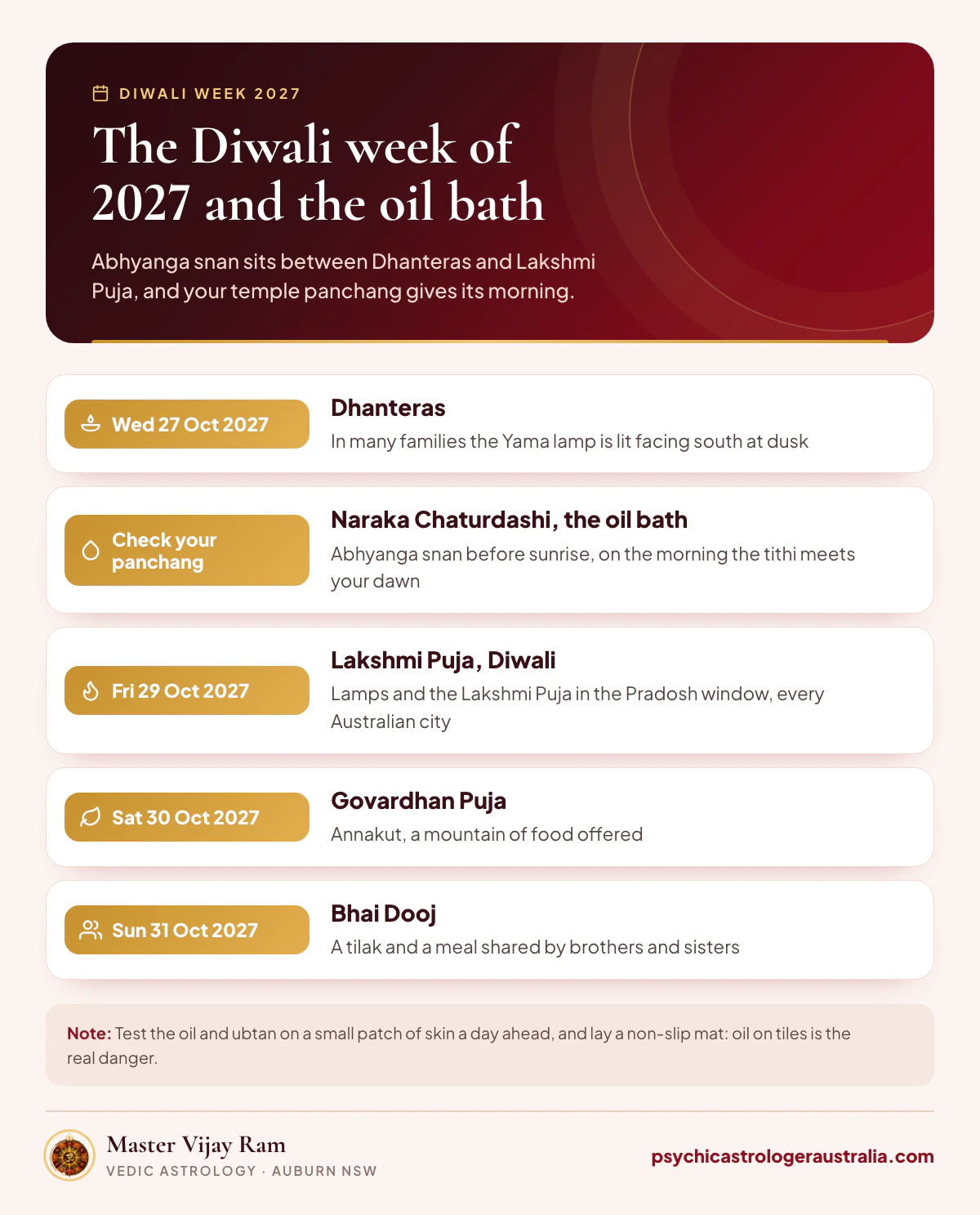
Naraka Chaturdashi is the Krishna Chaturdashi that comes after Dhanteras and before the Amavasya of Lakshmi Puja. The oil bath belongs to the morning on which that tithi is present before sunrise, so its day depends on your city’s dawn, and in some years it shares a morning with Lakshmi Puja.
| Day | When in 2027 | What it marks | Its custom |
|---|---|---|---|
| Dhanteras | Wed 27 Oct 2027, every Australian city | Dhanvantari and Lakshmi; buying metal for the home | The Yama lamp lit facing south at dusk |
| Naraka Chaturdashi (Choti Diwali, Kali Chaudas) | Check your temple panchang; the day depends on the tithi at your dawn | Krishna’s victory over Narakasura | Abhyanga snan before sunrise, then a lamp |
| Lakshmi Puja (Diwali) | Fri 29 Oct 2027, every Australian city and India | Lakshmi welcomed at dusk | Lamps and the Lakshmi Puja in the Pradosh window |
| Govardhan Puja | Sat 30 Oct 2027 | Krishna lifting Govardhan hill | Annakut, a mountain of food offered |
| Bhai Dooj | Sun 31 Oct 2027 | Brothers and sisters | A tilak and a meal shared |
Many panchangs print a short window for the bath, before sunrise and after the waning moon has risen. The city-by-city Lakshmi Puja windows are in Diwali 2026 and 2027 dates by city.
What is the Yama lamp lit the evening before?
On Dhanteras evening many families set a lamp outside the door facing south, the direction of Yama, the lord of death, in a custom called Yama deepam or Yamadeepdaan; in many homes it has four wicks. It asks Yama to keep untimely death away from the household, and it is the protective half of the same story the oil bath tells the next morning.
Some families light it on the Chaturdashi evening instead, and traditions differ. Whichever evening you keep, set it on a metal tray on the step, away from dry leaves and doormats, and do not leave it burning where nobody can see it.
How is abhyanga snan done, step by step?
The order matters more than the products. This is the common shape, and every family has its own variations:
- Warm a little sesame oil in a steel bowl over hot water, and check it against the inside of the wrist; it should feel warm, never hot.
- Work the oil into the scalp first, then the body, slowly, for as long as the household’s morning allows.
- Rest a few minutes while the oil sits, ideally somewhere warm and away from draughts.
- Rub ubtan over the oiled skin and scrub it off; it lifts most of the oil with it.
- Bathe fully before sunrise, hair included, and dry with a clean towel.
- Put on new or freshly washed clothes, light a lamp, and say a short prayer before anything else.
In Maharashtra many families crush a small bitter fruit, the karit, underfoot before the bath, standing in for the defeated demon. The sweet comes afterwards, and in many houses it is the first food of the day.
What goes into the ubtan?
An ubtan bath starts with a paste of besan, the chickpea flour every Indian kitchen holds, loosened with milk, curd or rose water and coloured with a pinch of turmeric; some families add sandalwood powder or ground masoor dal. It is called Roop Chaudas in parts of the north, the day of beauty, because of this paste.
Keep it simple and fresh, and make only what you will use. Turmeric stains grout and towels, so mix the paste in a steel bowl and rinse the shower afterwards, and keep camphor and strong oils out of it altogether. The everyday additions for a cleansing bath, and what to skip, are in the Hindu ritual bath and what to add.
How do you keep the oil bath safe?
Oil on a tiled floor is the real danger of the morning. Lay an old towel or a non-slip mat, wipe the floor before anyone else walks in, and give older parents a shower chair and a steady hand rather than a lecture about the tradition.
Test both the oil and the ubtan on a small patch of skin a day before, especially for children and anyone with eczema or sensitive skin. Anyone allergic to sesame uses coconut oil, keep oil and paste out of the eyes, and nothing goes on a baby’s face.
Scrubbing most of the oil off with the ubtan before the shower also keeps it out of the drain. A skin reaction that does not settle is a matter for a GP or pharmacist, not for a stronger paste.
How does it fit an Australian spring morning?
In India the oil bath belongs to the first chill of the year; here it lands in late spring, and the custom bends without breaking. In Darwin the humid weeks before the wet make a light coat of oil enough, and in Cairns and Townsville the bath is often taken with the windows open to a warm dawn; in Melbourne a heated bathroom and a warm towel make the difference.
Daylight saving resumed on Sun 3 Oct 2027 in NSW, Victoria, the ACT, Tasmania and South Australia, while Queensland, the Northern Territory and Western Australia keep standard time, so the clock at dawn differs from a neighbour’s interstate. Check your own sunrise, then set the alarm with enough margin for the oil, the paste and the bath.
What if the full bath is impossible that morning?
Then keep its core. A little oil on the head and feet, a quick scrub of ubtan on the hands and face, a shower before sunrise or as early as life allows, clean clothes and a lamp: the tradition counts the intention, and nobody is shut out of Diwali for a short version.
A nurse finishing a night shift at Townsville University Hospital, for example, might take it on reaching home at dawn rather than lose a night’s sleep over it. A family with a newborn might keep the lamp and the prayer and leave the oil for another year.
What can the Diwali oil bath not do?
Treat no skin condition, ache or illness with it: it is a festival rite, never offered as a remedy. Abhyanga also appears as an everyday practice in Ayurvedic routine; this post is about the festival bath and makes no health claim for either.
Nor does missing it bring bad luck. Families who skip a year because of work, travel or grief have lost nothing that cannot be kept next year, and the year’s heaviness is cleared as much by forgiveness and a clean house as by oil. The Diwali house and aura cleansing guide covers the house side of that.
When is a reading or a puja useful at Diwali?
Most families need neither: the oil bath, the lamps and the Lakshmi Puja are theirs to keep at home. A family that wants the puja hour fitted to its own charts can have Master Vijay Ram choose it in a $50 consultation, and one that wants the Lakshmi Puja performed on its behalf pays from $250, a sum agreed before it is performed.
He performs such pujas himself in Auburn, and online puja and havan explains how relatives in other cities follow along on video. He sells no oils, ubtan or kits.
Clients who book through a Vedic astrologer for Darwin clients keep Darwin time, which runs ninety minutes behind Sydney once daylight saving has begun, and meeting him in person means a trip to Auburn, booked ahead. The wider picture of cleansing body, breath, speech and mind is in the Vedic view of body cleansing.
Read next
- Govardhan Puja and Annakut 2027 in AustraliaGovardhan Puja and Annakut 2027 fall on Saturday 30 October in every Australian city and India, the day after Diwali.…
- Guru Purnima in Australia: Honouring TeachersGuru Purnima in Australia: the Ashadha full moon, why it is Vyasa Purnima, how to find the day for your city and simp…
- Diwali 2026 House & Aura Cleansing: Clear the Year's Heavy EnergyDiwali 2026 house and aura cleansing done honestly: clean first, use the Five-Lamp Check, and learn when heaviness is…
Frequently asked questions
What is abhyanga snan?
Abhyanga snan is the festival oil bath of Naraka Chaturdashi, taken before sunrise. Warm sesame oil is massaged into the scalp and body, a paste of ubtan is scrubbed off, and a full bath follows, then clean or new clothes and a lamp. It recalls Krishna bathing in oil after defeating Narakasura and marks a clean start to the biggest days of Diwali.
When is the Diwali oil bath in 2027?
Before sunrise on Naraka Chaturdashi, the Krishna Chaturdashi that follows Dhanteras on Wed 27 Oct 2027 and comes before or on the morning of Lakshmi Puja on Fri 29 Oct 2027. Its exact morning depends on when the tithi meets your city’s dawn, so check your temple panchang or family calendar rather than a general list.
Which oil is used for abhyanga snan?
Sesame oil, til or gingelly oil, is the traditional choice across most of India, warmed gently and tested on the wrist first. Anyone allergic to sesame uses coconut oil, which some families use anyway. Keep the oil warm rather than hot, keep it out of the eyes, and wipe the bathroom floor before anyone else walks in.
What is ubtan and how is it made?
Ubtan is a paste of besan, chickpea flour, loosened with milk, curd or rose water and coloured with a pinch of turmeric; some families add sandalwood powder or ground masoor dal. It is rubbed over the oiled skin and scrubbed off before the bath. Test it on a small patch of skin a day ahead, and mix it in a steel bowl because turmeric stains.
Why is the oil bath taken before sunrise?
Because the tradition ties it to the hours when the Chaturdashi tithi is present before dawn, re-enacting Krishna’s return from battle at first light. Many panchangs print a short window before sunrise for it. If work, a night shift or a baby makes that impossible, a bath as early as you can manage, with the lamp and a prayer, keeps the custom.
What is the Yama deepam?
A lamp set outside the door facing south, the direction of Yama, on Dhanteras evening in many families and on the Chaturdashi evening in others. In many homes it has four wicks. It asks Yama to keep untimely death from the household. Set it on a metal tray away from dry leaves and doormats, and never leave it burning unwatched.
Is it bad luck to miss the Diwali oil bath?
No. The custom is a way of starting the festival clean and grateful, not a test that brings misfortune if it is skipped. Families who miss a year because of work, travel, illness or grief lose nothing that cannot be kept the following year. A short version, a little oil, an early shower and a lamp, is a complete observance for anyone short of time.
Can children and older parents take part?
Yes, with care. Test the oil and ubtan on a small patch of a child’s skin a day before, keep everything away from the eyes, and nothing goes on a baby’s face. Older parents need a grip mat on the tiles, a seat in the shower and a steady hand, because oil on tiles is the real danger of the morning. A lighter coat of oil is fine for both.
Does Master Vijay Ram perform the Lakshmi Puja for families?
Yes, when a family asks for it. The puja hour can be chosen from the family’s own charts in a $50 consultation, and the Lakshmi Puja itself, performed by him in Auburn with relatives watching on video if they like, starts from $250, agreed before it is performed. He sells no oils, ubtan or kits.
People also ask
What is the meaning of abhyanga snan?
Abhyanga means anointing the body with oil and snan means bath. Together they name the pre-dawn oil bath of Naraka Chaturdashi, when families massage warm sesame oil into the scalp and body, scrub it off with ubtan and bathe before sunrise, recalling Krishna’s homecoming after defeating Narakasura and clearing the year’s heaviness before Lakshmi Puja.
What is Choti Diwali?
Choti Diwali, little Diwali, is the north Indian name for Naraka Chaturdashi, the day of the pre-dawn oil bath, usually the day before Lakshmi Puja. It is Kali Chaudas in Gujarat and Rajasthan and Bhoot Chaturdashi in Bengal, while in Tamil Nadu Deepavali itself is kept on this morning. Lamps are lit in the evening in most homes.
Which day is Narak Chaturdashi in Australia?
It is the Chaturdashi tithi present at dawn between Dhanteras and Lakshmi Puja, and in 2027 Dhanteras is Wed 27 Oct and Lakshmi Puja Fri 29 Oct. The oil bath belongs to the morning on which the tithi meets your local sunrise, which can differ by city, so your temple panchang gives the morning for where you live.
Why do we apply oil on Narak Chaturdashi?
In the tradition, Krishna was bathed in oil at dawn after killing Narakasura, and the household repeats that homecoming. The oil and ubtan are meant to clear the old year’s heaviness, its sluggishness and grudges, before Lakshmi is welcomed. It is a festival rite, not a treatment, and the safety rules are about slippery floors and sensitive skin.
What is Kali Chaudas?
Kali Chaudas is the Gujarati and Rajasthani name for Naraka Chaturdashi, the night associated with Kali and with protection from harm. Families keep the pre-dawn oil bath, light lamps, and in many homes offer prayers for protection that evening. It is a night for devotion and steadiness, never for any rite aimed at another person.
References & further reading
Serving clients across Australia
Confidential consultations by phone, video & WhatsApp — including: