
Quick answer
Nadi shodhana, or alternate nostril breathing, is the gentlest classical pranayama: in through one nostril, out through the other, slowly, with nothing held. With bhramari, the humming breath, it makes a ten-minute routine for a heavy mind. It is a practice rather than a treatment, and some people should ask their GP before they begin.
What does it mean to use the breath as a clearing?
Nadi shodhana is a seated breathing practice that moves the breath slowly from one nostril to the other, and the name means “cleansing of the channels”. In the yogic picture, prana, the life breath, travels through a network of fine channels called nadis, and a heavy mind is described as those channels silting up, the way a gutter slows long before it overflows. Pranayama, the regulation of the breath, is the tradition’s first answer, because nobody has to buy anything to breathe.
Master Vijay Ram suggests breath work to many people who ring about a heaviness that follows them from room to room, and he suggests it before anything else. It sits beneath Vedic aura cleansing as the part a person does for themselves each day, with a performed remedy kept for the rarer case that the chart actually points to.
Who should not start, and what makes you stop?
Practical matters first. Nothing on this page involves holding the breath, and that is deliberate: there is to be no breath-holding in pregnancy, or for anyone with high blood pressure, heart disease or epilepsy. If you have had surgery recently, of any kind, see your GP before taking up a breathing practice, even a gentle one.
Stop if you feel dizzy, light-headed or short of breath, or if your hands or face begin to tingle. Return to ordinary breathing and sit until it passes; a session that has to be forced is the wrong session for that day. Chest pain is never something to breathe through: stop and call 000.
How should you sit, and what do the hands do?
Sit where your back can stay upright without effort. A firm chair with both feet flat on the floor is as good as a cushion, and kinder to most knees. Rest the left hand on the thigh, palm up or down as you like.
Fold the index and middle fingers of the right hand into the palm, so that the thumb can close the right nostril and the ring finger the left. Many teachers call this Vishnu mudra; if it cramps, the thumb and index finger do the same job. Choose a time when the stomach is fairly empty, and leave the practice for another day if the nose is blocked rather than forcing air through it.
How is nadi shodhana done, step by step?
This is the beginner’s form of alternate nostril breathing, with no pause at the top or bottom of any breath. Breathe through the nose throughout, and quietly: if someone across the room could hear you, the breath is too forceful.
- Sit, lower the gaze or close the eyes, and take three ordinary breaths without changing anything.
- Close the right nostril with the thumb and breathe in slowly through the left, to a count of four.
- Close the left nostril with the ring finger, lift the thumb, and breathe out through the right, to a count of four.
- Breathe in through the right, to four.
- Close the right, open the left, and breathe out through the left, to four. That completes one round.
- Do nine rounds, then rest the hand in the lap and breathe normally for a minute.
After a week or two, if four counts feel easy, let the out-breath stretch to five or six while the in-breath stays at four. Teachers usually lengthen the exhale first, since it is the letting-go half of the cycle. Never stretch any count so far that the next breath arrives as a gasp.
Why is there no breath-holding for beginners?
In the classical texts pranayama builds towards kumbhaka, the pause with the breath held in or held out, and for many writers that pause is the heart of the discipline. It is also the stage the safety rules are written for, which is why the version on this page leaves it out entirely.
B. K. S. Iyengar, one of the best-known yoga teachers of the last century, cautioned that pranayama should come only after an established practice and be learned with an experienced teacher. That advice has aged well. A teacher who has watched you breathe for some months may add a short, comfortable hold; a video cannot see whether you are straining, and a book cannot tell you to stop.
What is bhramari, the humming breath?
Bhramari takes its name from the bhramara, the black bee, because the out-breath becomes a low, steady hum. People who find counting tedious often take to it at once, perhaps because the sound gives a busy mind something to hold on to.
- Sit as before, lips closed and teeth slightly apart.
- Breathe in through the nose, unhurried.
- Breathe out through the nose with a soft “mmm”, like a bee in the next room, for as long as is comfortable.
- If you wish, press the small flaps at the front of the ears closed with the index fingers, gently, so the sound stays inside.
- Do five to seven hums, then sit and listen to the quiet that follows.
Keep the hum soft rather than loud, and stop if the throat or ears feel strained. The point is the vibration, not the volume.
What does a ten-minute routine look like?
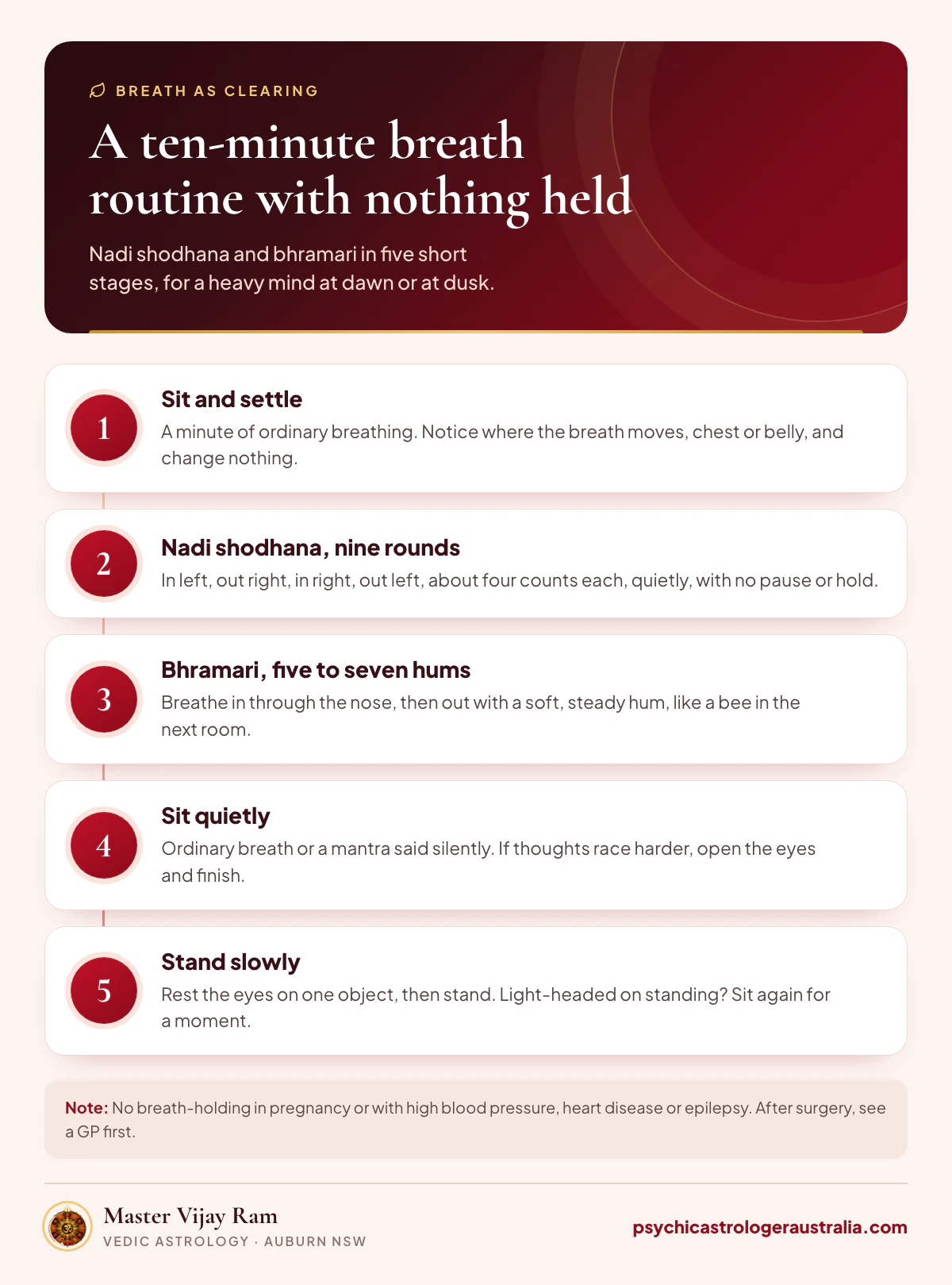
Ten minutes is long enough to change the tone of a morning and short enough to survive the end of the first keen week. The table gives one way to spend it as pranayama for a heavy mind; if time is short, trim each part a little rather than dropping the last one.
| Minutes | Practice | What to notice | Stop or skip if |
|---|---|---|---|
| 0–1 | Sit and breathe without changing anything | Where the breath moves: chest, belly or both | You are rushing; pick another time |
| 1–5 | Nadi shodhana, nine rounds at four counts | Which nostril is more open, something the tradition watches closely | Dizziness, tingling or a blocked nose |
| 5–7 | Bhramari, five to seven hums | The vibration in the face and chest | Strain in the throat or ears |
| 7–9 | Ordinary breath, or a mantra repeated silently | Whether the mind has slowed; it may not have, and that is fine | Thoughts race harder: open the eyes and finish |
| 9–10 | Open the eyes, rest them on one object, stand slowly | How the next half hour feels | Light-headed on standing: sit again |
Early morning, before the phone, is the classic hour, and dusk is the other. A pharmacist in Adelaide who finishes late might keep the routine for the moment she gets home, before dinner, which is when her day tends to sit heaviest. One session a day kept up for six weeks teaches more than three long ones on a bad Sunday.
What is the “clearing” the yoga tradition describes?
The yoga texts describe two main channels winding around a central one: ida on the left, cool and lunar, and pingala on the right, warm and solar, with sushumna between them. Alternate nostril breathing is said to even out the two sides so that the breath, and the mind riding on it, can settle in the middle. In that language a heavy mind is tamas, dullness, lodged in the channels, and the breath is the broom.
This is a description from inside the tradition, not a measurement, and nobody has put a meter on a nadi. The practice does not depend on one. It has lasted because people feel different afterwards, which is a fair reason to give it a month.
Can breathing clear negative energy?
As a daily habit, it is the first thing the tradition reaches for. Pranayama for negative energy, in the sense Vijay Ram ji means it, is the clearing of what an ordinary week leaves behind: a hard meeting, a crowded train, a phone call that sat on the chest all evening. Ten minutes at dusk lets that go before it follows you to bed.
What breath does not do is lift a pattern the chart shows or shorten a difficult planetary period. Where a heaviness began on a date you can name and has outlasted a month of practice, rest and ordinary care, it is worth having it read rather than breathed through, and health and wellbeing remedies describes the chart-based side of that work.
Is pranayama a treatment for panic attacks or depression?
No. Panic disorder, depression and anxiety that has gone on for weeks are health conditions, and a GP is the first step, with a psychologist often the second. Breathing practice can sit beside that care, but it does not replace treatment, and nobody should stop a medicine because a practice feels good.
For some people with panic, close attention to the breath makes the fear sharper rather than softer. If that happens, open the eyes, put both feet on the floor, and leave pranayama aside until a professional has helped with the panic itself. Beyond Blue is on 1300 22 4636 and Lifeline on 13 11 14, and when to see a doctor first explains where this site draws the line.
Where do kapalabhati and the stronger practices fit?
Kapalabhati, the “skull-shining” breath with sharp pumps from the belly, is the practice most people meet first in a class or online, and it is not a beginner’s practice. It belongs to the six cleansing techniques of hatha yoga rather than to gentle pranayama, and the six shatkarma cleansing practices sets out its cautions and which of the six can be learned at home.
Bhastrika, the bellows breath, sits in the same category. Both are forceful, both can leave a newcomer dizzy within a minute, and neither is needed for what this page is about.
Where does breath sit among the other Vedic cleansings?
In the household tradition, cleansing works through the body with the bath, the breath, speech through mantra and gentler talk, and finally the mind. Body cleansing in the Vedic tradition maps the whole set; breath is the one that needs no water, no materials and no special day.
Breath also makes a natural doorway into mantra. Many families follow the ten minutes with a few rounds of a mantra they already know, and the Maha Mrityunjaya mantra is the one most often chosen when the worry is about health. For the rest of the daily routine, sleep, food, speech and company, see the four-gate reset for personal heaviness.
How do you find a pranayama teacher in Australia?
Ask for one by name. Many yoga classes here are mostly postures with a few minutes of breathing at the end, so it is worth asking a school directly whether anyone teaches pranayama as a subject of its own, and how long they have practised it. Temples and community halls in the larger cities sometimes run yoga or meditation evenings in Hindi or Punjabi as well as English.
A good teacher asks about your health before teaching anything, watches you breathe, and is content to keep you on the gentle practices for months. Be wary of anyone who says a breathing course will lift a curse, heal an illness or make a doctor unnecessary.
What does Master Vijay Ram offer, and what does it cost?
He does not run breathing classes and has no course to sell. What he offers is a reading: a $50 consultation by phone, video or WhatsApp, in English, Hindi or Punjabi, that looks at the Moon, which the chart reads as the mind, and at the period your chart is running, and says honestly whether the heaviness has a shape the chart shows or simply needs rest, a doctor and a daily practice. Callers from Perth and the west to the Gold Coast are read the same way, and the only in-person option is Auburn, by appointment.
Where a remedy is warranted, it is a jaap or a shanti performed by him personally at his place of practice in Auburn, from $250 and agreed before anything is done; a performed puja or jaap explains how the family joins by video. For most people who ask about breath, the answer is the ten minutes on this page and no remedy at all.
What breath cannot do
A breathing practice cannot diagnose anything, treat an illness, remove black magic, or promise that a heavy month will lift. This page is faith-based guidance drawn from the yogic tradition, not medical or psychological advice, and anyone with a health condition checks with a GP before starting.
What it can do is give a crowded mind ten minutes of order each day, in a practice older than any app, asking nothing of you but attention. That is a modest offer, and an honest one.
Read next
- How to Cleanse a Business or Office of Heavy EnergyHow to cleanse a business or office of heavy energy: rule out the ordinary causes, keep a daily practice at the thres…
- How Much Does a Spiritual Cleansing Cost in Melbourne?Spiritual cleansing cost in Melbourne: why advertised prices are not comparable, the fee models that are red flags, a…
- Aura Cleansing in Australia: How It Works & When You Need ItHow aura cleansing actually works in Australia: the five-doorway read, each stage of a remote remedy, what you provid…
Frequently asked questions
Is it safe to do nadi shodhana every day?
For most healthy adults, the beginner’s version with no breath held is a gentle daily practice. Nine rounds at four counts, once or twice a day, is plenty. Anyone who is pregnant, or who has high blood pressure, heart disease or epilepsy, keeps strictly to the no-hold version, anyone recovering from surgery asks their GP first, and dizziness or tingling is a signal to stop for the day.
Can I do pranayama while pregnant?
Only the gentlest forms, and only after checking with your midwife or GP. There is to be no breath-holding of any kind in pregnancy, and the forceful practices such as kapalabhati and bhastrika are left out completely. If your midwife agrees, slow, even nostril breathing with nothing held and a soft bhramari hum are the kind of practice to keep to, and anything that makes you breathless or dizzy is stopped at once.
How long before alternate nostril breathing makes a difference?
Some people feel steadier after the first session and some feel nothing much for weeks; neither tells you whether to continue. The tradition treats it as a daily discipline rather than a quick fix, which is why a month of ten minutes a day is the fairest trial. If the heaviness is unchanged after that, or getting worse, see a GP and consider having the timing read.
What if one nostril is blocked?
Leave the practice for that day rather than forcing air through, and do bhramari instead, which needs only an easy in-breath. A nose that is blocked most days is worth mentioning to a GP. Some people rinse the nose first with a neti pot, which is safe only with sterile or boiled-then-cooled water, never straight from the tap; the shatkarma post explains why.
Why does alternate nostril breathing make me dizzy?
Usually because the breaths are too big or too fast, or because the count has been stretched too far too soon. Make each breath smaller and quieter, go back to four counts, and stop for the day if the dizziness continues. Dizziness that comes with chest pain, a racing heart or fainting is a medical matter, and chest pain means calling 000.
Should breathing come before or after mantra and prayer?
Before, in most households. A few minutes of nadi shodhana settles the breath so that a mantra can be said slowly and evenly, and the quiet sitting at the end of the routine is a natural place to begin japa. Some families light the lamp first, sit for the breath, and then chant; the order matters less than doing it at the same hour each day.
Can pranayama remove black magic or nazar?
It is not offered for that, and nobody should sell it that way. In the tradition, daily breath work clears the ordinary residue of hard days and steadies the person, which makes everything else easier to bear. A fear of black magic or nazar is a separate question for a reading, which looks at the chart and the timing first and often finds ordinary explanations.
Is it fine to learn pranayama from videos?
The gentle no-hold practices on this page are simple enough to start from written steps or a video. Breath retention, kapalabhati, bhastrika and anything forceful are different: they need an experienced teacher who can watch you, ask about your health and slow you down, which is what B. K. S. Iyengar advised. A video cannot see whether you are straining.
Does Master Vijay Ram teach pranayama?
No. He is a Vedic astrologer and spiritual healer, not a yoga teacher, and he sends people who want to learn properly to a qualified teacher. What he offers is a $50 reading by phone, video or WhatsApp that looks at the Moon and the period your chart is running, and a jaap or shanti from $250, agreed beforehand, only where the chart warrants one.
People also ask
How many rounds of nadi shodhana should a beginner do?
Nine rounds is a sensible start, each round being in through the left, out through the right, in through the right and out through the left, at about four counts per breath with nothing held. That takes three or four minutes. Add a few rounds only when nine feel easy, and keep the breath quiet enough that nobody nearby could hear it.
What is bhramari pranayama good for?
In the tradition, bhramari, the humming bee breath, quietens a restless mind, and many people use it before sleep or after a noisy day. You breathe in through the nose and out with a soft, steady hum, five to seven times. It is gentle and holds no breath, but it is still a practice rather than a treatment for anxiety or insomnia.
Who should not do pranayama?
Nobody who is pregnant, or who has high blood pressure, heart disease or epilepsy, should do any breath-holding, and anyone who has recently had surgery should see a GP before starting a breathing practice. The forceful techniques such as kapalabhati and bhastrika need a qualified teacher. Anyone who becomes dizzy, tingly or breathless should stop and breathe normally.
What is the best time of day for pranayama?
Early morning before breakfast is the classic time, and dusk is the other traditional hour. What matters more is a fairly empty stomach, a quiet ten minutes and the same time each day. People on rotating shifts can tie the practice to an event, such as coming home, rather than to a clock.
What does nadi shodhana mean?
Nadi means channel and shodhana means cleansing or purifying, so the name is the cleansing of the channels through which the tradition says prana, the life breath, flows. In practice it is alternate nostril breathing: in through one side, out through the other, slowly and evenly, with the hand closing each nostril in turn.
References & further reading
Serving clients across Australia
Confidential consultations by phone, video & WhatsApp — including: