
Quick answer
A Hindu cleansing bath is an ordinary bath made ritual: one or two small additions, such as a pinch of salt, cooled neem water, turmeric, a few drops of Gangajal or tulsi leaves, and the snana mantra said as the water is poured. Leave out camphor, undiluted oils and bought curse-removal kits, and keep a baby’s bath plain.
What is a Hindu ritual bath for cleansing?
A spiritual cleansing bath is an ordinary wash that a Hindu household turns into a rite with three things: a moment chosen for it, a small addition to the water, and a mantra said as the water is poured. Families call it snan, and what makes it a cleansing is the intention rather than anything bought.
Master Vijay Ram is asked about it most often by people who have been told online to bathe in something elaborate and are not sure it is safe. This post takes the additions one at a time, says what to leave out, and gives the short-shower version that suits an Australian bathroom; aura cleansing and how it is read covers the heavier case where a bath is not enough.
Why the tradition cleans the breath, speech and mind as well as the skin is set out in body cleansing in the Vedic tradition. This page stays with the water.
When is a cleansing bath usually taken?
Most often at dawn before the morning prayer, and on days that already carry weight: the start of a vrat, the morning of a puja, the end of an eclipse, a festival morning. Families also take one after a hard event, such as a frightening night, a long hospital visit or a quarrel that soured the house, as a line drawn under it.
The bath after a cremation or funeral is a separate custom with its own rules, and why Hindus bathe after a funeral explains it. Whatever the occasion, the tradition prefers the bath before food rather than straight after a meal.
What can be added to the water, and how much?
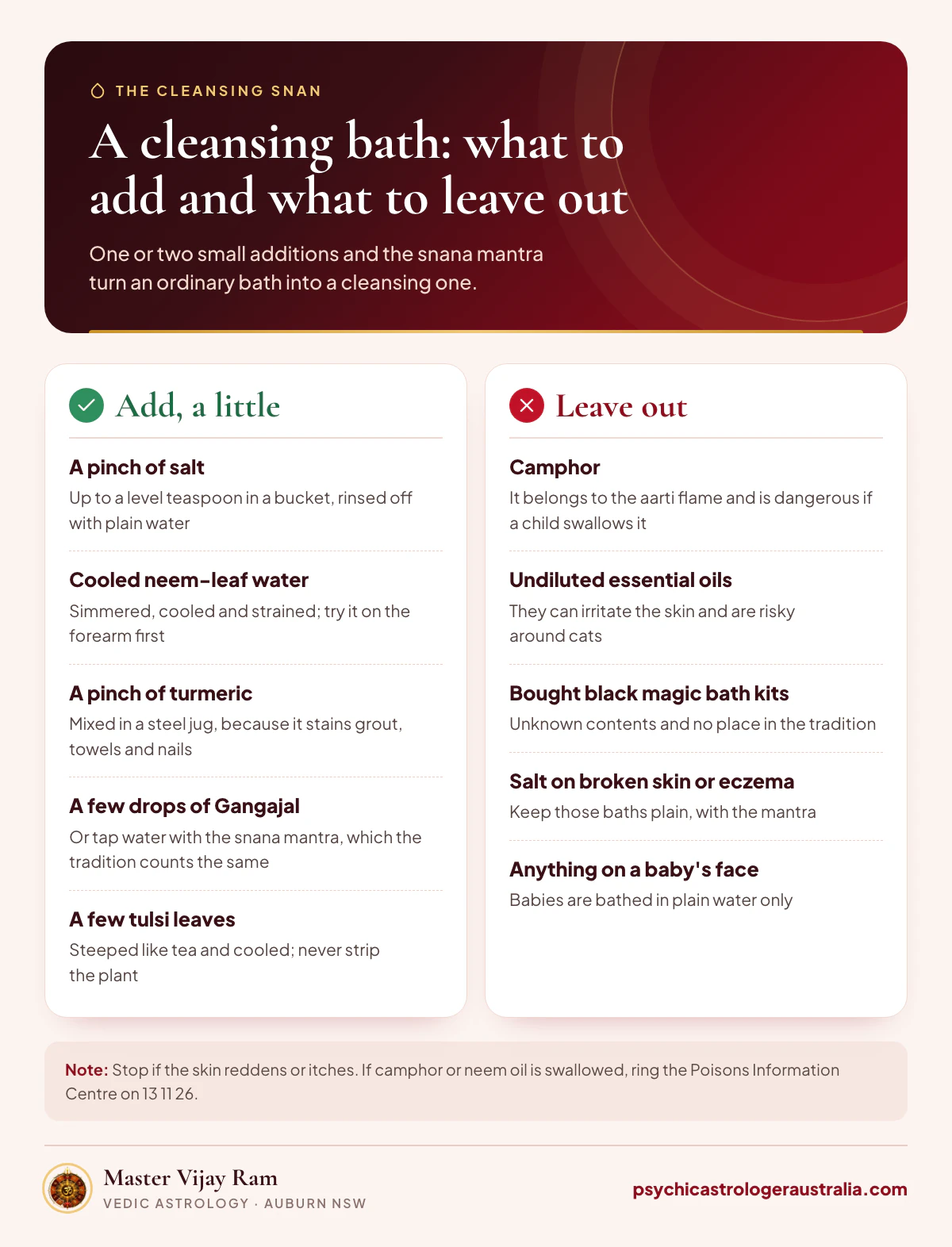
Five additions are traditional, and none needs to be expensive or imported. The quantities below are deliberately small, because more does not mean stronger and every one of them can irritate skin if overdone.
| Addition | How much, and how | What the tradition says it does | The caution |
|---|---|---|---|
| Salt | A pinch to a level teaspoon of rock or sea salt, dissolved in a bucket of warm water | Draws off heaviness picked up from outside, nazar above all | Stings broken skin, eczema and a fresh shave; rinse with plain water afterwards |
| Neem leaves | A handful simmered for a few minutes, cooled and strained | The classic bitter, protective cleansing leaf | Test on the forearm first; keep it out of the eyes; never neem oil instead |
| Turmeric | A pinch stirred into warm water | Auspicious, the yellow of Jupiter and of the days before a wedding | Stains grout, towels and nails; can redden sensitive skin |
| Gangajal | A few drops into the bucket or jug | Carries the sanctity of the Ganga into ordinary water | Store the bottle sealed; a few drops are plenty |
| Tulsi | A few leaves steeped in hot water like tea, then cooled | Sacred to Vishnu; purifying and calming in the tradition’s terms | Never strip the plant; many families avoid picking it after sunset or on Ekadashi |
Pick one or two, not all five. A bucket with a pinch of salt and a few drops of Gangajal is a complete cleansing bath in most families’ eyes, and the mantra matters more than the mix.
How much salt goes into a salt bath for negative energy?
Less than the internet suggests. A salt bath for negative energy, in the traditional sense, is a pinch to a level teaspoon of rock or sea salt dissolved in a bucket of warm water, poured over the body after the ordinary wash and followed by a rinse in plain water. Salt left to dry on the skin itches, and on cracked heels or a fresh shave it stings.
Leave the salt out altogether for anyone with eczema, psoriasis or broken skin. A plain bath with the mantra serves them just as well, and nothing in the tradition says otherwise.
How are neem and tulsi leaves prepared for a bath?
Neem goes in as a decoction, not raw: a handful of fresh or dried leaves simmered in a covered pot for a few minutes, cooled to a comfortable warmth, strained, and added to the bucket or poured over the shoulders at the end. A neem bath smells bitter and green, and the tradition prizes it for exactly that bitterness.
Try a little on the inside of the forearm and wait a day if your skin is sensitive, and keep it out of the eyes. Neem oil is another thing entirely, kept out of the ritual bath, never swallowed and stored away from children; neem leaves and neem oil, used safely sets out the difference.
Tulsi is gentler, a few leaves steeped in hot water like tea and left to cool. Many families pick tulsi only in daylight and never strip the plant, and a pot on a sunny sill through a Hobart or Canberra winter needs every leaf it has.
What do turmeric and Gangajal add?
A turmeric bath is the bridal one: haldi is the yellow of Jupiter and of the days before a wedding, and a pinch stirred into warm water brings that auspiciousness into an ordinary morning. It stains tile grout, towels and fingernails, so mix it in a steel jug rather than a plastic bucket and rinse the shower straight afterwards.
Gangajal needs only a few drops, which is how one sealed bottle brought back from a pilgrimage or a temple can serve a family for a long time. Families with no bottle at all lose nothing, for the reason the next section explains.
Which mantra is said during the bath?
The commonest is the snana mantra, said as the first water is poured: Gange cha Yamune chaiva Godavari Sarasvati, Narmade Sindhu Kaveri jale’smin sannidhim kuru. It asks seven sacred rivers, the Ganga, Yamuna, Godavari, Sarasvati, Narmada, Sindhu and Kaveri, to be present in this water.
That is why the tradition never required a bottle from Haridwar. Water from a Geelong tap, said over with those two lines, is on the tradition’s own terms the same water, and many families use the same verse when filling the kalash for a puja.
Households with a different custom use Om Namah Shivaya, the Gayatri mantra or a short prayer in their own language, and all of them are right. What matters is saying it with attention rather than rushing to get dressed.
What should be left out of the water?
Four things come up again and again, and none of them belongs in a cleansing bath:
- Camphor. It belongs to the aarti flame, not the water. Swallowed camphor can cause seizures in young children, sometimes within minutes, so blocks are kept locked away and camphor never goes on a child’s skin.
- Undiluted essential oils. They can irritate the skin, and cats are especially sensitive to them, so a bathroom heavy with oil is no place for a cat.
- Anything sold as a black magic bath. Powders, salts and coloured liquids sold online with a promise to lift a curse have unknown contents and no place in the tradition.
- Cut lemons, eggs and chillies. They belong to other folk rites and stay out of the water.
A seller who says you are cursed and must pay to be cleared may be engaging in misleading conduct, and NSW Fair Trading, Consumer Affairs Victoria and Queensland’s Office of Fair Trading take complaints. The traditional bath costs a pinch of salt.
How is it done in a short shower?
Most Australian bathrooms have a shower and no tub, and plenty of households watch their water, so the bucket bath becomes a jug at the end of an ordinary shower. This is the water-wise snan for cleansing:
- Before you start, fill a large jug with warm water and your one or two additions, or with cooled neem water, or leave it plain.
- Shower as usual, briefly.
- Turn the water off, stand still for a breath, and say the snana mantra.
- Pour the jug slowly from the shoulders down, or over the head if that is your family’s way, keeping it out of the eyes.
- Rinse with plain water if you used salt or turmeric, dry with a clean towel and put on fresh clothes.
- Pour any leftover without salt on a plant; leftover salt water goes down the drain.
It adds a minute or two to an ordinary shower and uses less water than any tub. In a dry year, or in a house on tank water, that suits the tradition well, because it was always about the intention.
Who should keep the bath plain?
Babies are bathed in plain water only, with nothing on the face or eyes and no camphor or strong scent anywhere near them. Anyone pregnant asks the midwife or GP before adding herbs to bathwater, and anyone with eczema, psoriasis, a wound or a healing surgical site keeps to plain water and the mantra.
Older parents need a safe floor more than any addition: a non-slip mat, a shower chair and no oil at all. The tradition gives up nothing by keeping the bath plain, because the mantra and the intention travel with plain water.
What can a cleansing bath not do?
It cannot treat a rash, an infection or an illness, and a bath that leaves the skin red or itchy should be stopped and shown to a GP or pharmacist. It cannot lift depression or exhaustion, which need a doctor, and anyone who swallows camphor or neem oil needs the Poisons Information Centre on 13 11 26 straight away.
Nor can it undo anything someone else has done, whatever a kit promises. The bath steadies the person who takes it and marks a fresh start, which is real and is enough; removing negative energy from yourself covers the wider set of home practices.
When is more than a bath needed, and what does it cost?
When the heaviness began on a date you can name, has outlasted weeks of baths and ordinary care, and a doctor has found nothing, the question is no longer what to put in the water. A $50 consultation with Vijay Ram ji, over the phone, on video or through WhatsApp, compares your chart with those dates and gives a straight answer on whether the timing carries anything; usually it does not.
Where a cleansing is warranted, negative energy removal describes how it is assessed. The rite itself, a puja, havan or jaap, is priced from $250 and agreed before it is performed, and he conducts it in person at his Auburn practice while the family can look on by video; online puja and havan explains what that involves.
Families who book through an astrologer for Canberra clients speak to him on the same clock as Sydney, and anyone wanting to sit across the table comes to Auburn by appointment. He sells no bath salts, powders or kits.
Read next
- Navratri & Dussehra 2026: Cleanse Your Home of Negative EnergyNavratri and Dussehra 2026 land in an Australian spring. Here is what a home cleansing can honestly do at festival ti…
- Camphor, Loban and Dhoop: The Hindu Home Cleansing Alternatives to SmudgingCamphor, loban and dhoop: what each does in a Hindu home cleansing, how the evening dhuni is done safely at home, and…
- Coming Home After a Hospital Stay: Gentle Cleansing for Patient and HouseComing home after a hospital stay: the discharge plan first, then a fresh smoke-free room, a recovery sankalp, prayer…
Frequently asked questions
What do you put in a spiritual cleansing bath?
One or two small additions: a pinch of salt, a cooled neem-leaf decoction, a pinch of turmeric, a few drops of Gangajal or a few steeped tulsi leaves. Then the snana mantra as the water is poured, and a rinse in plain water if you used salt or turmeric. More is not stronger, and plain water with the mantra is a complete cleansing bath in the tradition.
How much salt should go in a cleansing bath?
A pinch to a level teaspoon of rock or sea salt dissolved in a bucket of warm water, poured after the ordinary wash and rinsed off with plain water. That is far less than many online recipes suggest, and it is enough. Leave salt out entirely for anyone with eczema, psoriasis, broken skin or a fresh shave, because it stings and dries the skin.
How do you make neem water for bathing?
Simmer a handful of fresh or dried neem leaves in a covered pot for a few minutes, let it cool to a comfortable warmth, strain it, and add it to a bucket or pour it over the shoulders at the end of a shower. Test it on the inside of the forearm first if your skin is sensitive, keep it out of the eyes, and never use neem oil in its place.
Is a turmeric bath safe?
For most people a pinch of turmeric in warm water is harmless, and it is the bath families associate with the days before a wedding. It stains tile grout, towels and fingernails, so mix it in a steel jug and rinse the shower afterwards. Stop if the skin reddens or itches, and keep the bath plain for anyone with sensitive skin or a rash.
Can I use tap water instead of Gangajal?
Yes. The snana mantra, Gange cha Yamune chaiva, asks seven sacred rivers to be present in whatever water you are using, which is why the tradition never required a bottle from India. A few drops of Gangajal are a lovely addition where a family has some, and tap water said over with attention is, on the tradition’s own terms, enough.
What is the mantra for a cleansing bath?
The usual one is Gange cha Yamune chaiva Godavari Sarasvati, Narmade Sindhu Kaveri jale’smin sannidhim kuru, said as the first water is poured. It invites the Ganga, Yamuna, Godavari, Sarasvati, Narmada, Sindhu and Kaveri into the water. Families with another custom use Om Namah Shivaya, the Gayatri mantra or a prayer in their own language, and all of these are right.
Should I buy a black magic removal bath kit?
No. Powders, salts and coloured liquids sold online with a promise to remove a curse have unknown contents and no basis in the tradition, and some irritate the skin. A seller who says you are cursed and must pay to be cleared may be engaging in misleading conduct, and NSW Fair Trading or Consumer Affairs Victoria take complaints. A pinch of salt and the mantra are the traditional bath.
Can a baby or young child have a cleansing bath?
A baby is bathed in plain water, with nothing on the face or eyes and no camphor, oil or strong scent anywhere near. Many families say a short prayer over the water instead, which keeps the custom without any risk. Older children can have a pinch of turmeric or a few tulsi leaves if their skin is healthy, rinsed off afterwards.
How often should a cleansing bath be taken?
As often as the occasion calls for it: before a puja, at the start of a vrat, after an eclipse, after a hard event, or once a week if that is the household’s rhythm. A daily bath with the mantra and no additions is the steadiest practice of all. Someone who feels they need a salt bath every day just to cope has a problem the bath is not reaching.
Does Master Vijay Ram sell cleansing bath products?
No. Nothing he suggests for a cleansing bath needs more than an ordinary kitchen or an Indian grocer, and he sells no bath salts, powders, oils or kits. Where heaviness outlasts ordinary care, he offers a $50 consultation by phone, video or WhatsApp; a puja, havan or jaap follows only if the chart warrants it, from $250 and agreed before it is performed.
People also ask
Which bath is good for negative energy?
In the Hindu tradition, an ordinary bath at dawn with one or two small additions, such as a pinch of salt or a cooled neem decoction, and the snana mantra said as the water is poured. It steadies the person and marks a fresh start. Heaviness that outlasts weeks of baths and a doctor’s check is a matter for a reading rather than a stronger bath.
Does a salt bath remove negative energy?
In the tradition, salt is said to draw off heaviness picked up from outside, which is why a pinch in a bucket of warm water is the classic nazar bath. It steadies and refreshes; it proves nothing and treats nothing. Use a pinch, rinse afterwards, and skip it on broken skin or eczema.
What is snan in Hinduism?
Snan, from the Sanskrit snana, is bathing as a religious act: the morning bath before prayer and food, the bath before a puja or a vrat, the holy dip at a river on a festival, and the bath after a funeral. What makes it snan rather than a wash is the moment chosen, the intention, and usually a mantra said as the water is poured.
Can I bathe with neem leaves every day?
Many people use a mild neem decoction often without trouble, but it is bitter, can dry the skin, and is best kept for the days that call for it rather than every morning. Patch-test it first, keep it out of the eyes, and stop if the skin reacts. Neem oil is never a substitute and is kept away from children.
What should you not add to a spiritual bath?
Camphor, which belongs to the aarti flame and is dangerous if a child swallows it; undiluted essential oils, which can irritate skin and are risky around cats; and any powder or liquid sold online as a curse-removal bath, whose contents are unknown. Cut lemons, eggs and chillies belong to other folk rites and stay out of the water too.
References & further reading
Serving clients across Australia
Confidential consultations by phone, video & WhatsApp — including: