
Quick answer
Each weekday has a planet and a deity: Sunday the Sun, Monday the Moon and Shiva, Tuesday Mars and Hanuman, Wednesday Mercury and Ganesha, Thursday Jupiter with Vishnu and Brihaspati, Friday Venus with Lakshmi or Santoshi Mata, Saturday Saturn with Shani and Hanuman. A vrat can be one meal or a changed diet, and pregnancy, diabetes or medication means seeing a GP first.
What is a weekday vrat?
A weekday vrat is a vow kept on the day of the week ruled by a particular planet: usually a fast or a changed diet, joined to prayer to that day's deity, repeated week after week for a set period. Weekday fasting in the Hindu tradition is one of the oldest planetary practices families still keep, because it needs no priest, no purchase and no special place, only a kitchen and a calendar.
The fast is the container rather than the point. The tradition treats the vow, the sankalp, and the prayer inside it as what matters, which is why a single simple meal kept faithfully counts for more than a heroic fast abandoned in week three. When the start of a vrat or its closing ceremony needs a good day, that is the work of choosing an auspicious date.
Which day belongs to which planet and deity?
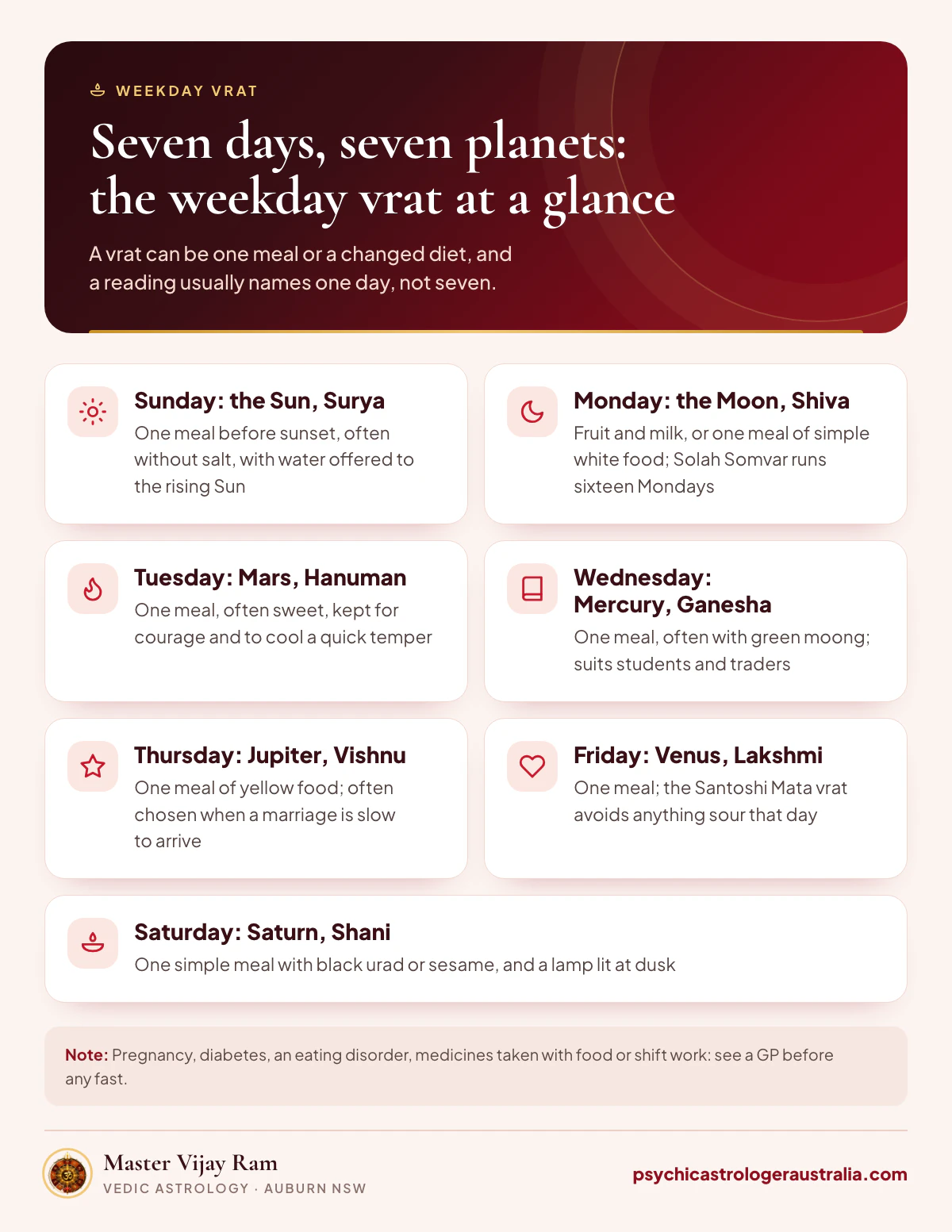
Each weekday is ruled by one of the seven visible planets and is linked with a deity, and the pairings below are widely shared across Indian traditions. Local customs about food differ, so the last column describes common forms rather than rules.
| Day | Planet | Deity | A form many families keep |
|---|---|---|---|
| Sunday | Sun | Surya | One meal before sunset, often without salt |
| Monday | Moon | Shiva | Fruit and milk, or one meal of simple white food |
| Tuesday | Mars | Hanuman | One meal, often sweet; in some families no salt |
| Wednesday | Mercury | Ganesha | One meal, often with green moong |
| Thursday | Jupiter | Vishnu, Brihaspati | One meal of yellow food, such as chana dal or besan |
| Friday | Venus | Lakshmi, Santoshi Mata | One meal; the Santoshi Mata vrat avoids anything sour |
| Saturday | Saturn | Shani, Hanuman | One meal, often with black urad or sesame, and a lamp at dusk |
Neither Rahu nor Ketu rules a day of the week, so families usually keep a vrat for Rahu on Saturday and for Ketu on Tuesday or Saturday.
What can a vrat actually be?
Far more than going without food. The strictest form, nirjala, takes no water from sunrise to sunrise and is kept only for a few great days of the year; the commonest weekly forms are phalahar, fruit and milk, or ek-bhukta, one meal in the day, usually taken in the evening after prayer.
A vrat can also be a changed diet rather than a reduced one: no grains, no salt, no onion or garlic, nothing fried, or simply vegetarian food on a day you would otherwise eat meat. It can be a vow of something added rather than removed, an extra recitation, a visit to a temple or an hour of service. The tradition counts all of these as vrat, and a reading often recommends the gentlest form that can be kept for months.
Who should check with a GP before fasting?
Anyone pregnant or breastfeeding, anyone with diabetes, anyone with a history of an eating disorder, anyone whose medicines must be taken with food, and anyone working rotating or night shifts should talk to a GP before keeping any fast. Skipping meals can be risky with some diabetes medicines, and a fast can feed an eating disorder while looking like devotion.
For these people the tradition itself offers the answer: keep the vow without the fast. A single ordinary meal at the usual time with prayer, a changed diet the doctor is happy with, or a vow of recitation rather than abstinence all count. Children, older relatives and anyone recovering from illness are traditionally given a lighter form, and no family should press a fast on someone who is unwell.
How do you decide which vrat to keep?
There are two honest routes. The first is devotion: many families keep the day of the deity they love, a Tuesday for Hanuman or a Monday for Shiva, without any reference to a chart, and that needs no astrologer at all.
The second is the chart, and it answers the question of which vrat to keep by finding the planet whose dasha is running while its placement is weak, which usually names one day, not seven. A kundli reading is where that is worked out, and the daily navagraha remedies describe the habits that go with each planet's day.
What does a Monday fast for Shiva involve?
The Monday fast for Shiva is the most widely kept of the seven, and it serves both the Moon and the deity: water or milk offered at a Shiva lingam or a home altar, Om Namah Shivaya, and white, cooling food taken once in the day. Families keep it for a restless mind, for peace at home, and, in its best-known form, the Solah Somvar vrat of sixteen Mondays, for a good marriage.
Mondays in the month of Shravana carry extra weight for Shiva's devotees, and many families make a point of visiting a temple on those evenings. Because the Moon governs the mind, a Monday vrat is also the one most likely to be suggested to someone in a Moon period whose sleep and mood have frayed, beside, never instead of, proper care.
What does a Saturday fast for Shani involve?
The Saturday fast for Shani is a fast of restraint rather than plenty: one simple meal, often with black urad dal or sesame, a lamp of mustard or sesame oil lit at dusk, the Hanuman Chalisa or Saturn's mantra, and something given to a person who works with their hands. Saturn rewards discipline, so a modest fast kept every Saturday for months suits it better than a severe one kept briefly.
Saturn's movements in 2027 put Sade Sati on Aquarius, Pisces and Aries Moons for the months it spends in Pisces, then on Pisces, Aries and Taurus Moons during its stay in Aries between 3 June and 19 October, and the Saturday vrat is among the commonest practices for anyone in that window. The mantra itself is set out in Saturn's beej mantra and how to chant it.
What does a Thursday fast for Jupiter involve?
The Thursday fast for Jupiter honours Vishnu and Brihaspati, the teacher of the gods, and it is the one families most often choose when a marriage is slow to arrive, especially for a daughter. Yellow is its colour: chana dal, besan, bananas and turmeric, yellow clothes, and in many homes water offered at a banana plant; some families also avoid washing hair or cutting nails on Thursdays.
Because Jupiter is the planet of teachers and children, the Thursday vrat is also kept for study and for a child's welfare. Its spirit is generosity within your means and respect for elders, which matter more than the colour of the meal.
What about Sunday, Tuesday, Wednesday and Friday?
Sunday's fast for the Sun is usually one meal before sunset, often without salt, with water offered to the rising Sun; it is kept for vitality, for a father's welfare and for standing at work. Tuesday's belongs to Hanuman and Mars and is kept for courage and to cool a quick temper, often with the Hanuman Chalisa and a sweet offering.
Wednesday's honours Ganesha and Mercury and suits students, traders and anyone whose speech carries their living. Friday's is kept for Lakshmi or Santoshi Mata and for Venus, for harmony and comfort in the home; the Santoshi Mata vrat is known for one strict rule, nothing sour that day, not even for others at the table.
When does a vrat begin, how long does it run, and how is it closed?
The tradition likes a vrat to start on its planet's day during Shukla paksha, the waxing fortnight, with a sankalp that names the number of weeks: sixteen Mondays, a set run of Saturdays, or simply the length of a difficult period. The day itself runs from sunrise to sunrise, so the hours after midnight and before dawn are counted with the previous day, as the panchang's sunrise rule explains.
At the end comes the udyapan, a closing puja with food shared or given away, on a day chosen for it. Once-a-year vrats follow the same logic on a larger scale; Karva Chauth moonrise times in Australia shows how a single fast can depend on the local sky.
How does a vrat fit a reading's remedies?
As the part the client does. A reading that finds a planet running and struggling usually prescribes a small set of things: that planet's mantra, a weekly vrat in a form the person can keep, a habit of conduct and an act of charity. Most people need nothing more.
Where the chart calls for a shanti as well, Master Vijay Ram carries out the rite himself at his place of practice in Auburn on a muhurat picked for it, and the client's part is the vrat kept at home; an online puja or havan explains how clients join by video. The consultation costs $50; puja or remedy work begins at $250, a figure agreed with you before the work starts.
What can a fast not do?
It cannot buy an outcome. A vrat is an offering of discipline and attention, not a bargain, and the tradition never promised that sixteen Mondays guarantee a husband or that Saturdays cancel Sade Sati. It cannot treat an illness, and a fast kept against medical advice is not what any scripture asks.
Nor should it be imposed. A vrat kept out of fear of a mother-in-law's disapproval has lost the devotion that gives it meaning, and where pressure or control at home has become frightening, 1800RESPECT is the call to make. Health questions go to a GP and Healthdirect, listed below.
How does Master Vijay Ram advise on a vrat?
He reads the chart for the planet that needs attention, checks what your health, work and family life allow, and suggests one day, one form and one length of time, along with the mantra to go with it. He prescribes no gemstone or bead for a vrat and sells none. You can speak with him for $50 over the phone, on a video call or on WhatsApp, in English, Hindi or Punjabi; meeting face to face means booking a time in Auburn.
The day follows your own sunrise, wherever you live. For families reached through astrology readings for Hobart, that means a late winter dawn and long summer evenings, so a sunrise-to-sunset vrat in December asks noticeably more of a Tasmanian than of someone in Darwin.
Read next
- Hartalika Teej 2027 in Australia: Date and the FastHartalika Teej 2027 is Friday 3 September in every Australian city and India. The story, the evening puja, the nirjal…
- Amavasya 2027 in Australia: Tarpan Days and New Moon Times by CityAmavasya 2027 in Australia: 13 new moon dates and times by city, the Diwali Amavasya, pitru tarpan, Shani Amavasya an…
- 11 Signs of Negative Energy in Your Life (and How to Clear It)Eleven signs of negative energy, the ordinary causes to rule out first, and the three-doors test that tells you wheth…
Frequently asked questions
Which fast is for which planet?
Sunday is the Sun's day, Monday the Moon's with Shiva, Tuesday Mars's with Hanuman, Wednesday Mercury's with Ganesha, Thursday Jupiter's with Vishnu and Brihaspati, Friday Venus's with Lakshmi or Santoshi Mata, and Saturday Saturn's with Shani and Hanuman. Neither Rahu nor Ketu owns a weekday, so a Rahu vrat is usually kept on Saturday and a Ketu vrat on Tuesday or Saturday.
What can I eat during a Monday fast?
Families differ, but the common forms are fruit and milk through the day, or one meal of simple white food such as rice, curd or kheer, taken after prayer. Many avoid grains, onion and garlic for the day. If you are pregnant, diabetic or on medication taken with food, keep an ordinary meal at the usual time and check with your GP; the vow and the prayer count without the fast.
How many Mondays should I fast?
The best-known form is the Solah Somvar vrat of sixteen Mondays, traditionally kept for a good marriage, but there is no single rule. Many people fast for a set run of weeks named in their sankalp, or for the length of a difficult Moon period. The tradition values a number you can keep faithfully over a larger one abandoned halfway.
Is the Saturday fast good during Sade Sati?
It is one of the commonest Sade Sati practices: one simple meal, a lamp of mustard or sesame oil at dusk, the Hanuman Chalisa or Saturn's mantra, and something given to a person who works with their hands. Kept modestly for months, it suits Saturn's preference for discipline. It does not cancel Sade Sati; it helps a person meet the period steadily.
Which vrat helps with delayed marriage?
Families most often choose the Thursday vrat for Jupiter, especially for a daughter, or the Monday vrat for Shiva, including the sixteen-Monday Solah Somvar. A reading looks at the seventh house, Venus, Jupiter and the dasha to see which planet is actually involved. No vrat guarantees a wedding; it supports the person while the chart's own timing unfolds.
Can I fast if I have diabetes?
Speak to your GP before any fast. Skipping meals can be risky with some diabetes medicines, and the safe approach depends on your treatment. The tradition does not require going hungry: you can keep the vow with an ordinary meal at the usual time, a changed diet your doctor approves, or a vow of prayer instead of abstinence, and it still counts as a vrat.
Can I keep a vrat if I work night shifts?
Yes, with adjustments. The panchang day runs from sunrise to sunrise, so a night worker's Monday fast covers the shift that begins on Monday evening only until Tuesday's sunrise. Many shift workers keep a changed diet rather than a fast, so that they can eat safely on duty, and anyone whose shifts rotate should check with a GP before fasting at all.
What is an udyapan?
It is the closing ceremony of a vrat, held once the vowed number of weeks is complete: a puja to the vrat's deity, food offered and shared or given away, and often a meal for a few guests. The day is usually chosen for it rather than taken at random. Families who cannot hold one at the time sometimes complete it later, and traditions differ on the details.
Can a fast replace a puja or medical treatment?
No. A vrat is a devotional discipline, and it sits beside medical care, never in place of it; illness belongs with a GP. It is also not a substitute for a puja where a chart genuinely calls for one, though for most people the vrat, the mantra and better conduct are all the remedy a period needs.
People also ask
Which day fast is good for Shani?
Saturday. The Saturday fast honours Shani and Hanuman with one simple meal, often with black urad or sesame, a lamp of mustard or sesame oil at dusk, the Hanuman Chalisa or Saturn's mantra, and service to someone who works with their hands. A modest fast kept for months suits Saturn better than a severe one kept briefly.
Which god is worshipped on Thursday?
Vishnu and Brihaspati, the teacher of the gods who is also the planet Jupiter. The Thursday vrat uses yellow food and clothes, often water offered at a banana plant, and is kept for marriage, study, children and wisdom. Its spirit is generosity within one's means and respect for teachers and elders.
Is it necessary to fast on the planet's day?
The tradition links each planet's practice to its own weekday, and a vrat begun for a planet is kept on that day. But the vrat can be a single meal, a changed diet or a vow of prayer, so nobody need go hungry to honour a planet, and anyone with a health condition should see a GP first.
Can I keep two weekday fasts?
You can, though a reading usually suggests one. Two fasts a week doubles the strain on health and routine, and the tradition prefers one vow kept faithfully. If you already keep a devotional fast, such as a Tuesday for Hanuman, a second for a planet in your chart can sometimes be folded into it.
References & further reading
Serving clients across Australia
Confidential consultations by phone, video & WhatsApp — including: