

Quick answer
Neem, the bitter tree Azadirachta indica, is used in Hindu households as a cooled leaf decoction in bathwater, a string of leaves at the door, neem water in the mop and a pinch with jaggery at Ugadi. Neem smoke stays out of the house, neem oil is never swallowed and is kept from children, and none of it is medicine.
What is neem, and why is it part of cleansing?
Neem is a bitter-leaved evergreen tree, Azadirachta indica, that Indian households have kept near the door, in the bathwater and on the festival plate for as long as anyone remembers. Its Sanskrit name is nimba, and in the tradition its bitterness is the point: a taste that wakes the senses and stands, in story and ritual, for clearing away what has gone stale.
Families who ask Master Vijay Ram about neem for negative energy are usually remembering a grandmother’s habits and want to keep them safely in an Australian home. This post covers the bath, the doorway, the festival plate and the garden, with the cautions beside each; where a heaviness is in the person rather than the house, aura cleansing and how it is read is the service that looks at it.
Where does neem appear in the tradition?
Most memorably at the new year. At Ugadi, in Telugu and Kannada homes, a little neem flower goes into the Ugadi pachadi with jaggery, tamarind and raw mango, so that the year begins with every taste, the bitter included; in Karnataka the same idea is bevu-bella, neem and jaggery, and at Gudi Padwa in Maharashtra neem leaves are eaten with jaggery and tied to the gudi.
In 2027 Ugadi and Gudi Padwa fall on Thu 8 Apr 2027 in Australia and Wed 7 Apr 2027 in India, the same day Chaitra Navratri begins. The bitter and the sweet eaten together is the tradition’s plainest lesson: a year holds both, and a household that tastes both on the first morning is ready for them.
Neem also belongs to the goddess. In Tamil Nadu it is the tree of Mariamman and in the north of Sheetala Mata, and households once hung neem leaves at the door while a fever was in the house, a custom of prayer that today sits beside the GP, never in place of one.
How is neem used at home and on the body?
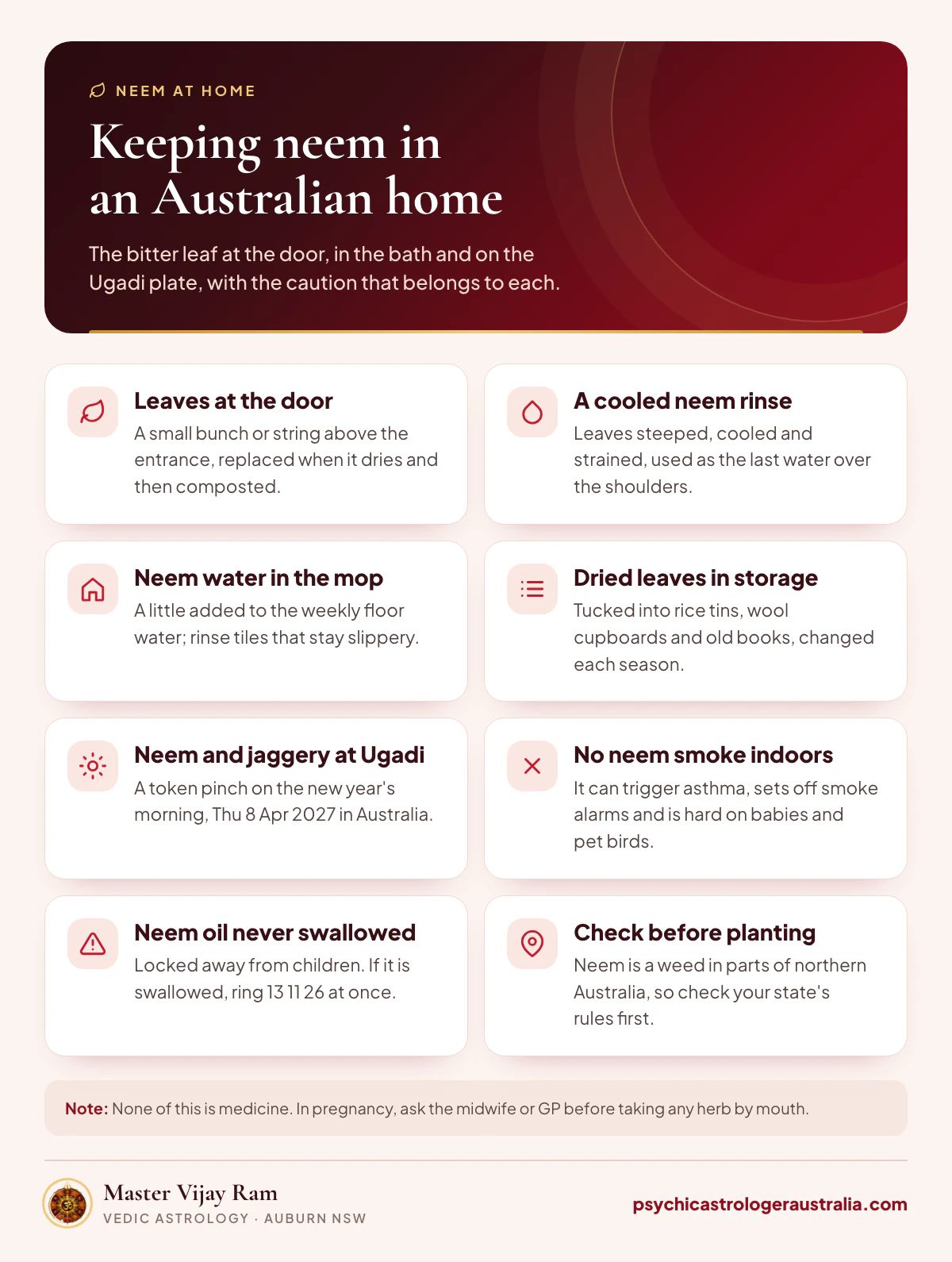
The table gathers the household uses most families mention, with the caution that belongs to each. None of them is medicine, and none needs anything more expensive than a packet of dried leaves.
| Use | How families do it | What the tradition says | The caution |
|---|---|---|---|
| Bathwater | Leaves steeped in hot water, cooled, strained and used as the last rinse | Clears what was picked up outside the home | A patch test inside the elbow first; mind the eyes |
| At the door | A small bunch or a string of leaves hung above the entrance | Keeps the threshold guarded | Replace when dry and brittle; compost the old leaves |
| Floor water | A little cooled neem water added to the mopping bucket | Freshens the house before a puja | Rinse tiles that stay slippery; keep the bucket from toddlers |
| In storage | Dried leaves tucked into rice tins, wool cupboards and old books | A habit families credit with keeping insects off | Change them each season; keep them out of food you will eat |
| Ugadi and Gudi Padwa | A pinch of neem with jaggery on the new year’s morning | The year’s bitter and sweet tasted together | A token amount only; ask the GP first in pregnancy |
| Smoke | Dried leaves burnt to fumigate, as some villages once did | Drives off insects and heaviness | Never indoors in an Australian home; see below |
Pick the one or two that fit your household. A house that keeps a neem string at the door and neem water in the weekly mop has kept the custom well.
How is a neem leaves bath prepared?
A neem water bath uses the leaves as a brew rather than loose in the tub. Steep a good handful, fresh or dried, in water just off the boil with the lid on, leave it until it is no warmer than the body, pour it through a sieve, and use it as the last water over the shoulders; the Hindu ritual bath and its additions sets neem beside salt, turmeric, Gangajal and tulsi.
Families reach for neem leaves in the bath rather than salt when skin dislikes salt, or after an illness in the house, when everyone wants the week to begin again. Dab a little inside the elbow the day before; if the skin reddens, leave neem out, and give babies plain water.
Can neem be hung at the door?
Yes, and it is one of the gentlest customs of all. A small bunch of neem leaves, or a string of them tied with red thread, hangs above the main door; some families pair it with mango leaves, others keep neem alone, and traditions differ on which festivals call for it.
Fresh leaves dry within days in an Australian summer, so replace them when they turn brittle and put the old ones in the compost or the garden. In a rental or a strata building, a string hung inside the door frame keeps the custom without troubling the body corporate.
Is neem smoke safe in the house?
No. Burning dried neem leaves was once a village way of keeping mosquitoes and heaviness at bay, but neem smoke for the home has no place indoors here: smoke can trigger asthma, sets off the smoke alarms every state requires, and is hard on babies and on pet birds, which are very sensitive to smoke.
The cleansing the smoke was meant to give can be had without it, from neem water on the floor, leaves at the door, a lamp and a mantra. Smoke-free home cleansing for asthma households sets out the full set of alternatives for units, rentals and anyone who wheezes.
What about neem oil?
Neem oil is a different thing from the leaves, and it needs more care. It is never swallowed, never put in bathwater or on a child, and is kept locked away from children, because swallowing it is a poisoning risk; if anyone swallows it, ring the Poisons Information Centre on 13 11 26 immediately.
Neem oil sold for the garden is a garden product and is used only as its label says. Soaps and creams that contain neem are cosmetics like any other, and any rash they cause is a matter for a pharmacist or GP, not a stronger dose.
Where do Australian families get neem?
Indian grocers in most cities sell dried neem leaves, neem powder and neem soap, and some carry fresh leaves or neem flowers before Ugadi. Families in the tropical north may know someone with a tree, and leaves are often shared at festival time.
Dried leaves carried from India are plant material, so they are declared on the Incoming Passenger Card and officers decide; the packet from the grocer down the road is simpler. Nothing about the custom requires leaves picked in India.
Can you grow a neem tree in Australia?
Check first. Neem has become a weed in parts of northern Australia, spreading into bush where it does not belong, so look up your state’s weed rules and ask your council before planting one. In Canberra or Hobart the frost settles the question anyway, since neem is a tropical tree.
Where it is allowed, a family on the Gold Coast or in a warm Adelaide suburb with room for a tree should also think about roots near pipes and foundations, which is an arborist’s question. A potted plant, kept small and never allowed to set seed in the garden, is the neighbourly compromise.
Is a neem tree good for vastu?
Vastu writers count neem among the trees welcome near a house, and advice on neem tree vastu placement differs from one writer to the next. For an Australian block the order of questions is the law, the pipes, and then the vastu, never the other way round.
A home that cannot hold a tree loses nothing in the tradition’s eyes, and leaves at the door do the household work. Where the layout of a home is the real worry, a vastu consultation for your home looks at the whole house rather than one tree.
What can neem not do?
Neem treats nothing here: no illness, infection or skin complaint, whatever a forwarded message or a packet promises, and this page makes no health claim for it in any form. Anyone pregnant, breastfeeding or on medication checks with the midwife or GP before taking any herb by mouth.
Nor can it undo another person’s doing. The leaf keeps a household’s rhythm and gives a new start its taste, which is all the tradition ever asked of it; the practices a person can keep alone are gathered in how to remove negative energy from yourself.
Is a reading ever needed, and what does it cost?
If a heaviness has a starting date, has outlasted weeks of neem, lamps and ordinary care, and has been through a GP’s check, a reading can look at the timing. Vijay Ram ji sets your chart beside those dates in a $50 consultation, by phone, video or WhatsApp and in English, Hindi or Punjabi, and more often than not his advice is to keep the household customs and worry less.
Should a rite be warranted, a puja, havan or jaap costs from $250, a figure agreed before it is performed; he conducts it himself at his Auburn practice and families can follow on video, as online puja and havan describes. He sells none of it: no neem, no oil, no kit.
Families booking through astrology readings for Gold Coast families keep Queensland time, and seeing him face to face means Auburn, by appointment. Neem sits among the household tools mapped in the Vedic tradition of body cleansing.
Read next
- Salt-Water Mopping: The Weekly Home Cleansing Ritual, Done SafelySalt water mopping (namak pocha) done safely: how much salt, which way to mop, where the water goes, which floors can…
- The Hindu Ritual Bath for Cleansing: What to Add and What to SkipThe Hindu ritual bath for cleansing: what to add (salt, neem, turmeric, Gangajal, tulsi), what to leave out, the snan…
- Signs of Negative Energy in Your Home & How to Clear ItSigns of negative energy in a home, the ordinary causes to rule out first, and how nazar, heavier interference and me…
Frequently asked questions
Does neem remove negative energy?
In the tradition, neem’s bitterness stands for clearing out what has gone stale, which is why families put it in bathwater, over the door and on the new year’s plate. It keeps a household’s rhythm; it cannot undo what another person has done. If a heavy feeling survives weeks of these customs and a GP’s check, have it read rather than adding more leaves.
How do you prepare a neem leaves bath?
Steep a good handful of neem leaves, fresh or dried, in water just off the boil, lid on, until it cools to body warmth, then strain it and use it as the final rinse over the shoulders. Dab a little inside the elbow a day ahead if your skin is sensitive, keep the water away from the eyes, and give babies plain water instead.
Can neem leaves be hung at the door?
Yes. A small bunch or a string of neem leaves tied with red thread above the main door is one of the gentlest household customs, and some families pair it with mango leaves. Replace the leaves when they dry out and turn brittle, compost the old ones, and in a strata building hang the string just inside the door frame.
Is it safe to burn neem leaves inside the house?
No. Neem smoke can trigger asthma, sets off the smoke alarms every Australian state requires, and is hard on babies and on pet birds, which are very sensitive to smoke. Keep the custom smoke-free instead: neem water in the mop, leaves at the door, a lamp and a mantra. Never disable a smoke alarm for any ritual.
Is neem oil safe to use at home?
Only with care. Neem oil is never swallowed, never put in bathwater or on a child, and is kept locked away from children. If anyone swallows it, ring the Poisons Information Centre on 13 11 26 at once. Garden neem oil is used only as its label directs, and a rash from a neem soap or cream is a matter for a pharmacist or GP.
Why is neem eaten with jaggery at Ugadi?
Because the new year is meant to begin with every taste of life. At Ugadi a little neem flower goes into the pachadi with jaggery, tamarind and raw mango; in Karnataka it is bevu-bella, and at Gudi Padwa neem leaves are eaten with jaggery. In 2027 Ugadi falls on Thu 8 Apr in Australia. A token pinch is the custom.
Where can I buy neem leaves in Australia?
Indian grocers in most cities sell dried neem leaves, neem powder and neem soap, and some stock fresh leaves or flowers before Ugadi. Leaves brought from India are plant material and must be declared on the Incoming Passenger Card, where officers decide, so the local grocer is usually simpler. Nothing in the custom requires leaves from India.
Can I plant a neem tree in my garden in Australia?
Check first. Neem has become a weed in parts of northern Australia, so look up your state’s weed rules and ask your council before planting. In frosty places such as Canberra and Hobart a tropical neem will struggle anyway. Where it is allowed, think about roots near pipes and foundations; a potted plant kept from setting seed is the neighbourly compromise.
Does Master Vijay Ram sell neem products?
No. A packet of dried leaves from an Indian grocer is all the custom needs; neem, oils, powders and kits are not things he sells. His part is the reading: a $50 consultation when a heaviness outlasts the household customs, and, if the chart truly calls for it, a puja, havan or jaap priced from $250 and agreed before it is performed.
People also ask
What is neem used for in Hindu tradition?
As a sign of cleansing and protection: a cooled leaf decoction in bathwater, a string of leaves at the door, neem water in the floor mop, dried leaves in storage, and a pinch with jaggery at Ugadi and Gudi Padwa. It is also sacred to Mariamman and Sheetala Mata. None of these uses is medicine, and the safety rules come with each.
How do you use neem leaves to cleanse the house?
Hang a small string of fresh leaves above the main door and replace it when it dries, add a little cooled neem water to the mopping bucket before a puja, and tuck dried leaves into storage cupboards if you like the old habit. Do not burn neem indoors, and rinse tiles that stay slippery after mopping.
Which direction should a neem tree be planted for vastu?
Vastu writers differ on the best direction, though most count neem among the trees welcome near a house. In Australia the first questions are your state’s weed rules and your council, then roots near pipes and foundations, and only then vastu. A home without room for a tree keeps the custom with leaves at the door.
Can neem be used during pregnancy?
Not by mouth unless the midwife or GP agrees, and neem oil never. A plain bath and the household customs at the door keep the tradition safely through a pregnancy. Any herb, powder or cream, however traditional, is worth a quick question to the midwife or GP first.
References & further reading
Serving clients across Australia
Confidential consultations by phone, video & WhatsApp — including: