

Quick answer
To cleanse a business or office of heavy energy, rule out the lease, staff, a competitor, parking, roadworks and a bad month first. Then keep a daily practice: a wiped threshold, a tended till, a lamp where rules allow, a mantra at the door. Where trouble began with a nameable event and the chart agrees, Master Vijay Ram performs a cleansing after a $50 consultation.
What it means to cleanse a business or office of heavy energy
To cleanse a business or office of heavy energy is a Vedic practice that treats a shop, a clinic or a floor of desks the way a household is treated: the ordinary causes are ruled out first, the owner's chart and the start of the business are read, and a remedy is performed only where the pattern and the chart agree. It is not a matter of walking through with smoke. It is mostly a matter of finding out what has actually gone wrong.
Owners ring Master Vijay Ram about a till that has gone quiet, a back room nobody will work in, or a team that has started fighting since the fit-out. Some of those calls end with a cleansing. Most end with a lease clause, a staffing problem or a council notice, and he says so.
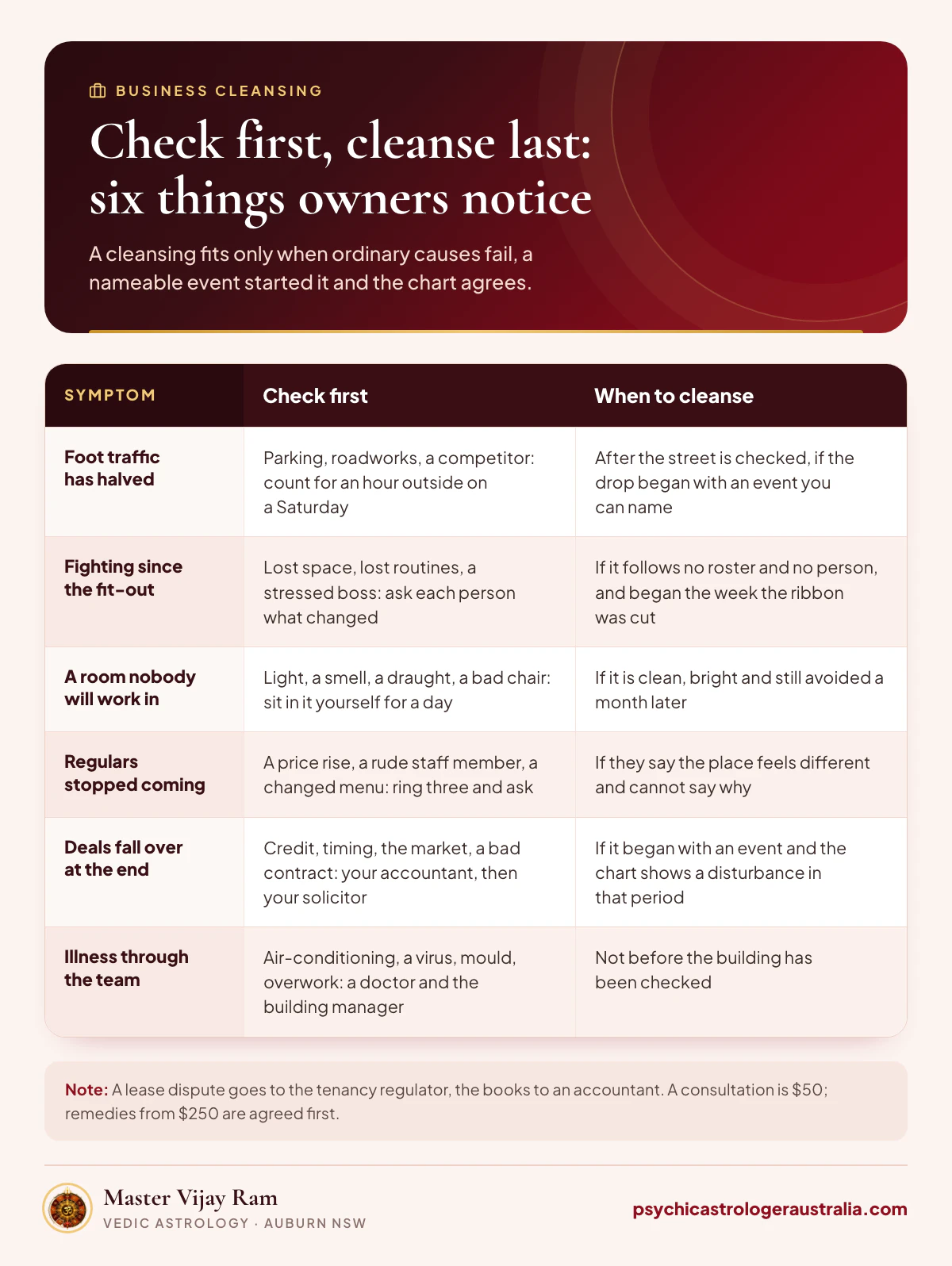
The ordinary causes first: lease, staff, competitor, parking, roadworks, a bad month
A business is a machine with more moving parts than a home, and more ways to feel cursed. Before anyone reads a chart, six things are checked, because any one of them produces exactly the heaviness owners describe.
- The lease: a rent review, an outgoings bill or a landlord who has stopped repairing changes the mood of a shop within a month.
- The staff: one unhappy person on the floor, a manager who has quietly started looking, a roster that nobody can live with.
- A competitor: the new place two doors down, or the online one with no rent at all.
- Parking and roadworks: a changed parking rule or a dug-up footpath can halve foot traffic without a single customer saying why.
- The calendar: school holidays, the end of the financial year, a wet fortnight, the month after a festival.
- The books: a bad month is sometimes just a bad month, and an accountant will tell you faster than a priest.
Vijay Ram ji asks about all six before the word nazar is used. An owner who can show that none of them fits has a stronger case for a reading, and a weaker one for despair.
What owners actually describe
The language is remarkably consistent across trades. The till is quiet while the neighbour's is not. Regulars have stopped coming and nobody can say when. There is a back room, a storeroom or a corner desk that staff avoid, and the smell in it is never quite found. Arguments start in the kitchen or the staff room and stop in the car park. A good month is followed by a bad quarter the moment the renovation is finished.
Each of those sentences has an ordinary reading and a spiritual one. The order in which the trouble began, and whether it began with an event, is what separates them, and that is the first thing he asks for.
Symptom, ordinary cause, check, and when to cleanse
| Symptom | Ordinary cause | Check | When to cleanse |
|---|---|---|---|
| Foot traffic has halved | Parking change, roadworks, a competitor, a closed anchor store | Stand outside for an hour on a Saturday and count | After the street has been checked and the drop began with an event you can name |
| Staff fighting since the fit-out | Lost space, lost routines, a boss who is stressed about the cost | Ask each person separately what changed | If the fighting follows no roster and no person, and started the week the ribbon was cut |
| A room nobody will work in | Poor light, a smell, a draught, a dead rodent, a bad chair | Sit in it yourself for a day; fix what you find | If the room is clean, bright and still avoided a month later |
| Regulars have stopped coming | A price rise, a rude staff member, a changed menu, a rival | Ring three of them and ask | If they say the place feels different and cannot say why |
| Every deal falls over at the last step | Credit, timing, the market, a bad contract template | Your accountant and your solicitor, in that order | If the pattern began with an event and the owner's chart shows a disturbance in the same period |
| Illness running through the team | Air-conditioning, a virus, a mould problem, overwork | A doctor and the building manager | Not before the building has been checked |
Is it nazar on a visible business?
The one spiritual cause that comes up again and again is nazar, the evil eye, and it attaches to businesses for the same reason it attaches to weddings: visibility. A new fit-out, a ribbon cutting, a queue photographed and posted, a cousin's comment about how well you must be doing. In the communities Master Vijay Ram serves, from the Harris Park strip to Dandenong and Sunshine, envy is understood to leave a mark, and the mark is described as a shop that was full and is suddenly not.
The signs of buri nazar on a business and evil-eye protection for a shop are each covered on their own. The short version is that nazar is read from timing: a sudden change after a moment of being admired, with the ordinary causes excluded.
An opening and closing practice for a shop
Whether or not a cleansing is ever performed, a shop benefits from a daily practice, and it costs the owner ten minutes. Vijay Ram ji gives a version of this to almost every business that calls, and it is adapted to what the premises allow.
- The threshold at opening: sweep it, then wipe it with salted water and then plain water, so the first thing that crosses it each day is clean.
- The till: keep it tidy, keep a small image or a coin of your tradition in it, and never let it sit empty overnight if you can help it.
- A lamp where permitted: an oil lamp in a grocer with a tiled floor is fine; in a kitchen, a salon or a strata office an electric diya does the same work without troubling the fire officer or the insurer.
- A mantra at the door: once at opening and once at closing, quietly, by the owner, not delegated to a junior.
- Closing: count, clean, put the chairs up and leave the place as you would want to find it; a shop closed in a hurry carries the hurry into the morning.
Food-preparation areas and anywhere with extraction systems should never have incense or open flame, and no practice on this site asks for them. The tradition is satisfied by light and intention, and the building rules are satisfied by electricity.
An office version: a desk, a floor, a meeting room
Offices are harder because the space is shared and the tenancy is not yours. A practice for a desk is discreet: a small object of your tradition in the drawer, a wiped surface at the start of each day, a mantra said silently before the first call. A floor that feels heavy is usually a floor with a problem in it, a manager, a merger, a layoff rumour, and a cleansing that ignores that is theatre.
Where an owner has the whole tenancy, the opening and closing practice above applies to the front door and the meeting room, and the Vastu consultation looks at where the desks and the door sit before anything is performed.
What about staff who do not share the belief?
Keep it yours. A practice at the till and the threshold is the owner's business and nobody else's, and no staff member should be asked to take part, told the premises were cursed, or expected to attend a ritual. Vijay Ram ji is firm about this because he has seen the alternative: a team told that the shop is afflicted finds the affliction everywhere. A quiet owner and a tidy threshold do more.
Vastu: when the layout is the problem
Some businesses feel heavy for a reason you can measure with a tape. A till facing the wrong way, a storeroom blocking the entrance, a desk with its back to the door, a kitchen fighting the direction of the building. Vastu is the Vedic science of placement, and most of its remedies for a shop or office are rearrangement rather than renovation. No wall needs to come down to move a till.
Where the layout is the cause, a cleansing is beside the point, and the honest advice is to move the furniture and watch the month that follows.
When is a cleansing warranted?
Three things have to be true at once. The ordinary causes have been checked and do not fit. The trouble began with an event the owner can name, a fit-out, a celebration, a visit, a falling-out. And the owner's chart, read for that period, shows a disturbance that matches. Where the business has a known start date, that chart is read too, because a business has a horoscope of its own.
When only one or two of those hold, the answer is a practice and a month of watching, not a remedy. When all three hold, a cleansing is explained, priced and arranged.
What Master Vijay Ram does for a business remotely
The consultation is $50 by phone, video or WhatsApp, and it is held with the owner. He asks about the six ordinary causes, then the timeline, then the owner's birth details and the date the business opened. Where a cleansing is warranted it is a havan and mantra performed personally at his own altar in Auburn on an auspicious hour, offered for the business and its owner by name, with a Lakshmi element where the chart calls for it; the business and career growth page describes that side of the work.
You are told the day and the hour and given the opening practice for the fortnight that follows. The negative energy and evil-eye removal work is the same whether the premises are a grocer or a dental practice, and it is done without a visit.
What it costs
A consultation is $50, and spell or prayer work, where it is warranted, starts from $250. The figure is agreed with the owner before anything is performed, and if the consultation finds a lease problem or a staffing problem rather than interference, nothing further is charged. There is no retainer, no monthly protection fee and no second ritual sold when the first changes nothing.
Where the calls come from
Most business calls reach him from strips where family enterprises stand shoulder to shoulder and everyone knows whose shop is full: the restaurants and grocers around Harris Park, the traders and tutoring colleges of Dandenong, and the shops along Hampshire Road in Sunshine. Clinics, salons and small offices make up the rest, and the questions are the same in every trade.
What a cleansing cannot do for a business
A mantra does not bring customers through a dug-up footpath, and a havan does not rewrite a lease. Disputes with a landlord go to the tenancy regulator, in Victoria Consumer Affairs and in New South Wales Fair Trading; disputes with the books go to an accountant. What a cleansing can do is clear what has settled in a premises after an event, steady an owner whose chart is under pressure, and give the day a shape at the threshold and the till. For a business that has done the checking, that is often the thing that was missing.
Read next
- How Much Does a Spiritual Cleansing Cost in Melbourne?Spiritual cleansing cost in Melbourne: why advertised prices are not comparable, the fee models that are red flags, a…
- Aura Cleansing in Australia: How It Works & When You Need ItHow aura cleansing actually works in Australia: the five-doorway read, each stage of a remote remedy, what you provid…
- Negative Energy After a Breakup: Cleansing Your Space and Your AuraNegative energy after a breakup: grief first, a home that still holds a person, a seven-day practice for the rooms, a…
Frequently asked questions
How do I know whether my shop has negative energy or just a bad quarter?
Check the six ordinary causes first: a rent review or landlord problem, an unhappy staff member or an impossible roster, a new competitor, a parking or roadworks change, the calendar and the books. Then ask whether the trouble began with an event you can name. A bad quarter with an ordinary explanation is a bad quarter; a sudden change after a visible success, with the causes excluded, is worth a reading.
Can a business be cleansed without anyone coming to the premises?
Yes, and that is how Master Vijay Ram does it. The consultation is held with the owner by phone, video or WhatsApp, the owner's chart and the business's start date are read, and where a cleansing is warranted the havan and mantra are performed at his own altar in Auburn, offered for the business by name. The owner keeps the opening and closing practice on site. No visit is involved.
What can I do in a food business where incense and open flame are not allowed?
Everything that matters. Wipe the threshold with salted then plain water at opening, keep the till tidy with a small image or coin of your tradition in it, use an electric diya instead of a lamp, and say a short mantra at the door at opening and closing. No practice on this site asks for smoke or flame in a kitchen, and the tradition is satisfied by light and intention.
What is nazar on a business, and how would I recognise it?
Nazar, the evil eye, is the harm envy is believed to leave on something admired, and a business attracts it the way a wedding does: a new fit-out, a ribbon cutting, a photographed queue, a relative's remark about how well you must be doing. It is recognised by timing, a sudden change after a moment of visibility, after the ordinary causes have been ruled out, never by the story alone.
Should I involve my staff in a cleansing?
No. The threshold and till practice is the owner's business and nobody else's, and no staff member should be asked to take part, told the premises are afflicted or expected to attend a ritual. A team told the shop is cursed finds the curse everywhere. Keep the practice quiet and personal; a tidy threshold and a calm owner change a floor more than an announcement does.
How much does a business cleansing cost?
The consultation is $50, by phone, video or WhatsApp, with the owner. Where a cleansing is warranted, spell or prayer work starts from $250 and the figure is agreed before anything is performed. If the consultation finds a lease, staffing or layout problem instead, nothing further is charged, and there is no retainer, monthly protection fee or repeat ritual sold on reflex.
Could the layout of my shop be the real problem?
Often. A till facing the wrong way, a storeroom crowding the entrance, a desk with its back to the door or a kitchen fighting the direction of the building all produce a heavy premises. Vastu, the Vedic science of placement, reads those, and most of its remedies for a shop are rearrangement rather than renovation. Where the layout is the cause, move the furniture and watch the month before considering anything else.
Does a business have a horoscope of its own?
Yes, where it has a known start date. The chart of the day and hour the doors first opened, or the registration date, is read alongside the owner's, and a disturbance that shows in both for the same period carries more weight than one that shows in neither. Owners who cannot recall the date are read through their own chart and the timeline of events.
My regulars have stopped coming and nobody can say why. Is that a sign?
It is a sign that three of them should be rung and asked. A price rise, a rude shift, a changed menu or a rival explain most quiet months, and customers will tell you if you ask them directly. If they say the place feels different and cannot put their finger on it, and the change began with a nameable event, that is the point at which a reading becomes reasonable.
What will a cleansing not fix?
A footpath that has been dug up, a lease that has become unaffordable, a landlord who will not repair, a competitor with no rent, or a set of books that do not add up. Those go to the council, the tenancy regulator, the landlord in writing and an accountant. A cleansing clears what has settled after an event and steadies an owner whose chart is under pressure; it does not run the business.
People also ask
How do you cleanse a business of negative energy?
Rule out the lease, the staff, a competitor, parking, roadworks and the calendar first. Then keep a daily practice: sweep and wipe the threshold with salted then plain water at opening, keep the till tidy, light a lamp or electric diya where rules allow, say a short mantra at the door at opening and closing, and leave the place tidy at night. A practitioner's cleansing comes only where trouble began with an event and the chart agrees.
What are the signs of negative energy in a workplace?
A till quiet while the neighbour's is busy, regulars gone without a reason anyone can name, a room staff avoid, arguments that start on the floor and stop in the car park, and a good month followed by a bad quarter the moment a renovation finishes. Each has an ordinary explanation to test before a spiritual one, and the order the trouble began in is what tells them apart.
Can you do a space clearing in an office you do not own?
A discreet one. A small object of your tradition in the drawer, a wiped desk at the start of the day and a mantra said silently before the first call need no permission from anyone. A whole floor that feels heavy usually has a manager, a merger or a rumour in it, and a clearing that ignores that is theatre; where the tenancy is yours, the threshold and meeting-room practice applies.
Is it safe to light a lamp or incense in a shop?
Only where the premises allow it. A grocer with a tiled floor and no extraction can keep an oil lamp; a kitchen, a salon or a strata office should use an electric diya, which satisfies the tradition and the fire officer at once. No cleansing practice worth following asks for open flame or smoke anywhere near food preparation or an extraction system.
How much does it cost to have a business cleansed?
With Master Vijay Ram the consultation is $50 and remedy work, where it is warranted, starts from $250, agreed with the owner before anything is performed. Prices advertised elsewhere are rarely comparable, because a per-visit clearing, a session fee and a monthly protection retainer are different products sold under one name; a retainer is itself a warning sign.
References & further reading
Serving clients across Australia
Confidential consultations by phone, video & WhatsApp — including: