
Quick answer
Navratri and Dussehra are a natural point to clear a home, because the festival already asks you to strip it back and begin again. In Australia the window falls in spring, so most houses that feel heavy then need airing, damp repair and rest rather than a remedy.
What Navratri and Dussehra actually mark
Navratri means nine nights. It is a period given to the Divine Mother in her nine forms, and it closes on the tenth day with Dussehra, also called Vijayadashami. One telling remembers Rama's victory over Ravana. Another remembers Durga's over Mahishasura. Both say the same thing: something that had grown too large was brought down.
Cleansing attached itself to this window for a plain reason. Families were already emptying cupboards, washing floors and settling small debts before the first night. The house was being stripped back anyway. Doing spiritual work at the same moment took almost no extra effort.
That origin is worth keeping in view. The nine nights hold no special authority over negative energy. They are simply the one stretch of the year when most households actually do the work.
When the 2026 festival window falls, and why the dates move
Sharad Navratri is set by the lunar calendar, so it lands on a different Gregorian date each year. It opens on the first tithi of the bright half of Ashwin, runs nine nights, and gives the tenth day to Dussehra. In 2026 that window sits in October.
Two things unsettle the dates here. A tithi begins and ends at a fixed moment, not at midnight, so a calendar printed for India can be a full day out in Australia. Daylight saving also starts in early October in New South Wales, Victoria, South Australia, the ACT and Tasmania, but not in Queensland or Western Australia. A family on the Gold Coast and one in Melbourne can read the same panchang and land on different days.
Use a panchang calculated for your own city, and settle the dates before you begin.
Spring here, autumn there: what the season does to an Australian home
Navratri is an autumn festival in the northern hemisphere. In Australia it arrives in spring, and that difference matters more than it sounds. Most of what makes a home feel heavy here in October is seasonal and physical.
A house shut through a southern winter holds damp. Mould shows behind wardrobes and along window reveals. Carpets that never dried properly hold a smell nobody can place. Pollen climbs through September and October, and a household of blocked sinuses and broken sleep will call the house oppressive without connecting the two.
None of that is spiritual. All of it answers to open windows, a dehumidifier, cleared gutters and mould treated properly rather than painted over. Do the physical work first. It costs less, moves faster, and in many homes it is the entire answer.
What tends to surface at each stage of the window
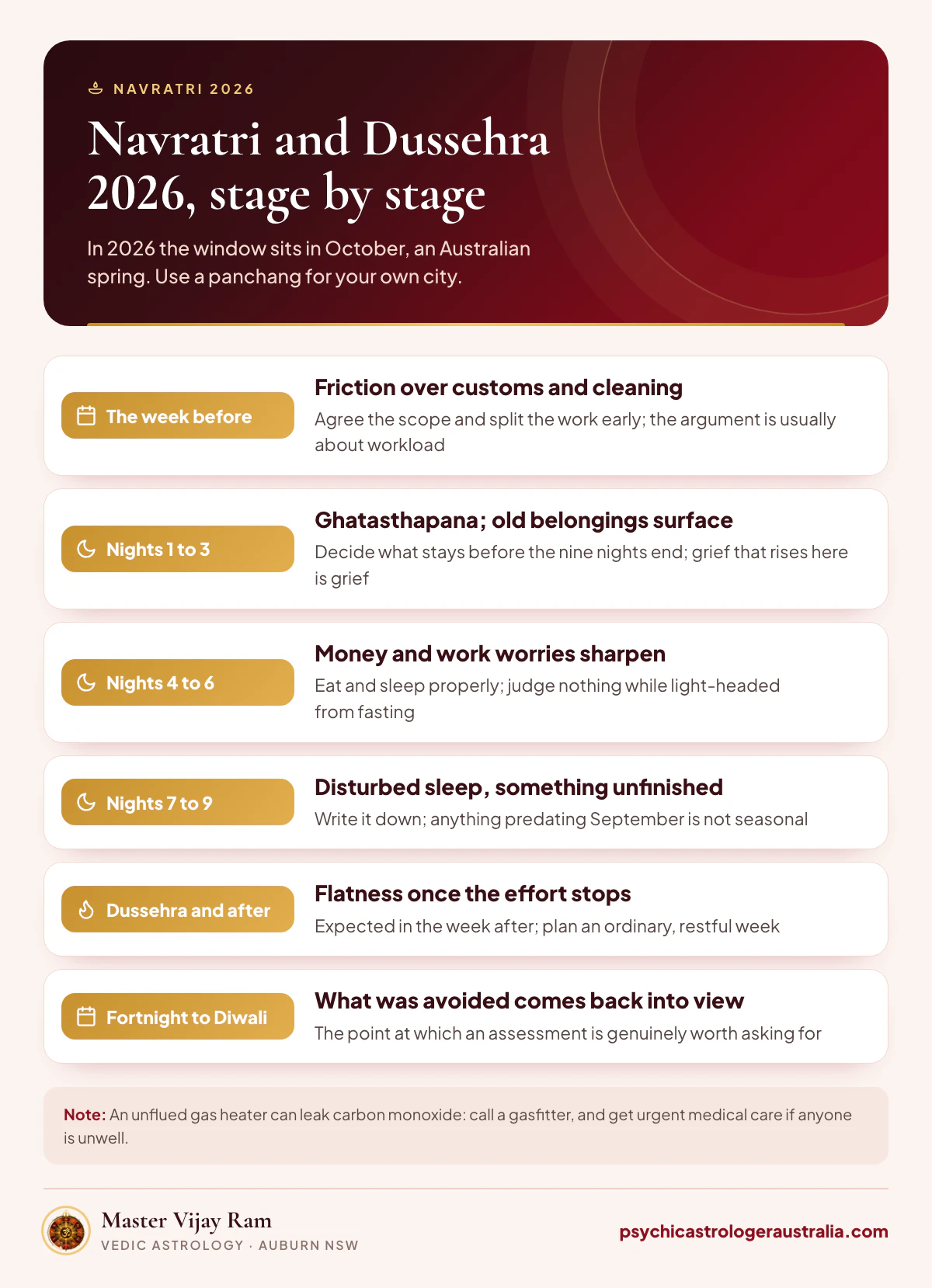
The nine nights have a shape, and so does the fortnight around them. Knowing what rises at each stage stops you reading an ordinary week as a warning.
| Time of year | What tends to surface | What to do about it |
|---|---|---|
| The week before the first night | Friction over whose customs are followed and who does the cleaning | Agree the scope and split the work early; the argument is usually about workload |
| Ghatasthapana and nights one to three | Old things surface: letters, photographs, a late relative's belongings | Decide what stays before the nine nights end; grief that rises here is grief |
| Nights four to six | Money and work worries sharpen, often while fasting | Eat and sleep properly; judge nothing while light-headed |
| Nights seven to nine | Disturbed sleep and a sense of something unfinished | Write it down; anything predating September is not seasonal |
| Dussehra and the week after | Flatness once the effort stops | Expect it, and plan an ordinary, restful week |
| The fortnight to Diwali | Whatever was being avoided comes back into view | The point at which an assessment is genuinely worth asking for |
Only that final fortnight usually leads anywhere near energy that has settled on a person or a home, and even then most enquiries close with a conversation.
The Nine-Night Ledger
Most people decide their house has a problem on the worst night of the nine, and remember nothing about the other eight. The Nine-Night Ledger is a correction for that.
Each night you write three short lines. What you cleared or cleaned that day. What actually went wrong, or went well, in the house. And any ordinary cause you can name: a bill, a brutal shift, a child's fever, an argument that had been building for months.
On Dussehra you read all nine entries in one sitting. The rule of thumb Master Vijay Ram works to is plain. If most nights carry a nameable ordinary cause, the house needs rest and repair rather than a remedy. If fewer than three do, and the same pattern runs back well before October, an assessment earns its place.
Ghatasthapana and the first three nights
Ghatasthapana is the setting of the pot on the first morning: barley sown in soil, a kalash of water, a lamp kept alight. It also fixes one spot that must stay clean for nine days, which is why most families clear that room first.
The first three nights are given to Durga in her fierce aspect, the removing of what has gone stale. Take it literally. Empty the spice drawer. Clear the wardrobe of clothes worn through a bad year. Wash the curtains, not just the windows. Anything kept only because binning it felt disloyal is the real target.
Across Greater Western Sydney, enquiries about what this looks like for people near Parramatta are common in October. Most end with a conversation and a suggestion to finish the airing and repairs first.
Nights four to six: money, work and everything that stalled
The middle three nights are commonly given to Lakshmi. In practice they are the nights when money surfaces, because fasting, late cleaning and a house full of guests make a thin bank balance feel thinner.
Be careful here. A business that stalled this year usually stalled for reasons you can write down: a rent review, a lost contract, a staff member who left, a run of rate rises, a market that moved. A job application that went nowhere usually did so for reasons a recruiter could give in one sentence.
Write those reasons down across these three nights. If the page fills easily, you have your explanation. If you genuinely cannot fill it, and the blockage has held for years across unrelated ventures, that is a different conversation worth having.
Nights seven to nine, and what Dussehra is really burning
The last three nights turn towards Saraswati and clarity. Then comes the tenth day. Effigies of Ravana are burned at community grounds around Australia every year, and the crowd is far larger than the ritual needs, which is part of the point.
What is being burned is not a person. It is the thing in a household that grew unchecked because everyone stayed polite about it: the drinking nobody names, the debt nobody opens, the relative whose behaviour the whole family works around.
Personal cleansing belongs to the tenth day too. A proper bath, hair washed, clean clothes, the house lit. Where a person rather than a building is carrying the weight, aura and chakra cleansing is the work that fits, and it stands apart from anything done to the walls.
Physical cleaning and spiritual cleansing are not the same work
Cleaning and cleansing get confused every October, and the confusion costs people money.
Physical cleaning changes the air, the light, the smell and the amount of surface you look at. It shifts mood quickly and reliably. Anyone who has emptied a garage knows the feeling.
Spiritual cleansing addresses something else: an influence that does not answer to airing, scrubbing or repair, and keeps returning despite every ordinary fix. It is far rarer than the internet suggests.
The order matters. Clean, repair, air and light the house first, then look again. A careful room-by-room method is set out in House Cleansing for Negative Energy: A Room-by-Room Vedic Guide, and working through it honestly settles most homes without anyone being called in.
What a festival cleansing does not do
A festival cleansing does not undo a decision someone has already made. A house cleared at Navratri does not bring a partner back, reverse a dismissal or change a visa outcome.
It does not work as insurance. Clearing a home in October so nothing goes wrong before Diwali is not how any of this functions, and anyone selling it that way should be avoided.
It does not settle a serious disturbance in a single evening. Where a household reports footsteps, a room nobody will sleep in, or a child describing the same figure over months, that is assessed on its own terms, closer to spirit or ghost disturbance than to a festival clean.
In Melbourne's western growth corridor, negative energy and evil eye removal for Werribee families comes up often in spring, and for most callers the honest answer is that the house is damp rather than disturbed.
When this is not the answer
Some causes come first, and no remedy should be discussed until they are ruled out.
An unflued gas heater can leak carbon monoxide. The signs read like a haunted house: headaches, nausea, exhaustion, everyone in the home affected, everyone better once they leave it. That needs a licensed gasfitter, and urgent medical care if anyone is unwell.
Mould and damp cause real respiratory illness. Depression, anxiety, grief, thyroid disorders, anaemia, sleep apnoea, postnatal depression and psychosis can all present as heaviness, dread or voices, and all have treatment. A GP comes before a healer.
Where there is family violence, a tenancy dispute, a debt spiral or an immigration problem, you need a lawyer, a tenancy service or the police. Spiritual work sits alongside medical and legal help. It never replaces it, and Vijay Ram ji will say so on the first call.
Rentals, share houses and families who do not agree
Not everyone will want this, and nobody should be pushed into it.
In a rental, keep to what does not alter the property: clean, air, light a lamp in a safe holder, wash fabrics, clear the entry. Do not paint, drill, bury anything in the garden, or burn anything on a balcony. A tenancy is not worth a ritual.
In a share house, cleanse your own room and the shared entry, and leave other people's rooms alone. Consent is not a formality.
This comes up often in Adelaide consultations, usually where one partner keeps the festival and the other quietly does not.
If you are unsure whether the heaviness sits in the building, the signs worth checking are set out in Signs of Negative Energy in Your Home & How to Clear It.
What is looked at before any remedy is agreed
The first conversation is mostly questions, and most are ordinary. When it started. What changed in the house that month. Who was unwell. What the doctors found. What has already been tried. Whether anyone else in the home feels it, or only you.
Category matters more than intensity. Household heaviness, a personal drain, a suspected evil eye, and the kind of disturbance handled under jinn disturbance are different things with different responses. Treating one as another wastes months.
If what you actually want is a relationship repaired, say so at the start. That is separate work, and what this looks like for people near Joondalup is far from anything done with lamps and water; it deserves its own conversation rather than being folded into a cleansing.
Most enquiries at festival time end without a remedy, and you are told that plainly.
After Dussehra: holding the house steady through to Diwali
The fortnight after the tenth day is where most of the gain is lost. The effort stops, the cleaning stops, and the house drifts back within a month.
Keep three things going, and only three. A light at the entrance each evening. One window open in every room each morning, weather permitting. And whatever the ledger said needed fixing, fixed inside the fortnight rather than deferred to summer.
General guidance on guarding a home through the rest of the year sits under spiritual protection and cleansing, and it is deliberately undramatic.
The next checkpoint is the festival of lights, and the steps for it are set out in Diwali 2026 House & Aura Cleansing: Clear the Year's Heavy Energy. If the house has settled by then, leave it alone. Most do.
Read next
- Negative Energy at Home? A Spiritual Cleansing Guide for Sydney ResidentsNegative energy at home in Sydney: what to rule out first, a room-by-room practice with household items, and what a r…
- Signs of Negative Energy in Your Home & How to Clear ItSigns of negative energy in a home, the ordinary causes to rule out first, and how nazar, heavier interference and me…
- House Cleansing for Negative Energy: A Room-by-Room Vedic GuideA room-by-room Vedic guide to house cleansing for negative energy: what to rule out first, what is safe to do yoursel…
Frequently asked questions
Does a home cleansing have to happen during Navratri, or can it be done at another time?
It can be done at any time of year. The nine nights are convenient rather than compulsory, because the house is already being emptied and scrubbed and the family is already gathered. If a home genuinely needs attention in March, waiting until October helps nobody. Urgency is decided by what is happening in the house, never by the calendar.
Our family keeps Chaitra Navratri rather than Sharad Navratri. Does that change what should be done?
The practical work is the same, but the season reverses. Chaitra Navratri falls around March or April, which in Australia is autumn rather than spring, so you are shutting a house up for winter instead of opening it after one. Check heater flues, ceiling insulation and window seals then, because those are the faults that surface once the cold arrives.
Should the house be physically cleaned before any spiritual work, or after it?
Before, without exception. Cleaning, airing, repairing leaks and treating mould change how a home feels on their own, and doing them first tells you how much of the heaviness was ordinary. If the house settles once it is clean and dry, you have your answer and need nothing further. If it does not, what remains is much easier to assess honestly.
We fast through the nine nights. Does fasting make a cleansing more effective?
Fasting is a discipline, not a lever. It can steady the mind, and many people find their judgement clearer for it. It can also leave you light-headed, irritable and sleeping badly, which is exactly the state in which an ordinary week starts to feel sinister. Eat and sleep properly before deciding anything about your home, and never fast against medical advice.
What is the Nine-Night Ledger, and how do I keep one?
It is three short lines written on each night of Navratri: what you cleared that day, what went wrong or went well in the house, and any ordinary cause you can name for it. On Dussehra you read all nine entries together in one sitting. If most nights carry a plain explanation, the house needs rest and repair rather than a remedy.
Is it wrong to throw out old puja items, photographs or a broken idol during Navratri?
It is not wrong, but it is worth doing carefully. Broken idols and worn puja items are traditionally returned to flowing water or to earth rather than a wheelie bin, and in Australia that means checking what is permitted locally rather than tipping anything into a creek. Photographs and letters are different. Keep what you want, and release what you keep only from guilt.
Someone suggested burning a Ravana effigy in our backyard for Dussehra. Is that necessary?
It is not necessary, and across much of Australia backyard burning is restricted or banned outright, with October sitting close to fire restriction season in many areas. Community events already hold the ritual properly and safely. What matters on the tenth day is naming honestly what has grown unchecked in your household, not the size of the fire.
Can only one room be cleared, or does it have to be the whole house?
One room can be cleared, and sometimes that is exactly right, particularly in a share house where the rest is not yours to touch. A whole-home approach makes sense when several people are affected or when the trouble moves from room to room. What is not sensible is clearing one room repeatedly while ignoring an obvious fault elsewhere in the building.
We moved in over winter and the place has felt wrong ever since. Is the festival window the right time to look at it?
It is a reasonable time, because the house will be opened up anyway. Start with the building. A home shut through its first winter with new occupants often holds damp, a blocked flue, poor ventilation or a heating system nobody has serviced. Deal with those, live in it through spring, and then see honestly what is left.
Which parts of a Navratri cleansing should never be attempted without guidance?
Anything involving another person without their knowledge, anything that names or targets someone you suspect, and anything a stranger online tells you to bury, burn or feed to an animal. Lamps, water, salt, incense and cleaning are safe for anyone. Rituals meant to move an influence from one place to another are not, and should never be improvised.
Does the direction the house faces change what is done at festival time?
Orientation affects light, damp and airflow far more than most people expect, and those are precisely the things that make a home feel heavy. A south-facing room in Australia gets little direct sun and stays cold and damp longer. Before reading anything spiritual into a room, notice whether it simply never dries out or never gets light.
My partner is not religious and would rather not take part. Does that weaken anything?
No. Nobody has to believe, participate or even be told the details for a household to benefit from being cleaned, aired and repaired. Where spiritual work is genuinely needed, it does not depend on everyone in the home joining in. What does damage a household is pressure and resentment over rituals one person never agreed to.
What should be done with the salt, water or lemons used in a home clearing?
Used material is disposed of, not kept, reused or displayed. Salt water goes down a drain, and organic material into the bin or green waste, depending on what your council accepts. Nothing is left sitting in a corner of the house afterwards. Anyone telling you to keep such items as a charm has misunderstood what they were for.
Dussehra has passed and nothing feels different. Does that mean it did not work?
Not necessarily, and it is worth resisting a quick verdict. Flatness in the week after a festival is common: the effort stops, the visitors go and ordinary life returns. Look instead at whether the specific things that troubled you have shifted at all. If nothing has changed by the time Diwali approaches, say so plainly and have the situation looked at again.
Is a cleansing done during the festival charged differently from one done at another time of year?
It should not be. A festival premium is a marketing device rather than a spiritual necessity, and urgency built around a date is a reason to slow down instead of booking. Master Vijay Ram's fees do not change with the calendar: a consultation is $50, and spell or prayer work, where it is warranted, starts from $250, whatever the time of year.
People also ask
What is the difference between Navratri cleaning and Navratri cleansing?
Cleaning is physical: emptying cupboards, washing floors, treating mould, clearing gutters. Cleansing is the spiritual work sometimes done alongside it, addressing an influence that does not answer to scrubbing or repair. The two are done in that order for good reason. A clean, dry, well-lit house very often settles on its own, which tells you no further work is needed.
Why do families deep clean the house before Navratri?
The custom is older than any single explanation, but the practical logic holds. The nine nights bring guests, lamps, cooking and a shrine that has to be kept clean, so the house must be ready for it. The festival also marks a break in the year. Clearing what accumulated over the past twelve months is far easier when everyone is doing it at once.
Does Navratri fall in spring or autumn in Australia?
Sharad Navratri, the main nine nights in September or October, is an autumn festival in India but falls in Australian spring. Chaitra Navratri, in March or April, is spring in India and autumn here. The reversal matters, because the household problems that surface in each window differ: damp and pollen in one, cold and poor ventilation in the other.
What is Ghatasthapana and does it need a priest?
Ghatasthapana is the installation on the first morning: a pot of water, barley sown in soil, and a lamp kept alight through the nine nights. Many families do it themselves, following what their elders did, and that is entirely acceptable. A priest is engaged where a household wants the fuller form, or where nobody can remember the sequence.
Is Dussehra considered a good day to start something new?
Vijayadashami is traditionally treated as an auspicious day for beginnings, which is why tools, books, vehicles and new ventures are blessed on it. Treat that as encouragement rather than a guarantee. A business started on the tenth day still needs a viable plan, and a well-chosen day does not compensate for one that was badly prepared.
References & further reading
Serving clients across Australia
Confidential consultations by phone, video & WhatsApp — including: