
Quick answer
Shatkarma is the set of six yogic cleansing practices named in the Hatha Yoga Pradipika: neti, dhauti, nauli, basti, kapalabhati and trataka. Two can be learned carefully at home, jala neti with sterile or boiled-then-cooled water and a gentle trataka. Dhauti, nauli and basti need a qualified teacher, and kapalabhati is best learned with one.
What is shatkarma?
Shatkarma is a set of six cleansing practices from hatha yoga that prepare the body for breath work and meditation: neti for the nose, dhauti for the digestive tract, nauli for the abdomen, basti for the lower bowel, kapalabhati for the lungs and the front of the head, and trataka for the eyes and the attention. The word simply means “six actions”. They are physical techniques, some of them strenuous, and the classical teaching never pretended otherwise.
Families ask Master Vijay Ram about them for two reasons: someone in the house has started a yoga course and come home with a neti pot, or an older relative remembers an ashram where all six were taught. He is an astrologer, not a yoga teacher, and his answer starts with safety. Where the real worry is health, his chart-based health and wellbeing remedies sit beside the GP, never in front of one.
Where do the six come from?
The Hatha Yoga Pradipika lists the six, and the Gheranda Samhita, a later manual, repeats them with more variations of each. In the traditional reading they are preparatory: a way to ready a body for pranayama rather than a regime everyone must follow for life. A student was expected to learn them from a teacher who lived alongside them, often over months.
That setting matters. The manuals assume a guru watching every attempt, a simple diet and a quiet routine, none of which comes with a video or a weekend workshop. Read the texts without that context and the practices look like home remedies, which most of them are not.
Which of the six can you learn at home, and which need a teacher?
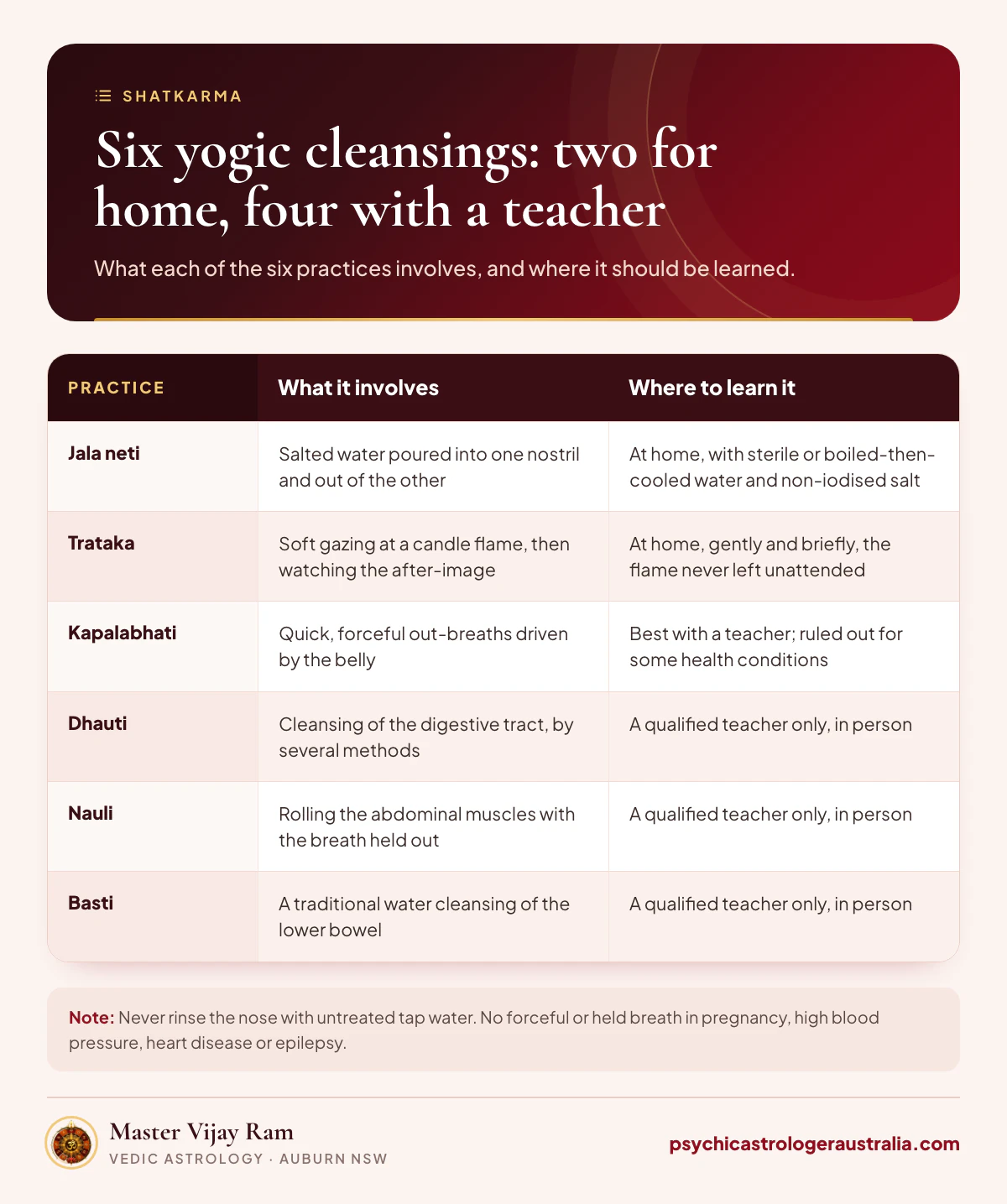
Two of the six are gentle enough to begin carefully on your own, one is best learned with a teacher, and three should only ever be learned in person from someone qualified. The table sets out the six yogic cleansing techniques side by side.
| Practice | What it cleanses, in the tradition | What it involves | Where to learn it |
|---|---|---|---|
| Neti (jala neti) | The nasal passages | Warm salted water poured into one nostril and out of the other from a small pot | At home, with sterile or boiled-then-cooled water and non-iodised salt |
| Neti (sutra neti) | The nasal passages | A soft thread or fine tube passed through the nose and out of the mouth | A qualified teacher only |
| Trataka | The eyes and the attention | Steady gazing at a candle flame, then watching the after-image with the eyes closed | At home, gently and briefly |
| Kapalabhati | The lungs and the front of the head | Short, forceful out-breaths driven by the belly, the in-breath left to happen | Best with a teacher; not for some health conditions |
| Dhauti | The digestive tract | Several methods, including drinking salt water and bringing it back up | A qualified teacher only |
| Nauli | The abdominal organs | Isolating and rolling the abdominal muscles on an empty stomach, the breath held out | A qualified teacher only |
| Basti | The lower bowel | A traditional water cleansing of the colon | A qualified teacher only |
Neti appears twice because its two forms sit at opposite ends of the scale. The water version is simple; the thread version is not.
What is neti, and how is jala neti done safely?
Neti kriya is the cleansing of the nose, and its water form, jala neti, is the one shatkarma many people have already met, often as a pharmacy nasal rinse under another name. The traditional recipe is purified water with non-iodised salt, at about body warmth.
- Use sterile water, or tap water that has been brought to the boil and then cooled to lukewarm. Never use water straight from the tap, a rainwater tank or a garden hose.
- Dissolve non-iodised salt in it, at the measure printed on the pot or on a rinse sachet made for the purpose.
- Lean forward over a basin, turn the head to one side, breathe through the mouth, and set the spout in the upper nostril so the water runs out of the lower one.
- Use half the pot, then turn the head the other way and repeat.
- Blow the nose gently, one side at a time, bending forward so the last of the water drains.
- Wash the pot, let it dry completely, and keep it dry until next time.
Skip the rinse when the nose is completely blocked or bleeding, and stop if you feel pain or pressure in the ears. A nose that needs rinsing most days is worth a visit to the GP.
Why does the water matter so much?
Because of Naegleria fowleri, an amoeba that can live in untreated water. Infection is rare and almost always fatal, and cases have followed nasal rinses made with untreated tap water. Drinking the same water is not the danger; sending it up the nose is.
That is the whole reason for the sterile or boiled-then-cooled rule, and it applies in every Australian city, including the ones with excellent drinking water. Kettle first, patience second, pot third: it adds ten minutes and removes the one serious risk this practice carries.
What is trataka, and how gentle should it be?
Trataka is steady gazing, usually at a candle flame, followed by closing the eyes and watching the after-image until it fades. The tradition says it cleanses the eyes and gathers a scattered mind to a single point, which is why it is sometimes taught as the bridge between the physical practices and meditation.
Set a candle in a steady holder on a metal tray, at eye level and about an arm’s length away, in a room without draughts or curtains close by. Gaze softly for a minute or two, blinking whenever you need to, then close the eyes and hold the after-image. The longer, unblinking versions found in the manuals are for a teacher to introduce.
Never leave the flame unattended, keep children and pets out of the room, and leave the smoke alarm exactly as it is. Anyone with epilepsy or an eye condition asks their doctor before starting, and sore or watering eyes are a reason to stop for the day.
What is kapalabhati, and why the caution?
Kapalabhati, “the shining skull”, is a run of quick, sharp exhalations made by snapping the belly inwards, with each in-breath allowed to fall back in by itself. It is popular in classes because it feels energising, and that is exactly why the kapalabhati caution matters: the force that makes it feel strong is the force that makes it unsuitable for some bodies.
Teachers generally keep it away from pregnancy, high blood pressure, heart disease and epilepsy, the same groups for whom breath-holding is ruled out, and anyone who has had recent surgery speaks to their GP first. Dizziness, tingling or a headache during a round means stop. Learn it in person, from a teacher who asks about your health before the first round and counts you through it.
For the gentle breath practices that can safely begin at home, see nadi shodhana and simple pranayama, where no breath is forced and none is held.
What are dhauti, nauli and basti?
Dhauti is the cleansing of the digestive tract, and the manuals give several methods for it, from drinking salt water and bringing it back up to swallowing a long strip of cloth. Some lists also fold simple care of the teeth and tongue into dhauti, which most households already do without the name. Nauli is the rolling of the abdominal muscles with the breath held out, and basti is a traditional water cleansing of the lower bowel.
These three are the reason the title of this page says most need a teacher. Dhauti, basti and nauli are learned only with a qualified teacher, in person, never from a book, a video or a friend’s description. Done wrongly they can hurt the throat, the stomach or the bowel, and this page deliberately gives no method for them.
Anyone with a history of disordered eating should leave the vomiting and fasting practices aside altogether, whatever a class suggests.
Who should not try shatkarma at all?
Pregnancy rules out the forceful practices and every form of breath-holding, which takes nauli and kapalabhati off the list and leaves dhauti and basti well alone; the midwife or GP is asked before anything else. High blood pressure, heart disease and epilepsy rule out breath-holding and the forceful breath. After surgery, of any kind, the GP comes first.
Ongoing digestive illness, a stomach ulcer or bowel disease belongs with a doctor rather than a kriya, and so does any sinus problem that does not clear. None of this is a judgement on the tradition, which always assumed a teacher would turn some students away.
Is shatkarma the same as the tantric “six acts”?
No, and the shared name causes real confusion. In tantric texts the phrase “six acts” names a completely different list of ritual actions, from shanti, pacification, through to maran, which the tradition treats as hostile. The only thing it shares with yogic cleansing is the number six.
The six tantric acts explains that other list and why only the protective work has any place in Vijay Ram ji’s practice. Someone who reads about shatkarma for the nose and then finds the tantric list online has met two different traditions under one word, not a hidden danger in neti.
Is shatkarma a detox?
Detox is the nearest English word and the least helpful one. The kriyas were never sold as products, and the tradition framed them as preparation for practice rather than a way to flush out unnamed toxins. Teas, foot pads and juice cleanses marketed as detoxes belong to a different world altogether.
The Vedic idea of body cleansing places shatkarma among the gentler tools of the tradition: the bath, the breath, mantra and simple food. For the subtle side of the body, the centres the yogic texts describe, see chakra healing in the Vedic frame.
How do you find a qualified teacher?
Ask directly, and expect plain answers. A teacher worth learning kriyas from will tell you how long they have practised them, who taught them, and which ones they do and do not teach. They will ask about your health, medicines and any surgery before showing you anything, and they will teach the internal practices in person rather than over a screen.
Be cautious of anyone who offers all six in a single weekend, sells kits alongside the class, or brushes aside a question about pregnancy, blood pressure or epilepsy. A good teacher is happy to tell you that you do not need a practice at all.
Where does an astrologer fit, if at all?
Not in teaching the kriyas; that belongs to a yoga teacher. Vijay Ram ji’s part begins when health has turned into worry and a family wants to know what the chart says about the season they are in. He reads the sixth house of illness and daily effort, the Moon as the mind, and the dasha currently in force, in a $50 consultation held by phone, video or WhatsApp in English, Hindi or Punjabi.
A caller in Hobart and the rest of Tasmania or on the Sunshine Coast is heard exactly as a caller in Sydney is, and anyone who wants to sit across the table comes to Auburn, by appointment. Remedies are the exception rather than the rule: if the chart warrants one, a shanti or a jaap is done by him in Auburn on a muhurat he chooses, with the figure, from $250, settled with you before he begins.
A puja or havan performed for you describes how the family takes part by video. When the heaviness sits around a person rather than in the body, aura cleansing is the closer service.
What shatkarma cannot do
The six practices cannot treat sinus disease, a digestive illness, an eye problem or anxiety, and they are not a remedy for black magic or nazar. Nobody can promise what a kriya will do for a particular body. This page is faith-based guidance from the yogic tradition, not medical advice, and any symptom goes to a GP first.
What the tradition does offer, done properly, is a disciplined preparation for breath and stillness, learned slowly from someone who has done it for years. That slowness is part of the practice, not an obstacle to it.
Read next
- Aura Cleansing in Australia: How It Works & When You Need ItHow aura cleansing actually works in Australia: the five-doorway read, each stage of a remote remedy, what you provid…
- A Home Cleansing Kit in Australia: What to Keep and What to SkipA home cleansing kit for Australian homes: the short list of puja items worth keeping, how to store them, where they …
- Reiki, Smudging or Vedic Cleansing: Which One Do You Need?Reiki, smudging and Vedic cleansing answer different questions. What each one is, what to rule out first, and which f…
Frequently asked questions
Is it safe to use tap water in a neti pot in Australia?
No. Use sterile water, or tap water that has been boiled and then cooled to lukewarm, every time. Naegleria fowleri, an amoeba that can live in untreated water, is rare but almost always fatal, and cases have followed nasal rinses made with untreated tap water. Drinking tap water is not the problem; sending it up the nose is, which is why the kettle comes first.
What salt should be used for jala neti?
Non-iodised salt, dissolved in sterile or boiled-then-cooled water at the measure printed on the pot or on a rinse sachet made for nasal use. Table salt with iodine or anti-caking additives is not the traditional choice. Pharmacy saline sachets are a simple option for anyone unsure of the measure, and the pot is washed and dried after every use.
Can I learn kapalabhati from a video?
It is better learned in person. The forceful out-breaths can cause dizziness quickly, and a teacher who has asked about your health can count you through short rounds and stop you when needed. Pregnancy, high blood pressure, heart disease and epilepsy generally rule it out, and a recent operation of any kind means a conversation with the GP before the first round.
Is trataka safe for the eyes?
The gentle version, a minute or two of soft gazing at a candle with blinking allowed, is how most people begin. Stop if the eyes become sore or keep watering, and leave the longer unblinking versions to a teacher. Anyone with epilepsy or an eye condition asks their doctor first, and the candle sits on a metal tray, away from curtains, never left burning in an empty room.
Why do dhauti, nauli and basti need a teacher?
Because they are internal practices that can injure the throat, the stomach or the bowel when done wrongly, and some involve holding the breath out. The manuals assumed a guru watching every attempt. A qualified teacher asks about your health first, teaches in person and turns away students for whom the practice is unsuitable, which no book or video can do.
Can shatkarma be practised during pregnancy?
Only what the midwife or GP agrees to, and that rules out the forceful and breath-holding practices: no kapalabhati, no nauli, and no dhauti or basti. Some women continue a gentle trataka or a careful saline nasal rinse with sterile or boiled-then-cooled water after checking. Anything that causes dizziness, breathlessness or discomfort is stopped straight away.
Is shatkarma the same as the six tantric acts?
No. Yogic shatkarma is six physical cleansing practices for the body. The tantric six acts are a different list of ritual actions, from pacification through to hostile rites, and the tradition treats some of them as harmful. They share a number and a phrase, nothing more, and Master Vijay Ram’s work is limited to protection and pacification.
Will shatkarma remove negative energy or black magic?
The kriyas were never meant as a remedy for a curse. Their job in the manuals is to ready the body for breath work and meditation, and selling them as protection would misrepresent the tradition. Someone frightened of black magic or nazar is better served by a calm reading of the chart and the timing, which very often turns up an ordinary explanation first.
Does Master Vijay Ram teach shatkarma or yoga?
Not at all; the kriyas are for a qualified yoga teacher to pass on, and he will say so. His own work is the chart: a $50 consultation by phone, video or WhatsApp about health timing, held alongside the doctor’s care. Only where the chart shows that a remedy is warranted does he offer a shanti or jaap, performed personally at Auburn, from $250 and agreed with you beforehand.
People also ask
What are the six shatkarmas?
Neti, the cleansing of the nose; dhauti, of the digestive tract; nauli, the rolling of the abdominal muscles; basti, a water cleansing of the lower bowel; kapalabhati, a forceful breathing practice; and trataka, steady gazing at a candle flame. The Hatha Yoga Pradipika lists them and the Gheranda Samhita repeats them with variations.
What is neti kriya?
Neti kriya is the yogic cleansing of the nasal passages. Jala neti pours warm salted water into one nostril and out of the other from a small pot, using sterile or boiled-then-cooled water and non-iodised salt. Sutra neti passes a soft thread or fine tube through the nose and out of the mouth, and is learned only from a qualified teacher.
Who should not do kapalabhati?
Teachers generally rule it out in pregnancy and for people living with high blood pressure, heart disease or epilepsy, and a recent operation means a word with the GP first. Beginners learn it in person, in short rounds, and stop at once for dizziness, tingling or a headache. It is one of the six shatkarmas, not a gentle breathing exercise.
Is dhauti dangerous?
It can be when done without training. The methods include drinking salt water and bringing it back up and, in its advanced form, swallowing a strip of cloth, and done wrongly they can hurt the throat or stomach. Dhauti is learned only in person from a qualified teacher, and anyone with a history of disordered eating leaves it aside.
References & further reading
Serving clients across Australia
Confidential consultations by phone, video & WhatsApp — including: