
Quick answer
Mula nakshatra is the nineteenth lunar mansion, 0° to 13°20′ of sidereal Sagittarius, ruled by Ketu, with Nirriti as its deity and tied roots as its symbol. People born in it begin life in Ketu's mahadasha. It is read as a star of inquiry and fresh starts, and as a gandmool star whose shanti is a calm rite, not a verdict.
What is Mula nakshatra?
Mula nakshatra is the nineteenth of the twenty-seven lunar mansions, the stretch of sky from 0° to 13°20′ of sidereal Sagittarius that the Moon crosses in roughly a day. Its name means root, and the tradition reads it as the star of the person who has to know what lies underneath: the cause beneath the symptom, the motive beneath the excuse, the first principle beneath the rule. When the Moon stood here at your birth, Mula is your janma nakshatra, and it colours the mind, the name and the timing of a life.
This guide stays with the star itself: its deity and symbol, why its people begin life in a Ketu period, how its four padas differ, what the tradition reads for work, marriage and health, and where Mula appears in muhurat. Finding the star needs the Moon's exact degree, which is why it is the first thing confirmed in a Vedic kundli reading, and nothing here replaces reading the whole chart.
Who is Nirriti, and why is the root star given to her?
Nirriti is the Vedic goddess of dissolution, the power that loosens and decays whatever has been built, and the hymns that mention her mostly ask her to keep her distance. Later tradition makes her the guardian of the south-west, the corner a vastu consultant still calls nairritya. She is not a comfortable deity, and Mula's reputation begins with her.
The tradition's answer to why such a goddess rules a star is the root itself. A root feeds on what has broken down in the soil, and nothing new grows until something old has rotted into it; Nirriti's star is read as the place where a person meets the end of a thing and is pushed down to its source. A collapsed business that teaches someone what it was really built on, or a loss that turns a casual believer into a serious student, is the kind of story astrologers associate with this star.
What does the bundle of roots stand for?
The symbol is a bunch of roots tied together, the way medicinal roots are bundled to dry. It is read two ways at once: as the tangle a Mula mind wants to pull apart and trace, and as the gathered, useful thing that results when it does. Traditions differ on the small details of the image, but every version points below the surface.
Modern writers like to add that the centre of our galaxy lies in this stretch of the sidereal zodiac, which suits a star named for the root of things. The old texts did not know that, and nobody needs it to read the star; it is simply a pleasing coincidence. The sign around Mula is Sagittarius, Jupiter's sign, so every Mula Moon carries a Jupiter question with it: what is all this digging for?
Why does a Mula birth begin in Ketu's mahadasha?
Ketu is the lord of Mula, and in the Vimshottari system the first mahadasha of a life belongs to the lord of the birth nakshatra. Ketu's full period is seven years, and the share left at birth depends on how far the Moon has already travelled through the star. A Moon one degree into Sagittarius leaves most of the seven years; a Moon at twelve degrees leaves less than one.
Take a Moon exactly halfway through Mula, at 6°40′ Sagittarius. Half of Ketu's seven years remain, so Ketu runs to about age three and a half; Venus follows for twenty years, to about twenty-three and a half; then the Sun to twenty-nine and a half, the Moon to thirty-nine and a half and Mars to forty-six and a half. For most Mula people, then, school and early adult life run under Venus, and the balance is worked out to the day from the Moon's exact degree.
Ketu is the south node of the Moon, read by the tradition as detachment, inherited skill and the cut that releases what is no longer needed. It also rules Ashwini and Magha, and all three of its stars open a fire sign straight after a water sign closes, which is the structural reason Mula is counted among the gandmool stars.
How do the four padas of Mula differ?
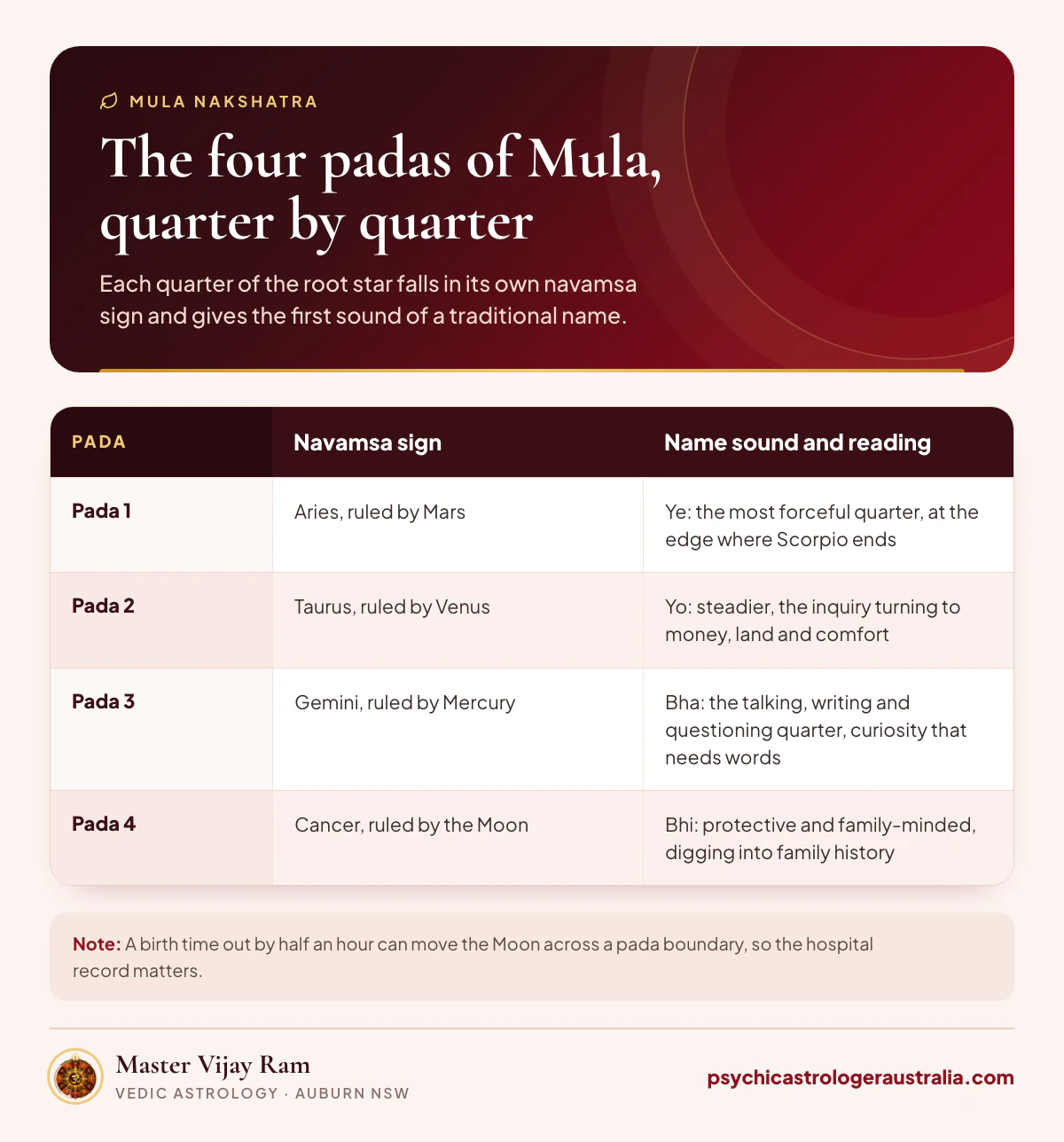
Each pada is a quarter of the star, 3°20′ of the Moon's path, and each falls in a different navamsa sign. Across the zodiac the 108 padas cycle through the twelve navamsa signs nine times, starting from Aries, and Mula opens one of those cycles, so its quarters fall in Aries, Taurus, Gemini and Cancer.
| Pada | Span in sidereal Sagittarius | Navamsa sign (its lord) | Name syllable | How the quarter is usually described |
|---|---|---|---|---|
| 1 | 0°00′–3°20′ | Aries (Mars) | Ye | The most forceful quarter, at the edge where Scorpio ends; quick to act on a hunch |
| 2 | 3°20′–6°40′ | Taurus (Venus) | Yo | Steadier and more practical; the inquiry turns towards money, land and comfort |
| 3 | 6°40′–10°00′ | Gemini (Mercury) | Bha | The talking, writing, cross-examining quarter; curiosity that needs words |
| 4 | 10°00′–13°20′ | Cancer (Moon) | Bhi | Protective and family-minded; digs into family history and old loyalties |
The pada matters for two practical reasons. It gives the first sound of the traditional name, Ye, Yo, Bha or Bhi, which is where choosing a baby name by nakshatra starts; and it places the Moon in the navamsa, the chart read for marriage and for the inner strength of planets. A birth time that is out by half an hour can move a Moon across a pada boundary, so the hospital record matters more than a remembered hour.
Is Mula a gandmool star, and should a family worry?
Mula is one of the six gandmool stars, the ones that sit at a junction where a water sign hands over to a fire sign; for Mula the junction is the end of Scorpio and the start of Sagittarius. Tradition marks such a birth with a shanti, usually done when the Moon comes back to the same star about twenty-seven days later. It is a rite of settling and welcome, not a verdict on the child.
What the texts actually say about that rite, and what has been added by fear, is set out in the gandmool shanti explained calmly, and this page does not repeat it. Where a family wants the shanti, Master Vijay Ram performs it personally at his place of practice in Auburn; it starts from $250, the figure is agreed before anything is performed, and puja and havan on request describes how a rite is arranged. Many families take the reading and the name and leave it there, which is entirely sound.
What is a person with the Moon in Mula traditionally like?
The Mula nakshatra traits the tradition lists start with inquiry. These are people who cannot leave a question half-answered, who read the footnotes, who ask the doctor what a test actually measures and the manager why a policy exists. Sagittarius adds frankness, and Ketu adds a readiness to drop whatever turns out to be hollow.
The same qualities have a shadow, and astrologers name it plainly. A Mula mind can pull up a plan, a friendship or a faith that was growing perfectly well just to inspect the roots, and it can burn a bridge because the bridge was built on a premise it no longer believes. The work of a Mula life, in the tradition's reading, is learning which things need examining and which need leaving to grow.
A data analyst in Melbourne with the Moon in Mula might recognise herself as the colleague who keeps asking why the numbers moved after everyone else has accepted the dashboard. That is the star at its most useful: the question nobody else wanted to ask, put kindly and early.
Which kinds of work suit a root-digging mind?
Questions about a Mula nakshatra career usually come from people who have already noticed they are happiest at the bottom of a problem. The tradition points to research of every kind, diagnostics and auditing, investigative journalism, law, philosophy and religious study, geology, soil science and botany, pharmacy and the old knowledge of medicinal roots. In modern dress that includes root-cause analysis in engineering and the slow, forensic patience of cybersecurity.
A mine-site geologist flying out of Darwin, or a hospital pharmacist in Townsville, might each find the star's description of their work oddly exact. What suits Mula less is any role that rewards not asking, the job where the answer is always the one the boss already gave. Even so, the star alone never picks a career; the house of career and the planetary periods decide far more.
How is Mula read for marriage and matching?
In matching, Mula carries Rakshasa gana, Adi nadi and the dog (male) as its yoni. Rakshasa gana is read as a strong-willed, self-protective temperament and is traditionally scored lower against Deva and Manushya partners; Adi nadi means a partner whose star is also Adi raises Nadi dosha unless one of the recognised exceptions applies; and the dog's natural partner in the yoni table is Ardra, while the deer of Jyeshtha and Anuradha is its traditional enemy. How these points are weighed, and when they cancel, belongs to nakshatra compatibility in kundli matching.
On Mula nakshatra marriage itself, the tradition reads a partner who needs honesty more than flattery, who tests a relationship by questioning it, and who settles deeply once the questions have been answered. Some families still hesitate over a Mula-born bride because of a folk saying about the in-laws; that worry belongs to the birth and its shanti, and Vijay Ram ji does not treat a grown woman's birth star as a reason to refuse a match. Two whole charts decide a marriage, never one star.
What health habits does the tradition link to Mula?
Sagittarius is traditionally linked with the hips and thighs, and Ketu with complaints that are hard to name, so the tradition's advice for a Mula Moon is about care rather than alarm. Keep the hips moving through long desk hours, eat at regular times when a problem has swallowed the day, and protect sleep from the late-night research spiral. These are habits read from a temperament, not predictions of illness.
Mula's inquiring streak carries one practical risk worth naming. People who need the root of everything tend to research their own symptoms for hours; the better use of that energy is a written list of questions taken to a GP, who comes first for any symptom, and a reading never replaces that visit.
Does Mula have a place in muhurat?
Muhurta texts traditionally class Mula among the tikshna, or sharp, stars, kept for acts that cut, separate or clear: pulling out what is diseased in a garden, ending a lease or a partnership cleanly, beginning a hard discipline. Traditions differ on the list, and a muhurat is never chosen from the star alone; the tithi, the weekday, the lagna and the charts of the people involved all count.
Two other uses surprise people. Many panchangs traditionally include Mula among the stars acceptable for a wedding, despite its fearsome name, and in Sharad Navratri many South Indian families invoke Saraswati on the day the Moon is in Mula, setting books and instruments before her. For a star of inquiry, that last custom fits rather well.
What can a reading of a Mula Moon tell you, and what can it not?
It can describe a temperament, the order of the dashas and roughly when each begins, the name syllable, the matching points and the kind of work and partner the mind leans towards. It cannot fix a fate, choose a spouse, diagnose anything or say whether a visa, a loan or a court case will succeed; those questions belong first with a GP, a financial adviser, a lawyer, Home Affairs or a registered migration agent. A Mula reading describes tendencies and timing, and it is wrong whenever the birth time behind it is wrong.
Where Ketu is afflicted and its period is pressing, the tradition's first remedies are Ketu's mantra and the worship of Ganesha, both given in the consultation; a Ketu shanti is rarer and, like any puja, starts from $250 after a $50 consultation. Master Vijay Ram sells no gemstones and no beads, and he will not suggest a cat's eye from a Moon star alone.
How does Master Vijay Ram read a Mula chart?
He confirms the Moon's degree and pada from a documented birth time, notes how close it sits to the Scorpio edge, and then reads Ketu's house and sign, Jupiter as the lord of Sagittarius, the navamsa and the dasha running now. A Mula Moon in a chart with a strong Jupiter reads very differently from one where Jupiter is weak, and that difference is usually the heart of the consultation.
Readings are by phone, video or WhatsApp in English, Hindi or Punjabi, for clients from Darwin and the Top End to Sydney and Melbourne, or in person at Auburn by appointment. The star before this one is Jyeshtha, the eldest star, and the next is Purva Ashadha, the invincible star; each is read in the same unhurried way.
Read next
- Ashwini Nakshatra: The Healer’s Star, Ruled by KetuAshwini nakshatra explained: the Ashvin twins, Ketu as lord, the four padas and name sounds, traits, career, marriage…
- Magha Nakshatra: The Star of Ancestors and AuthorityMagha nakshatra, 0° to 13°20′ Leo: the Pitris and the throne, Ketu as lord, padas and name syllables, matching, caree…
- Online Istikhara Service in Australia for Marriage & DecisionsHow online istikhara for marriage and other decisions works in Australia, what a genuine practitioner asks for, and t…
Frequently asked questions
Which planet rules Mula nakshatra?
Ketu, the south node of the Moon, rules Mula, so a person born with the Moon here begins life in Ketu's seven-year mahadasha, with the balance set by how far the Moon had travelled through the star. The sign around it is Sagittarius, ruled by Jupiter, and a careful reading weighs both: Ketu for the cut and the detachment, Jupiter for the meaning the digging is meant to find.
Is Mula nakshatra a bad star to be born in?
No birth star is bad. Mula's reputation comes from its deity, Nirriti, the goddess of dissolution, and from its place among the gandmool stars, but the tradition reads it as a star of inquiry, honesty and starting again from the root. What a Mula Moon brings in practice depends on Jupiter, Ketu, the lagna and the dasha running, which only a whole chart shows.
What are the name syllables for Mula nakshatra?
The traditional first sounds are Ye for the first pada, Yo for the second, Bha for the third and Bhi for the fourth, though regional lists vary a little in spelling. The pada is fixed from the Moon's exact degree, so the hospital birth time matters. Families often keep the syllable for a rashi name used at the temple and choose a different everyday name, which the tradition allows.
Is a Mula nakshatra bride a problem for her in-laws?
That worry is a folk saying attached to gandmool births, not a rule a careful astrologer applies to an adult's marriage. The tradition deals with the gandmool question through a shanti after birth, and a match is judged from both whole charts: the seventh house, Venus, Jupiter, the navamsa, the dashas and the nakshatra points together. Master Vijay Ram does not refuse a match because of one birth star.
Which nakshatras are compatible with Mula?
There is no single list, because compatibility rests on several points at once. Ardra shares Mula's dog yoni, while the deer stars Jyeshtha and Anuradha are its traditional yoni enemies; other Adi nadi stars raise Nadi dosha unless an exception applies; and Rakshasa gana scores differently against each gana. Tara, the two Moon signs and both full charts then decide how much any of those points matters.
When is the gandmool shanti done for a Mula birth?
Traditionally when the Moon returns to Mula, about twenty-seven days after the birth, though families and lineages vary. It is a calm rite of settling, not an emergency, and many families simply take the reading and the name. If the family would like the rite, Master Vijay Ram conducts it himself in Auburn, from $250, with the amount settled before the day.
What careers suit people with the Moon in Mula?
The tradition favours work that reaches the root of a problem: research, diagnostics, auditing, law, investigative journalism, philosophy, geology, soil science, botany and pharmacy, and in modern terms engineering root-cause analysis or cybersecurity. These are tendencies of temperament, not instructions. An actual career is read far more from the tenth house and the period running than from the Moon's star.
What is special about the first pada of Mula?
It covers the first 3°20′ of Sagittarius, falls in the Aries navamsa and carries the syllable Ye. It sits right at the junction where Scorpio ends, which is why the tradition gives it particular attention in gandmool reckoning. Read calmly, it describes a forceful, quick-starting temperament; it is not a judgement on the child, the parents or anyone else in the family.
How long does the Moon stay in Mula?
About a day, since the Moon covers roughly thirteen degrees in twenty-four hours and the star spans 13°20′. Someone born on a day the Moon left Mula may have Mula or Purva Ashadha as their birth star depending on the hour, so the birth time matters. Without one, a consultation can set out both possibilities and explain what changes between them.
People also ask
What does Mula mean in astrology?
Mula means root. It is the nineteenth nakshatra, spanning 0° to 13°20′ of sidereal Sagittarius, ruled by Ketu, with Nirriti as its deity and a bundle of tied roots as its symbol. The tradition reads it as the star of inquiry, of getting to the source of things, and of the clearing that comes before new growth.
Who is the deity of Mula nakshatra?
Nirriti, the Vedic goddess of dissolution and decay, whom later tradition makes guardian of the south-west. Her presence explains much of the star's fearsome reputation, but the tradition also reads her as the necessary undoing that lets something new take root, which is why Mula is associated with endings that turn into beginnings.
Is Mula nakshatra good for a wedding muhurat?
Many panchangs traditionally include Mula among the stars acceptable for a wedding, despite its name, though traditions differ. A wedding muhurat is never chosen from the star alone: the tithi, the weekday, the lagna at the time of the ceremony and the charts of both partners are weighed together, which is the work of a muhurat consultation.
Which dasha does a Mula native start life in?
Ketu's. Its full mahadasha is seven years, and the balance at birth depends on how far through Mula the Moon had travelled; a Moon halfway through leaves about three and a half years. Venus's twenty-year period follows, so for most people born in Mula the school years and early adulthood run under Venus.
What is the symbol of Mula nakshatra?
A bunch of roots tied together, like medicinal roots bundled to dry. It stands for the tangle a Mula mind wants to trace back to its source and for the useful thing gathered once it has. Some traditions describe the image slightly differently, but every version points below the surface of things.
References & further reading
Serving clients across Australia
Confidential consultations by phone, video & WhatsApp — including: