
Quick answer
Purva Ashadha nakshatra is the twentieth lunar mansion, 13°20′ to 26°40′ of sidereal Sagittarius, ruled by Venus, with Apas, the waters, as its deity and an elephant tusk or winnowing fan as its symbol. Its name means the earlier unconquered. People born in it begin life in Venus's twenty-year mahadasha, and the tradition reads them as confident, persuasive and persistent.
What is Purva Ashadha nakshatra?
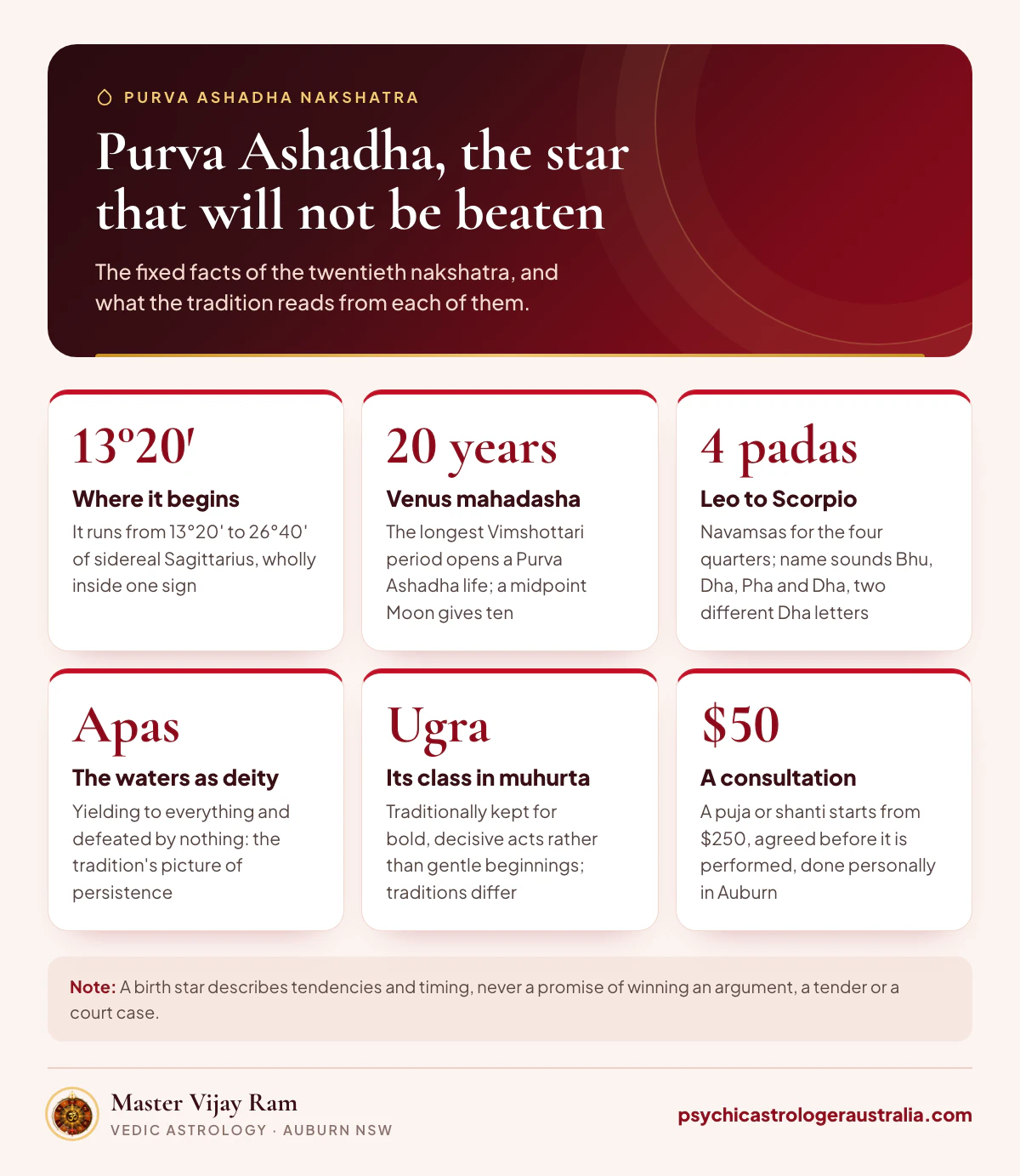
Purva Ashadha nakshatra is the twentieth lunar mansion, a band of sky running from 13°20′ to 26°40′ of sidereal Sagittarius, and the first of the two Ashadha stars whose shared name means the unconquered. Purva means former or earlier: this is the victory declared, while Uttara Ashadha, the star that follows, is the victory confirmed. Its deity is Apas, the waters, and the tradition reads the star through water's peculiar strength, which yields to everything and is defeated by nothing.
What follows covers the waters and the symbol, Venus as lord and the long dasha it opens, the padas and name sounds, the temperament, work, marriage and health habits the tradition reads, and how the star is treated in muhurat. Your Moon's nakshatra is confirmed from the birth time in a full kundli consultation, and it is always read inside the whole chart rather than on its own.
Why are the waters the deity of an invincible star?
Apas, the waters, are among the oldest powers in the Vedic hymns: mothers who nourish, purifiers who wash away fault, the substance from which much else is said to arise. A hymn to them that begins Apo hi shtha is still recited while water is sprinkled during the daily sandhya, asking the waters for strength and gladness. Every sankalpa, and every sip of achamana before a puja, calls on the waters as witnesses and cleansers.
The invincibility follows from what water does. It gives way to a pushing hand, takes the shape of any vessel and still carves gorges through rock, given time; nothing defeats it, because it never stands still long enough to be beaten. Purva Ashadha is read as that quality in a person: a confidence that keeps flowing round an obstacle until the obstacle has gone.
What do the elephant tusk and the winnowing fan mean?
Two symbols are given, and traditions differ on which comes first. The elephant tusk is strength on display, ivory that announces power before any contest begins, which suits a star of early victory. The winnowing fan, the flat basket that tosses grain into the wind so the husk blows away, is purification by discernment: keeping what is real and letting the chaff go.
Put together, the images describe a person who wins by sifting. A Purva Ashadha mind is traditionally quick to separate the argument that matters from the noise around it, and slow to let go of a conclusion once it has been reached. The second half of that description is where most of the star's difficulties begin.
Why does Venus rule Purva Ashadha, and what does that start?
Venus is the lord, the planet of pleasure, refinement and attraction, and the lord of the birth star sets the first mahadasha of a life. Venus's period is the longest in the Vimshottari scheme at twenty years, and it opens the lives of everyone born under Bharani, Purva Phalguni and Purva Ashadha. A Moon at the very start of the star gives almost the whole twenty years from birth; one at its midpoint, 20° Sagittarius, gives ten.
For that midpoint Moon the sequence runs Venus to about age ten, the Sun to sixteen, the Moon to twenty-six, Mars to thirty-three and Rahu to fifty-one. A child born early in the star can spend all of childhood and adolescence in Venus and meet the Sun's sharper six years at the end of school, a change many parents notice without knowing its name. What the long Venus period brings in adult life is covered in the Venus mahadasha and its lessons.
Venus carries its own story of invincibility. The planet is Shukra, teacher of the asuras, who in the Mahabharata knows the art of restoring the slain to life, so that his side could never be finally beaten. Waters that cannot be defeated and a lord who could undo defeat: the star's title is earned twice over.
How do the four padas of Purva Ashadha differ?
The star's quarters run through the Leo, Virgo, Libra and Scorpio navamsas, each 3°20′ wide, and each carries a traditional first sound for a name: Bhu, Dha, Pha and Dha. The two Dha sounds are different letters in Devanagari, a dental and a retroflex, which English spelling flattens, so a family should check which one the pada gives; naming a baby by nakshatra works through exactly that.
The first pada, in the Leo navamsa, is read as the proudest and most theatrical, the quarter that likes to be seen winning. The second, in Virgo, turns the confidence into craft and detail; the third, in Libra, Venus's own sign, is the most diplomatic and the most drawn to beauty; the fourth, in Scorpio, is the most intense and private, more interested in depth than display.
Purva Ashadha at a glance
| Feature | Purva Ashadha | What it is used for |
|---|---|---|
| Span | 13°20′–26°40′ sidereal Sagittarius | Finding the birth star from the Moon's degree |
| Lord | Venus, a twenty-year mahadasha | The first dasha of life and its balance at birth |
| Deity | Apas, the waters | The star's mythic character |
| Symbol | An elephant tusk or a winnowing fan | Its image of strength and discernment |
| Gana | Manushya (human) | The temperament points in matching |
| Nadi | Madhya (middle) | The eight Nadi points in matching |
| Yoni | Monkey (male) | The yoni points in matching |
| Padas | Leo, Virgo, Libra and Scorpio navamsas | The navamsa placement of the Moon |
| Name sounds | Bhu, Dha, Pha, Dha | The traditional first syllable of a name |
What is someone with a Purva Ashadha Moon traditionally like?
The Purva Ashadha nakshatra traits in the old descriptions are confidence, persuasion and a loyalty to ideas that borders on the stubborn. These are people who argue well, love beautifully made things, rally others to a cause and rarely believe, deep down, that they can lose. Sagittarius gives the philosophy, Venus the charm and the waters the persistence.
The shadow is the early declaration. This temperament can announce the result while the effort is still under way, take a disagreement as a contest, and find an apology harder than a fight. A teacher in Canberra with the Moon here might notice that she wins every staff-room debate and still loses the vote, until she learns to let others do some of the sifting too.
Which careers suit the star of water and persuasion?
For a Purva Ashadha nakshatra career, the tradition looks first at persuasion and refinement: advocacy and law, sales and marketing, politics and public speaking, teaching, design, fashion and the arts, hospitality and the food and wine trades that Venus enjoys. The waters add their own list: shipping and ports, marine science, water engineering, fisheries and anything that keeps a coastline safe.
A marine scientist in Hobart, a surf-school owner on the Gold Coast or a winemaker in Adelaide selling abroad might each recognise the description. The star suggests a flavour of work; whether that work arrives, and when it pays, is read from the career house and the running periods.
How is Purva Ashadha read in marriage and matching?
For matching the star carries Manushya gana, Madhya nadi and the monkey (male) as its yoni. Manushya gana sits comfortably with Deva and Manushya partners and is traditionally scored lowest against Rakshasa; Madhya nadi means a partner in another Madhya star, such as Dhanishta or Uttara Bhadrapada, brings Nadi dosha, which several recognised exceptions can lift; and the monkey's natural pair is Shravana, while the sheep stars, Krittika and Pushya, are its traditional enemies. How those points add up, and when they cancel, belongs to nakshatra matching beneath the guna score.
In Purva Ashadha nakshatra marriage the tradition reads a warm, generous, admiring partner who needs admiration back, and whose pride can turn a small disagreement into a campaign. The marriages that last are the ones where both learn to concede a point without counting it as a defeat, and where arguments have hardened, a counsellor helps more than any chart. Timing a wedding belongs to a love and marriage timing reading, which looks at the seventh house and the dashas rather than the star.
What health habits are traditionally read for this star?
A water star is traditionally read as one that loves the ocean, the pool and the bath, and a temperament happiest near water usually finds swimming the easiest exercise to keep up. Venus adds a fondness for sweet and rich food, and the star's confidence adds a habit of pushing on through tiredness. Drinking enough water on hot days, respecting the rip on an unfamiliar beach and keeping an ordinary check-up are the practical forms of that reading.
None of this predicts illness. The tradition reads tendencies for care, and any symptom goes first to a GP, whatever the chart says.
Where does Purva Ashadha stand in muhurat?
Muhurta texts traditionally place Purva Ashadha among the ugra, or fierce, stars, along with Bharani, Magha and the other two Purvas, kept for bold, competitive or decisive acts rather than for gentle beginnings such as a griha pravesh. Traditions differ on how strictly that is applied, and no muhurat is fixed by the star alone.
The lunar month of Ashadha takes its name from the two Ashadha stars, because its full moon falls in or near them, and that full moon is kept as Guru Purnima, the day for honouring teachers. A star of persuasion and philosophy sharing its name with the teachers' full moon is one of the tradition's tidier coincidences.
What can a Purva Ashadha reading tell you, and where does it stop?
It can describe the temperament, the long Venus opening and the order of what follows, the name sound, how the star scores in matching and which occupations its temperament usually enjoys. It cannot promise that an argument, a tender or a court case will be won, and it cannot replace a lawyer, a financial adviser, a GP or Home Affairs on the questions that belong to them. This is faith-based guidance about tendencies and timing, and it is only as good as the birth time it starts from.
Where Venus is weak and its period pressing, remedies begin with Venus's mantra on Fridays and the worship of Lakshmi, both given in the consultation. A Shukra shanti or other puja is rarer, is performed personally by Master Vijay Ram at his own place of practice in Auburn and starts from $250, agreed before it is performed; online puja and havan explains how families join by video. The consultation itself is $50, and he sells no diamonds or other stones.
What happens when a Purva Ashadha chart comes to Master Vijay Ram?
He checks the Moon's degree and pada, then reads Venus by sign, house and dignity, Jupiter as the lord of Sagittarius, and the navamsa where the pada has placed the Moon. A Purva Ashadha Moon with a strong Venus reads as persuasion that serves; with Venus afflicted, as pride that costs. The reading then turns to the dasha running now, because that is usually what the client rang about.
Families ring from Brisbane and Perth, from the Gold Coast, Adelaide, Canberra and Hobart, and speak with him by phone, video or WhatsApp in English, Hindi or Punjabi; anyone who prefers to sit across the table can book a time at Auburn. The previous star is Mula, the root star, and the next is Uttara Ashadha, the star of lasting victory.
Read next
- Purva Phalguni Nakshatra: The Star of Rest, Love and PleasurePurva Phalguni nakshatra, 13°20′ to 26°40′ Leo: Bhaga and the bed, Venus as lord, padas and syllables, love, work, ma…
- Purva Bhadrapada Nakshatra: The Star of Fire and AusterityPurva Bhadrapada nakshatra explained: Aja Ekapada and the funeral cot, Jupiter as lord, padas and name sounds, traits…
- Online Istikhara Service in Australia for Marriage & DecisionsHow online istikhara for marriage and other decisions works in Australia, what a genuine practitioner asks for, and t…
Frequently asked questions
What is the ruling planet of Purva Ashadha nakshatra?
Venus rules Purva Ashadha, and anyone whose Moon stood in this star at birth opens life in Venus's mahadasha, the longest in the Vimshottari scheme at twenty years. The star lies wholly in Sagittarius, Jupiter's sign, and a reading weighs both planets: Venus for charm, comfort and persuasion, Jupiter for the beliefs that the persuasion serves. Their strength in the birth chart matters more than the star's general description.
What are the name letters for Purva Ashadha nakshatra?
The traditional first sounds are Bhu, Dha, Pha and Dha for the four padas. The two Dha sounds are different letters in Devanagari, a dental and a retroflex, which English spelling makes look identical, so it helps to check which one the child's pada gives. Regional lists vary slightly, and plenty of families use the syllable only for the name spoken at the temple, choosing a different name for school and daily life.
Is Purva Ashadha a lucky nakshatra?
The tradition does not rank stars as lucky or unlucky. Purva Ashadha is traditionally read as confident, persuasive, loyal to ideas and persistent, with pride and stubbornness as its shadow. Whether those qualities serve a person depends on Venus and Jupiter in the chart, the lagna, the house the Moon occupies and the dasha running, which is why a star description is a starting point rather than a verdict.
Which nakshatra is the best match for Purva Ashadha?
There is no single best match. Shravana shares the monkey yoni and so scores well on that point, while the sheep stars Krittika and Pushya are traditionally its yoni enemies; a partner from another Madhya nadi star brings Nadi dosha, which several recognised exceptions can cancel; and Manushya gana scores lowest against Rakshasa. Beyond those points, Tara, the two rashis and the full charts settle whether the match is sound.
Why is Purva Ashadha called the invincible star?
Ashadha means unconquered, and Purva means earlier, so the name describes the victory that is declared first. Its deity, the waters, cannot be defeated because they yield and still wear through rock, and its lord Venus is Shukra, the teacher who in the Mahabharata could restore the slain to life. The tradition reads the title as persistence, not as a promise of winning.
What is the difference between Purva Ashadha and Uttara Ashadha?
They share a name but little else. Purva Ashadha lies wholly in Sagittarius, is ruled by Venus, belongs to the waters and is classed among the fierce stars in muhurta; Uttara Ashadha begins in Sagittarius and continues into Capricorn, is ruled by the Sun, belongs to the Vishvadevas and is classed among the fixed stars. One is the victory declared, the other the victory made to last.
How long is the Venus mahadasha for someone born in Purva Ashadha?
Anything up to twenty years, depending on how far through the star the Moon had travelled at birth. A Moon at the start of Purva Ashadha leaves almost the whole twenty; a Moon at its midpoint leaves ten; a Moon near its end leaves very little before the Sun's six-year period begins. The balance is calculated from the Moon's exact degree, which needs a documented birth time.
Is Purva Ashadha a gandmool nakshatra?
No. The six gandmool stars are the ones at the junctions of water and fire signs: Ashlesha and Magha, Jyeshtha and Mula, Revati and Ashwini. Purva Ashadha sits in the middle of Sagittarius, well away from any junction, so no gandmool shanti is involved. Its neighbour Mula is a gandmool star, which is why families sometimes ask about the two together.
Is Purva Ashadha a good star for starting something new?
Muhurta texts traditionally class it among the fierce stars, suited to bold, competitive or decisive acts rather than gentle beginnings such as a house-warming, though traditions differ. A muhurat for a business opening or a move is never fixed by the star alone: the tithi, the weekday, the rising sign at the chosen hour and the owner's own chart are weighed together, which is what a muhurat consultation does.
People also ask
What does Purva Ashadha mean?
It means the earlier unconquered, or the first invincible one. Ashadha is the unconquered and Purva is the former, so Purva Ashadha is the victory declared, while Uttara Ashadha, the next star, is the victory that lasts. It is the twentieth nakshatra, spanning 13°20′ to 26°40′ of sidereal Sagittarius, ruled by Venus with the waters as its deity.
Who is the deity of Purva Ashadha nakshatra?
Apas, the waters, honoured in the Vedic hymns as mothers, nourishers and purifiers. Water is the tradition's picture of a force that cannot be beaten, because it yields to everything and still wears through stone, and Purva Ashadha is read as that persistence in a person: confidence that flows round an obstacle until the obstacle has gone.
What is the symbol of Purva Ashadha?
An elephant tusk or a winnowing fan, and traditions differ on which they give first. The tusk is strength on display before any contest begins; the fan, which tosses grain so the husk blows away, is purification by discernment. Together they describe a person who wins by sifting the argument that matters from the noise around it.
Which rashi is Purva Ashadha nakshatra in?
Wholly in Dhanu, sidereal Sagittarius, from 13°20′ to 26°40′. Every Purva Ashadha Moon is therefore a Sagittarius Moon sign, ruled by Jupiter, while the star itself is ruled by Venus. Because the star sits in the middle of the sign, a Purva Ashadha Moon never changes rashi between its padas, unlike its neighbour Uttara Ashadha, which crosses into Capricorn.
Is Purva Ashadha good for marriage?
The tradition reads a warm, generous and admiring partner who needs admiration in return, with pride as the main risk in arguments. In matching it carries Manushya gana, Madhya nadi and the monkey yoni. Whether a particular marriage suits is a question for the two complete kundlis, read through their seventh houses, Venus and the running dashas, not for the birth star alone.
References & further reading
Serving clients across Australia
Confidential consultations by phone, video & WhatsApp — including: