
Quick answer
Jyeshtha is the eighteenth nakshatra, the last 13°20′ of sidereal Scorpio. Its name means the eldest, its deity is Indra, its symbol a protective amulet or umbrella and its lord Mercury, so life opens in Mercury's dasha. Tradition reads responsibility, protectiveness and sharp intelligence, and marks its gandmool junction with a gentle newborn shanti.
What is Jyeshtha nakshatra?
Jyeshtha nakshatra is the eighteenth lunar mansion, running from 16°40′ to the very end of sidereal Scorpio at 30°. Its name means the eldest or the most senior, its presiding deity is Indra, king of the gods, and its symbol is a circular amulet or an umbrella, both images of protection held over others. Its ruling planet is Mercury, and its star is Antares, the red heart of the Scorpion, which rides high over Australia on winter evenings.
Tamil calendars call it Kettai and Malayalam calendars Thrikketta, and the lunar month of Jyeshtha takes its name from it. Its theme is seniority and the duties that come with it, read as tendencies of the Moon rather than a fixed role. A complete kundli reading sets it beside Mercury, the sign's ruler Mars and the rising sign, because no star speaks alone.
Why is Indra the deity of the eldest star?
Indra is the senior among the gods: the one who leads them into battle, wins back the waters from the serpent Vritra and keeps the rain falling on the fields. In Vishakha he shares the stage with Agni; here he stands alone, holding the authority and also the worry that comes with it. Many Puranic stories show an Indra anxious for his throne, sending distractions to any ascetic whose power might rival his.
The tradition reads both sides into the star. A Jyeshtha Moon is read as capable, protective and willing to carry what others cannot, and also as someone who can feel that their standing is always under threat, guarding it a little too closely.
What do the amulet and the umbrella mean?
An amulet is worn for protection and an umbrella is held over someone's head; in older India the royal umbrella marked the person responsible for everyone beneath it. Both say the same thing about the star: Jyeshtha's gifts are meant to shelter others. A few lists show an earring, so the image varies between traditions, but the sense of a protector carrying a visible mark of rank runs through all of them.
What does Mercury's seventeen-year opening mean?
Mercury rules Jyeshtha, and Vimshottari begins each life in the period of the birth star's ruler, so a Jyeshtha child starts in Mercury's seventeen-year mahadasha. The share actually received depends on the Moon's place: nearly seventeen years at the star's opening degree, about eight and a half at its middle, very little near 30° of Scorpio. After Mercury come Ketu for seven years, Venus for twenty and the Sun for six.
For a midpoint birth that means Ketu from about eight and a half to fifteen and a half, and Venus from about fifteen and a half to thirty-five and a half, so the years of study, romance and first comfort fall under Venus early. The tradition reads Mercury's opening as a quick, watchful, verbal child, and the short Ketu stretch around the early teens as a time of feeling apart from friends.
What are the traditional Jyeshtha nakshatra traits?
The older lists say the Jyeshtha-born have few friends, are content with what they have, keep to what is right and anger quickly. Modern readings of the Jyeshtha nakshatra traits describe a responsible, protective, quick-minded person with a strong sense of seniority, good in a crisis, strategic, and often the one the family turns to when something has to be decided. Mercury adds wit, a sharp tongue and a talent for reading people.
The shadow is control. A protector can become a gatekeeper, a quick mind can become suspicious, and the habit of carrying everything alone can turn into loneliness at the top. The Moon here sits in Scorpio, its sign of fall, which the tradition reads in Jyeshtha as guardedness, feelings kept behind the amulet; the chart's cancellation rules are checked before anything is concluded.
What does the chart say to the eldest child?
Many Indian families in Australia have a Jyeshtha in spirit even when the star is elsewhere in the chart: the eldest son or daughter who sends money home, sponsors the visa paperwork, settles the siblings' quarrels and is expected to have an answer for everything. An engineer in Newcastle with a Jyeshtha Moon, supporting parents in Hyderabad and a younger brother at university, might ask how long this can go on. The tradition's answer starts with the houses that carry each part of the load.
| The question | Where the chart looks | Who else answers it |
|---|---|---|
| Can I support two households? | the 2nd house of family savings and the 11th of income | a licensed financial adviser |
| Should I bring my parents to Australia? | the 4th house of the mother and home, the 9th of the father, the 12th of foreign lands | Home Affairs and a registered migration agent |
| Why do my siblings resent me? | the 3rd house of younger siblings and the 11th of elder ones | an honest family conversation, or Relationships Australia |
| Am I wearing myself out? | the 6th house of illness and daily work, the Moon and Saturn | a GP, first and always |
A reading can show when a heavy period eases and which relationships carry the most strain; it cannot decide how much an eldest child owes. Family problem readings look at the whole household's charts, and readings for Newcastle clients take that conversation by phone or video.
Is Jyeshtha a gandmool nakshatra, and what is done for a baby?
Yes. Jyeshtha closes Scorpio, a water sign, where Mula, the root star, opens Sagittarius, a fire sign, and the six stars on such junctions are the gandmool stars. Many families attach the concern chiefly to Jyeshtha's last pada, the quarter that touches the junction, while others extend it to the whole star; customs vary by region and lineage.
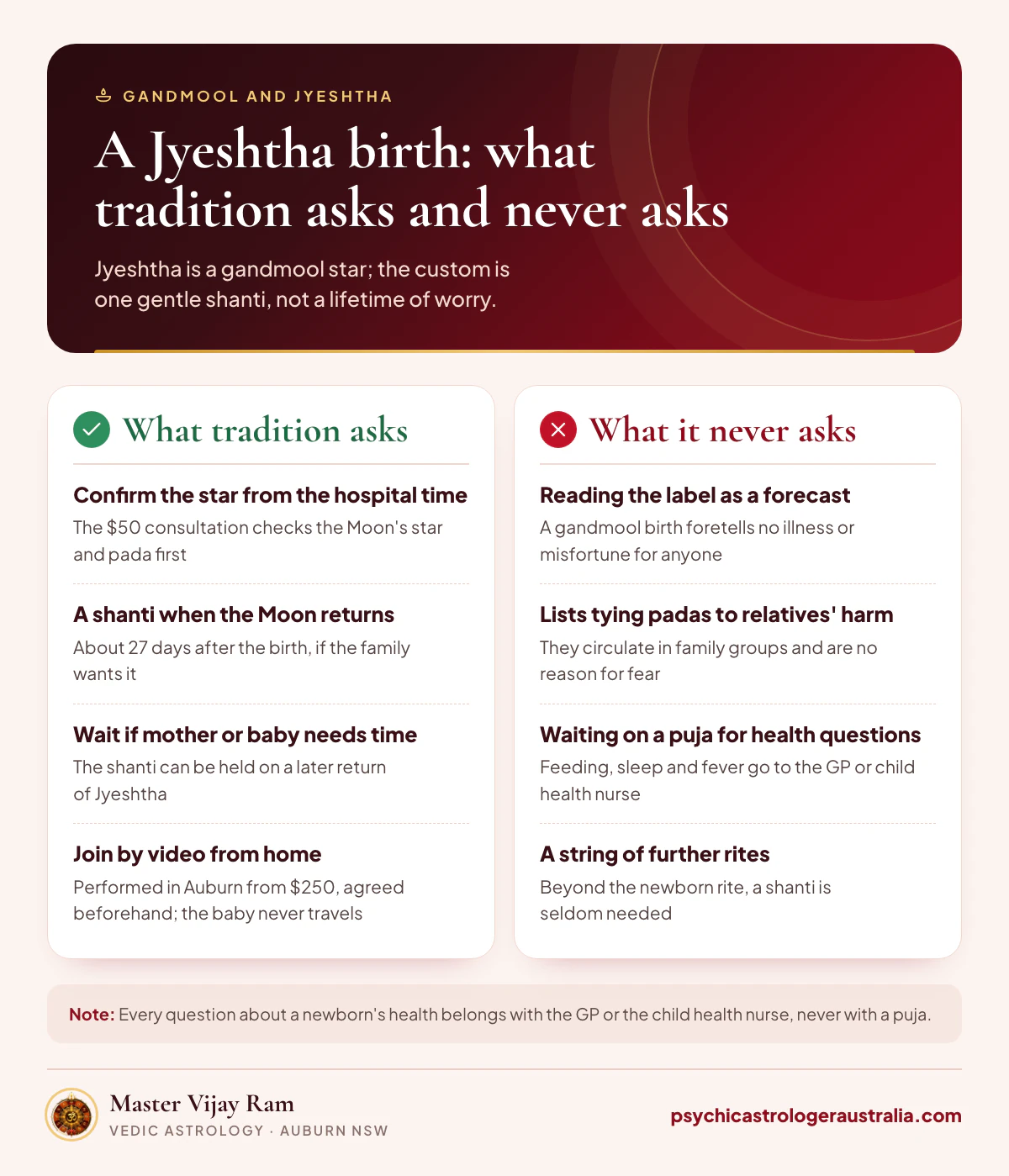
What the tradition asks for is modest: a shanti once the Moon has come round to Jyeshtha again, about 27 days after the birth, or on a later return if mother or baby needs time. The rite and the reasoning behind it are laid out gently in the gandmool shanti for newborns, and being born under a gandmool star forecasts neither illness nor misfortune for the child or anyone around them.
Where parents want the shanti, Master Vijay Ram performs it himself at his place of practice in Auburn on a day chosen from the panchang. It costs from $250, a figure agreed before the day, and follows a $50 consultation that first confirms the star and pada; how puja and havan are arranged explains how the family joins by video so the baby never has to travel.
What are Jyeshtha's padas and name sounds?
Jyeshtha's quarters occupy the Sagittarius, Capricorn, Aquarius and Pisces navamsas, and its traditional starting sounds are No, Ya, Yi and Yu.
- First pada, 16°40′ to 20° Scorpio, Sagittarius navamsa, No: a rare opening sound. Principled, outspoken, protective of the young.
- Second pada, 20° to 23°20′, Capricorn navamsa, Ya: Yash, Yamini or Yashika. Ambitious, dutiful and practical.
- Third pada, 23°20′ to 26°40′, Aquarius navamsa, Yi: rare in Hindi names. Independent, inventive, drawn to groups and causes.
- Fourth pada, 26°40′ to 30° Scorpio, Pisces navamsa, Yu: Yuvan, Yuvraj or Yukti. Sensitive and devout; the quarter at the junction.
Since No and Yi are awkward openings, a first or third pada child often carries the strict sound only in the name used at the temple, and baby naming by nakshatra helps the family settle on an everyday name as well.
Which careers suit the eldest star?
The Jyeshtha nakshatra career pattern favours work where someone must take charge and protect: management, the defence forces, police and emergency services, security and cyber-security, crisis and risk work, surgery and intensive care, administration, and any senior role where decisions cannot wait. Mercury adds analysis, negotiation and intelligence work, and the star often rises to the most senior seat in the room.
What kind of spouse does a Jyeshtha Moon make?
The tradition reads Jyeshtha nakshatra marriage as fiercely protective and loyal, with a partner who takes responsibility for the household and may struggle to let anyone else take the lead. The common strain is an eldest child's loyalty divided between the spouse and the family of origin, and couples do best when that is talked about openly before the wedding rather than discovered after it.
For matching, Jyeshtha carries a Rakshasa gana, the Adi nadi and a male deer yoni. Its yoni partner is the female deer of Anuradha, the star of friendship, just before it, though their ganas differ; Mula, the very next star, carries the opposing dog yoni and also shares the Adi nadi; Ashwini, Ardra, Hasta and Shatabhisha are among the other Adi stars, and any Adi pairing brings Nadi dosha unless an exception applies. How nakshatra compatibility is weighed explains the rest.
Is Jyeshtha avoided for weddings and openings?
Generally, yes. Muhurat texts place Jyeshtha with Ardra, Ashlesha and Mula in the tikshna, or sharp, group, traditionally kept for decisive acts that cut something away rather than for beginnings meant to grow. It is left off the classical wedding list and rarely chosen to open a business, though the tradition still uses it for firm, protective undertakings.
Which health habits does the tradition note?
Mercury is traditionally tied to the nerves and the skin, and the sign of Scorpio to the body's reproductive and excretory systems. The Jyeshtha habit to watch is the eldest's habit: sleep cut short to deal with everyone's problems, stress worn quietly, and their own appointments always last on the list.
These are tendencies, not forecasts. Exhaustion, skin flare-ups, or worry that keeps you awake should go to a GP before anything else, and Beyond Blue is there when the weight has become too much.
What does the tradition prescribe, and where does it stop?
For a troubled Mercury, the tradition begins with Wednesday observances, prayer to Ganesha, and Mercury's beej mantra, Om Braam Breem Braum Sah Budhaya Namah. An emerald is weighed only after the full chart has been read, never because of a birth star, and Vijay Ram ji keeps no stones for sale; a shanti beyond the newborn rite is seldom needed.
A reading describes temperament and timing. It cannot settle what an eldest child owes the family or approve a sponsorship, it stands beside your GP, solicitor and counsellor rather than in place of them, and it offers spiritual guidance rather than a promise of any result.
Read next
- Ashlesha Nakshatra: The Serpent’s Star, Without the FearAshlesha nakshatra without the fear: the Nagas, Mercury as lord, the padas and gandanta quarter, name sounds, traits,…
- Revati Nakshatra: The Final Star of Safe JourneysRevati nakshatra explained: Pushan, guardian of journeys, Mercury as lord, padas and name sounds, gandmool calmly, tr…
- Online Istikhara Service in Australia for Marriage & DecisionsHow online istikhara for marriage and other decisions works in Australia, what a genuine practitioner asks for, and t…
Frequently asked questions
What does the name Jyeshtha mean?
The eldest, or the most senior. The star is presided over by Indra, the senior among the gods, and its symbol is a protective amulet or umbrella, so the tradition reads it as the star of seniority and the responsibilities that come with it. The lunar month of Jyeshtha, around May and June, takes its name from this star.
Is Jyeshtha a gandmool nakshatra?
Yes. It is the last star of Scorpio, a water sign, and meets Mula at the start of Sagittarius, a fire sign, which makes both of them gandmool. The tradition responds with a small shanti once the Moon comes back to the birth star, about 27 days after the birth or on any later return. Some families apply it to every pada, others mainly to the last one.
Is a baby born in Jyeshtha unlucky for the family?
No. Lists that link particular padas to harm for particular relatives circulate in family groups, but they are not a reason for fear, and a birth star says nothing about what a child will bring to anyone. The tradition's response to a gandmool birth is a gentle shanti, and every question about the baby's health belongs with the GP or child health nurse.
How long is the Mercury dasha at birth for Jyeshtha?
Up to seventeen years, set by the Moon's position inside the star at birth. Near Jyeshtha's first degree almost seventeen remain, at its midpoint about eight and a half, near 30° of Scorpio very little. Ketu's seven years follow, then Venus's twenty, which for many Jyeshtha people covers the late teens and the twenties.
Which first sounds suit a Jyeshtha baby's name?
The traditional sounds are No, Ya, Yi and Yu, one for each pada. Ya and Yu give familiar names such as Yash, Yamini, Yuvraj and Yukti, while No and Yi are awkward openings in Hindi, so a first or third pada child often keeps the strict sound for the temple name only. The pada is confirmed from the hospital's recorded time first.
Which nakshatras match well with Jyeshtha?
On yoni, Anuradha's female deer pairs with Jyeshtha's male deer, though its Deva gana sits awkwardly with Jyeshtha's Rakshasa one. Mula and Ardra carry the opposing dog yoni, and Adi-nadi stars such as Ashwini, Hasta, Mula or Shatabhisha bring Nadi dosha unless an exception applies. A full kundli match weighs these against everything else before anything is decided.
Can a wedding be held when the Moon is in Jyeshtha?
Most families avoid it. Jyeshtha belongs to the tikshna, or sharp, group of stars that muhurat texts keep for decisive acts rather than beginnings, and it is not on the classical wedding list. Regional customs vary, and the date of a wedding is fixed from the couple's horoscopes and the whole panchang of the day, chosen with the family priest.
What careers suit a Jyeshtha Moon?
Roles where someone must take charge and protect: management, defence, police and emergency services, security and cyber-security, crisis and risk work, surgery and intensive care, administration and senior decision-making. Mercury adds analysis and negotiation. These are tendencies; the tenth house, its lord and the running dasha describe an actual career far better than the star.
Do I have to be the eldest child to be a Jyeshtha?
No. The star belongs to whoever was born with the Moon there, whatever their birth order, and plenty of second and third children have a Jyeshtha Moon. The tradition reads in them the eldest's temperament: the one who takes charge, protects and carries responsibility, sometimes for siblings older than themselves. Birth order itself is read from other parts of the chart.
People also ask
Who is the deity of Jyeshtha nakshatra?
Indra, king of the gods, who leads them in battle, defeats the serpent Vritra and brings the rain. In Vishakha he shares rule with Agni; in Jyeshtha he presides alone. The tradition reads his strength and his anxiety for his throne into the star: capability and protectiveness, and a tendency to guard one's position closely.
Which star is Jyeshtha in the sky?
Antares, the bright red star at the heart of the constellation Scorpius. From Australia it rides high overhead on winter evenings. In the sidereal zodiac its nakshatra, Jyeshtha, covers 16°40′ to 30° of Scorpio, the final section of that sign, after which Mula opens Sagittarius.
What is the symbol of Jyeshtha nakshatra?
A circular amulet or an umbrella, both images of protection held over others; in older India the royal umbrella marked the person responsible for everyone beneath it. Some lists give an earring instead, and traditions differ. The sense common to all of them is a protector carrying a visible mark of rank.
Which rashi is Jyeshtha nakshatra?
Scorpio, Vrishchika rashi, for all four padas, since the whole star lies between 16°40′ and 30° of sidereal Scorpio. A Jyeshtha Moon is a Scorpio Moon, so Saturn's Sade Sati and Jupiter's yearly movement are measured from that sign, and because the Moon is debilitated in Scorpio the chart's cancellation rules are always checked.
What is Jyeshtha called in Tamil?
Kettai in Tamil and Thrikketta in Malayalam; Telugu calendars call it Jyeshta. South Indian families often know their star by these names first, and older relatives sometimes repeat sayings about Kettai that the tradition itself does not support. The star is the same everywhere: the last part of sidereal Scorpio, ruled by Mercury.
References & further reading
Serving clients across Australia
Confidential consultations by phone, video & WhatsApp — including: