
Quick answer
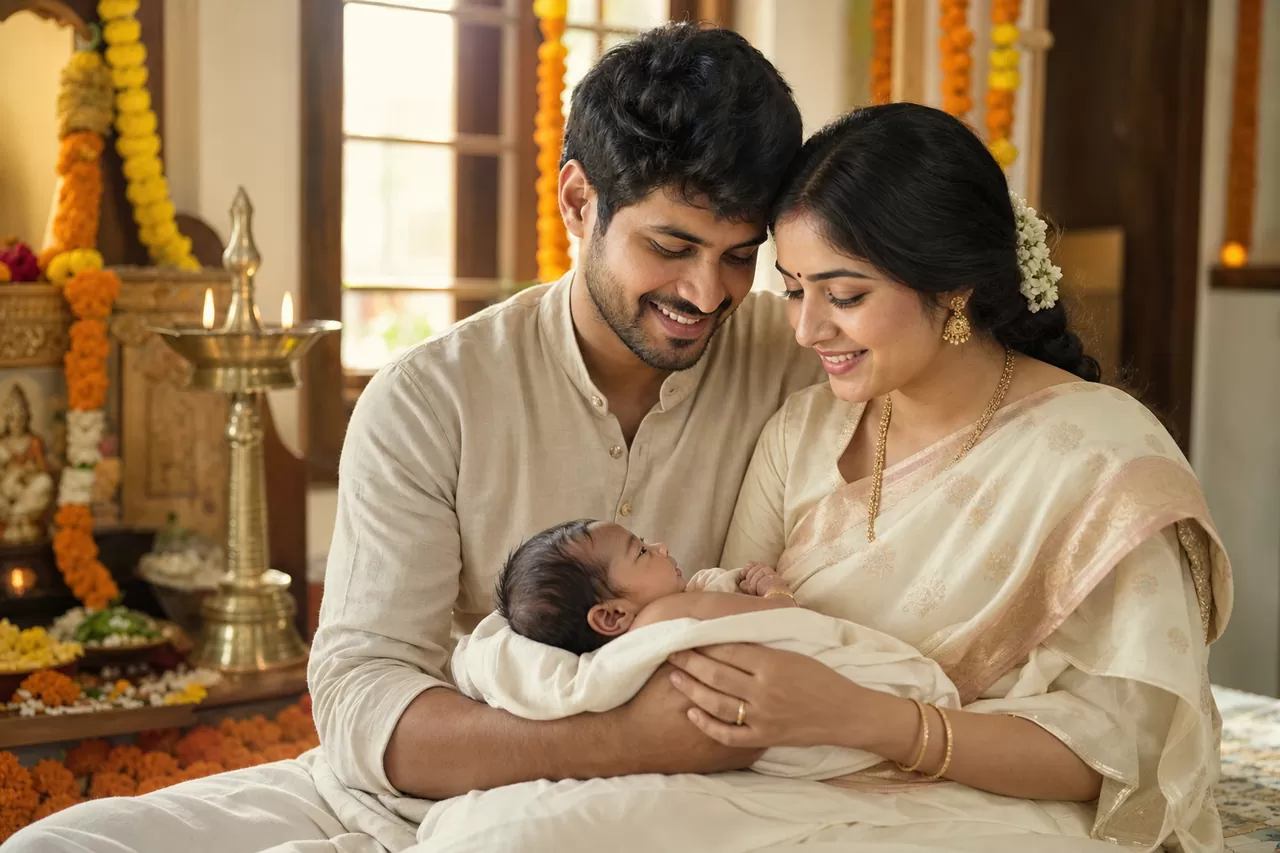
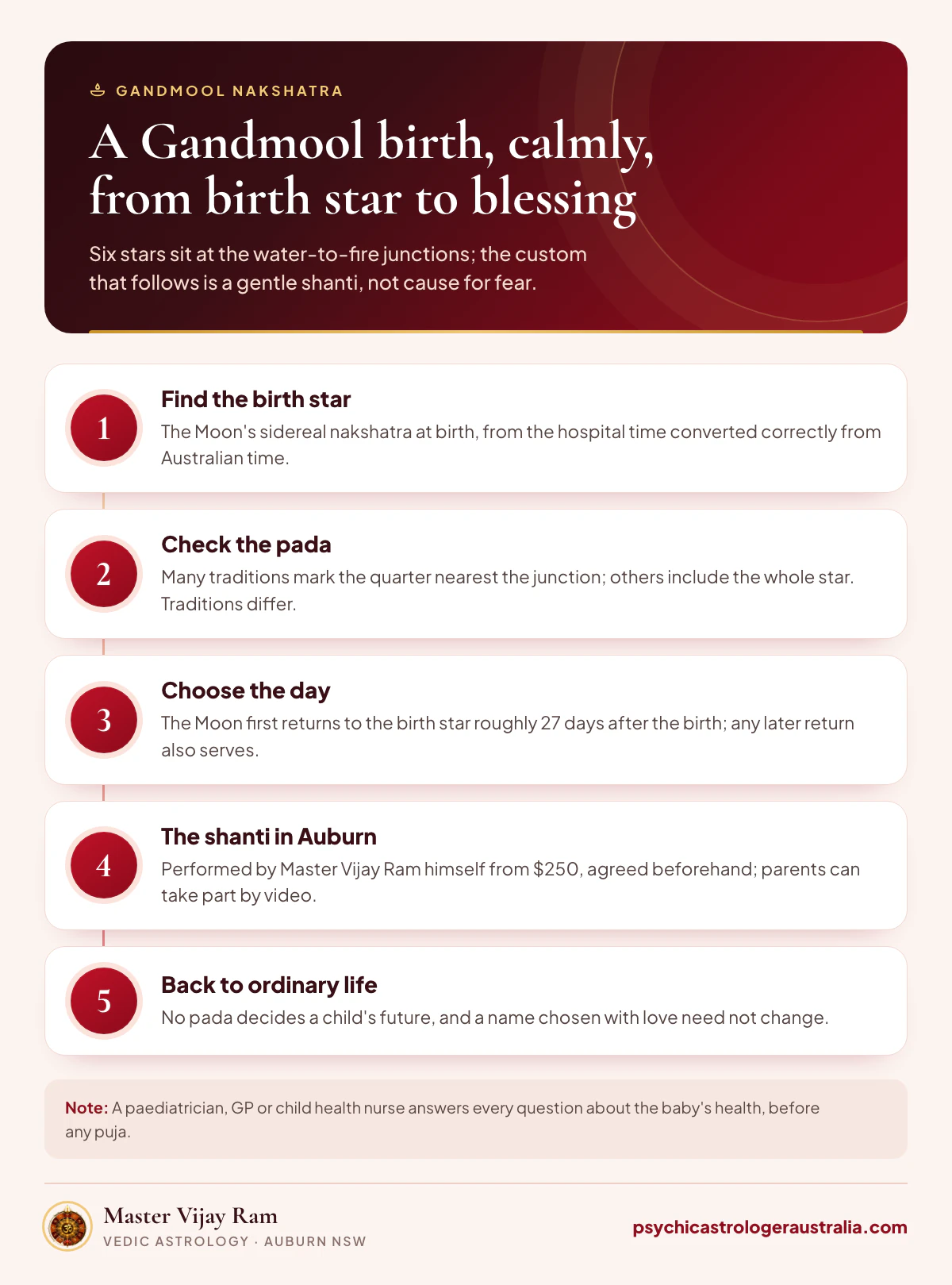
Gandmool is the name for six nakshatras at the water-to-fire junctions: Ashlesha, Magha, Jyeshtha, Mula, Revati and Ashwini. A baby with the Moon in one of them is not unlucky; the tradition simply offers a gentle shanti on the Moon's first return to that star, roughly 27 days later, or on a later return.
What is a Gandmool nakshatra?
A Gandmool nakshatra is one of six lunar mansions that sit at the three junctions where a water sign ends and a fire sign begins: Ashlesha and Magha, Jyeshtha and Mula, and Revati and Ashwini. A baby whose Moon was in one of them at birth is said in the tradition to be Gandmool-born, and the custom that follows is a gentle shanti puja. That is the whole of it, and nothing about your baby is wrong.
Grandparents often call it gand mool dosh, and the word dosh frightens new parents more than it should. This page explains the six stars, the junction, the padas, the timing of the shanti and what the puja involves, and the newborn kundli and naming reading gives you your baby's star and pada.
Which six stars are Gandmool, and where are the junctions?
There are three junctions, and each joins a Mercury-ruled star at the end of a water sign with a Ketu-ruled star at the start of a fire sign. At the Cancer–Leo junction, Ashlesha, the serpent's star, gives way to Magha, the star of the ancestors. At Scorpio–Sagittarius, Jyeshtha, the eldest star, gives way to Mula, the root star.
At Pisces–Aries, Revati, the star of safe journeys, gives way to Ashwini, the healers' star, which begins the zodiac again. Each star has its own page, and the table gathers what the tradition says about all six.
| Star | Where it sits | Sidereal span | Ruling planet | Deity | Symbol |
|---|---|---|---|---|---|
| Ashlesha | End of Cancer (water) | 16°40′–30° Cancer | Mercury | The Nagas, the serpents | A coiled serpent |
| Magha | Start of Leo (fire) | 0°–13°20′ Leo | Ketu | The Pitris, the ancestors | A throne |
| Jyeshtha | End of Scorpio (water) | 16°40′–30° Scorpio | Mercury | Indra | A circular amulet or umbrella |
| Mula | Start of Sagittarius (fire) | 0°–13°20′ Sagittarius | Ketu | Nirriti | A bunch of roots tied together |
| Revati | End of Pisces (water) | 16°40′–30° Pisces | Mercury | Pushan | A fish, or a drum |
| Ashwini | Start of Aries (fire) | 0°–13°20′ Aries | Ketu | The Ashvins, the divine physicians | A horse's head |
What is Gandanta, and why does the junction matter?
Gandanta means the knot at the end. It names the three junctions where a water sign gives way to a fire sign, and they are special for a simple reason: they are the only points in the zodiac where the end of a nakshatra and the end of a sign fall at exactly the same place, at the starts of Aries, Leo and Sagittarius.
At each of them the nine-star cycle of ruling planets also ends with Mercury and begins again with Ketu. The tradition treats such a crossing, from water to fire and from one cycle to the next, as a knot in the thread, and a birth Moon placed there as a life that begins at a turning point; the response it prescribes is a blessing to ease the crossing, which is all a Gandmool shanti is.
Is a Gandmool birth bad luck?
No, and the tradition itself does not say so. The six stars belong to the Ashvins, the divine physicians; the Nagas; the Pitris, the ancestors; Indra, king of the gods; Nirriti, who presides over dissolution and roots; and Pushan, the nourisher who protects travellers. These are powerful, protective presences, and the shanti exists to honour them at a turning point, never to protect a family from its own child.
A Mula nakshatra baby in particular attracts unkind talk, usually from someone repeating what they heard as a child. Mula is read as the star of roots and deep inquiry; your baby is a baby, and the right answer to the talk is a calm explanation, which is what this page is for.
Which padas are traditionally of concern?
Traditions differ, and it is worth saying so plainly to anxious grandparents. Many hold that the concern belongs to the quarter of the star nearest the junction: the last pada of Ashlesha, Jyeshtha and Revati, and the first pada of Magha, Mula and Ashwini. Others include the whole of each star, and some narrow it to the last or first few degrees.
Lists that tie each pada to a particular relative circulate widely in family groups and online. They are not repeated here because they are not a reason for fear, and no quarter of a star decides what happens to anyone in a family.
How do you find your baby's nakshatra correctly?
The birth star is the nakshatra the Moon occupied at the moment of birth, measured in the sidereal zodiac. The Moon is in the same place at that instant whether the baby is born in Geelong or in Jalandhar, so the country does not change the star; what must be right is the clock, converted correctly from Australian time and allowing for daylight saving where it applied. Finding the Moon's sign and star explains the method.
Precision matters near the edges. The Moon moves about half a degree an hour, so a pada of 3°20′ passes in roughly six hours, and a birth close to a junction can land in a different pada, or even a different star, if the time is rounded or the time zone is wrong.
What is Mula shanti, and when is it done?
The mool shanti puja, also called Gandmool shanti, is traditionally performed on the day the Moon returns to the nakshatra it occupied at birth. The Moon takes about 27 days to travel through all twenty-seven stars, so the first return falls about 27 days after the birth, and the panchang shows the exact day.
Exact customs differ between regions and families, and the reading confirms the date for yours. The aim is a calm, chosen day, not a race against the calendar.
What if the 27th day is not possible?
Then it is done later; the tradition allows for that. A mother recovering from a caesarean, a baby still in special care, or grandparents flying in from India are all good reasons to choose a later return of the birth star, which comes round about every 27 days, or another suitable day the reading identifies.
Traditions differ on the ideal timing, and a delayed shanti is not a failing. A family in Wollongong or Newcastle that waits until the household has settled is making a sensible choice.
What does the puja involve?
Customs differ between regions and families, and the rite should follow your family's tradition where you know it. A typical Gandmool shanti begins with Ganesha, sets up a kalash, names the child and the birth star in the sankalpa, invokes the star's deity and its ruling planet, Ketu or Mercury, honours the nine planets, and closes with mantras, a small havan and a blessing for the baby. Some customs gather offerings in sets of twenty-seven, one for each nakshatra.
The shanti is performed by Master Vijay Ram himself, in Auburn, on a day chosen from the panchang, from $250, the fee fixed with you before anything is performed. Parents can join by video from home, so a newborn never needs to travel, and photographs or a short recording are sent afterwards only where he offers them; joining a puja or havan by video explains how that works.
What should we tell the grandparents?
Most worry about Gandmool reaches new parents through older relatives who love the baby and remember the fear from their own childhood. Three calm points usually help: the birth star marks a junction in the sky, not a fault in the child; the shanti is a blessing that can be done on any later return of the star; and the lists linking a pada to a relative are not part of a careful reading.
Many families find it easier when the explanation comes from someone outside the family. A short call with Master Vijay Ram, with a grandparent in India on the video call too, can settle a question that has been circling the house for days.
Who answers the medical questions?
A paediatrician, your GP or the child health nurse answers every question about feeding, weight, jaundice, sleep or fever, and none of those should wait for a puja or a reading. Parents matter too: if worry about the birth star is keeping you awake, or the early weeks feel heavier than tiredness, your GP and PANDA support new parents through anxiety and low mood.
The tradition never meant a shanti to replace care. It was a blessing offered alongside care, and that is how it is best used now.
What can the chart not tell you about your baby?
It cannot tell you how healthy your child will be, how long they will live, or whether they will bring good or bad fortune to anyone in the family, and Master Vijay Ram will not read a newborn's chart for those things. It can tell you the birth star, its pada, the opening dasha and the date of the next return, which is all the shanti needs. What it offers is faith-based guidance, and the baby's health stays with the professionals who care for it.
How does Master Vijay Ram help new parents?
Send the baby's date, time and place of birth as written on the hospital record. He confirms the Moon's nakshatra and pada with the Lahiri ayanamsa, tells you whether your family's custom calls for a shanti, and gives the date of the next return of the birth star, with a calm explanation you can pass on to the grandparents.
That conversation is a $50 consultation; it can happen on the phone, over video or on WhatsApp, and in Hindi, Punjabi or English. Families in Hobart keep the same clock as Auburn, and in-person visits are in Auburn only.
Read next
- Numerology for a Baby’s Name, Alongside the NakshatraBaby name numerology beside the nakshatra: the birth-star syllable comes first, spelling changes the number, and the …
- Graha Shanti Puja: Which Planet Needs Pacifying and HowGraha shanti puja: how the birth chart shows which planet needs pacifying, Shani and Rahu shanti, what the rite invol…
- Diwali 2026 House & Aura Cleansing: Clear the Year's Heavy EnergyDiwali 2026 house and aura cleansing done honestly: clean first, use the Five-Lamp Check, and learn when heaviness is…
Frequently asked questions
Is a Gandmool baby unlucky?
No. Gandmool describes where the Moon was at birth, at one of three junctions the tradition marks with a blessing. It says nothing fixed about the child's health, character or fortune, and nothing about harm to parents or relatives. The tradition's own response is a gentle shanti, not fear, and a paediatrician or GP answers anything medical.
Which nakshatras are Gandmool?
Six: Ashlesha and Magha at the Cancer–Leo junction, Jyeshtha and Mula at the Scorpio–Sagittarius junction, and Revati and Ashwini at the Pisces–Aries junction. In each pair the first star, ruled by Mercury, closes a water sign and the second, ruled by Ketu, opens a fire sign. The junctions themselves are called Gandanta.
When should Mool shanti be done?
On the day the Moon first comes back to the baby's birth nakshatra, which is roughly 27 days after the birth. If that day is not practical, because the mother is recovering, the baby is still in hospital or family must travel, it can be done on a later return of the same star or another suitable day. Traditions differ on the ideal timing, and waiting is not a fault.
Is Gand Mool dosh only for certain padas?
Traditions differ. Many hold that the quarter nearest the junction carries the concern, the last pada of Ashlesha, Jyeshtha and Revati and the first of Magha, Mula and Ashwini, while others include the whole of each star and some narrow it further. The pada needs an accurate birth time, because the Moon crosses a pada in about six hours.
Does a birth in Australia change the baby's nakshatra?
No. The Moon's position is the same at a given instant everywhere on Earth, so the birth star depends on the moment, not the country. What has to be right is the clock: the hospital time must be converted correctly from Australian time, including daylight saving where it applied. Most errors come from casting the chart in the wrong time zone.
Can the Mool shanti be done without the baby present?
Yes. He performs it himself in Auburn, where he practises, and parents can join by video from wherever they live, so a newborn does not need to travel. The family gives the baby's birth details and name, and the rite is performed in the child's name. The cost starts from $250 and is settled with you before the day.
What happens in a Gandmool shanti puja?
Customs vary between families and regions. Typically it begins with Ganesha, sets up a kalash, invokes the deity of the birth star and its ruling planet, Ketu or Mercury, offers prayers to the nine planets, recites mantras and closes with a small havan and a blessing for the child. Some customs gather items in sets of twenty-seven, one for each nakshatra.
Should we change our baby's name because of Gandmool?
No. Gandmool has nothing to do with the name, and a name chosen with love need not change because a relative has grown anxious. If the family wants the first syllable to follow the birth star, a nakshatra naming reading gives the syllables, but that is a separate, optional custom rather than a remedy for anything.
Our baby was born in Mula nakshatra. What should we do?
First, enjoy your baby. Mula is the root star; Ketu rules it and Nirriti is its deity, and it is traditionally associated with a mind that goes to the root of things. If your family follows the custom, a Mula shanti on a return of the birth star is the traditional response; the reading confirms the pada and the date, and anything medical goes to your paediatrician or GP.
Is Gandmool the same as Gandanta?
They are linked. Gandanta is the junction itself, the point where a water sign and its last nakshatra end and a fire sign and its first nakshatra begin. Gandmool is the name for the six stars on either side of those three junctions. Some astrologers use Gandanta more narrowly, for a Moon or lagna within a few degrees of the junction.
People also ask
What is Gandmool nakshatra?
It is the name for six nakshatras at the junctions of water and fire signs: Ashlesha, Magha, Jyeshtha, Mula, Revati and Ashwini. A baby whose Moon sits in one of them is traditionally given a shanti on the Moon's return to that star, some 27 days on. It is a custom of blessing, not a sign of misfortune.
What is Mool shanti puja?
It is the pacification puja traditionally performed for a baby born with the Moon in a Gandmool nakshatra, usually on the day the Moon returns to the birth star. It includes prayers to Ganesha, to the star's deity and ruling planet and to the nine planets, with mantras and a small havan, and it can be performed later if the first return is not practical.
Which pada of Mula nakshatra is bad?
No pada is bad, and no quarter of a star decides a child's future. Several traditions single out the first pada of Mula, nearest the junction with Scorpio, as the one that calls for the shanti, while others include the whole star. Lists linking each pada to a relative circulate widely, but they are not a reason for fear.
What is Gandanta in astrology?
Gandanta, the knot at the end, is the junction between a water sign and the fire sign that follows: Cancer and Leo, Scorpio and Sagittarius, Pisces and Aries. These are the only three points where a nakshatra boundary and a sign boundary coincide, and the tradition treats a birth Moon there as a turning point to be blessed.
Do Australian families still do Gandmool shanti?
Many do, especially when grandparents ask for it. The shanti can be done on a return of the birth star, with the puja performed in Auburn and the parents joining by video, which suits families in Hobart, Canberra or Geelong with a newborn at home. Whether to do it is the family's choice, made calmly and without pressure.
References & further reading
Serving clients across Australia
Confidential consultations by phone, video & WhatsApp — including: