
Quick answer
An online istikhara service should give guidance about one clear decision, using only your name, your mother's name and the question itself. Anything that names an enemy, promises an outcome by a fixed date, or grows in price as you grow frightened is a warning sign rather than guidance.
What istikhara actually is, in plain words
Istikhara is a prayer for guidance. In the Islamic tradition it is a short prayer asking that a matter be made easy if it is good for you, and turned away from you if it is not. It asks for clarity, not a forecast.
That distinction does most of the work. Istikhara does not produce a date, a name or a guarantee. It does not tell you who is against you. What it tends to do is quieten the noise around a decision until your own judgement can operate again.
Master Vijay Ram has practised for more than forty years, and the request that reaches him most often is not for a verdict. It is for someone to look at a decision honestly, say what is ordinary about it, and say plainly when nothing spiritual is involved.
Why the request now arrives online, and late at night
Marriage proposals still travel through family. In Australia the family is often in another country and on another clock. A photograph arrives on WhatsApp, an answer is wanted by the weekend, and the elders who would once have talked it through are asleep.
The person in Canberra typing a question into a search bar at eleven at night is rarely shopping around. They are trying to keep a decision from tipping over before morning.
Online is also the only private option for many. Communities here are close, and walking into somewhere you might be recognised is not a small thing when the question is whether to accept a proposal, or whether to leave a marriage. A call from your own car is easier, and being careful about who you call asks only a little thought.
The question you ask matters more than the ritual
Most istikhara requests that go nowhere fail at the question. Will I be happy cannot be answered. Is he the one invites a stranger to make your decision for you.
A workable question is narrow, current and yours to act on. Should I go ahead with this proposal now, or wait until our families have met. Should I accept the transfer interstate this year. Should I keep trying with this marriage, or start the conversation about ending it.
Ask one thing at a time. Two questions inside a single prayer produce a muddle you will read whichever way you already lean. And be honest about where you stand. Wanting permission is not the same as being undecided, and anyone worth speaking to will say so.
What istikhara by name involves, and what you are asked to provide
Istikhara by name is the usual form at a distance: your name, your mother's name, and the decision itself. Where a chart reading is combined with it, your date, time and place of birth are added. That is the whole of it.
Treat anything beyond that carefully. Photographs of the other person, a piece of their clothing, their hair, or birth details obtained without their knowledge are not requirements of guidance. They belong to a different kind of work, and one you did not ask for.
Enquiries also change shape once the story comes out. A family in Western Sydney may open with a question about a proposal and end up asking about what this looks like for people near Blacktown, because what they are describing is jealousy and heaviness rather than indecision.
How an answer usually arrives, and why a dream is not a verdict
People expect a dream. Sometimes one comes. Far more often the answer arrives as movement. A thing becomes easy, or it becomes strangely difficult. Calls are returned or they are not. A doubt that would not settle finally settles.
No dream is not a failed istikhara; it is the ordinary outcome. The prayer is often repeated over several nights, and what you watch across those nights is the direction your heart keeps returning to when you are not arguing with yourself.
Be wary of a dream reported back to you in cinematic detail, with faces and names inside it. A vivid story is easy to produce and impossible to check. Real guidance tends to be quieter, and less flattering, than that.
The three-refusal rule
One test has proved more useful than any credential. Call it the three-refusal rule: a practitioner worth trusting refuses three things without being asked.
First, they refuse to name the person supposedly behind your trouble. Naming a relative is the fastest way to break a family, and no honest reading requires it. Second, they refuse to tell you the answer before the istikhara has been performed, and refuse to promise a result by a fixed date. Third, they refuse to escalate: no larger remedy stacked on the first before the first has been given time, and no fee that grows each time you sound frightened.
Five minutes reading about Master Vijay Ram before you send a single detail is not rude. It is ordinary care.
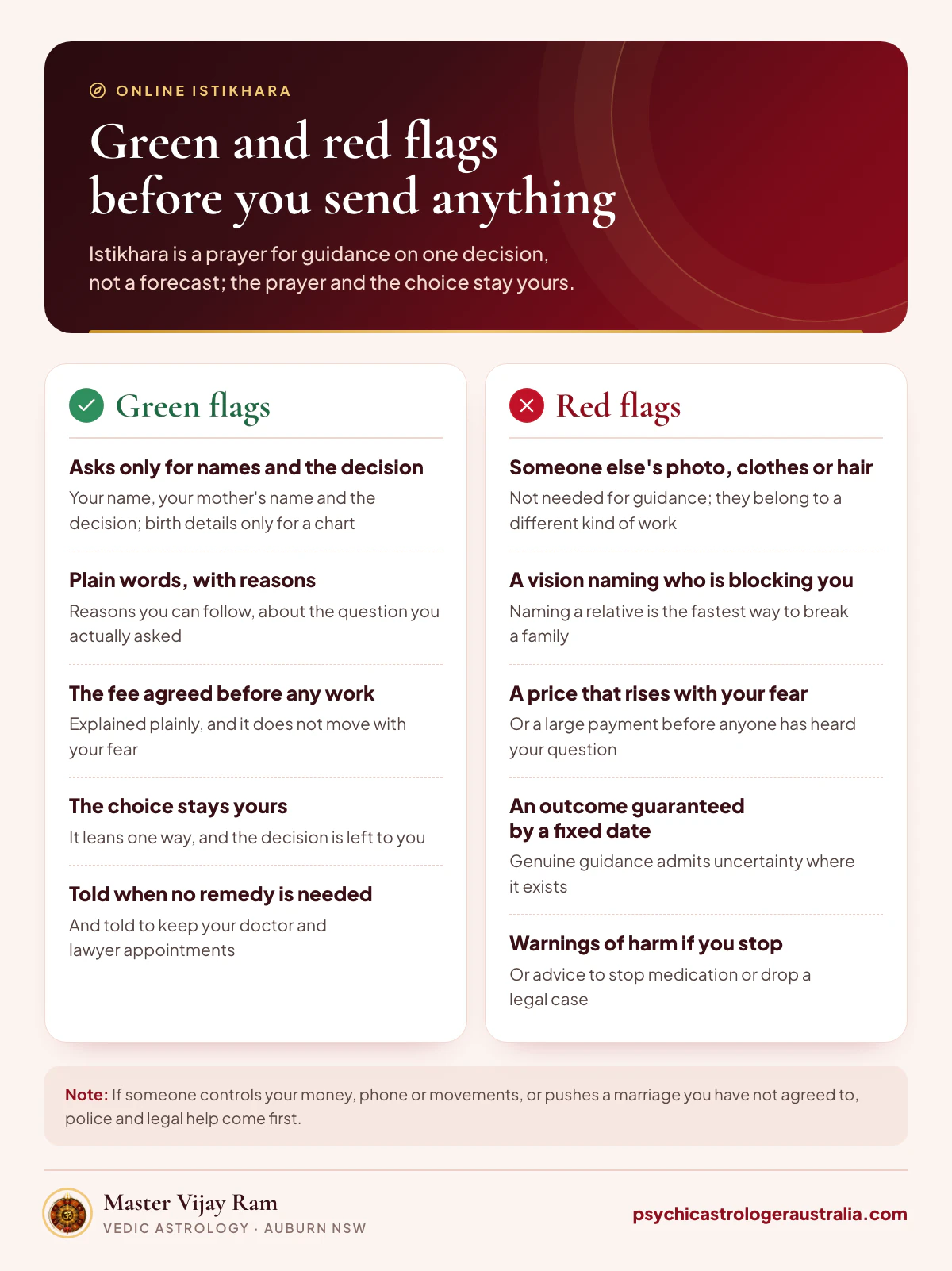
Reading the flags before you send your details
Most people can hear a wrong note. The difficulty is that fear makes the wrong note sound reasonable, so it helps to have the flags written down before you are frightened rather than after.
| What you are checking | Green flag | Amber flag | Red flag |
|---|---|---|---|
| What you are asked to send | Your name, your mother's name, the decision | A long form of family details "for the file" | Photographs, worn clothing or hair belonging to someone else |
| How the answer is given | Plain words, with reasons you can follow | A dramatic dream that never touches your question | A vision that names the person blocking you |
| Money | Fee explained plainly and agreed before any work | A deposit requested for materials | A price that rises each time you sound frightened |
| Certainty offered | It leans this way, and the choice stays yours | A firm yes or no with no reasoning attached | A guaranteed outcome by a fixed date |
| Boundaries | Being told plainly that no remedy is needed | A second service offered before the first is tested | Warnings of harm to your family if you stop |
| Doctors and lawyers | Told to keep your appointments | Hints that professionals cannot really help you | Told to stop medication or drop a legal case |
The same flags carry over to heavier work, which is why they run through Best Black Magic Removal Specialist in Australia: How to Choose as well.
Questions worth asking before any money changes hands
You are allowed to interview the person you are about to trust with a private decision. A short call settles most of it.
- What exactly do you need from me, and why do you need it?
- What will you tell me if you find nothing wrong?
- What is the fee, what does it cover, and when is it paid?
- What happens if I change my mind halfway through?
- Is there anything you will not do, whatever I offer to pay?
If a remedy genuinely is indicated, it should be named and explained rather than implied. Work on energy that has settled on a person or a home is a separate undertaking from guidance about a decision, with its own reasons and its own limits, and you are entitled to hear both before agreeing to anything.
When istikhara is not the answer
Most enquiries turn out not to need a remedy at all, and you should be told that plainly rather than sold something.
Repeated, urgent istikhara about the same decision can be a sign of obsessive doubt, which responds to psychological treatment rather than to more prayers. Exhaustion that will not lift may be depression, anaemia, thyroid trouble, sleep apnoea, or the months after a birth. A GP is the first step, not the last resort.
If someone controls your money, your phone or your movements, or you are being pushed towards a marriage you have not agreed to, that is not a spiritual matter first. It is a safety and legal one. Police, a family lawyer, a migration agent or a family violence service come first. Spiritual work sits alongside medical and legal help. It never stands in for it.
Istikhara, a chart reading and plain counsel are different things
Istikhara is a prayer you make about a decision. A chart reading looks at timing and pattern, and can say when a period is genuinely obstructed. Counsel is an experienced person telling you what they see. They answer different questions and are not interchangeable.
The practice of faith-based ruqyah is different again: recitation-based work for people who believe something has been done to them, rather than a method for deciding whether to marry.
One more piece of honesty. Vijay Ram ji practises in the Vedic tradition. The prayer itself stays yours to make. What sits alongside it is a reading of timing, a plain view of whether anything spiritual is present, and the discipline to say when nothing is.
Privacy, family pressure and who gets told
Most people asking about a proposal ask without the family knowing. That is not deceit. It is often the only way to think clearly while several relatives are already certain of the answer.
Confidentiality here means what it sounds like. Nothing goes back to the person who introduced the match. Nothing is discussed with a relative who rings afterwards, whoever they say they are. No detail of your situation is used as an example anywhere, including on this site.
The same discretion covers every kind of enquiry. A quiet question about a proposal and a request for the negative energy and evil eye removal work done for Dandenong households are handled the same way, and neither is repeated to anyone. In communities where everyone knows everyone, that is usually the first thing people want to hear.
The misunderstandings that cost people the most
Three patterns account for most of the money lost. The first is the dream for hire: a long, frightening dream reported back to you, always requiring an urgent remedy. The second is the endless cut, where each piece of work uncovers another, and the total is never named at the start.
The third is the automatic amulet. An istikhara that ends every single time with something to buy is a business model rather than guidance. Before accepting one from anybody, it is worth understanding Taweez & Kavach for Protection: Real Ones vs Fakes.
Where cleansing genuinely is indicated, it is named and explained. The work of aura and chakra cleansing addresses the residue people carry after a long, draining stretch, and it does not make the decision for you.
What the weeks after an answer usually look like
An answer is not an event. It is something you test. Give the direction two or three weeks of ordinary life and watch what happens to it. Does the path stay open, or does it keep closing quietly without anyone slamming a door?
Keep a short note of what actually happened rather than what you felt about it. Resist repeating the prayer nightly out of anxiety, because fear will read any sign as agreement. Go back to the question properly only if the circumstances themselves change.
Distance makes no difference to this part. Whether someone is searching for Vedic help across Hobart or living an hour from the practitioner, the weeks that follow look the same.
If a cleansing was advised, it helps to read Spiritual Cleansing Service: What to Expect From Start to Finish before the day arrives.
Consulting from anywhere in Australia
Consultations happen by phone, video or WhatsApp. Where a remedy is agreed, Vijay Ram ji performs it personally at his own place of practice, which is why your suburb, your state and your time zone make no difference to the work. In-person appointments are available there for anyone who prefers them.
The consultation is $50, any remedy is agreed with you before it is performed, and what you share stays between the two of you.
Other requests arrive alongside istikhara and are treated as what they are. Someone in suburbs like Casula and Moorebank asking about a broken engagement is asking a different question from someone weighing a proposal, and the honest answer to each is different.
None of that removes the part that belongs to you. The decision stays yours.
Read next
- Istikhara for Major Life Decisions: How Guidance ComesHow istikhara guides a job, visa, home or business decision, the forms an answer takes, why a dream is not a verdict,…
- How Much Does a Love Marriage Specialist Cost in Australia?Love marriage specialist cost in Australia: the $50 consultation, when a remedy from $250 is warranted, and the fee p…
- Preparing Questions for a Love ReadingHow to prepare for a love reading: questions a chart can answer, ones it cannot, whose birth details to bring and why…
Frequently asked questions
Can someone else perform istikhara on my behalf, or does the prayer have to be mine?
The prayer is traditionally yours to make, and nobody can take that part from you. What a practitioner can do is pray alongside you, read the timing of your situation, and help you frame the question so it can actually be answered. Treat anyone who says your own prayer is unnecessary, and that only theirs counts, with caution.
I did not dream anything after istikhara. Does that mean nothing happened?
No. A dream is one possible sign among several, and its absence is the ordinary outcome rather than a failure. Guidance more often shows itself as ease or resistance in the days that follow: doors that open without effort, or a matter that keeps stalling for reasons nobody planned. Watch the direction things move in.
How many nights should istikhara be repeated before I stop?
Many people repeat it across three to seven nights, and some traditions suggest continuing while a matter stays undecided. There is no fixed number that fits everyone. The honest guide is your own state. If you are repeating it because the situation is genuinely unresolved, continue. If you are repeating it out of fear, stop and speak to someone.
What details are appropriate to give for istikhara by name, and what is not?
Your name, your mother's name and a clearly stated decision are enough. Birth details are added only when a chart reading forms part of the work. Photographs of another person, their clothing, their hair, or birth details taken without their knowledge are not needed for guidance, and being asked for them is a reason to stop and think.
Is it wrong to ask for istikhara about something I have already decided?
It is not wrong, but it is worth admitting. Istikhara asks for a matter to be made easy if it is good for you, which means staying genuinely open to a no. If you already know your answer and want reassurance, say so at the start. A straight conversation will serve you better than a ritual.
My parents want istikhara done about me and I do not. Can they ask for it?
They can pray for you, and anyone may pray for anyone. What they cannot reasonably do is have a practitioner rule on your life without your knowledge and present the result as binding. An adult decision belongs to the adult making it. A practitioner who allows himself to be used as family pressure is not helping anybody.
The answer seemed to be no, but I still want to go ahead. What then?
Then you go ahead knowing what you saw. Istikhara compels nobody. It is worth asking why the answer is unwelcome, because it sometimes points at a condition rather than the whole decision: timing, money, or a family matter left unresolved. Deal with that part, and the picture often changes on its own.
How do I tell a genuine answer from a scripted one?
A genuine answer is specific to what you asked, gives reasons you can follow, and admits uncertainty where uncertainty exists. A scripted one is dramatic, vague about your actual question, and arrives with urgency attached. If the same reading, the same hidden enemy and the same remedy appear in every account you find, you are reading a script.
Should istikhara come before or after meeting the family?
Usually after you have gathered the ordinary facts. Guidance works best on a real question, and you cannot ask a real question about people you have not met or checked. Meet them, ask your practical questions, then pray about the decision that remains. That order also protects you from deciding on impressions alone.
Can istikhara tell me whether black magic has been done to my marriage?
That is a different assessment. Istikhara is guidance about a decision. Identifying interference is separate work with its own signs, its own questions, and its own honest possibility of finding nothing at all. Asking one to answer the other usually produces a frightening story rather than information. Ask for each thing separately and plainly.
Is a consultation wasted if I am told no remedy is needed?
It is the best outcome available. Being told plainly that your situation is difficult but ordinary saves you money, time, and the low-level fear that comes from believing you are under attack. Most enquiries end there. A practitioner who never reaches that conclusion for anybody is telling you something about the practice.
Does an istikhara answer expire if my circumstances change?
The guidance was for the question you asked, in the situation you were in. If something material shifts, such as the person moving country, a job ending, or a family position changing, the question itself has changed and it is reasonable to ask again. Mood swings and second thoughts are not material changes.
Can istikhara be used for work and money decisions, not only marriage?
Yes. The same approach applies to accepting a job, moving states, starting a business or signing a lease. Narrow the question, gather the ordinary facts first, and be ready for a no. Financial decisions also deserve professional advice from an accountant or a solicitor, which guidance supports rather than replaces.
When is a fee for istikhara reasonable, and when is it a warning sign?
A fee for a practitioner's time and attention is reasonable, provided it is stated plainly and does not move with your fear. The warning signs are an amount that rises after you sound worried, a large payment demanded before anyone has heard your question, and an urgent second fee for a danger nobody mentioned at the start.
I keep asking for istikhara about the same person. Is that a problem?
It can be. Asking repeatedly about one decision, and never being satisfied, is often anxiety or obsessive doubt rather than a shortage of guidance. That pattern responds to psychological support, and a GP is a sensible first call. It is also a sign the real question may be one you have not said out loud yet.
People also ask
Is istikhara only for Muslims?
Istikhara comes from the Islamic tradition, where it is a specific prayer for guidance. People from other backgrounds ask about it constantly, usually because a relative has suggested it. The underlying idea, asking for a decision to be made clear and staying willing to accept a no, is not owned by any one community, and the etiquette of the prayer is worth respecting either way.
What is the difference between istikhara and kundli matching before marriage?
Kundli matching compares two birth charts and looks at compatibility, timing and known difficulties in a marriage. Istikhara is a prayer asking for a decision to be made easy if it is good for you. One examines a pattern, the other asks for clarity. They can be used together, and neither removes the need to meet the person properly.
Does istikhara work if the other person does not know it was asked?
Yes, because istikhara concerns your decision rather than anyone else's will. You are asking for your own path to be made clear. That differs entirely from work aimed at changing another person's feelings, which raises consent questions a careful practitioner will not brush aside. If you are offered the second thing while asking for the first, stop there.
Can an istikhara answer be wrong?
The reading of it can be. Signs are interpreted by human beings, and fear, hope and family pressure all bend interpretation. That is why a careful practitioner explains reasoning instead of announcing verdicts, and why you test guidance against what actually happens over the following weeks rather than accepting it whole on the night it arrives.
Should istikhara replace asking practical questions about a proposal?
No, and treating it that way causes real harm. Ask about work, health, money, previous marriages, visa status, and whether the two of you have genuinely spoken alone. Guidance sits on top of ordinary due diligence rather than substituting for it. Anyone discouraging you from asking practical questions is a reason for concern, not reassurance.
References & further reading
Serving clients across Australia
Confidential consultations by phone, video & WhatsApp — including:
- Adelaide
- the Gold Coast
- Canberra
- Hobart
- Newcastle
- Wollongong