
Quick answer
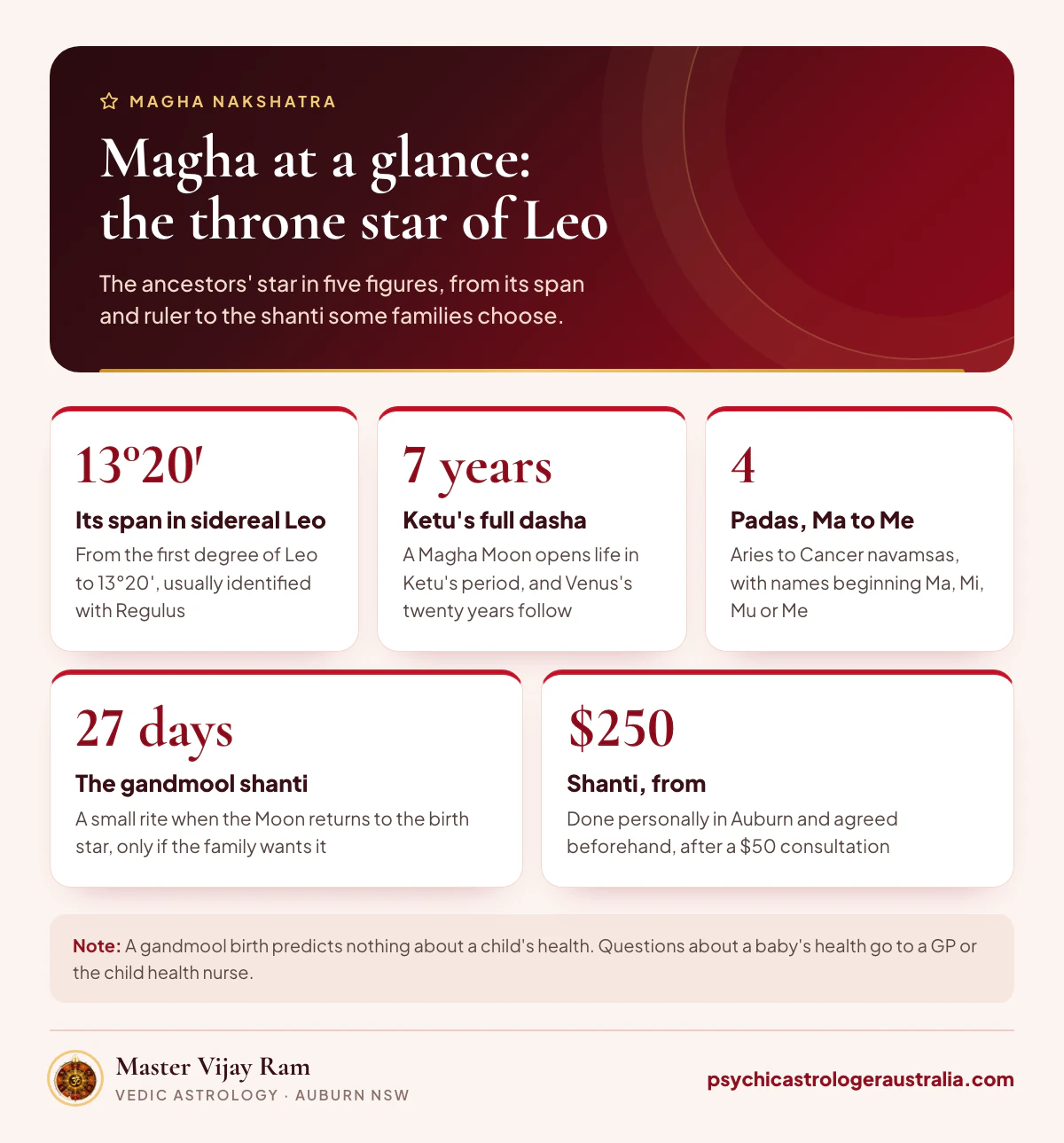
Magha is the tenth nakshatra, the first 13°20′ of sidereal Leo. Its deities are the Pitris, the ancestors, its symbol is a throne and its ruler Ketu, whose seven-year dasha is the first a Magha Moon lives through. Tradition reads dignity, loyalty to family and a need for respect, and as a gandmool star it calls for a small, calm shanti.
What is Magha nakshatra?
Magha nakshatra is the tenth lunar mansion of twenty-seven, the arc that opens sidereal Leo and runs to its 13°20′ mark, which the Moon takes about a day to cross. The name is usually translated as the mighty or the great, its symbol is a throne, and its presiding deities are the Pitris, the ancestors. It is usually identified with Regulus, the brightest star in the constellation of Leo.
To be born in Magha means the Moon stood in this arc at your birth, which makes it your janma nakshatra and Leo your Moon sign. What follows covers the star's myth, its lord and the dasha it starts, its four padas and name syllables, how it is read for work, marriage and health, and the plain facts about its gandmool label. A full kundli reading then puts the star back inside the whole chart, which is the only place it can be judged.
Who are the Pitris, and why is their symbol a throne?
The Pitris are the ancestors of every family, honoured through tarpan, the offering of water, and shraddha, the yearly rites for those who have died. The tradition does not treat them as ghosts to be appeased; they are the people whose labour built the seat the living now sit in. The throne is that seat, an inheritance of name, standing and obligation that a Magha Moon is said to feel more sharply than most.
The calendar keeps the link. The lunar month of Magha borrows its name from this star, since that month's full moon rises close to it, and in Pitru Paksha, the fortnight of the ancestors, many households mark the day the Moon passes through Magha as Magha Shraddha, a day thought especially fit for offerings. When a chart also shows pitra dosh and its remedies, the two themes are read together, carefully and without alarm.
What does Ketu, the lord of Magha, add?
Magha's planetary lord is Ketu, the Moon's south node, drawn in myth as a body that has lost its head. Ketu is read as the planet of what came before: skills learned early, loyalties carried without being chosen, and the detachment that arrives when something is complete. Put a planet of the past in charge of a star of ancestors and the tradition reads, in the Magha nakshatra Ketu pairing, an unusually strong sense of where one comes from.
Ketu also starts the clock. Vimshottari hands the opening period of every life to the ruler of the birth star, so a Magha Moon starts out under Ketu, whose full term is seven years, and the share actually received shrinks the further the Moon had moved into Magha. A Moon at Magha's first degree receives nearly the full seven years; one in its final degree, six months at most.
How do the dasha periods unfold after a Magha birth?
Ketu is followed by Venus for twenty years, the Sun for six, the Moon for ten, Mars for seven and Rahu for eighteen, always in that order. Because Ketu's share is short, a Magha child reaches Venus early and usually spends school, university and the first working years inside it, a stretch the tradition reads as a long season of friendships, comforts and first love.
| Mahadasha | Length | Moon at Magha's start | Moon at its midpoint | Moon at its end |
|---|---|---|---|---|
| Ketu (balance at birth) | up to 7 years | ends at 7 | ends at 3½ | ends within weeks |
| Venus | 20 years | ends at 27 | ends at 23½ | ends at 20 |
| Sun | 6 years | ends at 33 | ends at 29½ | ends at 26 |
| Moon | 10 years | ends at 43 | ends at 39½ | ends at 36 |
| Mars | 7 years | ends at 50 | ends at 46½ | ends at 43 |
| Rahu | 18 years | ends at 68 | ends at 64½ | ends at 61 |
The ages are arithmetic, not prophecy. What a Venus or a Rahu period actually brings depends on where those planets sit in your own chart, the houses they rule and the planets beside them.
Which traits does the tradition read in a Magha Moon?
The older nakshatra lists give the Magha-born wealth, helpers, a love of good things, reverence for the gods and the ancestors, and great energy for whatever they undertake. Read in modern terms, these are the Magha nakshatra traits of someone who carries themselves with dignity, keeps faith with the family, likes a ceremony done properly and expects to be taken seriously. A Tamil saying holds that a child born in Makam, the Tamil name for Magha, will rule the world, and grandparents repeat it with a smile.
The same qualities cast a shadow. Pride can harden into a need for deference, a strong sense of rank can make it hard to take instruction from someone younger, and loyalty to the family's way of doing things can make every change feel like disloyalty. These are tendencies of the Moon's texture, softened or sharpened by the lagna, the Sun as lord of Leo, and any planet aspecting the Moon.
How do Magha's four padas differ?
Every nakshatra is divided into four padas of 3°20′, and each pada falls in one navamsa sign. Counted from Ashwini, the zodiac's 108 quarters cycle through the twelve navamsa signs nine times, Aries first on every round, and Magha starts a new round: its quarters occupy the Aries, Taurus, Gemini and Cancer navamsas, and the traditional name syllables are Ma, Mi, Mu and Me.
- First pada, 0° to 3°20′ Leo, Aries navamsa, syllable Ma: the boldest quarter, read for initiative and command. It sits hard against the junction with Cancer, which is why some families attach the gandmool concern chiefly to it.
- Second pada, 3°20′ to 6°40′, Taurus navamsa, syllable Mi: steadier and more practical, read for building up the family's resources and enjoying them.
- Third pada, 6°40′ to 10°, Gemini navamsa, syllable Mu: lighter and more talkative, read for study, writing and negotiation.
- Fourth pada, 10° to 13°20′, Cancer navamsa, syllable Me: the most tender quarter, read for devotion to the home and a protective instinct towards children and elders.
A name from the pada's sound might be Madhav or Manya for the first quarter, Mihir or Mitali for the second, Mukund or Mukta for the third, and Megha or Meghna for the fourth. Regional lists differ slightly, and baby naming by nakshatra confirms the pada from the hospital's recorded time before any name is settled.
Is Magha a gandmool nakshatra, and what does the shanti involve?
Yes. The gandmool group is the six stars lying on the three seams between a water sign and the fire sign after it: Ashlesha and Magha where Cancer meets Leo, Jyeshtha and Mula where Scorpio meets Sagittarius, and Revati and Ashwini where Pisces meets Aries. For a baby whose Moon falls in one of them, the custom is a small shanti on the day the Moon comes back to that star, roughly 27 days later, and nothing beyond it.
Relatives sometimes pass on fears the texts do not support. Magha's reputation is milder than Mula's, and traditions differ on whether the shanti is needed for every pada or mainly for the first, the quarter that touches Ashlesha, the star before Magha. The rite itself is described step by step in the gandmool shanti for a newborn.
If the parents would like it done, Master Vijay Ram carries out the shanti himself in Auburn on a suitable muhurat, and they can watch by video from home. The fee starts at $250 and is settled with the family beforehand; whether it is needed at all is decided in a $50 consultation first, and how a puja or havan is arranged sets out the rest.
What kind of career suits a Magha Moon?
The throne points to work where authority is held inside a structure: the public service, law and the courts, the defence forces, administration, politics, and the institutions that keep history, such as museums, archives and libraries. Family businesses suit the star too, because they join inheritance to command, and so do ceremonial and religious roles. The tradition reads Magha nakshatra career success as rank earned slowly and kept by reputation rather than won by speed.
A policy officer in Canberra with a Magha Moon might ask why being passed over for an acting role stings far more than the money involved. The chart's answer usually lies with the Sun, the tenth house and the running dasha rather than the nakshatra alone, and that is the kind of question readings for Canberra clients are built around, by phone or video on Sydney's clock.
What do Magha's gana, nadi and yoni mean in matching?
Magha is Rakshasa in gana, Antya in nadi and male rat in yoni. Rakshasa describes a self-willed, intense and protective temperament rather than anything demonic, and in the gana koota it sits uneasily with Deva-gana partners. Antya nadi means that a partner whose Moon is also in an Antya star, such as Krittika, Rohini, Ashlesha, Swati, Vishakha, Uttara Ashadha, Shravana or Revati, brings Nadi dosha, softened by a short list of recognised exceptions.
The yoni is kinder than it sounds: the rat is Ganesha's mount, and the male rat pairs naturally with the female rat of Purva Phalguni, the next star, while the tradition sets it against the cat yoni of Punarvasu and Ashlesha. How these three scores sit within the rest of a match is set out in nakshatra compatibility in kundli matching, and no single score decides a marriage.
How is Magha read in love and marriage?
The tradition reads Magha nakshatra marriage as loyal, generous and conscious of family standing. A Magha partner often wants the marriage to be honoured by both families and may take a slight to their parents personally, which is a strength in a joint household and can become a strain in a small one far from the elders.
Friction tends to come from rank rather than affection: who decides, whose customs are followed at festivals, whose family name the house carries. Before anything is said about a particular relationship, the seventh house, Venus and the navamsa are read, because the Moon's star describes the person, not the partner.
What health habits does the tradition associate with Magha?
Leo is the Sun's sign and is traditionally linked with the heart, the back and general vitality, and Magha's sense of duty can make rest feel like a failing. The habit the tradition warns about is neglect rather than illness: carrying everyone's arrangements, skipping the check-up and treating tiredness as something to push through.
Read these as tendencies to look after, never as a forecast. A symptom, a family history of heart trouble or a back that will not settle belongs with a GP first, and no puja, mantra or stone takes the place of that appointment.
Is Magha used for weddings and other muhurats?
Muhurat texts place Magha among the ugra, or fierce, stars, with Bharani and the three Purvas, a group traditionally kept for bold or forceful undertakings. Even so, most lists of wedding nakshatras include Magha, usually without its first quarter, and traditions differ on how strictly that is kept. It is generally passed over for opening a business, and it remains the natural star for rites to the ancestors.
What can a Magha reading tell you, and where does it stop?
It can sketch the texture of a mind: how a person carries responsibility, what they expect of family and which slights they find hard to forget. It can say which dasha is running and how the lord of that period stands in the chart. It cannot fix a fate, promise a promotion or choose a spouse, and any reading that claims to is overreaching.
This is faith-based guidance within the Vedic tradition, not medical, legal, financial or psychological advice. A question about money goes to a financial adviser, a dispute over an estate to a lawyer and a health worry to a GP; the chart can help with timing and temperament alongside them, never instead of them.
How does Vijay Ram ji approach a Magha chart?
He confirms the Moon's degree from the birth time, settles the pada, and reads Ketu and the Sun, the lords of the star and of the sign, before anything else. Then come the running dasha and the transits: Jupiter, for example, enters sidereal Leo on 31 Oct 2026 and slips back into Cancer on 25 Jan 2027, and in that short stay it never leaves Magha's degrees, before returning to Leo on 26 Jun 2027.
He reads by phone, video or WhatsApp anywhere in Australia, in Hindi, Punjabi or English, and sees people face to face only in Auburn, booked ahead. Gemstones are never chosen from a birth star alone and he sells none; most Magha readings end with a clearer view of the family story the person carries and one simple practice, such as offering water to the ancestors on Amavasya.
Read next
- Ashwini Nakshatra: The Healer’s Star, Ruled by KetuAshwini nakshatra explained: the Ashvin twins, Ketu as lord, the four padas and name sounds, traits, career, marriage…
- Mula Nakshatra: The Root Star of Deep InquiryMula nakshatra explained: Nirriti and the root symbol, Ketu as lord, the four padas and name syllables, traits, caree…
- Online Istikhara Service in Australia for Marriage & DecisionsHow online istikhara for marriage and other decisions works in Australia, what a genuine practitioner asks for, and t…
Frequently asked questions
Which rashi is Magha nakshatra in?
All four padas of Magha lie in sidereal Leo, Simha rashi, between 0° and 13°20′, so anyone born with the Moon in Magha has Leo as their Moon sign. Transit readings such as Sade Sati and the yearly forecast are therefore counted from Leo. The navamsa sign changes with the pada, running from Aries in the first quarter to Cancer in the fourth, and that is read for marriage and inner strength.
Why does a Magha birth start in Ketu's dasha?
Because Vimshottari gives the opening period of each life to the planet that rules the birth star, and Magha's ruler is Ketu. How much of Ketu's seven years remains depends on the Moon's position: at the star's first degree almost all of them, at its very end almost none. Venus's twenty-year period comes next, usually running through school and early adulthood.
What names suit a baby born in Magha?
Tradition gives a starting sound for each pada: Ma for the first, Mi for the second, Mu for the third and Me for the fourth. Madhav, Mihir, Mukund and Meghna are examples, and regional lists vary slightly. The pada has to be confirmed from the exact recorded birth time, because a Moon near the edge of a quarter can change the syllable, and families often keep the star name for temple use alone.
Is it bad for a child to be born in Magha nakshatra?
No. Magha belongs to the gandmool group of six stars at the water and fire junctions, and the tradition's answer is a small shanti when the Moon comes back to the birth star, roughly 27 days later. Traditions differ on whether every pada needs it. Magha's reputation is milder than Mula's, and a gandmool birth predicts nothing about the child's health or the family's fortunes.
Which nakshatra matches Magha best in marriage?
No star suits every Magha chart, because the whole kundli decides. On the nakshatra layer, Purva Phalguni shares the rat yoni and scores well there, Deva-gana stars score lower on gana, and a partner in another Antya-nadi star such as Swati, Vishakha or Revati raises Nadi dosha unless one of the recognised exceptions covers it. A low score on one koota is information to weigh, not a verdict.
What does the throne symbol of Magha mean?
The throne stands for an inherited seat: the name, standing and responsibilities a person receives from the family line, which is why the star's deities are the ancestors. It is read as a sense of dignity and duty, and sometimes as pride. A throne must also be sat in well, and the tradition reads Magha's lesson as authority used for the benefit of those who come after.
Is Magha nakshatra good for a wedding date?
Most traditional lists of wedding nakshatras include Magha, often leaving out its first quarter, although the star also belongs to the ugra or fierce group that muhurat texts keep for bold undertakings. Traditions differ, so families follow their own panchang and priest. A wedding muhurat is chosen from both charts, the tithi, the weekday and the rising sign, never from the nakshatra alone.
What careers are traditionally linked with Magha?
Work that carries authority inside a structure: public service, law and the courts, administration, the defence forces, politics, family businesses, ceremonial and religious roles, and the institutions that keep history, such as museums and archives. These are tendencies of temperament. An actual career is read from the tenth house and its ruler and from the period running; the Moon's star only colours it.
Does a Magha Moon mean I will hold power or become famous?
No. The nakshatra describes the texture of the mind, including a wish for respect and a feel for rank, but power and recognition are read from the whole chart, especially the tenth house, the Sun and the dasha periods. Plenty of Magha people live quiet, private lives and find their throne in a family, a temple committee or a community rather than in public office.
People also ask
What is special about Magha nakshatra?
It is the star of the ancestors. Its deities are the Pitris, its symbol is a throne, and the lunar month of Magha is named after it. It opens sidereal Leo, Ketu rules it, and it belongs to the gandmool group at a water and fire junction. During Pitru Paksha many households mark the day the Moon crosses it as Magha Shraddha.
Who is the deity of Magha nakshatra?
The Pitris, the ancestors of the family line, honoured through tarpan, the offering of water, and through the yearly shraddha rites. They are not treated as spirits to be feared but as the generations whose work built the seat the living occupy. That is why Magha is read for lineage, family duty, inheritance and the dignity a person feels bound to uphold.
What is Magha Shraddha?
In Pitru Paksha, the two weeks set aside for offerings to the ancestors, the day the Moon moves through Magha nakshatra is called Magha Shraddha by many families and is thought especially suitable for offerings to the Pitris. It shifts every year with the lunar calendar, so families check a local panchang and follow whatever their household and their priest have always done.
What animal represents Magha nakshatra?
The male rat, in the yoni system used for marriage matching. It pairs fully with the female rat of Purva Phalguni and is traditionally set against the cat yoni of Punarvasu and Ashlesha. The rat is also the mount of Lord Ganesha, which many families find a kinder way to think about it. In the eight-koota match, yoni carries four of the thirty-six points.
Which star comes after Magha?
Purva Phalguni, the eleventh nakshatra, which runs from 13°20′ to 26°40′ of sidereal Leo and is ruled by Venus. The star before Magha is Ashlesha, the last star of Cancer. Ashlesha and Magha meet at the Cancer and Leo junction, the gandanta point, which is why both are counted among the gandmool stars.
References & further reading
Serving clients across Australia
Confidential consultations by phone, video & WhatsApp — including: