
Quick answer
Nakshatra compatibility is the layer of kundli matching that reads the two birth stars rather than the headline score: Tara distance, Yoni, Gana, Nadi and, in the South Indian method, Rajju and Vedha. It is where most real doshas live and most cancellations apply, so a couple whose points look poor, or suspiciously good, needs the stars read before anything is decided.
What is nakshatra compatibility?
Nakshatra compatibility is the comparison of two people's birth stars, the nakshatra the Moon occupied when each was born, to see how their temperaments, health and timing fit. It is the engine underneath Gun Milan: six of the eight kootas are decided by the nakshatra rather than the sign, and the South Indian star-matching tradition is built on the nakshatra almost entirely. When a family says the stars do not match, this is the layer they mean.
The headline score tells you very little on its own. Master Vijay Ram treats the number as a summary of twenty-seven-by-twenty-seven possibilities and reads the two stars directly, which is the only way to tell a real dosha from an accident of arithmetic. A love and marriage prediction reading always includes this layer, whichever region the families come from.
Why does the nakshatra carry more detail than the sign?
There are twelve Moon signs and twenty-seven nakshatras, each divided into four padas, so a birth star places the Moon within a span of a little over three degrees rather than thirty. Two people with the same rashi can have birth stars of opposite temperament, and two people with different rashis can share a star. The nakshatra is also what starts the Vimshottari dasha clock, which means it sets the timing of the whole life, not only its temperament.
That is why a sign-only comparison, the kind most free apps show, misses most of what matters. The Moon's placement describes the emotional nature; the nakshatra describes its texture, its ruling planet and the dasha sequence it launches.
How does the South Indian star matching system differ?
Tamil, Telugu, Kannada and Malayali families usually match by the ten poruthams rather than by the 36 points of the north. Star matching in this method is a set of yes-or-no checks, each with its own weight, and two of the ten that matter most, Rajju and Vedha, have no equivalent in Ashtakoot at all, while Dina corresponds to the northern Tara koota. A couple matched at 28 in the north can fail Rajju in the south, and that is the most common reason a Chennai grandmother and a Delhi uncle disagree about the same two charts.
| Porutham | What it checks | Northern equivalent |
|---|---|---|
| Dina | Star count from the woman's star to the man's: health and daily harmony | Tara |
| Gana | Temperament class of the two stars | Gana |
| Mahendra | Star count that favours children and protection | None |
| Stree Deergha | The man's star well ahead of the woman's: provision and longevity | None |
| Yoni | Animal symbol of each star: physical compatibility | Yoni |
| Rasi | Distance between the Moon signs | Bhakoot |
| Rasyadhipati | Friendship of the two sign lords | Graha Maitri |
| Vasya | Mutual attraction and influence | Vashya |
| Rajju | Which part of the body the star belongs to; the same part is a dosha | None |
| Vedha | Pairs of stars said to obstruct each other | None |
Dina, Gana, Mahendra, Stree Deergha, Yoni, Rasi, Rasyadhipati, Vasya, Rajju and Vedha are usually weighed with Rajju and Dina at the top, and many families accept a match that passes those two and most of the others. The Gun Milan guide covers the northern points in detail; this page stays with the stars.
What is Rajju dosha, and why do elders fear it most?
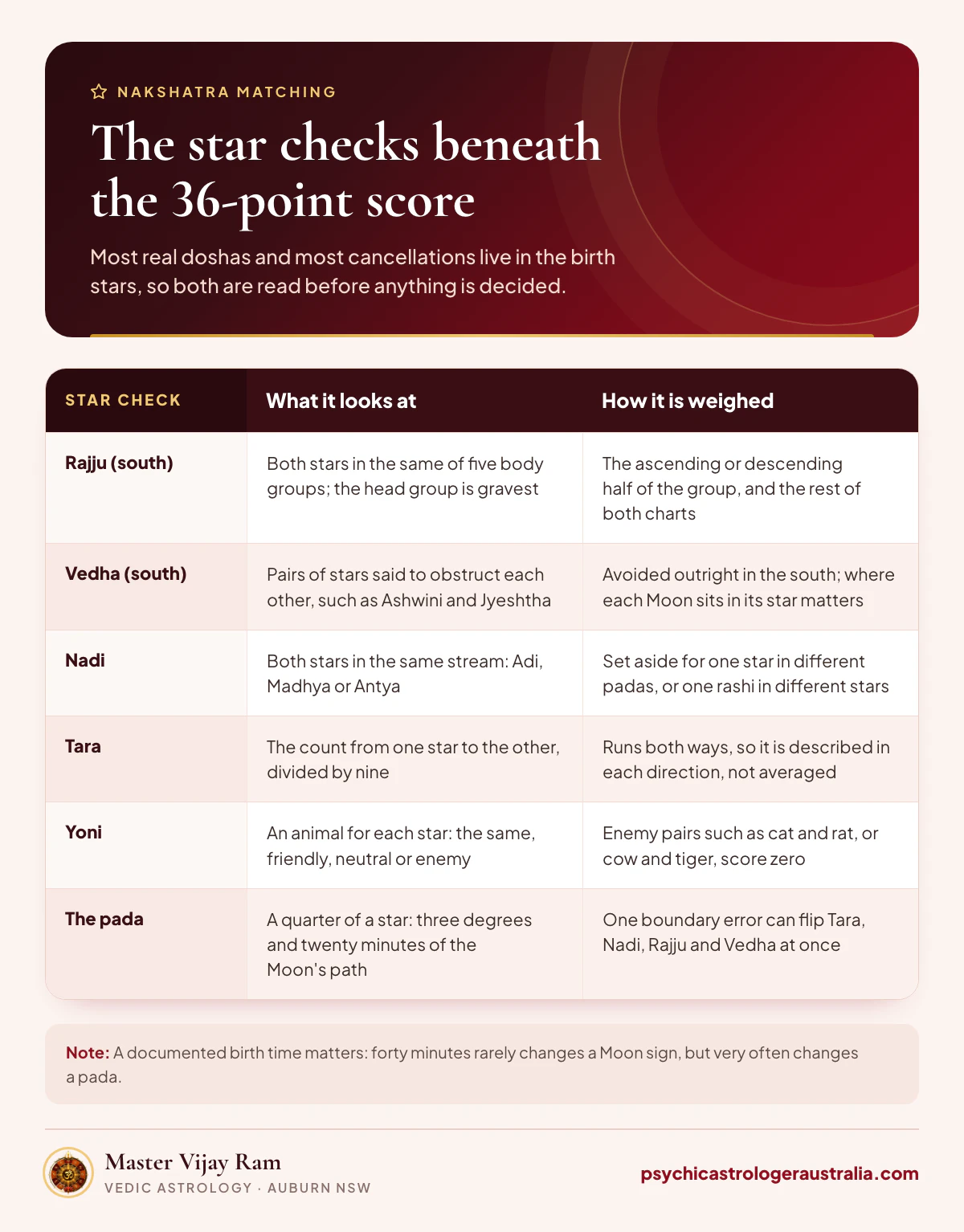
Rajju sorts the twenty-seven stars into five groups named for parts of the body: pada (feet), kati (waist), nabhi (navel), kantha (neck) and shira (head). Rajju dosha is scored when both partners' stars fall in the same group, and the tradition attaches a different fear to each group, with the head group, Shira Rajju, treated as the gravest. It is the one porutham South Indian families will rarely overlook, whatever the rest of the match says.
Master Vijay Ram reads it as the tradition does and then does what the tradition also does, which is to look for the usual qualifications: whether the stars are in the ascending or descending half of the same group, whether the rest of the match is strong, and whether the charts show the longevity and health that Rajju is worried about through other, more direct indicators. He will not call a Shira Rajju match clean when it is not, and he will not let a Pada Rajju result alone end a good match either.
What is Nadi dosha at the nakshatra level?
Every nakshatra belongs to one of three Nadi streams, Adi, Madhya or Antya, and Nadi dosha is scored when both stars share a stream. In the north it costs all eight Nadi points; in the south it sits inside the health checks. The tradition links it to constitution and to children, which is why a family that has heard the words will not let them go.
The cancellations are specific and worth knowing. The same rashi with different stars, the same star with different padas, and friendly or identical Moon-sign lords are the common ones, and some lineages add a rule for the same star when it is one of a short list. A Nadi shanti puja is the classical remedy where the dosha stands, and it is performed for the person, not for the pair.
What does Vedha mean, and which stars obstruct each other?
Vedha pairs certain stars as mutually obstructing: Ashwini with Jyeshtha, Bharani with Anuradha, Krittika with Vishakha, Rohini with Swati, and so on through the list, with Mrigashira, Chitra and Dhanishta each paired to two stars. A match with Vedha is traditionally avoided outright in the south, which makes it the second hard stop after Rajju.
It has no cancellation list of its own, but it does have a question of degree. Two Moons at the far ends of obstructing stars behave differently from two in the middle of them, and a careful reader says which case a couple is in rather than announcing the word and stopping.
How are Tara and Yoni read in detail?
Tara counts from one star to the other and divides the result by nine; the remainder names the tara, and Janma, Vipat, Pratyak and Naidhana taras are the unfavourable ones. Because the count runs both ways, a couple can be favourable from her star to his and unfavourable the other way, and the points system averages what a reading should describe.
Yoni gives every star an animal, horse, elephant, sheep, serpent, dog, cat, rat, cow, buffalo, tiger, deer, monkey, mongoose and lion, and scores the pair as the same animal, friendly, neutral or enemy. Enemy pairs such as cat and rat, or cow and tiger, score zero and are read as a mismatch in physical temperament. It is a blunt instrument, and it is also the koota that embarrassed families most want explained quietly.
How much can a single pada change the result?
Each star has four padas of three degrees and twenty minutes, and the pada moves a Moon between navamsa signs. Two people in the same star but different padas can escape Nadi dosha, which is the most-used cancellation of all, and a Moon in the last pada of one star is sometimes recorded by a careless calculation as the first pada of the next. That single boundary can flip Tara, Nadi, Rajju and Vedha at once.
This is why Master Vijay Ram asks for a documented birth time rather than a remembered one. A difference of forty minutes rarely changes a Moon sign; it very often changes a pada, and in a close match the pada is the whole argument.
What should a couple do when the two families use different systems?
A Punjabi family in Perth and a Tamil family in Melbourne will arrive with a 36-point sheet and a ten-porutham sheet, and the two will not agree, because they are measuring different things. The honest response is not to pick the friendlier one. It is to have one reader apply both, state where they agree, and explain each disagreement in plain words.
Vijay Ram ji does this on a single video call with both sets of parents when they want it, usually with a written summary afterwards that each family can take to its own elders. Couples in Melbourne and Geelong often start that process through the Melbourne astrology page, and families in Adelaide, Newcastle and the Gold Coast do the same by phone.
Why the birth star also sets the timing of the marriage
The nakshatra of the Moon at birth decides which Vimshottari dasha a person is born into and how much of it remains, so two birth stars are also two clocks. A kundli nakshatra match that stops at temperament misses the question most couples actually have, which is whether the next five years favour a wedding, a move and a child, and whether both charts are in supportive periods at the same time.
Reading the two clocks together is the deeper layer again. The dasha sync and nodal contacts guide explains how the two timelines are laid side by side and what it means when they pull in opposite directions.
How does Master Vijay Ram read a nakshatra match?
The consultation is $50 by phone, video or WhatsApp. He casts both charts, confirms the padas from documented birth times, and reads the stars through both the northern kootas and the southern poruthams, naming any dosha and any cancellation as he goes. He then reads what no star system covers: the seventh house, Venus and Jupiter, Manglik status and the two dasha timelines. A relationship compatibility reading is the written version for couples who want the full document.
Where a Nadi or Rajju concern stands without cancellation and the rest of the match is sound, he may suggest a shanti puja. Spell or prayer work of that kind starts from $250, is agreed before it is performed, and is done personally on an auspicious muhurat at his place of practice in Auburn, with the family joining by video if they wish; the online puja and havan page sets out how that works. Where Manglik status is the real issue, the Manglik dosha page is the better starting point.
What star matching cannot tell you
It cannot tell you whether a person is kind, patient or honest with money. It cannot see how two people argue, or whether they can repair after they do. A clean match is not a reason to stop paying attention, and a flawed one is not a reason to stop loving someone; both are information for a decision that remains yours.
It is faith-based guidance, not medical, legal or financial advice. A question about fertility belongs first with a doctor, and a relationship that already frightens you belongs with 1800RESPECT, not with a nakshatra table. Vijay Ram ji says so plainly when it applies.
Questions couples ask about nakshatra matching
Our stars are the same, is that bad? Not by itself. Same-star matches are treated differently depending on the star and the padas, and several are considered favourable; the pada rule often clears the Nadi concern.
Can a remedy fix Rajju dosha? A shanti addresses the person's chart and the fear the dosha carries; it does not rewrite the star. Whether a match should proceed is a judgement about the whole chart, made with both families in the room.
Do we need both systems? If the two families come from different traditions, yes, because each side will trust its own sheet. One reading that explains both saves months of quiet disagreement.
Nakshatra matching when the elders are in India and the couple in Perth
In Perth's south-east, around Canning Vale, Willetton and Harrisdale, a match may first be raised at a festival at the Perth Hindu Temple, the oldest in Western Australia, or at Mandogalup's Bala Murugan Temple. Families who meet there may keep different methods, and nakshatra compatibility is where those methods either agree or quietly collide.
Then the sheets start to travel. Elders in India send a ten-porutham sheet on WhatsApp, the couple have a 36-point printout from an app, and Perth's clock helps: India is only two and a half hours behind, so an evening video call in Perth reaches the grandparents in the late afternoon. Reading both systems on that one call can settle what otherwise takes months of forwarded messages.
Sydney families who keep the southern method have the Sydney Murugan Temple at Mays Hill, near Parramatta, and from the east coast the evening suits as well, since a Sydney evening falls in the Indian afternoon. The Vedic astrologer in Perth and astrology readings in Sydney pages show how calls are timed in each city.
Both birth stars can be read inside a full kundli reading when the families want the whole chart as well, with India joining the same video call. For anyone who prefers to meet in person, Master Vijay Ram's single place of practice is Auburn, and appointments there are arranged ahead.
Read next
- Nadi Dosha in Kundli Matching: What It Means and When It Is CancelledNadi dosha explained: the three nadis and their 27 nakshatras, why the same nadi scores 0 of 8, the commonly cited ca…
- Bhakoot Dosha: The 6-8, 2-12 and 5-9 Moon Signs in MatchingBhakoot dosha explained: which Moon-sign pairs fall 6-8, 2-12 or 5-9 apart, why they score 0 of 7, when the sign lord…
- Online Istikhara Service in Australia for Marriage & DecisionsHow online istikhara for marriage and other decisions works in Australia, what a genuine practitioner asks for, and t…
Frequently asked questions
What is nakshatra matching for marriage?
Nakshatra matching compares the birth stars of two people, the nakshatra the Moon occupied at each birth, across checks such as Tara, Yoni, Gana and Nadi in the north and the ten poruthams in the south, including Rajju and Vedha. It sits underneath the Gun Milan score and decides most of it. Master Vijay Ram reads both systems in a single $50 consultation by phone, video or WhatsApp.
What is Rajju dosha and can we marry with it?
Rajju dosha is scored when both birth stars fall in the same of five groups named for parts of the body: feet, waist, navel, neck and head. South Indian families treat it as the most serious porutham, with the head group gravest. Whether a couple marries with it depends on the qualifications a careful reader applies and on the rest of the chart, and some families will not proceed regardless, which is their right.
Is nadi dosha cancelled if we have the same nakshatra?
Often, yes. The classical rule sets Nadi dosha aside when the two Moons share a nakshatra but sit in different padas, and also when they share a rashi with different nakshatras or when the Moon-sign lords are friends or the same planet. A few stars are excepted in some lineages. Because the pada depends on an accurate birth time, a documented time matters more here than anywhere else in the match.
What is the difference between North and South Indian kundli matching?
The north uses Ashtakoot Gun Milan, eight kootas scored out of 36 points. The south uses ten poruthams, each a yes-or-no check, with Rajju and Vedha having no northern equivalent. Both are built on the birth star. When the two families come from different traditions, one reading that applies both and explains each disagreement is the practical way through.
Can nakshatra compatibility be checked online?
A calculator can find both stars and run the standard checks if the birth data and the ayanamsa are entered correctly. It cannot judge a Moon near a star boundary, weigh a Rajju result against the rest of the chart, or compare the two dasha timelines. Master Vijay Ram does that by phone, video or WhatsApp for couples anywhere in Australia and overseas, and in person in Auburn by appointment.
Which nakshatras should not marry each other?
The tradition lists Vedha pairs as mutually obstructing, such as Ashwini with Jyeshtha, Bharani with Anuradha, Krittika with Vishakha and Rohini with Swati, and treats same-Rajju pairs as a dosha. No list should be read without the charts: the degree of each Moon, the padas and the rest of the match change what a pairing means, and an honest reader says which case a couple is in.
Does the birth star affect the timing of marriage?
Yes. The Moon's nakshatra at birth sets which Vimshottari dasha a person starts in and how much of it remains, so each birth star is also a timing clock. A full match lays the two clocks side by side to see whether both charts favour a wedding, a move or a child in the same years, which is a question most couples care about more than temperament.
How much does a nakshatra match cost with Master Vijay Ram?
The consultation is $50 and covers both charts, the northern kootas and the southern poruthams, the cancellations, and the deeper reading of the seventh house, Venus, Jupiter, Manglik status and the dashas. Most matches end there. Where a Nadi or Rajju shanti is genuinely warranted, that puja starts from $250 and the figure is agreed before anything is performed.
People also ask
What is star matching in Tamil marriage?
Tamil families match the ten poruthams: Dina, Gana, Mahendra, Stree Deergha, Yoni, Rasi, Rasyadhipati, Vasya, Rajju and Vedha, each a check on the two birth stars rather than a score out of 36. Rajju and Dina are usually weighed most heavily. The system is Moon-based like Gun Milan but reads several things the northern method does not.
Which Rajju is most dangerous?
The tradition treats Shira Rajju, the head group, as the gravest, followed by Kantha (neck), Nabhi (navel), Kati (waist) and Pada (feet), each attached to a different fear for the couple's life together. A careful astrologer reads the group, the direction of the stars within it and the rest of both charts before saying what the result means for a particular couple.
Does nadi dosha really matter?
It matters to the tradition, which links it to constitution and children, and it matters to families who have heard the words. It also cancels in several common situations and is addressed by a Nadi shanti where it stands. What it cannot do is override a strong seventh house, favourable dashas and two people who are good to each other.
Can a love marriage ignore nakshatra matching?
Legally and practically, yes, and many couples do. Those who still ask for it tend to use it as preparation: knowing which years will be demanding, whether any dosha is worth a remedy, and when a wedding sits well in both timelines. A low result in that setting is information for the couple, not a verdict on the relationship.
What if one partner was born outside India?
The method is the same. A birth in Perth or Cairns is cast with Lahiri ayanamsa and the local time zone, including daylight saving where it applied, and the birth star follows from that. The risk is a wrong time-zone offset moving the Moon across a pada or star boundary, which is why a documented birth time is requested for every match.
References & further reading
Serving clients across Australia
Confidential consultations by phone, video & WhatsApp — including: