
Quick answer
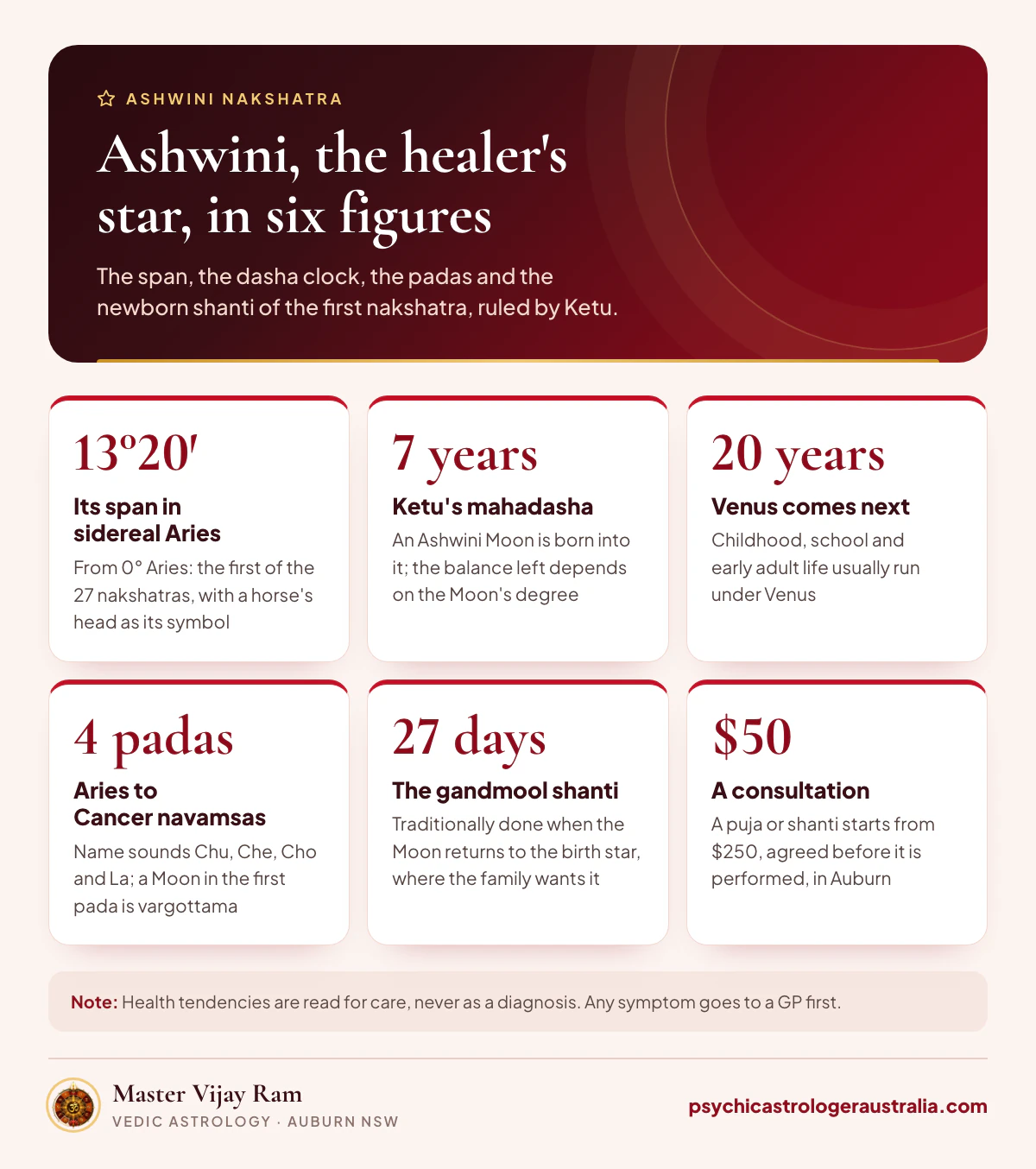
Ashwini nakshatra is the first of the 27 lunar mansions, covering 0° to 13°20′ of sidereal Aries. Its deities are the Ashvins, the twin physicians of the gods, its symbol is a horse's head and its lord is Ketu, so an Ashwini Moon begins life in Ketu's seven-year dasha. The tradition reads it for speed, healing and fresh starts.
What is Ashwini nakshatra?
Ashwini is the first of the twenty-seven nakshatras, the lunar mansions of Vedic astrology, and it covers the opening 13°20′ of sidereal Aries. Its deities are the Ashvins, the twin horsemen who serve as physicians to the gods, its symbol is a horse's head, and its lord is Ketu. When people speak of Ashwini nakshatra they usually mean a birth with the Moon in this stretch of sky, though any planet can stand in it.
This page stays with the star itself: the stories behind it, what its lord does to the timing of a life, its four padas and naming sounds, and what the tradition reads in temperament, work, marriage and health. A full kundli reading places the star inside the rest of the chart, which is where it starts to mean something for one particular person.
Who are the Ashvins, and why is this called the healer's star?
The Ashvins, Nasatya and Dasra, are twin gods who drive a golden chariot ahead of the dawn. The Rigveda calls on them again and again for rescue and repair: they pull the shipwrecked Bhujyu out of the sea, give sight back to the blind, and fit the warrior Vishpala with an iron leg after she loses hers in battle. No other Vedic deities are asked so consistently to mend a body.
Their birth is told in later texts. Saranyu, wife of the Sun, could not bear his heat and slipped away as a mare, leaving a shadow in her place; the Sun followed as a stallion, and the twins were born of that meeting. The horse's head that marks the star comes from here, along with its old associations of speed, dawn and first light.
The best-loved healing story belongs to the sage Chyavana, old and frail until the twins restored his youth. In gratitude he insisted at a great sacrifice that they receive a share of soma, which the gods had withheld because the twins mixed with mortals as doctors. The tradition reads Ashwini through that story: help that arrives quickly, and a little outside the usual rules.
Why does a horse's head belong to Ketu, the planet without one?
Ketu is the body of the demon Svarbhanu, who slipped among the gods to drink the nectar of immortality and was beheaded by Vishnu's discus; the head became Rahu and the body Ketu. So the first star of the zodiac, symbolised by a head, is ruled by a planet that has none. It sounds like a contradiction, and the tradition treats it as a clue.
A Vedic story softens it. The Ashvins wanted the secret teaching of the sage Dadhyanch, whom Indra had threatened with beheading if he ever shared it, so the twins gave him a horse's head to teach through; when Indra struck that head off, they restored the sage's own. Heads lost and given back are part of this star's oldest imagery.
The reading drawn from it is about instinct. Ketu acts before it explains, and an Ashwini Moon often knows what to do in an emergency well before it can say why, while the same reflex can rush past a question that deserved a slower answer. Ketu also rules Magha and Mula, the stars that open the other two runs of nine, so every beginning in the nakshatra cycle belongs to it.
Which dasha does an Ashwini birth begin with?
Ketu's, seven years in full. The Vimshottari clock starts with the lord of the birth star, and the balance depends on how far the Moon had already travelled through Ashwini: a Moon at 1° of Aries leaves about six and a half years of Ketu, a Moon at the middle of the star about three and a half, and a Moon near its far edge only a couple of months. That position comes from the birth time to the minute, and a remembered hour can start the clock in the wrong place.
Venus follows with twenty years, so an Ashwini Moon usually spends most of childhood, school and early adult life in a Venus period, and then meets the Sun's six years, the Moon's ten and Mars's seven. A family that rings first about a toddler's unsettled early years and later about a teenager suddenly drawn to music, clothes and company may be describing that changeover.
For anyone born under another star, Ketu's seven years arrive later, straight after Mercury's seventeen. Met in adult life, the period tends to feel less like an unsettled start and more like a stripping back to what is truly one's own.
The four padas of Ashwini and the navamsa each one falls in
| Pada | Degrees of Aries | Navamsa sign | Navamsa lord | Name sound | Traditional colouring |
|---|---|---|---|---|---|
| 1 | 0°00′–3°20′ | Aries (vargottama) | Mars | Chu | the purest Ashwini: direct, fast, first to move; the quarter nearest the Revati junction |
| 2 | 3°20′–6°40′ | Taurus | Venus | Che | steadier hands; comfort, craft and money sense slow the pace |
| 3 | 6°40′–10°00′ | Gemini | Mercury | Cho | quick talk and quick study; diagnosis, teaching, writing |
| 4 | 10°00′–13°20′ | Cancer | Moon | La | the caring quarter; nursing, family and feeling come forward |
The 108 padas of the zodiac run through the navamsa signs from Aries nine times over, which is why Ashwini's first pada lands back in Aries. A Moon there is vargottama, the same sign in the birth chart and the navamsa, a placement the tradition reads as consistent and strong; Bharani's padas then carry on from Leo to Scorpio.
The colourings are shorthand, and the navamsa they rest on needs a birth time accurate to a few minutes. Of all the Ashwini nakshatra characteristics, the one the pada refines most is where the star's energy goes: into building in the second quarter, into words in the third, into caring in the fourth.
Which name sounds belong to Ashwini?
Chu, Che, Cho and La, one for each pada in order, are the sounds a naamkaran traditionally starts from. Lalit, Lavanya and Lakshmi carry the fourth pada's La; Chetan and Chetana carry the second pada's Che. Regional lists spell the sounds a little differently, and a family's own priest or elder may hold a variant that is just as valid.
Naming a baby by nakshatra explains how the sound is fixed from the hospital time and paired with a name that works in an Australian classroom as well as at a grandmother's table.
What are Ashwini nakshatra traits?
Speed comes first. The Ashwini nakshatra traits the texts list are quickness of body and mind, a liking for being first, a youthful, attractive manner and a readiness to help that does not wait to be asked. Deva gana, the gentle and idealistic temperament of the three, adds good intentions even when the person is being impatient.
The shadow side is the same speed. Starting is easy and finishing is harder, a decision made on instinct is seldom revisited, and boredom arrives early in any task that has stopped moving. A mother in Adelaide might describe her Ashwini son as the boy who fixes the neighbour's bike before breakfast and leaves his own homework on the bench.
None of this is fixed. Mars, lord of Aries, colours the star from above and Ketu from within, while the lagna, the aspects to the Moon and the running dasha decide how much of it shows; two Ashwini Moons with different lagnas can look more like cousins than twins.
Ashwini nakshatra career: where does the healer's speed fit?
The tradition sends this star toward work where speed and care meet: emergency medicine, ambulance work, nursing, physiotherapy, sports medicine, veterinary practice, and anything involving horses, vehicles or transport. Ketu adds a taste for a narrow, deep skill, so Ashwini people often become the specialist who is called when the generalist is stuck. The Ashwini nakshatra career pattern is less a job title than a pace: quick response, visible result.
A paramedic on the Gold Coast, a sports physio in Melbourne and a diesel mechanic in Perth could all be reading the same star. What suits them less is slow procedural work with no visible end, and an Ashwini Moon kept in such a role for years usually shows it first as restlessness.
The chart still decides. The tenth house, its lord and the dasha running say more about a career than the Moon's star alone, and a reading that names a profession from the nakshatra by itself is guessing.
What does the tradition read about Ashwini in marriage?
An Ashwini partner tends to want a relationship that moves: plans, outings, shared projects and someone who does not mind a quick decision. The tradition reads them as loyal and protective once committed, and as poor at sitting through a long silence or an argument left unresolved. Ashwini nakshatra marriage questions often come from couples where one wants to go faster than the other.
In matching, three facts about the star do most of the work: it is Deva gana, Adi nadi and horse yoni (male). Its same-animal partner is Shatabhisha, the female horse, yet Shatabhisha also sits in the Adi nadi, so the one star that matches the yoni perfectly is the one that raises the nadi question; the tradition also pairs the horse against the buffalo, the yoni of Hasta and Swati. Two Ashwini Moons in different padas escape the nadi concern by the usual exception, while an Ashwini Moon with a partner in Ardra, Punarvasu, Hasta, Mula or another Adi star does not.
These are inputs, not verdicts. How nakshatra matching really works sets out the kootas and their cancellations, and a low score on one of them is a reason to read further rather than to stop.
Which health habits does the tradition watch in an Ashwini chart?
Aries is traditionally linked with the head, and Ashwini with the quick body that carries it: the tradition associates the star with headaches, fevers that rise and fall fast, and the bumps and sprains of people who move before they look. The pattern seen most often in practice is plainer. The healer's star looks after everyone else first and skips its own meals, sleep and check-ups.
The useful habits are ordinary ones: eat before the shift, warm up before the game, and book the appointment instead of self-diagnosing. These are tendencies read for care, not diagnoses, and any symptom goes to a GP first.
Is an Ashwini birth a gandmool worry?
Ashwini is one of the six gandmool nakshatras, the stars at the junctions where a water sign meets a fire sign; here the seam runs between Revati at the end of Pisces and Ashwini at the start of Aries. Many traditions treat the first pada, nearest that seam, as the sensitive one, while others recommend the shanti for any Ashwini birth. Traditions differ, and the difference is no reason for alarm.
The shanti is traditionally done when the Moon returns to the birth nakshatra, about 27 days after birth, and then the matter is closed. The gandmool shanti, explained calmly sets out what the old texts ask for and what fear has added since. Where a family wants it, Master Vijay Ram performs it personally at his place of practice in Auburn, from $250 agreed beforehand, with the family joining by video if they wish; how a puja or shanti is arranged walks through the steps.
A grandmother in Brisbane might ring about a new grandson's star in a panic, and the answer is usually calmer than she expects. The baby is a baby, and feeding, sleep and weight belong with the GP and the child health nurse.
What is Ashwini used for in muhurat?
The tradition counts Ashwini among the swift, light stars, with Pushya and Hasta, and favours it for beginnings that need momentum: setting out on a journey, starting a study, buying a vehicle, opening a clinic. The month of Ashwin takes its name from it, because that month's full moon falls in or near the star. The Sun enters Ashwini at Mesha Sankranti, on 14 Apr 2027 in Sydney, the solar new year in several Indian calendars.
The Moon crosses Ashwini in roughly a day each month, so a window comes round often, but a usable muhurat also needs a suitable tithi, weekday and rising sign for your own city. Medical treatment is the special case: the doctor's timing comes first, and a muhurat is only ever fitted around it.
When is an Ashwini Moon not the whole story?
Nearly always. The Moon's star describes the mind's pace and sets the dasha clock, but the lagna, the house the Moon occupies, Ketu's own placement and Mars as the sign lord can each pull the picture elsewhere; an Ashwini Moon in the twelfth house reads very differently from one in the tenth. Planets other than the Moon count as well.
The Sun in Ashwini is exalted by sign and is traditionally read as a confident early start; Saturn there is debilitated by sign and is read as asking for patience before reward. Neither is a verdict, and both are weighed with aspects and the navamsa before anything is said.
What can a reading of Ashwini honestly tell you?
It can describe tendencies of pace, temperament and timing, and say which stretches of life are likely to bring which themes forward. It cannot decide your choices, diagnose an illness or promise an outcome, and no mantra or puja replaces a doctor, a lawyer, a financial adviser or a counsellor. That is the plain limit of faith-based guidance, and Vijay Ram ji names it whenever a question goes past it.
How does Master Vijay Ram read an Ashwini chart?
A consultation is $50, by phone, video or WhatsApp, in English, Hindi or Punjabi. He casts the chart from the date, the time to the minute and the place, confirms the pada, works out the Ketu balance and the Venus period that follows, and then reads the lagna, the tenth and seventh houses and the dasha running now. Clients in Perth book the same way, with the call set in their own time zone.
Nothing is performed unless it is warranted and agreed, and most Ashwini questions end with a clearer sense of timing and a short daily practice, often a Ganesha prayer, which the tradition links with Ketu. Anyone who would rather sit across the table can see him in person in Auburn by appointment. The cycle runs back to Revati, the last nakshatra and on to Bharani, Yama's star.
Read next
- Magha Nakshatra: The Star of Ancestors and AuthorityMagha nakshatra, 0° to 13°20′ Leo: the Pitris and the throne, Ketu as lord, padas and name syllables, matching, caree…
- Shatabhisha Nakshatra: The Star of a Hundred HealersShatabhisha nakshatra explained: Varuna and the empty circle, Rahu as lord, padas and name sounds, traits, career and…
- Online Istikhara Service in Australia for Marriage & DecisionsHow online istikhara for marriage and other decisions works in Australia, what a genuine practitioner asks for, and t…
Frequently asked questions
What is Ashwini nakshatra?
Ashwini is the first of the twenty-seven nakshatras, spanning 0° to 13°20′ of sidereal Aries. Its deities are the Ashvins, twin physicians of the gods, its symbol is a horse's head and its lord is Ketu. A person is called an Ashwini native when the Moon stood in this stretch of sky at birth. The tradition reads it for speed, initiative, healing and new beginnings, always as tendencies shaped by the rest of the chart.
Which planet rules Ashwini nakshatra?
Ketu rules the star, and Mars rules Aries, the sign it sits in, so both colour it. Because the Vimshottari dasha begins with the lord of the birth star, an Ashwini Moon starts life in Ketu's seven-year period, or whatever part of it remains, and then moves into Venus for twenty years. Ketu also rules Magha and Mula, the stars that begin the other two runs of nine.
What are the name letters for Ashwini nakshatra?
The traditional sounds are Chu for the first pada, Che for the second, Cho for the third and La for the fourth. Names such as Chetan, Chetana, Lalit, Lavanya and Lakshmi carry them. Regional lists differ slightly in spelling, and the pada is fixed from the birth time on the hospital record, so the chart is cast before a sound is chosen rather than guessed from the date.
Is Ashwini a gandmool nakshatra?
Yes. It is one of six gandmool stars, the ones at the junctions where a water sign meets a fire sign, here between Revati and Ashwini. Many traditions treat the first pada as the sensitive one and others recommend the shanti for any Ashwini birth. The shanti is a small rite done when the Moon returns to the birth star, about 27 days after birth, and it is not a reason for fear.
Which nakshatras are compatible with Ashwini?
There is no honest one-line list. Ashwini is Deva gana, Adi nadi and horse yoni, so a partner in another Adi star, Shatabhisha included, raises the nadi question, while Deva and Manushya stars usually sit comfortably on gana. Yoni, Tara, Bhakoot and the Moon signs all count, and exceptions cancel many doshas. Two charts read together in a proper matching consultation settle it far better than any table of good and bad stars.
What careers suit Ashwini nakshatra?
The tradition favours work where speed and care meet: emergency medicine, ambulance and nursing work, physiotherapy, sports medicine, veterinary practice, and jobs with horses, vehicles or transport. Ketu adds a liking for a narrow specialist skill. These are tendencies only; the tenth house, its lord and the running dasha say more about a career than the Moon's star, and nobody should choose a course from a nakshatra alone.
What is the gana of Ashwini nakshatra and what does it mean?
Ashwini is Deva gana, the gentle and idealistic temperament of the three ganas, alongside Manushya and Rakshasa. In daily life it is read as goodwill and a readiness to help, even when the Ashwini speed makes a person impatient. In matching, gana is one of the eight kootas, and a Deva Moon is traditionally most at ease with another Deva or a Manushya partner, though the other kootas can outweigh it.
Is Ashwini a good nakshatra for starting medical treatment?
The tradition counts Ashwini among the swift, light stars and associates it with healing, so some families like to begin a course of treatment under it. That preference must never delay care. The doctor decides when treatment starts; if there is room to choose a day, a muhurat can be fitted around the medical plan, and a reading never replaces medical advice.
What does it mean to have the Moon in Ashwini pada 1?
The first pada covers 0° to 3°20′ of Aries and falls in the Aries navamsa, so the Moon there is vargottama, the same sign in the birth chart and the navamsa. The tradition reads it as the most concentrated form of the star: direct, quick and independent. It is also the quarter nearest the Revati junction, which many traditions treat as the most sensitive for the gandmool shanti.
People also ask
What is the symbol of Ashwini nakshatra?
A horse's head. It comes from the Ashvins, the twin horsemen who drive their chariot ahead of the dawn, and from the story of their birth to the Sun and Saranyu, who had taken the form of a mare. The tradition reads the symbol as speed, readiness and the first light of a new start, which suits the star that opens the zodiac.
Who is the deity of Ashwini nakshatra?
The Ashvins, twin gods named Nasatya and Dasra, who are the physicians of the gods. The Rigveda praises them for rescues and cures, including restoring the sage Chyavana's youth and fitting the warrior Vishpala with an iron leg. That is why Ashwini is called the healer's star and why the tradition links it with medicine and quick help.
Which rashi does Ashwini nakshatra belong to?
Mesha, sidereal Aries. All four padas of Ashwini lie within the first 13°20′ of Aries, so an Ashwini Moon is always an Aries Moon in Vedic astrology. The sign's lord, Mars, adds drive to the star's own lord, Ketu. Western Aries is measured differently, so a Western Aries is not necessarily a Vedic one.
What is the animal, or yoni, of Ashwini nakshatra?
The horse, male. Its same-animal partner is Shatabhisha, the female horse, and the tradition sets the horse against the buffalo, the yoni of Hasta and Swati. Yoni is one of the eight kootas in matching and is read as physical and instinctive temperament, but it is only one score of several and never decides a match on its own.
References & further reading
Serving clients across Australia
Confidential consultations by phone, video & WhatsApp — including: