
Quick answer
Nadi dosha is the zero score in the Nadi koota of Ashtakoot matching, given when both partners' Moons sit in nakshatras of the same nadi: Adi, Madhya or Antya. It costs all 8 Nadi points. Commonly cited exceptions can set it aside, traditions differ on them, and even where it stands it is weighed against both whole charts rather than read as a verdict.
What is Nadi dosha in kundli matching?
Nadi dosha is a matching result that is scored when the Moons of two partners fall in nakshatras belonging to the same nadi, and it takes away all eight points of the Nadi koota. Nadi is the last and heaviest of the eight kootas in Ashtakoot Gun Milan, so a couple who lose it begin the conversation eight points down out of 36. That arithmetic, more than anything mystical, is why the two words carry so much weight at a family table.
Master Vijay Ram is asked about this koota more than any other, usually by a couple who have already looked at venues or by a parent who has just seen an app result. The useful answer is slower than the app: which nadi, which nakshatras and padas, whether a commonly cited exception applies, and what the rest of both charts says. A relationship compatibility reading works through those steps in that order, and this page explains each one.
What are the three nadis, and which nakshatras belong to each?
The 27 nakshatras are shared out evenly among three nadis, nine stars to each. The word nadi means a channel or a pulse, and the tradition ties the three to the doshas of Ayurveda: Adi to vata, Madhya to pitta and Antya to kapha. Your own nadi is simply the nadi of the star your Moon occupied when you were born.
| Nadi | Traditional association | Nakshatras, in zodiac order |
|---|---|---|
| Adi (the first) | Vata: air, movement, the nervous temperament | Ashwini, Ardra, Punarvasu, Uttara Phalguni, Hasta, Jyeshtha, Mula, Shatabhisha, Purva Bhadrapada |
| Madhya (the middle) | Pitta: fire, digestion, the driven temperament | Bharani, Mrigashira, Pushya, Purva Phalguni, Chitra, Anuradha, Purva Ashadha, Dhanishta, Uttara Bhadrapada |
| Antya (the last) | Kapha: water, structure, the steady temperament | Krittika, Rohini, Ashlesha, Magha, Swati, Vishakha, Uttara Ashadha, Shravana, Revati |
Read around the zodiac, the pattern zigzags: Ashwini is Adi, Bharani Madhya, Krittika and Rohini Antya, Mrigashira Madhya, then Ardra and Punarvasu back to Adi, and the wave repeats. That is why two people whose birth stars sit side by side often land in different nadis, while stars on opposite sides of the sky, such as Ardra and Jyeshtha, share one.
Why does the same nadi score zero out of eight?
The Ashtakoot Nadi koota is unusual because it penalises sameness, where most of the other kootas reward it. The reasoning in the tradition is that two people of the same constitution double one tendency instead of balancing each other, much as two very airy or two very fiery temperaments might. So different nadis earn the full 8 points and the same nadi earns none, with no score in between.
Because this koota carries the largest weight of the eight, the loss shows in the total. A couple who would otherwise score 27 fall to 19, still above the conventional mark of 18 but suddenly a borderline case in an elder's eyes. The way the whole total is built is set out in how Gun Milan scores its 36 points, so this page stays with the one koota.
How do you find out which nadi you are?
You need the Moon's nakshatra from a sidereal birth chart, cast from the date, time and place of birth. Most kundlis print it near the top as the janma nakshatra, often with the pada beside it; find that star in the table above and you have your nadi. A Western horoscope will not help here, because Gun Milan reads the Moon against the sidereal stars.
The birth time matters most when the Moon sits close to the edge of a star. The Moon crosses a whole nakshatra in roughly a day, so a recorded time that is out by an hour can push a borderline Moon into the next star, and neighbouring stars can belong to different nadis. A hospital record is worth finding before two families argue about a result.
When is Nadi dosha cancelled?
Several situations are commonly cited in which the dosha is set aside even though both Moons share a nadi. Traditions differ on the list and on how strictly each item is applied, so the same pair of charts can be called a dosha by one family astrologer and cancelled by another. The three quoted most often are these:
- The same rashi with different nakshatras: both Moons are in one Moon sign but in two different stars.
- The same nakshatra in different rashis: possible only for the nine stars that straddle two signs, such as Krittika, Punarvasu, Chitra and Vishakha.
- The same nakshatra with different padas: both Moons are in one star but in different quarters of it.
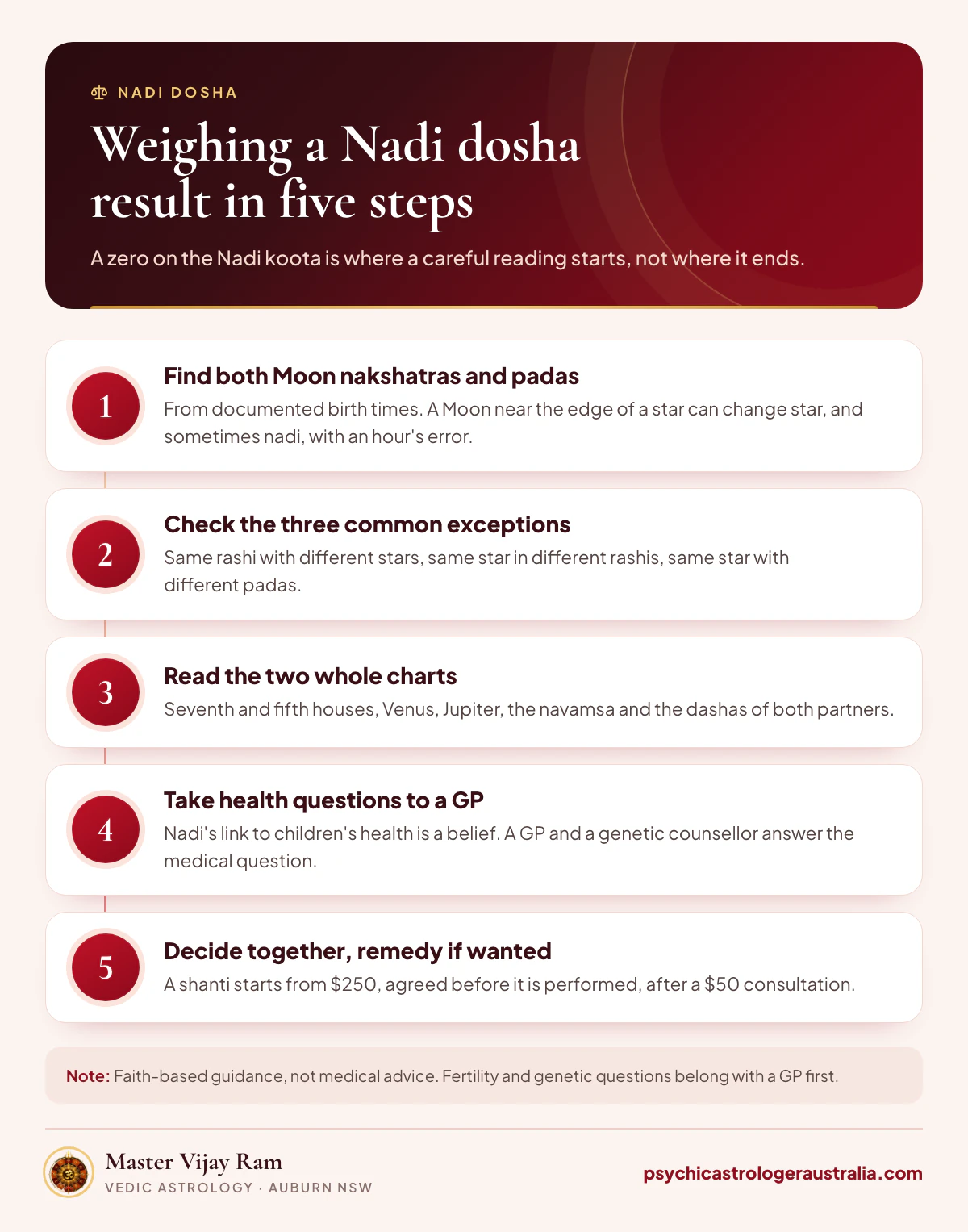
When the two Moons share the same star and the same pada, none of the three can apply, and the dosha is read at full weight. Some lineages add conditions of their own, which is why a good reading names the rule it is using and shows it on both charts. That is the heart of a sound nadi dosha cancellation: a rule shown openly, not a number quietly changed.
How do the exceptions play out on a pair of charts?
The pairs below are illustrations, not clients, chosen to show each rule at work. Every pair shares a nadi, so every pair begins with the koota at zero.
| Partner A's Moon | Partner B's Moon | Shared nadi | Commonly cited exception |
|---|---|---|---|
| Rohini, in Taurus | Krittika pada 3, in Taurus | Antya | Same rashi, different nakshatras |
| Vishakha pada 2, in Libra | Vishakha pada 4, in Scorpio | Antya | Same nakshatra, different rashis |
| Hasta pada 1, in Virgo | Hasta pada 3, in Virgo | Adi | Same nakshatra, different padas |
| Ardra, in Gemini | Jyeshtha, in Scorpio | Adi | None of the three; the dosha stands |
| Mula pada 2, in Sagittarius | Mula pada 2, in Sagittarius | Adi | None; same star and pada, read at full weight |
The last two rows are the ones a family should take seriously, and even they are a beginning rather than an ending. Nothing in the table knows about the seventh house, Venus or the dashas, and those are where the next questions lie.
What does the tradition say Nadi dosha affects?
In the classical reading, Nadi speaks to constitution: physical compatibility, health within the marriage and, above all, children. That last link is the one that frightens people, and it is why a grandmother in Ludhiana may hold to a Nadi result long after she has made peace with a weak Yoni or Gana score. The worry is old and it comes from love.
It still needs saying plainly: the link between Nadi and children's health is a belief of the tradition, not a medical finding. No nakshatra can test a gene, measure fertility or predict how a pregnancy will go. Those questions have real answers, and the answers come from doctors.
What should a couple do about the health question itself?
Take it to a GP, ideally before the wedding or before trying for a child. A GP can go through family history, arrange carrier screening where it is appropriate and refer to a genetic counsellor, who explains what a result would mean for a future pregnancy. Pregnancy, Birth and Baby, listed below, is a sensible place to start reading.
This is not a step away from the tradition; it is how the tradition's worry gets a proper answer. Vijay Ram ji says the same on the call: the chart can describe a family's hopes and the timing of children, and the clinic answers the medical question. Where conception itself is the concern, santan prapti guidance for children sits beside medical care, never ahead of it.
How does a family weigh Nadi dosha against the whole chart?
A Nadi result describes one strand of two Moons. The marriage is read from far more: the seventh house and its lord in each chart, Venus and Jupiter, the fifth house of children, the navamsa, and the dashas both people will run in their first years together. A strong showing there carries real weight against one lost koota.
Families can work through three plain questions:
- Does a commonly cited exception apply, and has the astrologer said which one?
- What do the two seventh houses and the two fifth houses say once the points are put to one side?
- Are both partners in supportive dashas for marriage and children over the coming years?
The two birth stars can be compared in finer detail than any koota allows, which is the subject of nakshatra compatibility beneath the score. The Moon-sign koota that sits beside Nadi, and is sometimes lost with it, is covered in Bhakoot dosha and the Moon-sign distances.
Can you marry with Nadi dosha?
Yes, and many couples do, including couples whose families took the result seriously. A low guna score is not a sentence, and a lost Nadi koota is not a ban written in the sky; it is a reason to read both charts properly and to have the health conversation with a doctor. What the tradition adds beyond that is prayer, not a veto.
Many families still treat a same nadi marriage as a step to take carefully, and care is no bad thing. Care looks like an exception checked, two whole charts read and a GP consulted, after which the decision belongs to the couple and their families together. Fear looks like a wedding called off over an app screenshot.
Which Nadi dosha remedies are traditionally offered?
Where the dosha stands without an exception and the families want a remedy, the tradition offers a few quiet options. The Maha Mrityunjaya mantra, addressed to Shiva for health and long life, is the one most often recited, sometimes for a set number of rounds before the wedding. A Nadi dosha shanti puja is the formal rite, and many families add a gift of grain or clothing to people in need.
Nadi dosha remedies speak to the worry each person carries; they do not change the arithmetic between two charts. Master Vijay Ram performs a shanti personally at his place of practice in Auburn on a muhurat chosen for it, with the couple joining by video if they wish. Prayer work of this kind starts from $250 and the amount is agreed before anything is performed; how a shanti puja is performed describes the day.
How does Master Vijay Ram read a same-nadi match?
The consultation is $50, by phone, video or WhatsApp. He casts both charts, confirms each Moon's nakshatra and pada against the documented birth times, applies the exceptions out loud and then reads the seventh houses, the fifth houses, Venus, Jupiter and the dashas. Most same-nadi questions end there, with a clear explanation and no remedy at all.
Families often join from two cities and two countries. A couple in Perth with grandparents in Amritsar can take the call in the early evening, which falls in the Indian afternoon, and the Vedic astrologer for Perth families page explains how those calls are arranged. Couples in Brisbane, Adelaide, the Gold Coast, Canberra and Hobart book the same way, and anyone who would rather sit across a table can arrange a time in Auburn.
What can a Nadi reading not tell you?
It cannot tell you whether a future child will be healthy, and anyone who says it can is overstating the tradition. It cannot test genes, read a family's medical history or decide whether two people should marry. It reads a classical worry, checks whether the classical exceptions apply and places the result inside two whole charts.
It is faith-based guidance, not medical, legal or financial advice. Couples who want help with the conversations a marriage needs, about children, money or in-laws, can also see a pre-marriage counsellor; Relationships Australia, listed below, offers that kind of support.
Read next
- Bhakoot Dosha: The 6-8, 2-12 and 5-9 Moon Signs in MatchingBhakoot dosha explained: which Moon-sign pairs fall 6-8, 2-12 or 5-9 apart, why they score 0 of 7, when the sign lord…
- Kundli Matching for Marriage: Gun Milan Explained and What a Low Score MeansKundli matching for marriage: how Gun Milan scores 36 points, what each koota measures, why a low score is not a verd…
- Online Istikhara Service in Australia for Marriage & DecisionsHow online istikhara for marriage and other decisions works in Australia, what a genuine practitioner asks for, and t…
Frequently asked questions
Is Nadi dosha serious?
It is the heaviest single koota in Ashtakoot matching, worth 8 of the 36 points, so losing it matters to the score. Whether it matters to the marriage depends on whether a commonly cited exception applies and on what the rest of both charts says. A careful reading treats it as a reason to look closely at the two charts, not as a judgement on the couple.
Which nakshatras are in the same nadi?
Adi nadi holds Ashwini, Ardra, Punarvasu, Uttara Phalguni, Hasta, Jyeshtha, Mula, Shatabhisha and Purva Bhadrapada. Madhya holds Bharani, Mrigashira, Pushya, Purva Phalguni, Chitra, Anuradha, Purva Ashadha, Dhanishta and Uttara Bhadrapada. Antya holds Krittika, Rohini, Ashlesha, Magha, Swati, Vishakha, Uttara Ashadha, Shravana and Revati. Two Moons in the same group give Nadi dosha before any exception is checked.
Is Nadi dosha cancelled if both partners have the same rashi?
It is commonly set aside when both Moons share a rashi but sit in different nakshatras, and that is one of the exceptions applied most often. Traditions differ on how strictly to use it, so the astrologer should say which rule is being applied. If the two Moons share the same nakshatra and the same pada as well, this exception does not apply.
Does Nadi dosha mean we will have trouble having children?
No. The tradition links Nadi to children, but that link is a belief rather than a medical finding, and a nakshatra cannot predict fertility or a child's health. A GP can go through family history, discuss carrier screening and refer to a genetic counsellor where it would help. The chart can speak to hopes and timing; medicine answers the medical question.
Can Nadi dosha be removed by a puja?
A puja does not change the two nakshatras, so nothing removes the koota result itself. What a Nadi dosha shanti and the Maha Mrityunjaya mantra are traditionally said to do is ease the worry the dosha carries. With Master Vijay Ram a shanti starts from $250, agreed before it is performed, and he says plainly when one is not needed.
The app says 0 for Nadi but our astrologer says it is cancelled. Who is right?
Both can be, because they are doing different jobs. Most apps score the koota and stop, while an astrologer applies the commonly cited exceptions afterwards. Ask the astrologer to name the exception and to show both Moons' nakshatras and padas. If the rule fits the two charts, the cancellation is sound; if nobody can name the rule, a second look is reasonable.
Is Nadi dosha the same as Bhakoot or Rajju dosha?
No. Nadi compares the nadi of the two birth stars and is worth 8 points. Bhakoot compares the distance between the two Moon signs and is worth 7. Rajju belongs to the South Indian porutham system and groups the stars by parts of the body. A couple can have one, two or none of them, and each has its own exceptions.
Does Nadi dosha matter once we are already married?
Not in the way it matters before a wedding. Matching is a tool for choosing, and once a couple are married the useful questions move to the dashas, the seventh house and how the two people are actually getting on. If a relative raises the old result, a reading can explain what it meant and what the whole chart says now.
Can the Nadi check be done without exact birth times?
Roughly, yes, if the Moon sits well inside a nakshatra for the whole of the possible birth window. It cannot be done reliably when the Moon is near the edge of a star, because a shift of an hour can change the star, the pada and sometimes the nadi. A birth certificate or hospital record is worth finding first.
People also ask
What is nadi dosha in kundli matching?
It is the result given when both partners' Moons fall in nakshatras of the same nadi, Adi, Madhya or Antya. The Nadi koota then scores 0 of its 8 points in Ashtakoot matching. The tradition reads it as a concern about constitution and children, and it is set aside in several commonly cited situations, which differ between traditions.
What happens if nadi dosha is present?
The match loses 8 of 36 points, and the astrologer checks the commonly cited exceptions before reading anything into it. If none applies, the result is weighed against the seventh and fifth houses, Venus, Jupiter and the dashas of both charts. Health questions go to a GP. Many couples marry with it after that kind of reading.
Is nadi dosha cancelled if the nakshatra is the same?
Often, but not always. A shared nakshatra is commonly set aside when the two Moons fall in different padas of it, or in different rashis for the nine stars that cross a sign boundary. If both Moons share the same star and the same pada, none of those exceptions applies and the dosha is read at full weight.
What are the remedies for nadi dosha?
The tradition offers the Maha Mrityunjaya mantra, a Nadi dosha shanti puja and a gift of grain or clothing to people in need. These address the worry rather than the arithmetic of the match. With Master Vijay Ram a shanti is performed personally in Auburn and starts from $250, agreed before it is performed, after a $50 consultation.
Is same nadi marriage allowed?
Nothing in the tradition makes it a ban. A same-nadi match is a reason to check the exceptions, read both whole charts and take any health question to a doctor, after which many families go ahead with a clear conscience. The decision belongs to the couple and their families, not to a single koota.
References & further reading
Serving clients across Australia
Confidential consultations by phone, video & WhatsApp — including: