

Quick answer
Nazar on a business is blamed far more often than it is found. Before treating a quiet shop as spiritual, count the door, the till and the returning customers for two trading weeks, rule out pricing, staffing and street changes, then ask whether anything else is at work.
What business owners mean when they say the shop has nazar
A trader says the shop has nazar when trade turns and nothing on the books explains it. The stock is the same. The prices are the same. Then a fortnight goes by, the room feels flat, and opening up in the morning takes something it never used to take.
The word changes with the household. Buri nazar, drishti, mati, malocchio, the evil eye. All of them describe one idea: that concentrated attention from other people can settle on a visible place and take the ease out of it. Master Vijay Ram hears this most often from owners who have already been through the ordinary explanations and found nothing there. That is where this article starts. Most quiet months are not nazar at all.
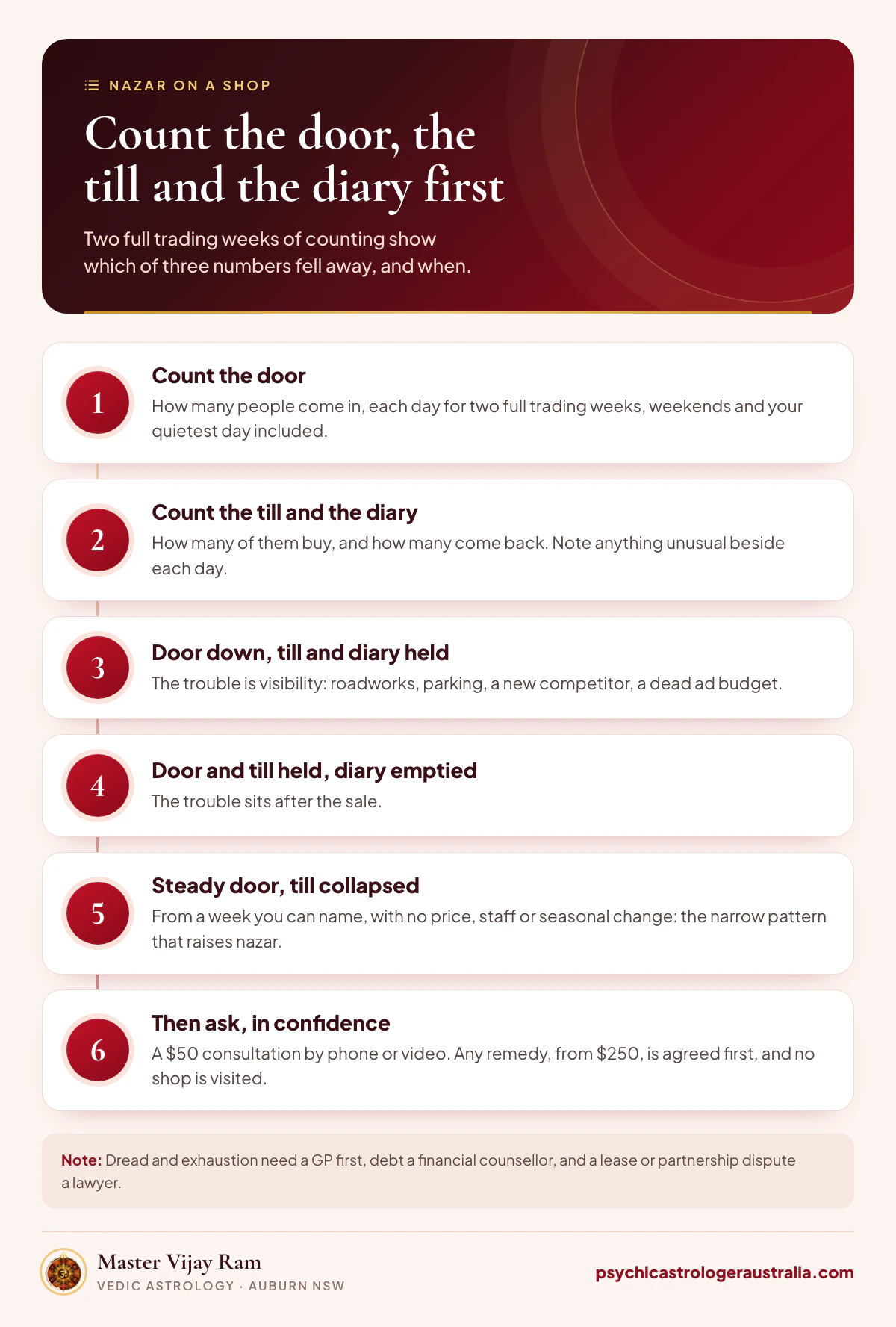
The three-counter check for reading a bad trading month
Before reaching for a remedy, count three things for two full trading weeks. The door: how many people come in. The till: how many of them buy. The diary: how many come back. Nearly every trading problem shows in which of the three fell away.
If the door dropped while the till and diary held, the trouble is visibility: roadworks, parking, a new competitor, a dead ad budget. If the door and till held while the diary emptied, the trouble sits after the sale. If the door held steady and the till collapsed from a week you can name, with no price change, no staff change and no seasonal reason, that narrow pattern is what brings owners to ask about nazar. It is also the subject of Buri Nazar on Your Business: Signs Sales Are Energetically Blocked.
What the evil eye is said to be, and what it is not
In the Vedic reading, nazar is not a spell. Nobody sits down and performs it. It is the residue of concentrated attention, some envy, some plain admiration held too intently, landing on a place that has been unusually visible. A new sign goes up. A queue forms out the door. A second van appears in the car park. Visibility is the condition, not the cause, and the attention is often not malicious.
That is why this kind of nazar sits at the light end of the work on the evil eye and nazar. It has no author, no ritual behind it and no ongoing intent, which separates it from anything deliberate. Left alone it thins out as attention moves elsewhere. What it does while it lasts is take the ease out of a place.
The situations owners describe most often
Across forty years of practice the same situations come around, and most have an ordinary cause underneath. The table below sets out what owners describe, what is usually behind it, and what helps first. A shopkeeper asking about Vedic help across Brisbane gets the same answer as one running a roadhouse four hours from anywhere: work the third column first.
| Situation | What is usually behind it | First step that helps |
|---|---|---|
| Takeaway or restaurant loses trade a fortnight after a busy, well-reviewed run | A roster change, a menu change, or roadworks and parking in that same fortnight | Name the week it turned, then check the roster, the price list and the street |
| Retail customers come in, browse and leave without buying | Stock gaps, layout, online pricing, or a staff member who has stopped engaging | Count the door, the till and the repeat customers for two trading weeks |
| Trade enquiries hold up, but quotes stop converting | Slow quote turnaround, price creep, or a competitor undercutting the same jobs | Compare the last twenty quotes for turnaround time and margin |
| Salon or clinic regulars quietly stop rebooking | A practitioner leaving, a booking system change, or an unexplained price rise | Ring ten past clients and ask them plainly why they stopped |
| Relatives who once worked well together now argue daily | Undefined roles, money never formally separated, and plain exhaustion | Put roles and money on paper, and bring in an accountant or a mediator |
| Owner dreads opening, sleeps badly, feels watched in the shop | Chronic stress, debt pressure, sleep debt, or an undiagnosed health problem | See a GP and a financial counsellor before treating it as spiritual |
Shopfronts, takeaways and the compliment at the counter
Retail and hospitality carry more of this than other trades, for an obvious reason. The work happens in public, in front of strangers, all day. A hundred people a week form an opinion about how you are doing, and a few form it with feeling. Owners describe the same moment repeatedly: a customer stood at the counter, admired the fit-out or the new van, and something went quiet afterwards.
That memory is not proof of anything. It is a marker on a timeline. Shop owners across South East Queensland raise it constantly, and it comes up in enquiries about the negative energy and evil eye removal work done for Logan households as often for businesses as for households. The useful question is whether the numbers turned that same week, or whether the memory was recruited afterwards to explain a slower slide.
Nazar, heavy premises and something deliberate
Three different things get called by the same name, and telling them apart changes what is worth doing. Nazar is light, unauthored and tied to visibility. It tends to lift. Heaviness in a room is different: it builds slowly where there has been argument, grief, long hours or a bad ending, and premises taken over after a failed business often carry it. That is the ground covered by heavy or negative energy, and it is far more common in shops than anything dramatic.
Deliberate work, a curse or spell sent with intent, is rarer than the internet suggests. It does not lift on its own. It tends to return in cycles. It usually shows in more than one part of a life, not only in the takings.
Staff, mood and what a room does to people
When an owner says the shop feels wrong, the first place to look is the people standing in it eight hours a day. A room with no natural light, a broken air conditioner, a roster that gives nobody a proper weekend, or one person quietly resentful about pay will do everything that gets blamed on energy. Tempers shorten. Mistakes cluster. Good staff leave without explaining why.
Fix those honestly, at real cost, and many shops settle without any spiritual work at all. Owners ask about this often, and enquiries about how this is handled for families in the Peel region south of Perth come from cafes and salons as much as from households. Where the mood does not lift after ordinary repairs, a closer look becomes reasonable.
What an honest assessment of a business looks like
An assessment is mostly listening, and mostly dates. Vijay Ram ji asks when trade turned, to the week if possible. What changed in that week on the street, in the roster, in the pricing, in your own health. Whether the fall is in the door, the till or the repeat customers. Whether anything similar has happened before, and what ended it last time. Whether you are sleeping.
Much of that has nothing to do with astrology, and that is deliberate. A chart is read where birth details are given and where it adds something, though the timeline usually tells more. The same twenty minutes are described in Evil Eye Removal Service in Australia: Confidential Nazar Healing. At the end of it, most people are told plainly that no remedy is needed.
Family businesses, partners and the trouble nobody names
Many small businesses are run by a couple, two brothers, or a parent and a grown child. When that relationship goes wrong the business goes wrong with it, and the business is the easier thing to talk about. Owners will describe six months of falling sales before mentioning that they and their partner have not spoken properly since March.
That is worth saying out loud: the help a marriage needs is not the help a shopfront needs. Where the real trouble sits between two people rather than in the premises, what fits is relationship work, the kind families in Parramatta ask about. A frank conversation about money and roles usually comes first. A business rarely recovers while the two people running it avoid each other.
Threads, amulets and what may honestly be placed in a shop
There is a long tradition of protective objects at a threshold, and a large trade in selling them to worried people. Both are real. A genuine kavach or taweez is prepared for a particular person and situation, and has a narrow use. It is never the first thing offered, and never the answer to a problem nobody has examined.
Be wary of anyone who sells you an item on a first call, names an enemy for you, or turns a quiet month into a curse. Honest protective items, of the kind set out under protective amulets, are a small part of the work and no substitute for fixing what is actually wrong. A lemon at the door harms nobody. It also does not do the books.
When this is not the answer
Some of what gets brought to a spiritual healer belongs somewhere else first, and saying so plainly is part of the work. Dread on the drive in, exhaustion that sleep does not touch, weight loss, a racing heart, waking at three every morning: those are ordinary symptoms of chronic stress, anxiety, depression, thyroid trouble, sleep apnoea and burnout. A GP appointment comes before any remedy. Debt that cannot be serviced needs a financial counsellor, sometimes an insolvency adviser.
A dispute with a landlord, a partnership breaking down, an unfair supply contract, a former employee taking clients, an insurance claim refused: those need a lawyer, and no cleansing has ever changed a lease. Spiritual work sits alongside medical and legal help. It never replaces it, and anyone who says otherwise should not be trusted with your business.
What you are asked for, and what you are not
What is asked for is small. The trading pattern, the week things turned, who works there, what has already been tried, and birth details where a chart will add something. Nothing commercial is required: no books, no ABN, no takings, no supplier names. Nobody is asked to name the person they suspect, because naming rarely helps and it poisons families and trading strips.
Everything said is confidential; a consultation is $50, and any remedy, from $250, is agreed before it is performed. Consultations are by phone, video or WhatsApp, so an owner in Perth is in the same position as one two streets away. In-person appointments are available at Vijay Ram ji's own place of practice.
Where a business difficulty sits inside a wider household picture, the broader work of spiritual protection and cleansing is the more useful starting point.
Where the work is done, and what a clearing involves
There is a common assumption that a shop must be visited, closed for a morning, or walked through with incense. None of that is asked of you. Any remedy is performed by Vijay Ram ji at his own place of practice, on his own time, which is why the location of the business makes no difference. No trading hours are lost. No customer sees anything. No staff member needs to be told.
For premises that feel heavy rather than targeted, the work is closer to aura and chakra cleansing than to anything dramatic, in that it settles what a room has absorbed instead of removing something placed there. Owners are usually asked to do one or two simple things themselves: open the shop up properly, clear the back room, sort the clutter behind the counter.
Keeping a shop steady after things settle
What tends to bring an owner back is the shape that brought them the first time: a run of success, a great deal of public attention, no quiet afterwards, and a tired body with nothing in reserve. Big openings, awards, a post that travels further than expected, a bumper Christmas. Visibility is good for trade and hard on the person carrying it.
The steadying habits are unglamorous. Keep counting the door, the till and the repeat customers, so the next dip is read from numbers instead of memory. Take one real day off a week. Do not announce takings. Keep the entrance clean and lit. Simple weekly practices of the kind set out in How to Remove Evil Eye at Home: Safe Daily Practices do more over a year than any single dramatic remedy.
Read next
- Buri Nazar on Your Business: Signs Sales Are Energetically BlockedWorried buri nazar has settled on your shop? Learn the signs owners report, the ordinary causes to rule out first, an…
- Evil Eye Removal in Sydney: Signs, Nazar Utarna and When to CallEvil eye removal in Sydney: the signs families describe, home nazar utarna practices, what Master Vijay Ram checks fi…
- Evil Eye Removal Service in Australia: Confidential Nazar HealingHow to tell nazar from black magic, jinn disturbance and ordinary medical causes, plus what confidential evil eye rem…
Frequently asked questions
Trade dropped the fortnight after we won a local award. Is that nazar or coincidence?
It may be either, and the order of checking matters. An award brings a burst of attention, and it often lands in the same fortnight as a price rise, a staff change or a seasonal dip. Write down the exact week trade turned, then look at the roster, the pricing and the street. If nothing there explains it, the timing is worth discussing.
Customers come in, look around and leave without buying. What does that pattern usually point to?
Usually to something inside the shop rather than outside it. Stock gaps, a confusing layout, pricing that loses against an online seller, or a staff member who has stopped greeting people will all produce it. Count the door and the till separately for two trading weeks. A steady door with a collapsed till is the one pattern worth a closer conversation.
My staff have started snapping at each other since we expanded. Is that something spiritual?
Far more often it is the expansion itself. New space, new roles nobody has defined, longer hours and a roster that gives no one a proper weekend will sour a good team within a month. Sort roles, breaks and pay first, in writing. If the mood stays sour once those are genuinely fixed, a closer look is reasonable.
Should I stop posting photos of the shop and the takings on social media?
Posting the shop is fine, and it is how people find you. Posting money is different. A screenshot of a record day invites a very particular kind of attention, and it tells competitors and strangers more than you want them to know. Show the work, the food, the fit-out and the team. Keep the numbers between you and your accountant.
A rival trader has been cold with us since we opened. Do I have to name them?
No, and you will not be asked to. Naming a suspect rarely improves the work and it does real damage, because a name said out loud in a small trading strip travels and hardens into certainty. Describe what happened and when it happened. The work does not depend on identifying anyone, and no accusation is ever made on your behalf.
My brother and I own the business together. Is it wrong to ask about this without telling him?
It is not wrong to ask questions on your own, and many people do. What is needed is a clear picture of the business, not his agreement to be discussed. Where the real difficulty turns out to sit between the two of you, that is said plainly, because nothing spiritual repairs a partnership that needs an honest conversation about money and roles.
Does anything have to be done inside the shop, or during trading hours?
No. Any remedy is performed by Vijay Ram ji at his own place of practice, which is why the location of the business makes no difference. Nothing happens on your premises, no trading time is lost, and no customer or staff member sees anything. You may be asked to do one or two ordinary things yourself, such as clearing the back room.
Our accountant says the figures are healthy, but the place feels wrong. What do I do with that?
Take the feeling seriously and test it anyway. Healthy figures with a heavy room often point to the people in it, the hours being worked, or premises that carried a bad ending before you took them on. Check light, air, rosters and the back room first. If the heaviness persists once those are addressed, describe it and it will be looked at properly.
Is hanging a lemon and green chillies at the door superstition, or does it do something?
It is a custom with a long history and it harms nobody. What it mainly does is mark a threshold and remind you to look at your own entrance, which is useful in itself. It will not fix pricing, a tired team or a lease dispute. Treat it as a small habit rather than protection, and replace it before it gathers dust.
What do you need from me about the business, and do you want to see the books?
The books are not asked for. What helps is the trading pattern, the week things turned, who works there, what you have already tried, and birth details where a chart will add something. No ABN, no takings, no supplier names, no customer data. Everything shared stays confidential, and you are never asked to justify the business to anyone.
My mother wants a red thread tied to the till. Is there any harm in it?
There is no harm in it, and often some good, because it settles her and asks nothing of the business. Keep it in proportion. A thread is a token of care, not a remedy, and it should never be sold to you as one. If someone charges heavily for an object on a first call, that alone is reason to walk away.
What does help for a business cost?
A consultation is $50, and spell or prayer work, where it is warranted, starts from $250. The situation is discussed, an honest view is given, and if no remedy is needed you are told so and nothing further is charged. Where protection work for the shop is warranted, the figure is agreed with you before anything is performed, and it does not change afterwards.
How long should I keep the three-counter log before I ring anyone?
Two full trading weeks is usually enough to show which of the three numbers actually moved, and it is short enough that you will finish it. Include weekends and your quietest day, and note anything unusual beside each day. Longer is better if your trade is seasonal. The log is far more useful in a conversation than any amount of recollection.
Once things settle, what stops it coming back the next busy season?
Mostly ordinary discipline. Keep counting the door, the till and the repeat customers, so the next dip is read from numbers rather than memory. Take one genuine day off each week. Keep the entrance lit and the back room clear. Do not announce takings. Nothing here is promised, but shops that keep those habits tend to read a dip earlier.
Is a food business treated differently from a shop or a trade?
The questions change more than the approach does. Food carries health inspections, supplier problems, staff turnover and public reviews, so more ordinary causes have to be cleared before anything else is considered. A trade business turns on quotes and turnaround. A salon turns on rebookings. In every case the first task is finding which number moved, and when.
People also ask
How does buri nazar show up in a shop or business?
Owners usually describe the same shape: takings that fall from a week they can name, no change in stock, staffing or pricing, customers who come in and leave without buying, small breakages and equipment faults in clusters, and a flatness in the room that staff notice too. None of it is proof on its own. Pattern and timing matter more than any single sign.
Can nazar affect sales in a shop?
In the Vedic reading, concentrated attention can take the ease out of a visible place, and a shop is as visible as anything gets. What it is said to touch is the moment of decision rather than the number of people who walk in. That is why a steady door count with a falling till is the pattern most worth examining.
How do you protect a new business from the evil eye?
Keep success quiet while it is still fragile, particularly the numbers. Keep the entrance clean, lit and uncluttered. Give the team proper breaks and clear roles, because a resentful room does more damage than any stranger. Mark your opening simply and privately rather than loudly. If a protective item is offered to you before anyone has looked at the business, decline it.
Is a lemon and chilli string effective for a shop?
It is a traditional threshold custom rather than a remedy, and it does no harm. Its practical value is that it makes you look at your own doorway regularly, which most owners never do. It will not correct pricing, rosters, a bad lease or a health problem. Use it as a small weekly habit and expect nothing dramatic from it.
What is the difference between nazar on a business and a vastu problem?
Nazar is tied to attention and usually arrives after a visible run of success, often from a week you can point to. A vastu or layout difficulty is structural and constant: it was there before the good period and it does not come and go. If trade was strong in the same premises last year, the building is unlikely to be the explanation.
References & further reading
Serving clients across Australia
Confidential consultations by phone, video & WhatsApp — including: