
Quick answer
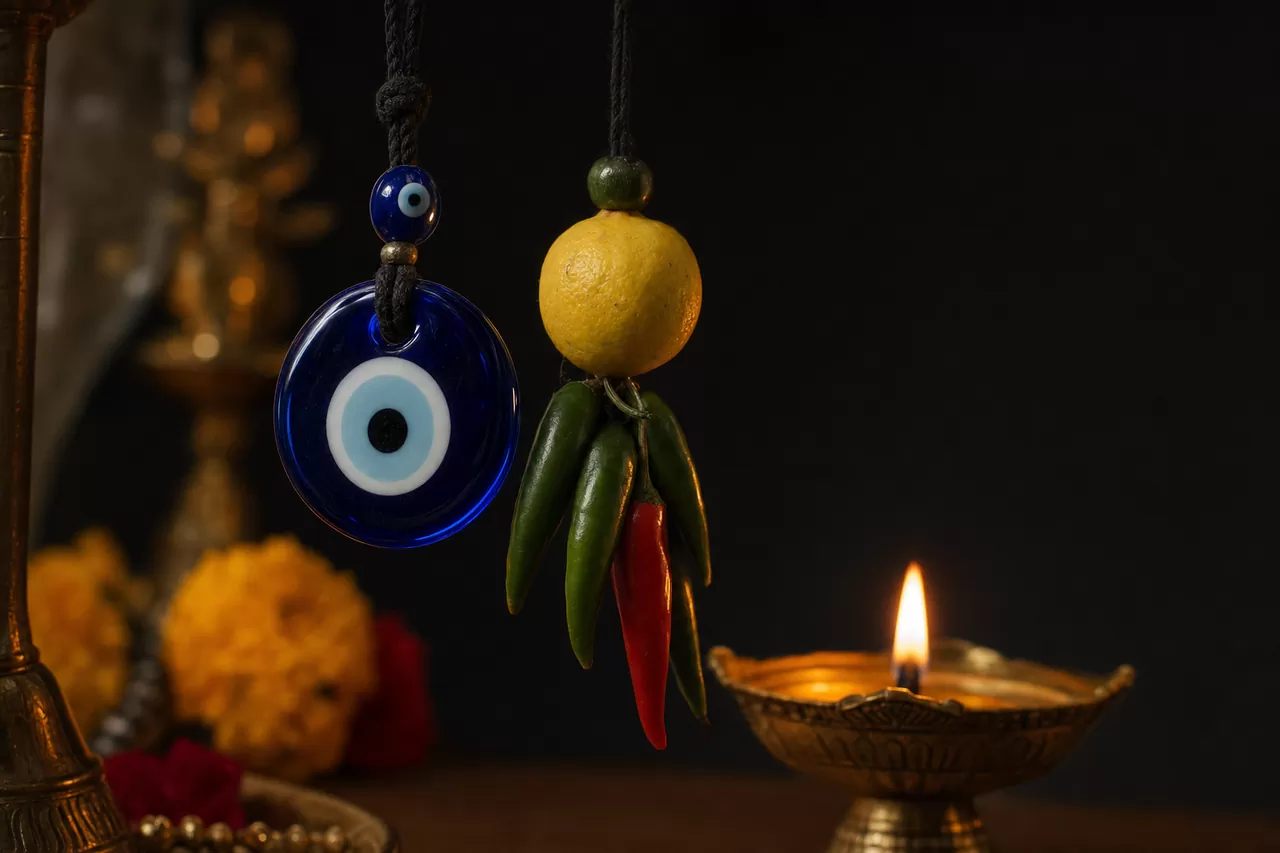
Salt, lemon and chillies are the three materials of household nazar practice: salt absorbs and is thrown away, the sour lemon and hot chillies are said to keep Alakshmi, misfortune, at the door, and the bundle is replaced each week. They are custom, not cure. When a worry outlasts the custom, the pattern is read rather than the lemon replaced faster.
What do salt, lemon and chillies mean in a Hindu household?
Nimbu mirchi is the bundle of a lemon and chillies on a thread that hangs at a shop door or a home’s entrance, and it is the most visible of a family of small practices that use salt, sourness and heat against the evil eye. Each material has a meaning, each has a story behind it, and each is custom rather than cure. This page is about the meanings, because a household that knows why it does something does it more calmly.
Master Vijay Ram treats these practices as what they are: the ordinary first response of a household to a worry. Evil eye and nazar removal as he performs it begins only where the custom has been done, the ordinary causes checked, and the worry has outlasted both.

Where does the nimbu mirchi custom come from?
The story most families tell is about Alakshmi, the elder sister of Lakshmi, who brings poverty and quarrel where Lakshmi brings wealth. Alakshmi is said to love sour and pungent things, so a lemon and chillies at the door feed her at the threshold and she goes no further, while Lakshmi, who prefers sweetness, comes inside. The bundle is a small offering to misfortune so that it stays outside.
The practical layer is older than the story. A shop with a fresh bundle every Saturday is a shop whose owner is watchful, and customers read it that way. The replacement day varies by region, Tuesday in some families and Saturday in most, and the old bundle is dropped at a crossroads or a tree rather than in the kitchen bin.
Why salt?
Salt is the absorber. Almost every culture that fears the evil eye has a salt practice, and the Indian one passes a fistful of rock salt over the person, from head to foot, and then throws it into running water or burns it. The idea is that whatever landed on the person moves into the salt, which is why the salt is never kept and never reused.
Used as salt for negative energy in a room, a small bowl sits in a corner for a few days and is then thrown away outside. A glass of salt water washed over a threshold does the same for an entrance. None of this is more than a few cents of rock salt from an Indian grocer, and none of it needs anyone else’s help.
Why lemon, and why seven chillies?
Sourness is the lemon’s meaning, and heat is the chillies’. Together they are the two tastes misfortune is said to want, and the number seven is customary rather than scriptural: some families use five, some use a single large chilli. The cotton thread is pushed through with a needle, the lemon last so that it hangs at the bottom.
The other lemon practice cuts the fruit and circles it over the person, or places the halves at the four corners of a room overnight. A lemon that goes dark or soft by morning is read as having taken something, and is thrown away outside. It is a reading of a lemon, not of a person, and he says so when families ask.
What does each practice mean?
The table sets the main household nazar remedies side by side: what is used, what it is said to do, and the sensible handling that keeps a custom from becoming a hazard.
| Practice | Material | What it is said to do | Sensible handling |
|---|---|---|---|
| Nimbu mirchi at the door | A lemon and chillies on a thread | Feeds misfortune at the threshold so it stays outside | Replace weekly; dispose of the old one outside, not in the kitchen |
| Salt pass | A fistful of rock salt | Absorbs what has landed on a person | Once, then into water or fire; never reused |
| Salt bowl | Rock salt in a dish | Absorbs heaviness in a room | Three days in a corner, then thrown away outside |
| Lemon circling | A whole or cut lemon | Takes nazar from the person it is passed over | Once at dusk; bin it outside; no reading of the fruit beyond that |
| Chilli smoke | Chillies on a hot pan or coal | If the smoke does not make the household cough, nazar is blamed | Outdoors only; never near children, asthma or a smoke alarm |
| Kala tikka | A dot of kajal | Marks a child so that admiration lands on the mark | Harmless custom; a fever still sees a GP |
Nazar utarna at home sets out the methods step by step for anyone who wants the how rather than the why.
What are these practices not?
They are not medicine: a child who will not eat sees a doctor, and a lemon circled over her afterwards is a comfort to the parents, not a treatment. They are not black magic, whatever a nervous neighbour of another faith may think when they see a bundle at the door. And they are not messages: chillies and lemons placed at someone else’s door are a hostile act, and the tradition has no place for them.
They are also not a way of finding out who gave the nazar. The practices clear the household; they do not name anyone, and no honest practitioner will name anyone either.
What about burning chillies?
The chilli smoke test is the one practice he asks families to be careful with. Chillies on a hot pan release a smoke that irritates the eyes, nose and chest, which is exactly why the custom says a household that does not cough has nazar: the folklore reads a chemical fact as an omen. Done indoors in a modern Australian home it sets off the smoke alarm, upsets an asthmatic child, and clears nothing.
If a family keeps the custom, it belongs outdoors on a still evening, briefly, with children and anyone with a chest condition well away. Most families find the salt or the lemon practice does the same work without the coughing, and he suggests those first.
Are these practices a kind of totka?
Yes, in the plain sense. A lemon chilli totka is a small folk remedy, and totka means exactly that: a household trick, passed down, costing almost nothing. Tona is the other word, and it means the harmful kind, something done to a person rather than for a household. The two get confused in English, and the confusion frightens people.
A bundle at your own door is totka; a bundle left at someone else’s is an attempt at tona, or at least looks like one. Jadu tona explained draws the line properly for anyone who has found something at their gate and does not know what it means.
How often should a household do them?
Once, for the person; weekly, for the bundle at the door; and never nightly. A family that is circling salt over a child every evening has stopped doing a custom and started managing an anxiety, and the anxiety is the thing to look at. The old rule is simple: do it once, wait a week, and if nothing has shifted, the practice has told you something.
What it has told you is that the cause is probably ordinary. Safe daily practices for the evil eye describes the seven-night ledger that makes that judgement honest.
When is custom not enough?
When the signs began on a date you can name, within a day of praise or a new purchase, and have outlasted a week of home practice and a visit to the doctor. Then the pattern is read rather than the lemon replaced faster. He asks for the birth details of the person affected and the dates, reads the chart against them, and says plainly whether the timing carries anything.
Most of the time it does not, and the family is sent back to the ordinary explanation with no remedy offered. When it does, a nazar shanti is described, its cost agreed, and the household given a short practice for the evenings that follow.
What does Master Vijay Ram do when a household asks?
The consultation is $50 by phone, video or WhatsApp, in English, Hindi or Punjabi, and that is the whole of the first charge. Where a shanti is warranted it is performed by him personally at his place of practice in Auburn, on a chosen muhurat, from $250 agreed before anything is done; online puja and havan explains what is included.
He does not sell lemons, salt, chillies or threads. A family already owns everything the customs need, and the only thing he adds is the reading of whether a custom was ever the right tool for the worry.
Where do these customs sit across Australia?
The bundle hangs at grocers in Harris Park and Blacktown, at a sweet shop in Dandenong, outside a Punjabi restaurant in Perth and a Fijian-Indian home in Darwin. The customs travelled with the families and lost nothing on the way. A caller in Sydney or Cairns is read the same way, and the only in-person option is Auburn by appointment.
Shopkeepers ask about the bundle more than anyone, usually after a slow month. Evil eye protection for a shop covers what is reasonable for a business beyond the lemon at the door, and the negative energy removal page describes the heavier household work when it is the house rather than a person.
What the practices cannot do
A salt and lemon remedy cannot cure a child, mend a marriage or bring customers back to a shop that has lost its parking. It cannot be guaranteed, and nobody should pay for a bundle or a salt pass performed by someone else. Vedic astrology and nazar shanti are offered as faith-based guidance, not as medical, legal or financial advice.
What the practices can do is give a household a calm, cheap and harmless way to answer a worry once, and a signal, when the worry outlasts them, that it is time to look elsewhere. That is their whole value, and it is real.
Read next
- Visiting India: Nazar, Gifts and Protection When You Travel HomeVisiting India and nazar: small protections before you fly, taking praise without fear, gifts and biosecurity, jet la…
- Negative Energy From a Neighbour: What to Do Without Starting a WarNegative energy from a neighbour: what the fear usually is, what to rule out, the protection that stays on your side …
- Nazar Utarna at Home: Salt, Chillies, Lemon & When to Call a HealerNazar utarna at home explained plainly: how salt, lemon and chillies are used, how to dispose of them safely, and the…
Frequently asked questions
What does nimbu mirchi mean?
The lemon and chillies on a thread at a door are an offering to Alakshmi, the goddess of misfortune, who is said to love sour and pungent tastes; fed at the threshold, she stays outside while Lakshmi, who prefers sweetness, comes in. It is replaced weekly, usually on a Saturday, and the old bundle is left at a crossroads or a tree rather than binned in the kitchen.
How do you use salt to remove negative energy?
A fistful of rock salt is passed over the person from head to foot once at dusk and then thrown into running water or burnt, never kept or reused. For a room, a small bowl of rock salt sits in a corner for three days and is then thrown away outside; for an entrance, a glass of salt water is washed over the threshold. All of it costs a few cents.
Why seven chillies with the lemon?
Seven is customary rather than scriptural; some families use five and some a single large chilli. The chillies supply heat and the lemon supplies sourness, the two tastes misfortune is said to want. The thread is pushed through with a needle, chillies first and the lemon last so that it hangs at the bottom, and the bundle is hung at the entrance on the replacement day.
Is burning chillies to check for nazar safe?
Not indoors. Chilli smoke irritates the eyes, nose and chest, which is why the custom reads a household that does not cough as having nazar: a chemical fact taken as an omen. In an Australian home it sets off the smoke alarm and distresses anyone with asthma. If the custom is kept it belongs outdoors, briefly, with children well away, and the salt or lemon practice does the same work without the smoke.
What is the difference between totka and tona?
Totka is a small household remedy, a lemon at your own door or salt passed over your own child, passed down and costing almost nothing. Tona is the harmful kind, something done to another person. A bundle at your door is totka; a bundle left at someone else’s is an attempt at tona, or looks like one, and the tradition has no place for it.
Someone left chillies and a lemon at my door. What does it mean?
Usually far less than it feels like. It may be a neighbour’s old bundle dropped on the way to the bin, children, or an attempt to frighten you. Photograph it, bin it outside with gloves, wash the threshold with salt water and leave it there. He never names a culprit, and no honest practitioner will; where the household then feels wrong for weeks, the pattern is read, not the bundle.
How often should these practices be done?
Once for a person, weekly for the bundle at the door, and never nightly. A family circling salt over a child every evening has moved from custom to anxiety, and the anxiety is the thing to look at. Do it once, wait a week, and if nothing has shifted the practice has told you that the cause is probably ordinary and worth a different kind of attention.
When should a household stop relying on custom and get a reading?
When the signs began on a nameable date, within a day of praise or a new purchase, and have outlasted a week of home practice and a visit to the doctor. Then Master Vijay Ram reads the birth chart against those dates by phone or video for $50, says plainly whether the timing carries anything, and only where it does describes a nazar shanti from $250, agreed before it is performed.
People also ask
What is the meaning of lemon and chilli hanging at the door?
It is a small offering to Alakshmi, the goddess of misfortune, who is said to crave sour and pungent tastes. Fed at the threshold with a lemon and chillies, she stays outside while Lakshmi, who likes sweetness, enters. Shops renew the bundle each week as a sign of a watchful owner, and the custom is harmless and cheap.
Does salt really absorb negative energy?
In the tradition, yes: a fistful of rock salt passed over a person, or a bowl left in a room, is said to take what has landed there and is then thrown away outside. It is custom, not chemistry, and it costs a few cents. Its real value is that it gives a household a calm, single action, after which a week of waiting shows whether the worry was ever spiritual.
How do you remove nazar with a lemon?
A whole or cut lemon is circled over the person once at dusk, or halves are placed at the corners of a room overnight, and the fruit is binned outside in the morning. A lemon that darkens is read as having taken something. It is done once, not nightly, and a child who is unwell sees a doctor before any lemon is circled.
What should I do if I find chillies or a lemon outside my house?
Treat it as rubbish until proven otherwise: photograph it, bin it with gloves, wash the step with salt water, and do not retaliate or accuse anyone. Most such finds are a neighbour’s discarded bundle or a prank. If the household feels wrong for weeks afterwards, have the pattern read rather than the bundle interpreted; no culprit is ever named.
Can these household remedies replace a healer?
For most worries they are all that is needed, which is why Master Vijay Ram tells families to do them first and wait a week. They cannot treat illness or mend a marriage, and they do not tell you who gave the nazar. A reading is for the minority whose signs began with praise, outlasted the customs and the doctor, and show in the chart’s timing.
References & further reading
Serving clients across Australia
Confidential consultations by phone, video & WhatsApp — including: