

Quick answer
Nazar on a baby is the evil eye, harm believed to follow an admiring or envious glance. A baby who cries, will not feed, sleeps badly or runs a fever needs the GP or child health nurse before any custom. The customs themselves, a kala tikka, a whispered prayer, salt circled and burnt outside, are gentle and kept away from the cot.
First, the people to call before anyone else
A newborn who cries through the evening, will not feed, sleeps in fits or feels hot is a baby for the GP, the child health nurse or Pregnancy, Birth and Baby on 1800 882 436, and for nobody else first. Master Vijay Ram says this before any grandmother in the family is allowed to say nazar, and he says it on every call about a baby.
Nazar on a baby is the evil eye: harm believed to follow an admiring or envious glance, and in Indian households a newborn is thought to attract it more than anyone, because a newborn is the most admired person in the room. The customs that answer it are gentle and old, and this page is about keeping them gentle, after the doctor has been seen.
What nazar on a baby is said to look like, and what it usually is
The table sets out what families notice, what the nurse or GP checks first, and the family custom that follows once they have. The order is the point.
| What the family notices | What the nurse or GP checks first | The family custom, afterwards |
|---|---|---|
| Crying every evening for hours | Colic, cluster feeding, overtiredness, reflux; the normal evening of a six-week-old | A whispered prayer over the baby; nothing applied |
| Will not feed, or feeds and brings it up | Attachment, tongue-tie, reflux, a blocked nose; the weight checked | Nothing until the nurse has seen the feeding |
| Sleeps badly, wakes often | The normal sleep of a newborn, which is broken by design | A kala tikka behind the ear, if the family keeps the custom |
| A rash on the face or body | Milia, heat rash, cradle cap, eczema; a rash that does not fade under a glass is an emergency | Nothing; the skin is left alone |
| Hot to touch, floppy, or not waking to feed | Fever in a baby under three months is the doctor today, or 000 after hours | Nothing at all until the baby has been seen |
| Unsettled after a crowded visit | Overstimulation; the ordinary cost of being passed round a room | Salt circled over the baby and burnt or thrown outside, by whoever keeps the custom |
The nurse's column is longer than the custom's on purpose. Nazar is what a family does with its love and its worry once the ordinary causes have been seen to, and it is never what a sick baby is waiting for.
The customs: kala tikka, kajal, the black thread, the chhati
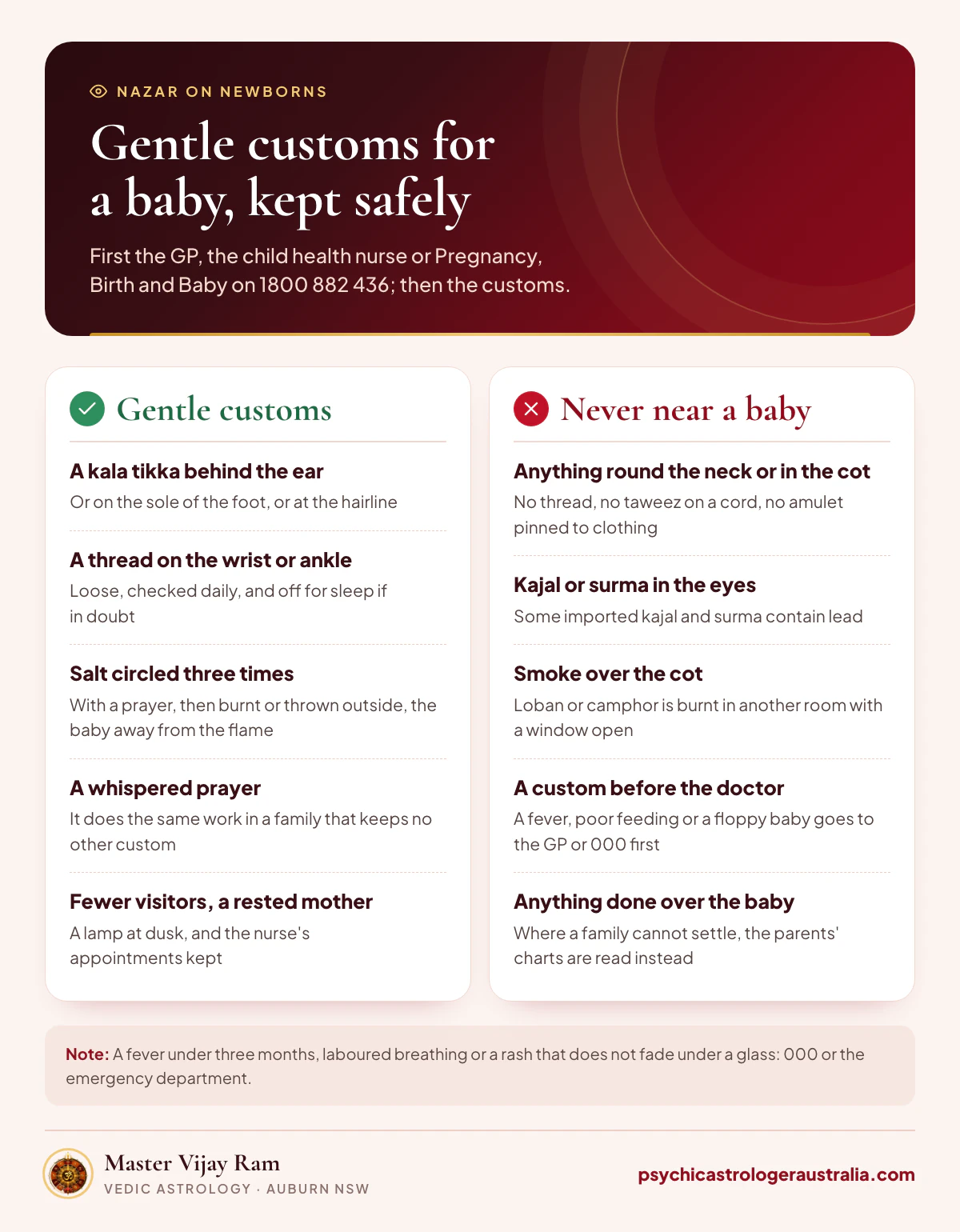
The kala tikka is a small black dot placed behind the ear, on the sole of the foot or at the hairline, deliberately imperfect, so that the admiring eye lands on the flaw and not on the baby. Kajal round the eyes was its older form. A black thread on the wrist or ankle does the same work, and the chhati, the sixth-day ceremony, is the first naming of the baby to the household and its gods.
Each is a way of saying, in front of visitors, that the baby is loved and guarded. None of them is a treatment, and a family that keeps them as custom rather than cure keeps them exactly right. Naamkaran by nakshatra is the formal naming that often follows the chhati, with the first letter chosen from the baby's birth star.
Safety: what the old customs must give way to
Nothing goes round a baby's neck, ever, and nothing goes in the cot: no thread, no taweez on a cord, no amulet pinned to the clothing. A black thread lives on the wrist or the ankle, loose, checked daily, and comes off before sleep. Safe sleep comes before every custom, and the child health nurse will say so.
Nothing goes in the eyes. Australian health authorities have warned about lead in some imported kajal and surma, and a baby's eyes are not a place for any of it; the tikka behind the ear carries the custom without the risk. Loban, camphor and agarbatti are burnt in another room with a window open, never over the cot, and the baby is never passed through smoke.
Nazar utarna at home, for a baby
The removal custom for a baby is the gentlest version of the household one. A handful of salt, or salt with a few dried chillies, is circled over the baby three times by whoever keeps the custom, usually a grandmother, with a prayer, and then burnt on the gas or thrown outside; the baby is never near the flame. A whispered prayer alone does the same work in a family that keeps no other custom.
Nazar utarna at home describes the household practice in full, and the baby's version differs only in being quieter and quicker.
Visitors, photographs and the social media question
The old advice was to keep a newborn away from crowds for the first forty days, and it was good advice for reasons that had nothing to do with envy: infection, exhaustion and a mother who needed to sleep. The modern version of the fear is the photograph posted to a hundred people, and the honest answer is that a photograph carries admiration, not harm.
A family that would rather not post is entitled to say so without explanation. A family that posts is not inviting anything in. What a newborn needs is fewer visitors and a quieter house, and nazar customs have always been a polite way of asking for both.
When a family wants more than custom
Some families, after the doctor and the nurse, still carry a worry that will not settle, usually because the baby arrived after a long wait or a loss, or because a relative has said something unkind. Evil eye and nazar removal is the reading for that worry: the parents' charts and the baby's, read against the timeline, with the ordinary causes named first.
Nothing is ever applied to the baby, done over the baby or asked of the baby. Where the reading warrants a puja, Master Vijay Ram performs it personally at his own place of practice on a muhurat, with the family joining by video if they wish, and the online puja and havan service explains what that involves. The consultation is $50; a puja starts from $250 and is agreed before it is performed.
The mother matters as much as the baby
A great deal of what is called nazar on a baby is exhaustion and anxiety in the mother, read outward. Perinatal anxiety and depression are common, treatable and nothing to be ashamed of, and PANDA on 1300 726 306 exists for exactly this; the GP is the other door.
New parents who find themselves arguing in the small hours are not under attack either, and the guide to husband and wife disputes is the honest place to look. This is faith-based guidance, not medical advice, and nothing on this page replaces the nurse.
What is not nazar: the signs that need a doctor today
- A fever in a baby under three months, or a baby who feels hot and is unusually sleepy.
- Breathing that is fast, laboured or noisy, or a blue tinge to the lips.
- Not waking to feed, or far fewer wet nappies than usual.
- A rash that does not fade when a glass is pressed on it.
- A high-pitched or unusual cry that does not stop, or a baby who is floppy.
Any of these is 000 or the nearest emergency department, before any call, any custom and any prayer. Nazar waits; these do not.
A gentle routine for the first forty days
Fewer visitors, and shorter visits. The mother fed and asleep whenever the baby is. A lamp lit at dusk in the room where the family sits, and a whispered prayer over the cot by whoever wants to say one. The tikka behind the ear if the custom is kept, the thread on the wrist, off before sleep and never on the neck, the smoke in another room. The child health nurse's appointments kept, and the weights written down.
That is the whole of evil eye protection for a newborn as the tradition actually practises it, and it asks of a family nothing but attention.
Black magic and a newborn: the fear a reading can calm
Occasionally the fear is heavier than nazar: that something has been done against the baby, or against the mother through the baby, usually by a relative the family has fallen out with. In more than forty years Master Vijay Ram has not found a newborn to be the target of anything, and he says so plainly on the call. Black magic removal reads the parents' charts and the household's timeline for what is actually there, which is almost always an ordinary strain made unbearable by sleeplessness.
He will not name a relative, read the baby's chart for a culprit or perform anything over a child. Protecting children from black magic and negative energy covers the older child, where the questions are different.
The next step, if there is one
For most families there is none beyond the nurse, the lamp and the tikka. For the family that still cannot settle, a consultation is $50, by phone, video or WhatsApp, in English, Hindi or Punjabi, with the grandmother welcome on the call. The Melbourne astrology page and its sisters describe the readings he offers beyond this one, and buri nazar on a baby is the Hindi form of a worry he has calmed many times by saying what the nurse already said.
When the baby is in Brisbane and the grandparents are in India
A baby born in Sunnybank, Springfield or Logan may be shown to half the family in India before the first fortnight is out, on a video call that grows by the evening. Queensland and India never change their clocks, so the call keeps the same hour all year round: after dinner in Brisbane is mid-afternoon for the grandparents.
When a grandmother on that call says nazar on the baby, the order on this page still holds: the GP or the child health nurse first, then the gentle customs. A grandmother who has flown out for the birth brings real help, and the kala tikka behind the ear, a whispered prayer and a quieter house are the parts of her tradition worth keeping, while anything in the cot, round the neck or in the eyes is not.
Some families mark a first temple visit at the Shree Laxmi Narayan Mandir at Burbank or the Sri Selva Vinayakar Koyil at South Maclean, and a short visit at a quiet time of day suits a newborn better than a festival crowd. If an older brother or sister is unsettled by all the talk of nazar, Kids Helpline is there for them too, and a calm sentence from a parent does the rest.
Where the worry will not settle after the nurse has seen the baby, the parents can talk it through on a video call or a WhatsApp chat in Hindi, Punjabi or English, with the grandmother listening in, and nothing is ever done to or over the baby. Families who arrive through evil eye removal in Logan or evil eye removal in Ipswich hear the same thing, and Vedic readings for Brisbane families cover the wider reading for the household. Auburn, in Sydney, is his only place of practice, so nothing here asks a newborn to travel.
Read next
- Protecting Children From Black Magic & Negative EnergyA grounded guide for parents worried about black magic or negative energy around a child: what it usually turns out t…
- Spiritual Protection for Children at School and OnlineSpiritual protection for children at school and online: what a parent does first, the gentle practices a family keeps…
- Evil Eye Protection for Your Business & ShopTrade dropped and nothing on the books explains it. A plain guide to nazar on a shop, what to rule out first, and hon…
Frequently asked questions
My baby cries every evening. Is it nazar?
It is the evening of a six-week-old, most often: colic, cluster feeding, overtiredness or reflux, all of which the child health nurse or GP can look at and settle your mind about. See them first. Afterwards, if the family keeps the custom, a whispered prayer or a tikka behind the ear does no harm and says the baby is loved. Nothing is ever applied because of the crying.
Is a kala tikka safe?
Behind the ear, on the sole of the foot or at the hairline, a small black dot made with a safe marker is harmless and is the whole of the custom. The eyes are different: Australian health authorities have warned about lead in some imported kajal and surma, and nothing should go in or near a baby's eyes. The tikka carries the custom without the risk.
Can I tie a black thread on my baby?
On the wrist or the ankle, loose enough to turn, checked every day, and taken off before sleep. Never round the neck, never on a cord, and never anything left in the cot, because safe sleep comes before every custom. A thread that is too tight or that the baby can chew is a thread that comes off.
How do I do nazar utarna for a baby?
A handful of salt, or salt with a few dried chillies, circled over the baby three times by whoever keeps the custom, with a prayer, then burnt on the gas or thrown outside with the baby nowhere near the flame. A whispered prayer alone does the same work in a family that keeps no other custom. The baby is never touched with anything and never passed through smoke.
Can I post photographs of my newborn?
Yes. A photograph carries admiration, not harm, and a family that posts is not inviting anything in. A family that would rather not is entitled to say so without explaining. What a newborn actually needs in the first weeks is fewer visitors and a quieter house, which is what the old nazar customs were a polite way of asking for.
Does Master Vijay Ram read a baby's chart?
For naamkaran, yes: the baby's nakshatra gives the first letter of the name, and the newborn kundli is a gift many families ask for. He does not read a baby's chart for interference or for a culprit, and nothing is ever applied to or done over a child. Where a family cannot settle, it is the parents' charts and the household's timeline that are read.
What does it cost?
The consultation is $50, by phone, video or WhatsApp, with the grandmother welcome on the call. Most families need nothing beyond the nurse, the lamp and the tikka, and are told so. Where the reading warrants a puja, it is performed personally at Auburn on a muhurat and starts from $250, agreed before it is performed; nothing is ever sold on the strength of a parent's fear.
Which signs mean the doctor today, not a custom?
A fever in a baby under three months; breathing that is fast, laboured or noisy, or a blue tinge to the lips; not waking to feed or far fewer wet nappies; a rash that does not fade under a pressed glass; a high-pitched cry that does not stop, or a floppy baby. Any of these is 000 or the nearest emergency department before any call, custom or prayer.
My mother-in-law says a relative has done something to the baby. What do I do?
Let the nurse see the baby first, and then let the fear be read for what it is: in more than forty years Master Vijay Ram has not found a newborn to be the target of anything. He will not name a relative, and he will say that an unkind word from a family member is a strain on the mother, not an attack on the child. The mother's rest is the remedy.
People also ask
What is nazar on a baby?
Nazar is the evil eye: harm believed to follow an admiring or envious glance, and in Indian households a newborn is thought to attract it most because a newborn is the most admired person in the room. The customs that answer it, a kala tikka, a thread on the wrist, a whispered prayer, are gentle, and they follow the nurse and the GP, never replace them.
How do you protect a newborn from the evil eye?
After the doctor and the child health nurse: fewer visitors and shorter visits, the mother rested, a lamp at dusk in the family's room, a kala tikka behind the ear if the custom is kept, a thread on the wrist that comes off before sleep and never the neck, and any smoke burnt in another room. The protection the tradition actually practises asks nothing of a family but attention.
Why do Indian babies have a black dot?
The kala tikka is a small black dot placed behind the ear, on the foot or at the hairline, deliberately imperfect, so that an admiring eye lands on the flaw rather than on the baby. It is a custom that says the baby is loved and guarded, not a treatment, and it belongs behind the ear rather than anywhere near the eyes.
What are the signs of nazar in babies?
Families name evening crying, poor feeding, broken sleep and unsettledness after visitors, and every one of these has an ordinary cause the nurse or GP checks first: colic, attachment, reflux, the normal sleep of a newborn, overstimulation. A fever, laboured breathing, a rash that does not fade or a floppy baby are never nazar and need a doctor today.
Is kajal safe for babies?
Not in or near the eyes. Australian health authorities have warned about lead in some imported kajal and surma, and a baby's eyes are not a place for any of it. A dot behind the ear or on the sole of the foot carries the custom with none of the risk, and it is what the tradition has always allowed.
References & further reading
Serving clients across Australia
Confidential consultations by phone, video & WhatsApp — including: